World Heritage Identification Number: 392
World Heritage since: 1986
Category: Cultural Heritage
WHE Type: Archaeological Sites
Transboundary Heritage: No
Endangered Heritage: No
Country: 🇬🇷 Greece
Continent: Europe
UNESCO World Region: Europe and North America
Map
Temple of Apollo Epicurius at Bassae: An Architectural Marvel in Ancient Greece
The Temple of Apollo Epicurius at Bassae, inscribed as a UNESCO World Heritage Site in 1986, stands as a testament to the architectural prowess and artistic vision of ancient Greece. Located in the remote heights of the Arcadian mountains, this temple dedicated to the god of healing and the sun offers a unique blend of architectural styles that showcases the transition from Archaic to Classical Greek art.
More to come…UNESCO Description of the World Heritage Site
This famous temple to the god of healing and the sun was built towards the middle of the 5th century B.C. in the lonely heights of the Arcadian mountains. The temple, which has the oldest Corinthian capital yet found, combines the Archaic style and the serenity of the Doric style with some daring architectural features.
UNESCO Justification of the World Heritage Site
Criterion (i): The Temple of Bassae represents a unique artistic achievement, remarkable for its archaic features (elongated surface, an exceptional proportion of 15 columns on the longer side and 6 columns on the facade, and a north-south exposure), and for its daring innovations: use of Ionic and Corinthian orders for a Doric edifice, the variety of materials used, and the originality of the layout of the cella and the adyton.
Criterion (ii): The capital of the central column of the Temple of Bassae is the most ancient conserved Corinthian capital, and as such the temple may be considered a model for all “Corinthian” monuments of Greek, Roman and subsequent civilisations.
Criterion (iii): Isolated as it is in a conserved environment, the temple of Apollo is an outstanding example of a Hellenic votive sanctuary in a rural setting.
Encyclopedia Record: Bassae
Bassae is an archaeological site in Oichalia, a municipality in the northeastern part of Messenia, Greece. In classical antiquity, it was part of Arcadia. Bassae lies near the village of Skliros, northeast of Figaleia, south of Andritsaina and west of Megalopolis. It is famous for the well-preserved mid- to late-5th century BC Temple of Apollo Epicurius.Additional Site Details
Area: 20.46 hectares
Number of Components: 1
(ii) — Significant interchange of human values
(iii) — Unique or exceptional testimony to a cultural tradition
Coordinates: 37.43498 , 21.89694
Image
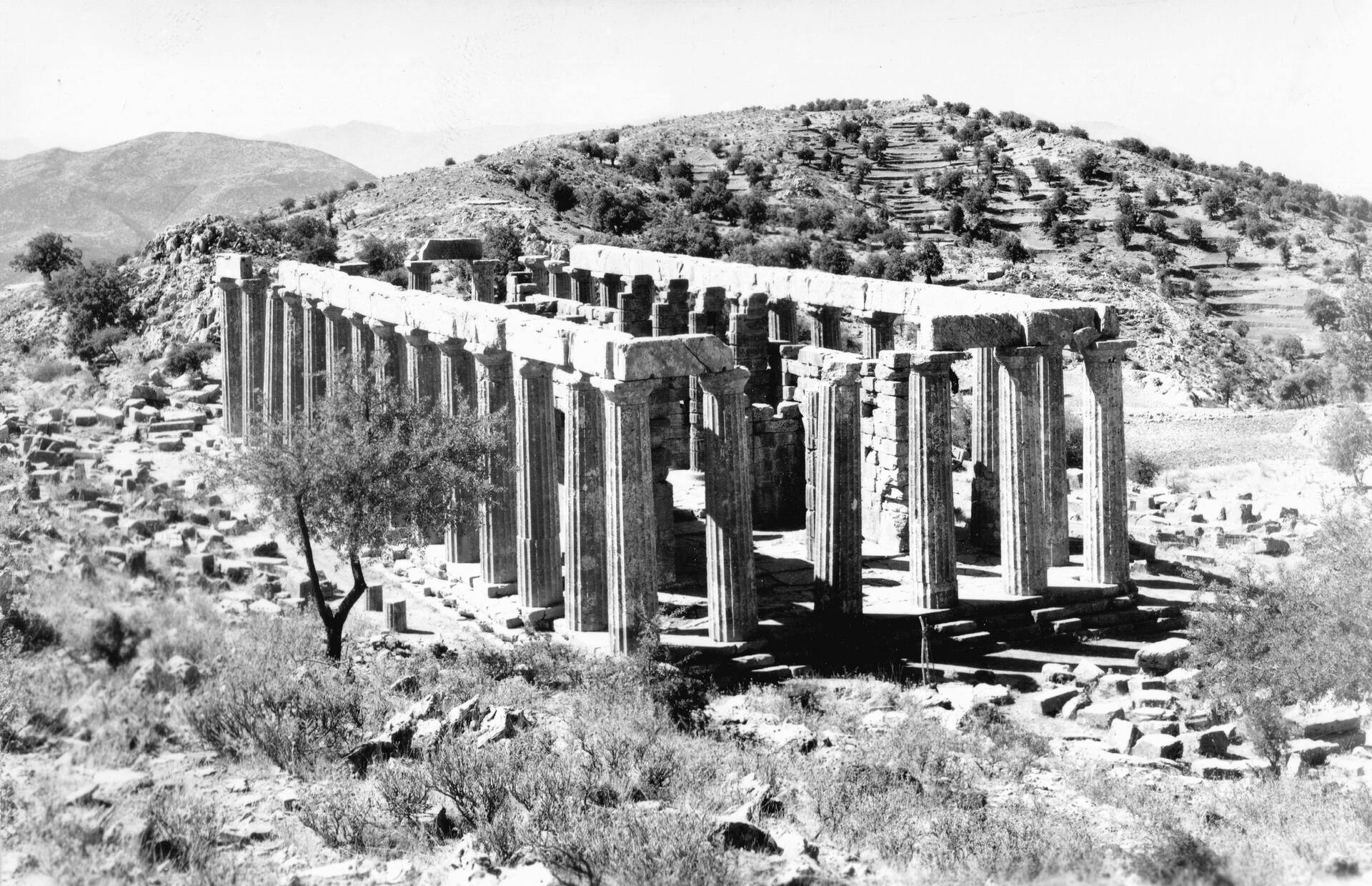
© Tuh de, CC BY-SA 4.0 Resized from original. (This derivative is under the same CC BY-SA license.)
World Heritage Research
Discover scientific research and academic studies that deepen our understanding of Temple of Apollo Epicurius at Bassae from its history and significance to its conservation, management, and contemporary challenges.
-
De – form to Re – form. Architectural Preservation as Safekeeping of the Performative Structure of Space
Classical Greek architecture, particularly the Temple of Apollo Epicurius at Bassae, is revealed as a 'performative' structure that articulates cultural narratives through bodily experience, resonating with dramatic scenes. Traditional preservation methods like anastylosis often reduce monuments to static objects, obscuring their dynamic, scenographic character. The study identifies traces of this performative conception in 18th- and 19th-century architectural discourse, notably in English garden design principles and the notion of picturesque. It proposes an experimental approach that prioritizes preserving articulated scenes experienced by visitors over mere material form restoration, aiming to reintegrate monuments into contemporary culture as vibrant storytelling entities rather than passive tourist attractions.
Kaleris, A., & Castro, G. (2025). De – form to Re – form. Architectural Preservation as Safekeeping of the Performative Structure of Space. Proceedings of the Performing Space 2023 Conference, 94–111. https://doi.org/10.12681/ps2023.7966
View Publication Record | Read Publication -
Society and Archaeological Sites in Interwar Greece
Greek society's investment in archaeological sites, including the Temple of Apollo Epicurius at Bassae and Delphi, during the interwar period (1918–1939) was driven by national political and diplomatic agendas. This study reveals that while antiquities were promoted for their cultural value, their management often involved contradictions and conflicts between local communities, authorities, and the Greek Archaeological Service. High tourist interest during this era further complicated these relationships. The research draws on archival materials from the Directorate for the Management of the National Archive of Monuments (DMNAM) to analyze these dynamics, highlighting the complex interplay between heritage preservation, tourism, and societal priorities in modern Greece.
Vlizos, S., Petarouda, G., & Giannakaki, C. (2024). Society and Archaeological Sites in Interwar Greece. Journal of Mediterranean Archaeology, 36(2), 182–201. https://doi.org/10.1558/jma.29074
View Publication Record | Read Publication -
Figurative Images and Their Iconographic Prototypes in Decoration of Scabbard and Gorytos Overlays from Scythian Tombs of the 4th Century BC.
Research reveals that monumental Greek sculptures from the 5th and 4th centuries BC, including those from the Temple of Apollo Epicurius at Bassae, served as iconographic prototypes for decorative elements on Scythian scabbards and gorytos (shield covers) from the same period. The study identifies consistent patterns in how these motifs were adapted, such as maintaining character roles, circumstances, and affiliations with Greeks or barbarians, while allowing for creative reinterpretation by craftsmen. Notably, the same iconography was used to depict Amazons on monumental sculptures and male figures on toreutic (metalwork) pieces, suggesting a flexible yet structured approach to artistic representation. Additionally, the research highlights that Scythian patrons' attitudes toward nudity influenced the treatment of figurative images, providing insight into cultural exchange and adaptation in ancient art.
Galdanova, O. (2016). Figurative Images and Their Iconographic Prototypes in Decoration of Scabbard and Gorytos Overlays from Scythian Tombs of the 4th Century BC. Actual Problems of Theory and History of Art, 6, 42–51. https://doi.org/10.18688/aa166-1-4
View Publication Record | Read Publication -
Designing a Glass Pavilion to Protect an Ancient Greek Temple
A groundbreaking approach to preserving the UNESCO World Heritage Site, Temple of Apollo Epicurius at Bassae, demonstrates that a glass pavilion can effectively protect ancient limestone structures from environmental degradation while maintaining visual transparency and passive climate control. The study introduces an innovative design featuring 24-meter-span glass beams, eliminating the need for internal columns and ensuring minimal intrusion on the monument's aesthetic integrity. This solution addresses critical challenges of visibility, structural support, and environmental regulation, offering a model for future conservation efforts at similar sites.
Veer Fred, Oikonomopoulou Phaedra, & Bokel Regina. (2012). Designing a Glass Pavilion to Protect an Ancient Greek Temple. Challenging Glass 3. https://doi.org/10.3233/978-1-61499-061-1-139
View Publication Record | Read Publication