World Heritage Identification Number: 941
World Heritage since: 1999
Category: Cultural Heritage
WHE Type: Archaeological Sites
Transboundary Heritage: No
Endangered Heritage: No
Country: 🇬🇷 Greece
Continent: Europe
UNESCO World Region: Europe and North America
Map
The Archaeological Sites of Mycenae and Tiryns: A Journey into the Heart of Ancient Greece
The Archaeological Sites of Mycenae and Tiryns, inscribed by UNESCO in 1999, offer a captivating glimpse into the rich history and cultural legacy of ancient Greece. Located in the Argolis region of the Peloponnese, these two cities were once the dominant powers of the Mycenaean civilization, which flourished between the 15th and 12th centuries BC. Their influence extended far beyond the borders of modern-day Greece, shaping the course of classical Greek culture and leaving an indelible mark on European art, literature, and mythology.
More to come…UNESCO Description of the World Heritage Site
The archaeological sites of Mycenae and Tiryns are the imposing ruins of the two greatest cities of the Mycenaean civilization, which dominated the eastern Mediterranean world from the 15th to the 12th century B.C. and played a vital role in the development of classical Greek culture. These two cities are indissolubly linked to the Homeric epics, the Iliad and the Odyssey , which have influenced European art and literature for more than three millennia.
UNESCO Justification of the World Heritage Site
Criterion (i): The architecture and design of Mycenae and Tiryns, such as the Lion Gate and the Treasury of Atreus and the walls of Tiryns, are outstanding examples of human creative genius.
Criterion (ii): The Mycenaean civilisation, as exemplified by Mycenae and Tiryns, had a profound effect on the development of classical Greek architecture and urban design, and consequently also on contemporary cultural forms.
Criterion (iii): Mycenae and Tiryns bear unique testimony to the political, social and economic development of the Mycenaean world, thus representing the peak of this early stage of Greek civilization.
Criterion (iv): Both sites illustrate in a unique manner the achievements of Mycenaean civilization in arts, architecture and technology, which laid the foundations for the evolution of later European cultures.
Criterion (vi): Mycenae and Tiryns are intricately linked with the Homeric epics, the Iliad and the Odyssey, which profoundly influenced European literature and arts for more than three millennia.
Encyclopedia Record: Mycenae
Mycenae is an archaeological site near Mykines in Argolis, north-eastern Peloponnese, Greece. It is located about 120 kilometres south-west of Athens; 11 kilometres north of Argos; and 48 kilometres south of Corinth. The site is 19 kilometres inland from the Saronic Gulf and built upon a hill rising 274 metres above sea level.Additional Site Details
Area: Not available
Number of Components: 2
(ii) — Significant interchange of human values
(iii) — Unique or exceptional testimony to a cultural tradition
(iv) — Outstanding example of a type of building or landscape
(vi) — Directly associated with events or living traditions
Coordinates: 37.73333333 , 22.75
Image
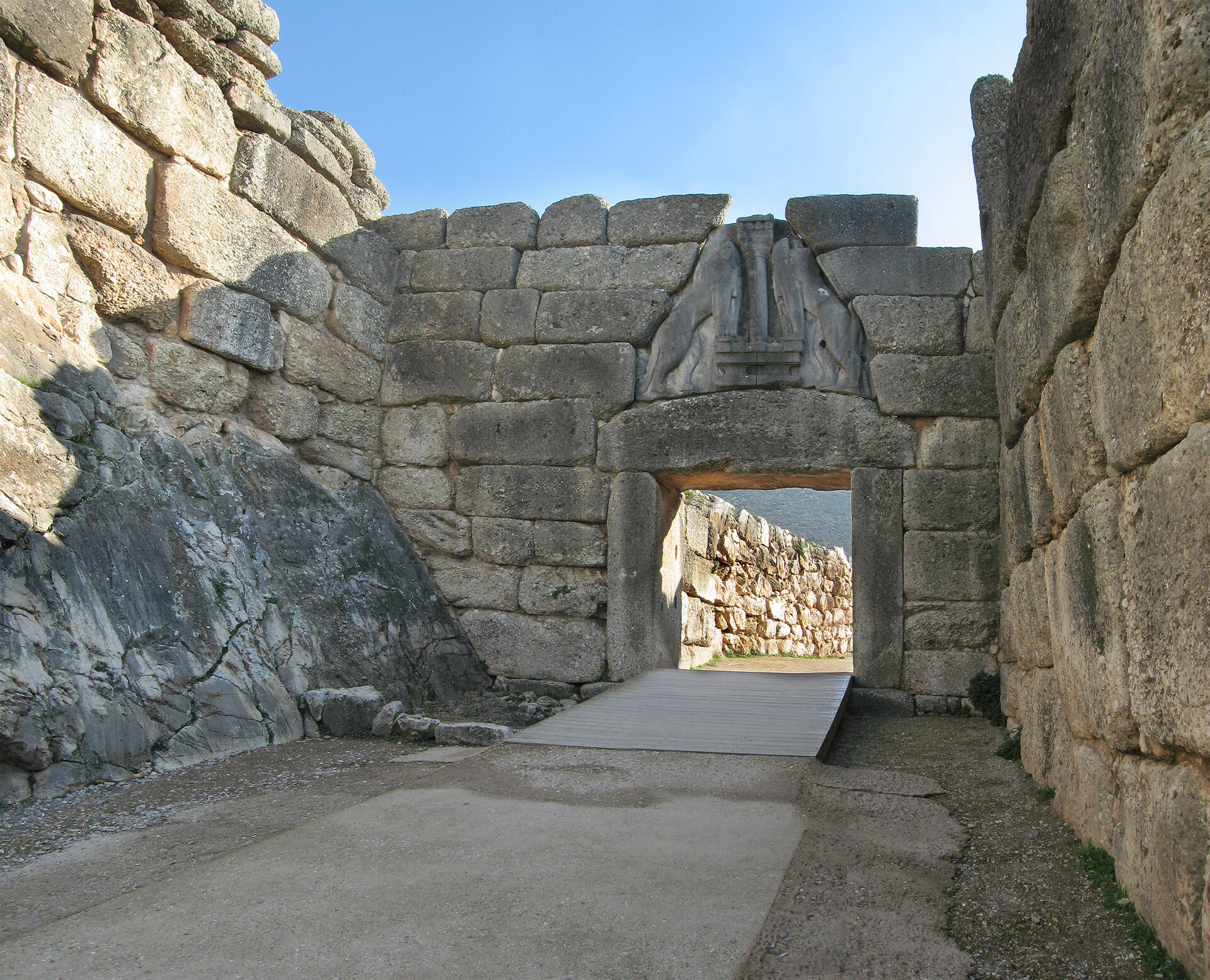
© Andreas Trepte, CC BY-SA 2.5 Resized from original. (This derivative is under the same CC BY-SA license.)
World Heritage Research
Discover scientific research and academic studies that deepen our understanding of Archaeological Sites of Mycenae and Tiryns from its history and significance to its conservation, management, and contemporary challenges.
-
Of Real and Mythic Places
A site-specific devised play, 'Journeys of Water (Five Myths from the Ancient Argolid),' successfully integrated local ancient myths with the architectural and natural environments of Mycenae, Tiryns, and Epidaurus, transforming these UNESCO World Heritage Sites into dynamic performance spaces. The project, led by Okypus Theatre Company in 2012, demonstrated how mythological storytelling could enhance the cultural significance of archaeological sites while engaging audiences through a multidisciplinary approach. By leveraging the region's historical heritage, the play's dramatury, mise en scène, music, and scenography were deeply influenced by the chosen locations, creating an immersive experience that bridged ancient narratives with contemporary performance.
Stourna, A. (2025). Of Real and Mythic Places. Proceedings of the Performing Space 2023 Conference, 326–332. https://doi.org/10.12681/ps2023.7951
View Publication Record | Read Publication -
Synchronizing the Destructions of the Mycenaean Palaces
A groundbreaking analysis reveals that the destructions of Mycenaean palaces, spanning from Crete to central Greece and including sites like Pylos, Mycenae, Tiryns, and Thebes, occurred synchronously. This discovery is based on advanced pottery studies, providing precise relative chronological dates for these events. The research, involving leading scholars often directly engaged in excavations, offers the first comprehensive framework for understanding the timing of palace destructions. It also aims to explain the historical causes behind these events, integrating primary data from multiple sites and contemporary regions like Cyprus and Syria. This work serves as a foundational resource for interpreting administrative texts from palace archives and reconstructing the building history of these ancient structures.
Kardamaki, E. (2022). Synchronizing the Destructions of the Mycenaean Palaces. https://doi.org/10.1553/978oeaw88773
View Publication Record | Read Publication -
Confronting Hegemony in Mycenaean Central Greece
Central Greece, though less prominent than the Peloponnese in Mycenaean studies, hosted significant palatial centers like Thebes, Orchomenos, and Gla during the Late Bronze Age. This study challenges the assumption that Mycenaean political organization was uniformly centered around monumental sites such as Mycenae or Pylos, revealing instead a diverse range of sociopolitical formations across the region. While tholos tombs—characteristic of Peloponnesian funerary architecture—were adopted later in central Greece, elaborate funerary enclosures and chamber tomb cemeteries, particularly at Thebes, Chalkis, and Athens, indicate alternative pathways to social differentiation. Additionally, the presence of imported pottery, especially from Crete, underscores central Greece's role in Aegean trade networks, with sites like Thorikos serving as key hubs for copper and silver exchange. The study also highlights the shifting dominance in maritime trade, marked by Mycenae's rise and Aegina's decline during the LH IIIA period.
Knodell, A. R. (2021). Confronting Hegemony in Mycenaean Central Greece. Societies in Transition in Early Greece: An Archaeological History, 63–115. https://doi.org/10.1525/luminos.101.d
View Publication Record | Read Publication -
Rituals, Collapse, and Radical Transformation in Archaic States
Ritual practices played a significant role in the collapse and transformation of archaic states, serving as both a cohesive force and a point of fracture during societal transitions. The book 'Rituals, Collapse, and Radical Transformation in Archaic States,' edited by Joanne M.A. Murphy, explores this theme through diverse case studies spanning Greece, the Americas, East Africa, southern India, and classical Myanmar. It argues that ritual can promote social cohesion but also fragment societies during times of trouble, often tied to ruling and elite cultures. The research approach involves analyzing ritual changes across different periods and regions, highlighting how these practices evolved or were abandoned post-collapse. Key findings include the shift from palace-controlled cults in Crete to more communal participation, the loss of ideological significance around Mycenaean tombs, and the decline of temple-building during state collapses in southern India.
Middleton, G. D. (2022). Rituals, Collapse, and Radical Transformation in Archaic States Edited by Joanne M.A. Murphy. London: Routledge 2021. Pp. 242. $160. ISBN 9780367230265 (cloth). American Journal of Archaeology, 126(1), E009–E011. https://doi.org/10.1086/718062
View Publication Record | Read Publication -
Evolution of a social dynamic in a changing landscape: the case of Argos (Argolis, Greece) in the Mycenaean period
Argos, once a prominent center during the Middle Helladic period, experienced a significant decline in its importance from the transitional phase (MH III/LH I) through the Mycenaean palatial period. This study reveals that Argos' status was influenced by natural disasters, particularly the eruption of Thera, which altered the political, economic, and social geography of Argolis to Argos' detriment. The research employs archaeological evidence and the Adaptive Cycle (AC) model to demonstrate how certain sites or parts of Argolis functioned according to a positive/negative system throughout protohistoric periods. Additionally, it suggests that a group of people may have migrated from Argos to Mycenae at the beginning of MH III, contributing to Mycenae's rise.
Baeriswyl, P. (2020). Evolution of a social dynamic in a changing landscape: the case of Argos (Argolis, Greece) in the Mycenaean period. BAF-Online: Proceedings of the Berner Altorientalisches Forum, 4(1). https://doi.org/10.22012/baf.2019.12
View Publication Record | Read Publication -
Tiryns
Tiryns, one of the Mycenaean palatial centers closest to the sea, played a pivotal role as a major Mediterranean harbor during the Bronze Age. Geoarchaeological research by Eberhard Zangger reveals that the site's proximity to the coast has significantly changed over the Holocene due to massive sedimentation from soil erosion, with the shoreline in Mycenaean times positioned approximately halfway between its current location and Tiryns itself. This finding underscores Tiryns' strategic importance in long-distance exchange networks. Restoration works in the late 1950s, led by Nikolaos Verdelis, uncovered underground cisterns in the Lower Citadel, which spurred renewed archaeological interest and expanded excavation efforts to previously neglected areas, including the Lower Town.
Maran, J. (2012). Tiryns. The Oxford Handbook of the Bronze Age Aegean, 722–734. https://doi.org/10.1093/oxfordhb/9780199873609.013.0054
View Publication Record | Read Publication