World Heritage Identification Number: 511
World Heritage since: 1989
Category: Cultural Heritage
WHE Type: Archaeological Sites
Transboundary Heritage: No
Endangered Heritage: No
Country: 🇬🇷 Greece
Continent: Europe
UNESCO World Region: Europe and North America
Map
Mystras: The Medieval Jewel of the Morea
The Archaeological Site of Mystras, inscribed as a UNESCO World Heritage Site in 1989, stands as a testament to the rich history and cultural diversity that once thrived in the Morea region of Greece. Nestled within the picturesque landscape of the Taygetus mountain range, this fortified town offers a unique blend of Byzantine, Frankish, and Ottoman influences, making it a captivating destination for historians, archaeologists, and travelers alike.
More to come…UNESCO Description of the World Heritage Site
Mystras, the 'wonder of the Morea', was built as an amphitheatre around the fortress erected in 1249 by the prince of Achaia, William of Villehardouin. Reconquered by the Byzantines, then occupied by the Turks and the Venetians, the city was abandoned in 1832, leaving only the breathtaking medieval ruins, standing in a beautiful landscape.
UNESCO Justification of the World Heritage Site
Criterion (ii): Mystras constitutes a medieval city whose art, the fruit of the so-called Palaeologan Renaissance, influenced the development of Late Byzantine and Post-byzantine art. The influence of the art of Mystras during the late and post Byzantine era is visible on a large number of monuments in the Peloponnese (such as Geraki, Mani, Longanikos, Leontari, Roinos) especially in painting. During the late Byzantine period the radiance of the art of the Despotate seems to influence the artistic streams which are developed throughout the Greek territory – including that of the Cretan School painting – always in combination with the powerful influence exerted by the art of Constantinople. This influence can be easily seen on the works of post-Byzantine painters, such as Xenos Digenis originating from the Despotate who was active in Crete, Aitolia, and Ipeiros or the family of Phokas in Crete and many others. The heritage of Mystras is apparent not only in architecture and painting but also in intellectual aspects. Distinguished intellectuals of Mystras, amongst them, Georgios Gemistos Plethon, the Neoplatonist philosopher, aroused the interest of the West for the interpretation of Platonic philosophy and the study of ancient Greek texts, thus contributing to the European Renaissance.
Criterion (iii): Mystras constitutes a unique example of a Byzantine city, an expression of flourishing urban society within the late Byzantine Empire. As a political and administrative provincial centre of the Byzantine state, Mystras became a unique intellectual, cultural and artistic centre.
Criterion (iv): Mystras is an exceptional example of a well-preserved fortified late-Byzantine city with elaborate spatial planning organization, and fortifications with the citadel on top of the hill and two fortified precincts at the lower level. The urban fabric of the city includes palaces, residences and mansions, churches and monasteries, as well as constructions related to the city’s water supply and drainage and to commercial and craft-based activities. Various architectural styles are applied in ecclesiastical architecture, but the so-called “mixed type of Mystras” (in which a three aisled basilica at ground level is combined with a five-domed cross-in-square at the level of the gallery) is dominant. The splendid complex of palaces, one of the few Byzantine survivals, the impressive mansions and the urban residences clearly demonstrate the high quality of life of the city’s inhabitants in the two last centuries of the Byzantine Empire.
Encyclopedia Record: Mystras
Mystras or Mistras, also known in the Chronicle of the Morea as Myzethras or Myzithras (Μυζηθρᾶς), is a fortified town and a former municipality in Laconia, Peloponnese, Greece. Situated in the Taygetus range, above ancient Sparta, and below a "Frankish" castle, it served as the capital of the Byzantine Despotate of the Morea in the 14th and 15th centuries, experiencing a period of prosperity and cultural flowering during the Palaeologan Renaissance, including the teachings of Gemistos Plethon. The city also attracted artists and architects of the highest quality.Additional Site Details
Area: 54.43 hectares
Number of Components: 1
(iii) — Unique or exceptional testimony to a cultural tradition
(iv) — Outstanding example of a type of building or landscape
Coordinates: 37.08056 , 22.36667
Image
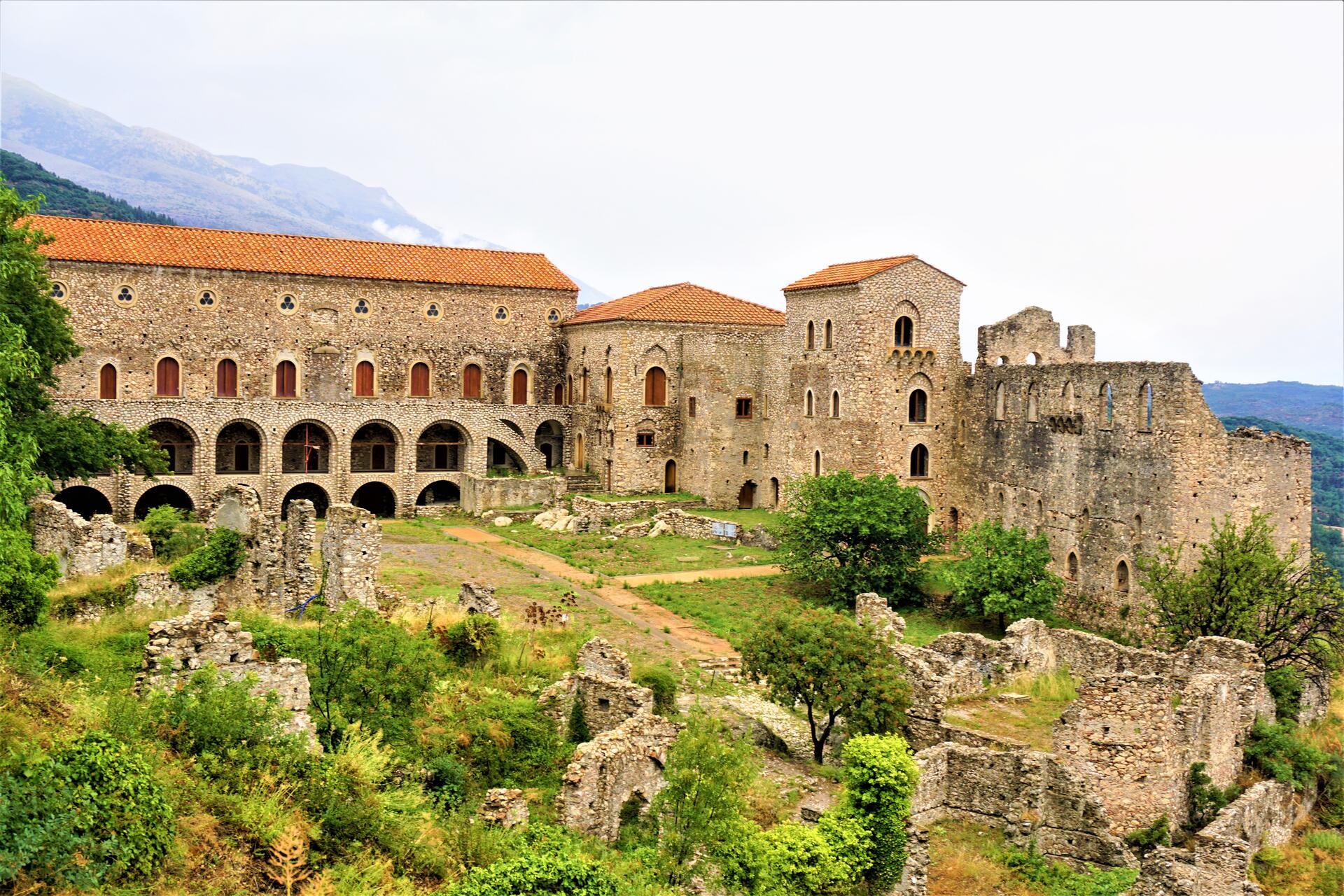
© Joyofmuseums, CC BY-SA 4.0 Resized from original. (This derivative is under the same CC BY-SA license.)
World Heritage Research
Discover scientific research and academic studies that deepen our understanding of Archaeological Site of Mystras from its history and significance to its conservation, management, and contemporary challenges.
-
The Plant Diversity of Cultural Habitat Islands: Aspects of the Flora of the Mystras UNESCO World Heritage Site (Greece)
Mystras, a UNESCO World Heritage Site in Greece's Peloponnese, harbors remarkable plant diversity with 321 vascular taxa identified, including 14 Greek and seven Balkan endemics. The flora is dominated by Mediterranean species, ruderals, and therophytes, reflecting its disturbance-adapted ecological conditions. Comparisons with other archaeological sites in the region revealed Mystras' high α-diversity and unique floristic composition, emphasizing its significance as both a cultural monument and biodiversity reservoir. The study underscores the need for integrated conservation strategies to protect native flora while preserving historical structures.
Panitsa, M., Tsakiri, M., Constantinou, I., & Nikoloudis, I. (2025). The Plant Diversity of Cultural Habitat Islands: Aspects of the Flora of the Mystras UNESCO World Heritage Site (Greece). Diversity, 17(11), 749. https://doi.org/10.3390/d17110749
View Publication Record | Read Publication -
Mystras Captured from the Air – Digital Recording Techniques for Cultural Heritage Management of a Monumental Archaeological Site
Advanced digital recording techniques, including aerial documentation and 3D modeling, have revolutionized the study and preservation of the UNESCO-listed Archaeological Site of Mystras. This research demonstrates how these methods can capture the monumental landscape and its intricate details with unprecedented accuracy, providing a new framework for cultural heritage management. By integrating drone surveys, photogrammetry, and digital storytelling—highlighted through the case of the Bronchotion Monastery—scientists offer a scalable approach to documenting and analyzing complex archaeological sites. The findings underscore the potential of these technologies to enhance conservation efforts while preserving historical narratives for future generations.
Waagen, J. (2024). Mystras Captured from the Air – Digital Recording Techniques for Cultural Heritage Management of a Monumental Archaeological Site. Peer Community in Archaeology. https://doi.org/10.24072/pci.archaeo.100420
View Publication Record | Read Publication -
At the Edge of a City: The Digital Storyline of the Brontochion Monastery of Mystras
A groundbreaking digital reconstruction of the Brontochion Monastery, located at the edge of Mystrasreveals its architectural evolution from a modest 13th-century foundation to a prestigious Palaiologos dynasty temple. Using advanced spatial technologies including unmanned aerial systems (UAS), high-accuracy GPS, and photogrammetry, researchers created high-resolution 3D models and orthophotos, enabling precise visualization of the monastery's phases. This study contributes to a broader digital depiction of Mystras' Byzantine city, offering new insights into its historical development through georeferenced data and GIS analysis.
Vayia, P. V., Vasiliki, V., Anastasios, K., & Nikolaos, Z. (2023). AT THE EDGE OF A CITY: THE DIGITAL STORYLINE OF THE BRONTOCHION MONASTERY OF MYSTRAS. Zenodo. https://doi.org/10.5281/ZENODO.8126953
View Publication Record | Read Publication -
Assessing the risks of climate change for cultural heritage – The CLIMASCAPE project
Climate change poses significant and varied risks to Greece's cultural heritage, necessitating tailored adaptation strategies for UNESCO World Heritage Sites. The CLIMASCAPE project identifies differentiated climate impacts—such as heatwaves, floods, droughts, fires, and sea level rise—across eight archaeological sites, including Mystras. Preliminary findings highlight the need for site-specific vulnerability assessments based on projected climate changes and unique site characteristics. The study introduces a multi-criteria methodology to evaluate exposure, sensitivity, adaptive capacity, and overall vulnerability, using climate model projections and quantitative data. This approach underscores the urgency of developing localized adaptation plans to safeguard these irreplaceable cultural assets.
Cartalis, C., Polydoros, A., Mavrakou, T., Philippopoulos, K., Asprogerakas, E., Pantazis, P., Samarina, A., Zoumpaki, S., & Karambinis, M. Assessing the risks of climate change for cultural heritage – The CLIMASCAPE project. Proceedings of the 17th International Conference on Environmental Science and Technology. https://doi.org/10.30955/gnc2021.00767
View Publication Record | Read Publication -
Digital Mystras: An Approach Towards Understanding the Use of an Archaeological Space
Digital Mystras offers a groundbreaking approach to visualizing the evolution of one of Greece's most significant Byzantine archaeological sites. By leveraging modern spatial technologies, including UAVs, GPS, and photogrammetry software, researchers have created a detailed orthophoto map that serves as a base for GIS analysis. This digital depiction allows for the temporal and spatial reconstruction of Mystras' urban fabric, from its foundation in 1249 to its flourishing period under Byzantine rule. The study provides unprecedented insights into population fluctuations, structural elements, ecclesiastical and secular buildings, and fortifications, contributing significantly to Cultural Heritage Management. This innovative method highlights the transformative potential of digital technologies in understanding and preserving archaeological spaces.
Panagiotidis, V., & Zacharias, N. (2022). DIGITAL MYSTRAS: AN APPROACH TOWARDS UNDERSTANDING THE USE OF AN ARCHAEOLOGICAL SPACE. Zenodo. https://doi.org/10.5281/ZENODO.6640278
View Publication Record | Read Publication -
Late Byzantium Reconsidered: The Arts of the Palaiologan Era in the Mediterranean
Late Byzantium Reconsidered challenges the conventional narrative of decline during the Palaiologan era (1261–1453), demonstrating that Byzantine artistic and cultural production thrived even as the empire faced political crisis. Through comparative analysis, the volume explores parallels between late antiquity and late Byzantium, revealing continuity in creativity despite the fall of Constantinople in 1453. Case studies—including the reign of Andronicus II Palaeologus, scientific illustration trends, and regional art in Mystras and Crete—highlight resilience in artistic innovation, religious institutions, and cross-cultural interactions. The research employs interdisciplinary methods, integrating archaeology, art history, and textual analysis to reconsider decline as a multifaceted phenomenon, offering new perspectives on Byzantine legacy beyond classical frameworks.
Kuyumdzhieva, M., & Biliarsky, I. (2021). Late Byzantium Reconsidered: The Arts of the Palaiologan Era in the Mediterranean. Hiperboreea, 8(2), 282–286. https://doi.org/10.5325/hiperboreea.8.2.0282
View Publication Record | Read Publication