World Heritage Identification Number: 183
World Heritage since: 1982
Category: Cultural Heritage
WHE Type: Archaeological Sites
Transboundary Heritage: No
Endangered Heritage: Yes
Country: 🇱🇾 Libya
Continent: Africa
UNESCO World Region: Arab States
Map
The Archaeological Site of Leptis Magna: A Gem of Ancient Rome in Modern Libya
The Archaeological Site of Leptis Magna, located in modern-day Libya, stands as a testament to the grandeur and splendor of ancient Rome. Inscribed as a UNESCO World Heritage Site in 1982, Leptis Magna offers an exceptional glimpse into the history, urban planning, and cultural life of the Roman Empire.
Originally founded as a Phoenician settlement, likely in the 7th century BCE, Leptis Magna later became an important city within the Carthaginian sphere of influence before being absorbed into the Roman Empire. Situated at the mouth of the Wadi Lebda, the city developed into a major Mediterranean port, featuring an impressive harbor, extensive storehouses, a thriving commercial sector, numerous shops, and well-defined residential districts.
The city reached the height of its prosperity during the reign of Emperor Septimius Severus (r. 193–211 CE), who was born in Leptis Magna. His patronage transformed the city through ambitious building programs, including the construction of monumental public spaces and lavish architectural complexes. These enhancements elevated Leptis Magna to one of the most beautiful cities in Roman Africa and the wider empire.
Among the most remarkable features of Leptis Magna are its two major fora. The older forum (Forum Vetus) dates to the early Imperial period, while the grand Severan Forum—built under Septimius Severus—served as a monumental civic center adorned with imported marble columns, statues, and richly decorated architectural elements, many of which still stand today, offering a tangible connection to the past. The fora functioned as focal points for political life, public ceremonies, and social interaction.
Another notable structure is the Roman Theatre, which was constructed in the early 1st century CE, and could seat around 16,000 people. The theatre was financed and dedicated by the local benefactor Annobal Rufus, a prominent member of Leptis Magna’s elite, as recorded in surviving inscriptions. Designed for dramatic performances, musical events, and public gatherings, the theatre is among the best-preserved Roman theatres in North Africa and reflects the cultural vitality of the city. Gladiatorial contests, by contrast, were held in the amphitheater, a separate structure located outside the city center, as was customary in Roman urban design.
The commercial heart of Leptis Magna included a well-organized Macellum (marketplace) dates back to the 1st century CE and is famous for its circular pavilions and carved stone tables used for weighing and measuring goods. This expansive area housed a multitude of shops selling everything from foodstuffs to luxury items, catering to the diverse needs of the city's inhabitants. Remnants of the marketplace's colonnades and mosaics can still be seen today, providing insight into the daily life and commerce of the ancient city.
In addition to its monumental architecture, Leptis Magna was renowned for its carefully planned urban layout. Wide streets, elegant residential quarters, bath complexes, and sophisticated water-management systems—including aqueducts and cisterns—supported a large and prosperous population. The city's strategic location along major trade routes made it a hub for commerce and cultural exchange, contributing to its prosperity and influence.
Following its peak, Leptis Magna entered a period of decline due to a combination of economic challenges, Vandal invasions in the 5th century CE, and shifting trade patterns. The city declined further after the Arab conquests in the 7th century and was eventually buried and preserved beneath Saharan sands.
Today, the Archaeological Site of Leptis Magna stands as one of the most impressive survivals of Roman urbanism anywhere in the world. Its preservation serves as a reminder of the enduring legacy of the Roman Empire and the rich cultural tapestry that continues to shape our world. Visitors to this remarkable site can walk among the ruins, imagining the lives of those who once called Leptis Magna home, and marvel at the ingenuity and ambition that built this ancient gem.
Due to political instability and ongoing conservation challenges in Libya, Leptis Magna has been on the UNESCO List of World Heritage in Danger since 2016. The World Heritage Committee reaffirmed its continued status on that list in its 2024 and 2025 reviews.
UNESCO Description of the World Heritage Site
Leptis Magna was enlarged and embellished by Septimius Severus, who was born there and later became emperor. It was one of the most beautiful cities of the Roman Empire, with its imposing public monuments, harbour, market-place, storehouses, shops and residential districts.
UNESCO Justification of the World Heritage Site
Criterion (i): Leptis Magna is a unique artistic realisation in the domain of urban planning and in its application of monumental display. The urban fabric of the city represents a synthesis of progressive developments and enlargements which came to a height in the Severan period, incorporating major monumental elements of that period worthy of an imperial capital. The Severan forum, the basilica and the Severan arch rank among the finest monuments known from the Roman world and were strongly influenced by African and Eastern traditions. The sculpture and carvings, including that of the Severan basilica and the Severan arch are innovative in their linear definition of forms, the crispness of their contours and the angular delineation of their volumes. The port of Leptis is one of the outstanding works of Roman technology.
Criterion (ii): The large number of sculptures and statues found in Leptis demonstrate clearly Punic, Roman, Greek and Hellenistic influences. Aegean craftsmanship can be seen in the magnificent marble decorations on the pillars in the Severan Basilica and those on the Arch of Severus. Leptis, which was rediscovered in the 17th and 18th centuries by travellers such as Durand and Lemaire, has played a major role in the movement back to Antiquity and in the elaboration of the Neo-classic aesthetic.
Criterion (iii): The number and the variety of the structures of Leptis Magna bear witness to a vanished civilization. The site provides a full picture of life in a large provincial city through the urban, architectural and decorative aspects that have been preserved. The monuments furnish a vivid impression of the lifestyle enjoyed in the city during the early and middle periods of the Roman Empire. The city still maintains the most important elements of its antique port, including vestiges of the former warehouses and the outline of its artificial basin of nearly 102,000 m2 still discernible. The market, an essential element in the everyday life of a large commercial trading centre, with its votive arch, its colonnades and its shops, has been, for the most part, preserved. The prestigious monuments, arches, gates, old forum, Severan forum, temples, baths, theatre, circus and amphitheatre all attest to the commercial, industrial, and civic activity of the city.
Encyclopedia Record: Leptis Magna
Leptis or Lepcis Magna, also known by other names in antiquity, was a prominent city of the Carthaginian Empire and Roman Libya at the mouth of the Wadi Lebda in the Mediterranean.Additional Site Details
Area: 387.485 hectares
Number of Components: 1
(ii) — Significant interchange of human values
(iii) — Unique or exceptional testimony to a cultural tradition
Coordinates: 32.63833 , 14.29306
Image
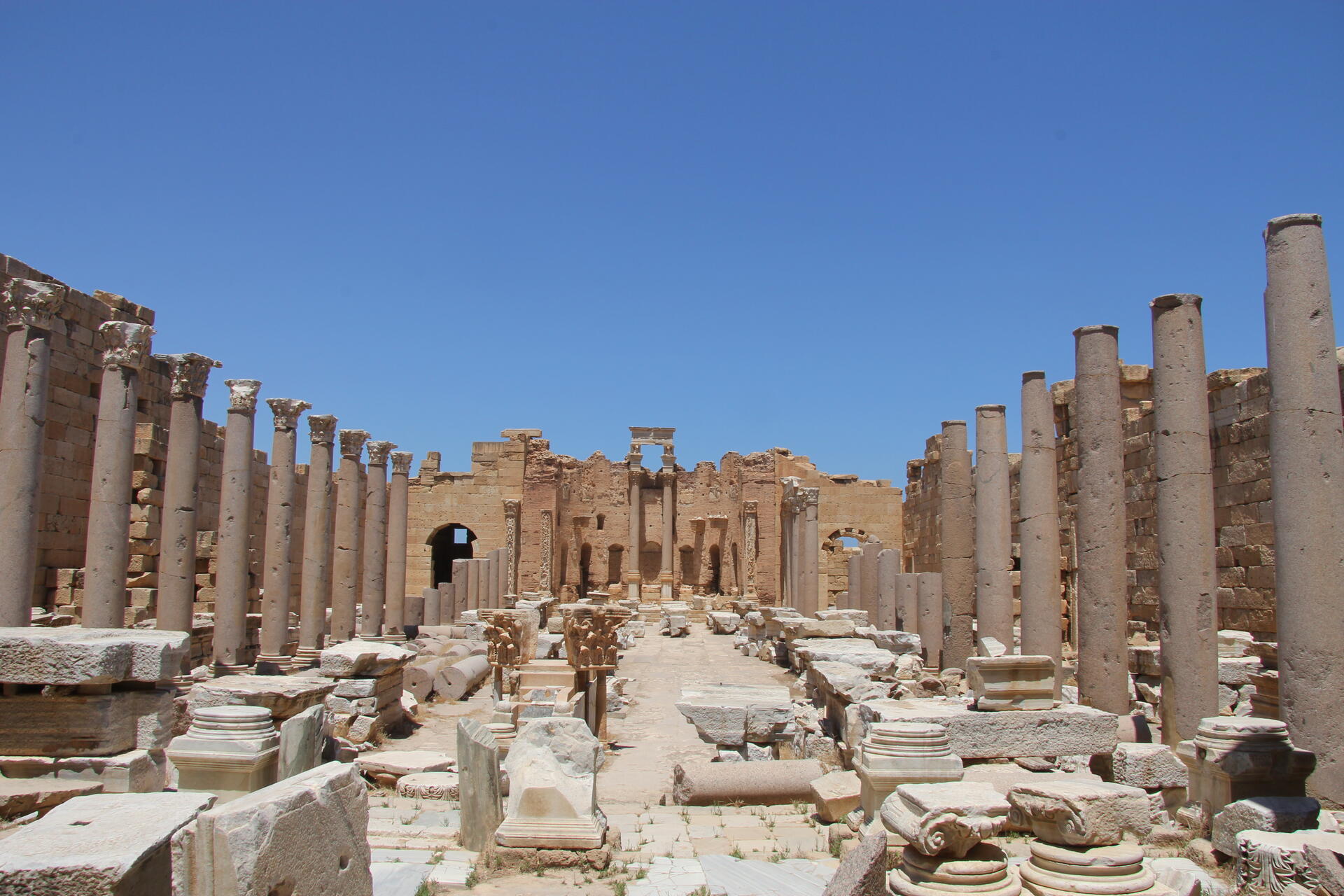
© joepyrek from Richmond, Va, USA, CC BY-SA 2.0 Resized from original. (This derivative is under the same CC BY-SA license.)
World Heritage Research
Discover scientific research and academic studies that deepen our understanding of Archaeological Site of Leptis Magna from its history and significance to its conservation, management, and contemporary challenges.
-
Gaphara – Minna villa Marci- Ras Chacra – Gasr Jafara : processus de changements toponymiques au fil des siècles ou diversité de sites ?
A comprehensive analysis of the Archaeological Site of Leptis Magna reveals a dynamic history of toponymic changes over centuries, reflecting shifts in cultural and political significance. The study identifies that the site, known as 'Gaphara' during the Phoenician-Punic era, underwent multiple name transformations—including 'Minna Villa Marsi' in late Roman times, 'Ras Cha c ra' in the Middle Ages, and a resurgence of its ancient name 'Gasr Jafara/Djefara' in the late Middle Ages. These changes correlate with shifts from an urban harbor to a luxury residence exploited by the aristocracy of Leptis Magna for olive product exports, followed by its role as an official maritime station before eventual abandonment. The research cross-references literary evidence with archaeological data, providing a nuanced understanding of how toponymic evolution mirrors broader historical and functional transitions at this UNESCO World Heritage Site.
Abdouli, H., & Ahmed, M. (2022). Gaphara – Minna villa Marci- Ras Chacra – Gasr Jafara : processus de changements toponymiques au fil des siècles ou diversité de sites ? Libyan Studies, 53, 70–83. https://doi.org/10.1017/lis.2022.13
View Publication Record | Read Publication -
A Multidisciplinary Approach to the Coastal Protection of Two Archaeological Sites in Lybia
A multidisciplinary approach integrating multi-beam technology, satellite imagery, and bathymetric surveys has been successfully employed to design coastal protection measures for the UNESCO World Heritage Site of Leptis Magna in Libya. This method addressed logistic challenges and time constraints while providing detailed morphological reconstructions essential for safeguarding the archaeological site from flooding risks posed by the Wadi Lebda. The study, part of a broader project initiated in 2009, demonstrates the effectiveness of combining advanced remote sensing techniques with ground investigations to support large-scale heritage conservation interventions.
D’Urso, I., Ombrelli, M., Telaroli, P., Calesso, W., Badin, C., Senigaglia, M., Urrutia, C., & Sterponi, L. (2015). A MULTIDISCIPLINARY APPROACH TO THE COASTAL PROTECTION OF TWO ARCHAEOLOGICAL SITES IN LYBIA. The International Archives of the Photogrammetry, Remote Sensing and Spatial Information Sciences, XL-5/W5, 109–116. https://doi.org/10.5194/isprsarchives-xl-5-w5-109-2015
View Publication Record | Read Publication -
Espaço e Materialidade na Tripolitania Romana: uma tentativa de reconstituição da cidade de Oea em meados do II Século * Space And Materiality In Roman Tripolitania: an attempt of recovery of the city of Oea in the Mid-Second Century
A groundbreaking attempt to reconstruct the lost Roman city of Oea, now buried beneath Tripoli, Libya, sheds light on its material culture and urban space. By analyzing Apuleius of Madaura's Apology—a firsthand account of his public vilification for witchcraft—and comparing it with surviving archaeological and epigraphic artifacts from nearby Leptis Magna and Sabrata, researchers partially visualize the city as it existed in the mid-2nd century AD. This interdisciplinary approach, combining literary, epigraphic, and comparative urban studies, offers a rare glimpse into a Roman city otherwise obscured by modern development.
LIMA NETO, B. M. (2014). Espaço e Materialidade na Tripolitania Romana: uma tentativa de reconstituição da cidade de Oea em meados do II Século * Space And Materiality In Roman Tripolitania: an attempt of recovery of the city of Oea in the Mid-Second Century. História E Cultura, 2(3), 186. https://doi.org/10.18223/hiscult.v2i3.1103
View Publication Record | Read Publication -
Degradation of stone materials in the Greek–Roman Hadrianic Baths in Leptis Magna (Libya)
Severe weathering, including honeycomb formation and biological damage, is significantly degrading the limestone and marble structures of Leptis Magna's Hadrianic Baths. This study identifies multiple deterioration factors—such as salt weathering, moisture, temperature fluctuations, and microbial activity—that contribute to structural degradation in this marine climate. The research characterizes the building materials affected by these processes, providing insights into their vulnerability and potential conservation strategies.
Abd el tawab, N. (2011). Degradation of stone materials in the Greek–Roman Hadrianic Baths in Leptis Magna (Libya). The Conference Book of the General Union of Arab Archeologists, 14(14), 323–324. https://doi.org/10.21608/cguaa.2011.35627
View Publication Record | Read Publication