World Heritage Identification Number: 393
World Heritage since: 1987
Category: Cultural Heritage
WHE Type: Archaeological Sites
Transboundary Heritage: No
Endangered Heritage: No
Country: 🇬🇷 Greece
Continent: Europe
UNESCO World Region: Europe and North America
Map
The Archaeological Site of Delphi: The Navel of the Ancient Greek World
The Archaeological Site of Delphi, inscribed as a UNESCO World Heritage Site in 1987, is a testament to the rich cultural heritage and spiritual significance that permeated ancient Greece. Located in central Greece, this pan-Hellenic sanctuary served as the religious center and symbol of unity for the ancient Greek world during the 6th century BC.
More to come…UNESCO Description of the World Heritage Site
The pan-Hellenic sanctuary of Delphi, where the oracle of Apollo spoke, was the site of the omphalos, the 'navel of the world'. Blending harmoniously with the superb landscape and charged with sacred meaning, Delphi in the 6th century B.C. was indeed the religious centre and symbol of unity of the ancient Greek world.
UNESCO Justification of the World Heritage Site
Criterion (i): The layout of Delphi is a unique artistic achievement. Mt. Parnassus is a veritable masterpiece and is where a series of monuments were built whose modular elements – terraces, temples, treasuries, etc. – combine to form a strong expression of the physical and moral values of a site which may be described as magical.
Criterion (ii): Delphi had an immense impact throughout the ancient world, as can be ascertained by the various offerings of kings, dynasts, city-states and historical figures, who deemed that sending a valuable gift to the sanctuary, would ensure the favour of the god. The Sanctuary at Delphi, the object of great generosity and the crossroads of a wide variety of influences, was in turn imitated throughout the ancient world. Its influence extended as far as Bactria, following the conquest of Asia by Alexander the Great. Even pillaging of the Sanctuary by the emperor Nero and by Constantine the Great, who transported spoils from it to Rome and Constantinople, added to the artistic influence of Delphi.
Criterion (iii): Delphi bears a unique testimony to the religion and civilization of ancient Greece. At the legendary site where Apollo slew the serpent Python, celestial cults replaced chthonian cults and introduced the old heritage of myths originating from primitive times. The Delphic oracle, over which four sacred wars were fought, is one of the focal points of Greek political history, while the Theatre and the Stadium, where the Pythian Games took place every four years, were places of community celebrations reflecting triumphant Hellenism.
Criterion (iv): Delphi, situated in a magnificent natural setting which is still intact, is an outstanding architectural ensemble and an example of a great Pan-Hellenic sanctuary.
Criterion (vi): According to the ancients, the Temple of Apollo was where the Omphalos was located, that is, the navel of the universe, the centre of the earth. Delphi is consequently directly and tangibly associated with a belief of manifest universal significance.
Encyclopedia Record: Delphi
Delphi, in legend previously called Pytho (Πυθώ), was an ancient sacred precinct in central Greece. It was the seat of Pythia, the major oracle who was consulted about important decisions throughout the ancient classical world. The ancient Greeks considered the centre of the world to be in Delphi, marked by the stone monument known as the Omphalos of Delphi. The term omphalos was the Greek word for "navel".Additional Site Details
Area: 51.04 hectares
Number of Components: 1
(ii) — Significant interchange of human values
(iii) — Unique or exceptional testimony to a cultural tradition
(iv) — Outstanding example of a type of building or landscape
(vi) — Directly associated with events or living traditions
Coordinates: 38.48149 , 22.49617
Image
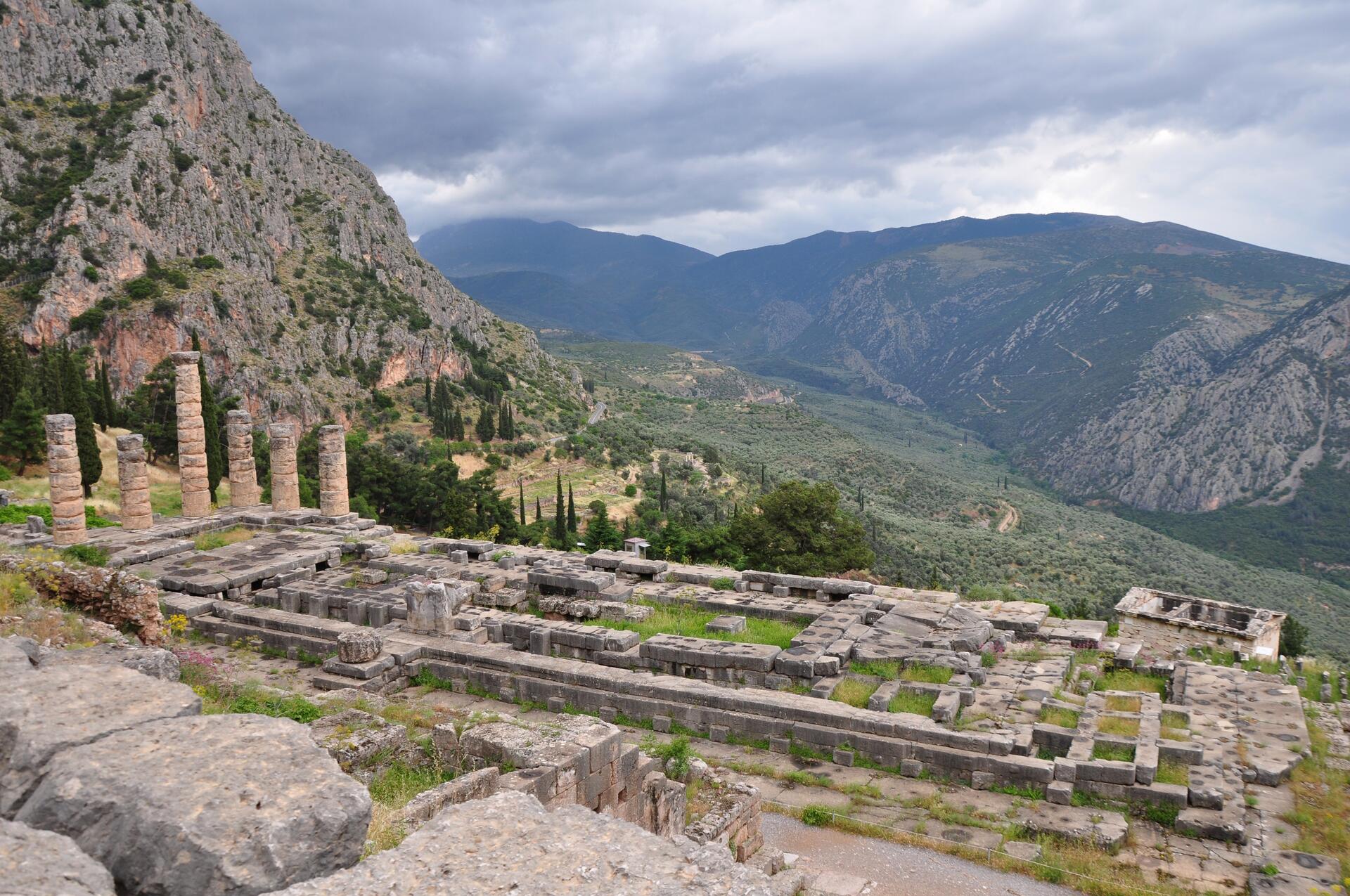
© Helen Simonsson, CC BY-SA 3.0 Resized from original. (This derivative is under the same CC BY-SA license.)
World Heritage Research
Discover scientific research and academic studies that deepen our understanding of Archaeological Site of Delphi from its history and significance to its conservation, management, and contemporary challenges.
-
Digitizing Delphi: Educating Audiences Through Virtual Reconstruction
A virtual reconstruction of the Tholos at Delphi offers unprecedented insight into archaeological decision-making, revealing the often-overlooked processes behind ancient temple reconstructions. By integrating on-site images, original renderings, and conflicting theories, this 3D model enables side-by-side comparisons that educate both academic and general audiences about the complexities of reconstructing missing or fragmented structures. Unlike previous static representations, this dynamic tool bridges the gap between professional analysis and public engagement, transforming the reconstruction process into an interactive experience. The study highlights how modern technology can demystify historical interpretation while advancing digital archaeology.
Koury, K. (2024). Digitizing Delphi: Educating Audiences Through Virtual Reconstruction. The Journal of Purdue Undergraduate Research, 13(1). https://doi.org/10.7771/2158-4052.1633
View Publication Record | Read Publication -
Excavating the Nation: European Popular Nationalism and the Excavations of Delphi and Knossos, 1890–1914
European popular nationalism at the turn of the twentieth century influenced public perceptions of Greek archaeology, particularly through the excavations at Delphi and Knossos. This study reveals that these archaeological endeavors were often exalted as evidence of national genius, with findings interpreted through the lens of national identity in popular periodical publications. The research analyzes news-media coverage from nationally prominent publications during 1890–1914, demonstrating how archaeologists were increasingly relied upon to empirically entrench and legitimize modern nation-states by linking them to a civilizational pedigree. This highlights the intersection of scientific study and nationalist projects, showing how diffuse understandings of national heritage shaped public perceptions of Greek archaeology as a discipline inherently tied to turn-of-the-century nationalism.
Cavanagh, M. (2024). Excavating the Nation: European Popular Nationalism and the Excavations of Delphi and Knossos, 1890–1914. Bulletin of the History of Archaeology, 34(1). https://doi.org/10.5334/bha-665
View Publication Record | Read Publication -
Determining Rockfall Hazard and Risk in Historical Sites
Rockfall risk at the UNESCO-listed archaeological site of Delphi is significant, with potential impacts ranging from low-energy events (2.5 kJ for 0.008 m³ blocks) to high-impact scenarios (thousands of kJ for 5 m³ blocks), posing threats to monuments and intangible heritage. The study employs Rockyfor3D software to model rockfall propagation, assessing reach probabilities (3–29.93%) without protective measures. Findings underscore the necessity for steel fences and interception systems to mitigate risks, balancing preservation with safety at culturally critical sites.
Mavrouli, O. (2023). DETERMINING ROCKFALL HAZARD AND RISK IN HISTORICAL SITES. Zenodo. https://doi.org/10.5281/ZENODO.7953622
View Publication Record | Read Publication -
General
Delphi, a UNESCO World Heritage Site and one of Europe's most significant ancient Greek oracular sites, is comprehensively analyzed in a meticulously curated volume. This edited collection, derived from a 2017 conference, stands out for its extensive coverage, high production quality, and useful indices, making it an invaluable resource for scholars and enthusiasts alike. The volume features 23 chapters in German and English, organized into six thematic sections: archaeology, oracle functionality, Delphi's historical role, literary representations of the oracle, theological and philosophical debates during the Roman period, and modern reception. Its interdisciplinary approach ensures that anyone interested in Delphi will find relevant insights, positioning it as a definitive reference on the subject.
Petrovic, I. (2022). General. Greece and Rome, 69(2), 362–365. https://doi.org/10.1017/s0017383522000158
View Publication Record | Read Publication -
Assessing the risks of climate change for cultural heritage – The CLIMASCAPE project
Climate change poses significant risks to cultural heritage, particularly for UNESCO World Heritage Sites. The CLIMASCAPE project introduces a multi-criteria system to evaluate the vulnerability of archaeological areas to climate impacts such as heatwaves, floods, droughts, fires, and sea level rise. By analyzing eight Greek sites—including Delphi—using climate model projections, the study highlights the need for tailored adaptation plans based on site-specific characteristics and projected climate risks. Preliminary findings underscore that differentiated strategies are essential to mitigate these threats effectively, ensuring the sustainability of both cultural heritage and tourism.
Cartalis, C., Polydoros, A., Mavrakou, T., Philippopoulos, K., Asprogerakas, E., Pantazis, P., Samarina, A., Zoumpaki, S., & Karambinis, M. Assessing the risks of climate change for cultural heritage – The CLIMASCAPE project. Proceedings of the 17th International Conference on Environmental Science and Technology. https://doi.org/10.30955/gnc2021.00767
View Publication Record | Read Publication -
Emploi de la pierre en Grèce antique autour du Golfe de Corinthe
The sanctuary of Delphi stands out for its diverse stone usage, with over twenty facies identified, including both local and allochthonous stones. Unlike other sites in the Gulf of Corinth region, which predominantly used local resources, Delphi's construction involved a significant volume of imported materials such as oolitic dune from Corinth, limestone from Megara, black stones, Cycladic and Attic marbles, and various sandstones. This suggests extensive stone exchange networks in antiquity. The study employed fieldwork to inventory construction-stones and ancient quarries, combined with geological and historiographical analysis. It found that density was the primary petrophysical property influencing stone choice by Greek builders.
de Vals, M. Emploi de la pierre en Grèce antique autour du Golfe de Corinthe. https://doi.org/10.70675/84a240b6z41b2z4601za524z8774bc870ed7
View Publication Record | Read Publication -
The Stone Roof Marble Tholos Tiles in the Sanctuary of Athena Pronaia at Delphi. Stereotomy and compression resistant forms in the domed roof structures of ancient Greece
A groundbreaking study challenges the long-held assumption that the Tholos of Athena Pronaia at Delphi's roof was constructed using trusses and substructures, suggesting instead a sophisticated stone tile system that formed a domed structure. Through virtual reconstruction, physical modeling, and analysis of tile grooves and recesses, researchers demonstrated that these tiles could aggregate into a reciprocal spatial structural system, creating a dome with an outer diameter of approximately 15 meters. This finding not only redefines the architectural capabilities of ancient Greek builders but also raises new questions about the geometric matrix underlying this design and the potential causes of its collapse, excluding decorative functions as a primary factor.
Pizzigoni, A., Beatini, V., & Paris, V. (2022). IL TETTO DI PIETRA. LE TEGOLE DI MARMO DELLA THOLOS DI ATHENA PRONAIA A DELFI [JD]. Structural, 240, 1–57. https://doi.org/10.12917/Stru240.08
View Publication Record | Read Publication