World Heritage Identification Number: 190
World Heritage since: 1982
Category: Cultural Heritage
WHE Type: Archaeological Sites
Transboundary Heritage: No
Endangered Heritage: Yes
Country: 🇱🇾 Libya
Continent: Africa
UNESCO World Region: Arab States
Map
The Archaeological Site of Cyrene: An Ancient Greek Colony Turned Roman City
The Archaeological Site of Cyrene, located near present-day Shahhat in northeastern Libya, offers a fascinating glimpse into the rich history of the Hellenic world. Inscribed as a UNESCO World Heritage Site in 1982, this ancient Greek colony and later Roman city played a significant role in the region known as Cyrenaica.
More to come…UNESCO Description of the World Heritage Site
A colony of the Greeks of Thera, Cyrene was one of the principal cities in the Hellenic world. It was Romanized and remained a great capital until the earthquake of 365. A thousand years of history is written into its ruins, which have been famous since the 18th century.
Encyclopedia Record: Cyrene, Libya
Cyrene, also sometimes anglicized as Kyrene, was an ancient Greek colony and Roman city near present-day Shahhat in northeastern Libya in North Africa. It was part of the Pentapolis, an important group of five cities in the region, and gave the area its classical and early modern name Cyrenaica.Additional Site Details
Area: 131.675 hectares
Number of Components: 1
(iii) — Unique or exceptional testimony to a cultural tradition
(vi) — Directly associated with events or living traditions
Coordinates: 32.825 , 21.85833
Image
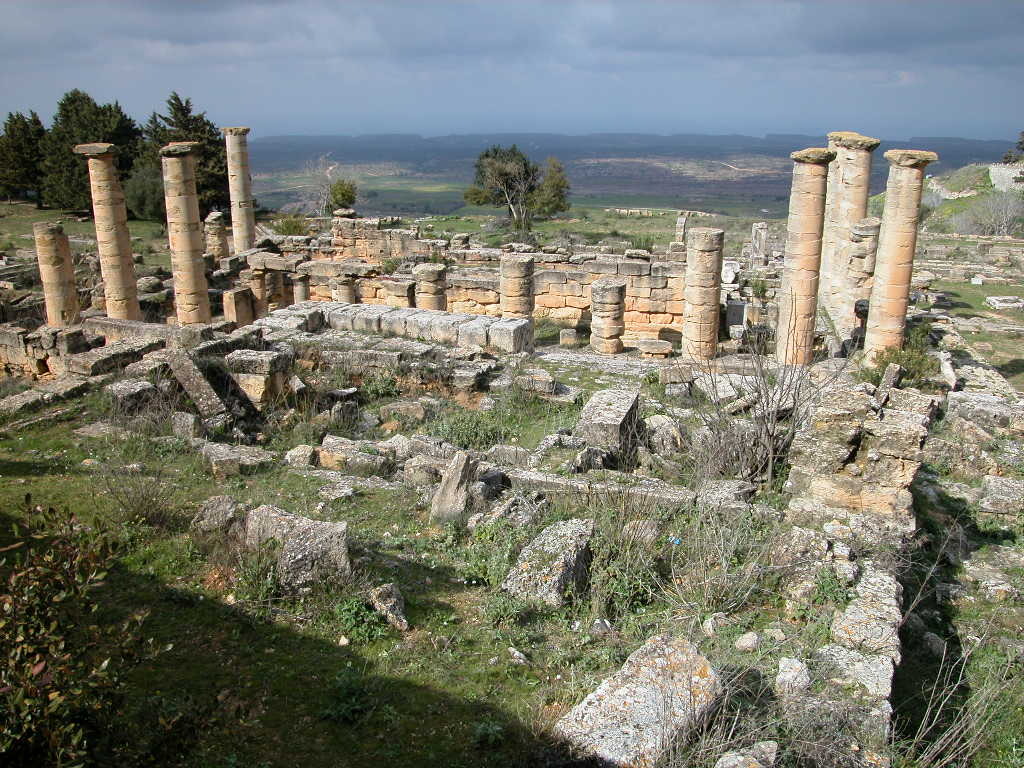
©
World Heritage Research
Discover scientific research and academic studies that deepen our understanding of Archaeological Site of Cyrene from its history and significance to its conservation, management, and contemporary challenges.
-
Cyrene
Greek migrants established the polis of Cyrene in North Africa around the 7th century BCE, providing a rare and detailed record of early Greek colonization. This settlement, governed by a hereditary monarchy until the mid-5th century BCE, offers unique insights into the challenges of founding a colony and its complex relationships with indigenous Libyans, neighboring Egyptians, and the Persians who ruled Egypt after 525 BCE. The study highlights Cyrene's significance in understanding the diversity of Greek history during the Archaic period, drawing from a variety of textual sources to reconstruct these interactions.
Schaus, G. P. (2025). Cyrene. The Oxford History of the Archaic Greek World, 1–125. https://doi.org/10.1093/oso/9780199383559.003.0001
View Publication Record | Read Publication -
Geomorphosite Inventory of Apollonia and Cyrene in Northeast Libya: involvement in Geotourism Promotion
Libya's northeast region, home to the UNESCO-listed archaeological sites of Cyrene and Apollonia, harbors significant geomorphosites—landforms with scientific, cultural, aesthetic, or economic value. A recent study identifies these geomorphosites as key assets for sustainable development, particularly through geotourism. The research employs a comprehensive inventory approach to assess their potential, highlighting Libya's underutilized geological heritage. By integrating geoheritage conservation with local economic growth, the study underscores the region's suitability for designation as a UNESCO geopark, offering a model for similar initiatives in Africa and developing nations.
AbdelMaksoud, K. M., Abdulsamad, E. O., Muftah, A. M., & Aly, M. F. (2022). Geomorphosite Inventory of Apollonia and Cyrene in Northeast Libya: involvement in Geotourism Promotion. Geoheritage, 14(4). https://doi.org/10.1007/s12371-022-00747-z
View Publication Record | Read Publication -
Mapping impact of urbanization in Shahat-Cyrene (Libya) using a big SAR data approach of change detection with COSMO-SkyMed time series
A novel approach leveraging big Synthetic Aperture Radar (SAR) data from the COSMO-SkyMed constellation has demonstrated high accuracy in mapping the spatial and temporal spread of new buildings and road blocks around Shahat, Libya, threatening the UNESCO World Heritage Site of Cyrene. The study analyzed over 180 SAR images collected since 2011 at a resolution of 3 meters, revealing finer details and more precise timelines for urban development compared to traditional methods using Copernicus Sentinel-2 imagery. This method's higher spatial resolution and frequent observations (every two weeks) provide critical insights into the rapid and unregulated urbanization impacting Cyrene's archaeological landscape.
Tapete, D., & Cigna, F. (2020). Mapping impact of urbanization in Shahat-Cyrene (Libya) using a big SAR data approach of change detection with COSMO-SkyMed time series. IOP Conference Series: Earth and Environmental Science, 509(1), 12056. https://doi.org/10.1088/1755-1315/509/1/012056
View Publication Record | Read Publication -
Archaeological Mission of Chieti University in Libya: Reports 2006-2008
A comprehensive archive of archaeological data from the chora (territory) of Cyrene, Libya, is presented, capturing findings from 2006 to 2008. This publication aims to document and preserve critical monuments facing threats, serving as a reference for global archaeologists. The research, conducted by Chieti University in collaboration with international teams since 1997, employs systematic excavation and documentation methods to safeguard Libya's archaeological heritage. By compiling detailed reports on sites and artifacts, the study contributes to the long-term conservation efforts of this UNESCO World Heritage Site.
Menozzi, O. (2020). Archaeological Mission of Chieti University in Libya: Reports 2006-2008 (H. Walda, M. Turjman, A. S. Sharif, & M. A. S. Abdulgader el Mziene, Trans.). https://doi.org/10.2307/j.ctv1ddckq3
View Publication Record | Read Publication -
A proposal for the use of Core and Buffer Zones to protect the heritage of the Cyrenean landscapes
Recent decades have seen unprecedented destruction to the ancient landscapes of Cyrene, Libya, threatening its UNESCO World Heritage status. Urban expansion, demographic pressure, and unsustainable resource exploitation have accelerated damage, overwhelming local heritage protection efforts. To address this crisis, researchers propose a strategic framework using core and buffer zones to safeguard Cyrene's archaeological integrity. Building on prior studies documenting necropolis degradation since 2011, the proposal outlines a collaborative approach involving the Department of Antiquities (DoA), UNESCO, and academic institutions like the University of Chieti. The study combines field assessments with policy recommendations, aiming to mitigate encroachment while preserving Cyrene's unique historical landscape for future generations.
Menozzi, O., Cherstich, L., Di Valerio, E., Di Antonio, M. G., & Abdalrahim Shariff Saad, A. (2019). A proposal for the use of Core and Buffer Zones to protect the heritage of the Cyrenean landscapes. Libyan Studies, 50, 107–135. https://doi.org/10.1017/lis.2019.23
View Publication Record | Read Publication -
A ‘living’ necropolis: change and reuse in the cemeteries of Cyrene
Research on the cemeteries of Cyrene reveals that monumental tombs were continuously used from the Archaic period through Roman times, challenging traditional notions of 'reuse' which imply distinct phases separated by hiatuses. The study, focusing on the Southern and Northern Necropolises, employs an 'anthological approach,' synthesizing data from recent surveys and excavations—including Tomb S1 and a tomb in the Northern Necropolis—to explore the dynamic, uninterrupted nature of these archaeological landscapes. This work serves as an introductory framework for future, more comprehensive analyses.
Cherstich, L., Menozzi, O., Antonelli, S., Cherstich, I., Mancini, M. C., Di Antonio, M. G., Sheriff Saad, A. A., & Abdel Hati, S. F. (2018). A ‘living’ necropolis: change and reuse in the cemeteries of Cyrene. Libyan Studies, 49, 121–152. https://doi.org/10.1017/lis.2018.3
View Publication Record | Read Publication -
From Magas to Glaukon. The Long Life of Glaukon of Aithalidai and the Chronology of Ptolemaic Re-Annexation of Cyrene (ca. 250 BCE)
A new analysis of a fragmentary catalogue of eponymous priests of Apollo from mid-third-century BCE Cyrene reveals key insights into the chronology of Ptolemaic re-annexation and the presence of Glaukon, an Athenian statesman. This study identifies Glaukon—younger brother of Chremonides—as a likely Ptolemaic commissioner who held priesthood for several years, providing previously unknown details about his life and death in Cyrenaica. By cross-referencing this inscription with other historical sources, the research sheds light on the turbulent political landscape following King Magas' death and clarifies the sequence of events leading to Ptolemy II's reassertion of control over Cyrene.
Rosamilia, E. (2018). From Magas to Glaukon. The Long Life of Glaukon of Aithalidai and the Chronology of Ptolemaic Re-Annexation of Cyrene (ca. 250 BCE). 2018, 263–300. https://doi.org/10.1515/9783110613759-012
View Publication Record | Read Publication