World Heritage Identification Number: 1733
World Heritage since: 2025
Category: Cultural Heritage
WHE Type: Buildings & Architectural Ensembles
Transboundary Heritage: No
Endangered Heritage: No
Country: 🇬🇷 Greece
Continent: Europe
UNESCO World Region: Europe and North America
Map
Unraveling the Mysteries of the Minoan Palatial Centers
The Minoan Palatial Centers, inscribed as a UNESCO World Heritage Site in 2025, offer a fascinating glimpse into one of the most enigmatic civilizations of the ancient world – the Minoans. Located on the island of Crete, Greece, these six archaeological sites date back to the period between 1900 and 1100 BCE, providing valuable insights into the Minoan civilization's complexities and enduring influence on Mediterranean history.
The Minoan palaces, renowned for their grandeur and intricate design, served as the administrative, economic, and religious hubs of the Minoan society. These monumental buildings were constructed using local materials like limestone and gypsum, showcasing the Minoans' advanced architectural skills and urban planning abilities.
One of the most notable features of the Minoan palaces is their distinctive architectural vocabulary and organization. The palaces typically consist of multistory wings surrounding an open rectangular central court. Key room types found within these structures include the lustral basin, possibly used for ritual purification, and the pillar crypt, believed to have served ritual or storage functions. However, each palace exhibits its unique characteristics, reflecting the continuous evolution and remodeling that took place throughout their lifespans.
Among the six recognized Minoan palaces, Knossos stands out as the most famous and extensively excavated site. Discovered by British archaeologist Sir Arthur Evans in 1900, Knossos boasts a labyrinthine layout, with over 1,000 documented spaces spread across several levels. The palace's frescoes, pottery, and Linear A script provide evidence of the Minoans' artistic prowess, maritime networks, and early writing systems.
Phaistos, another significant palace, is situated on a commanding hill overlooking the Messara Plain. Unlike Knossos, it is celebrated for its austere and majestic architecture, featuring grand ceremonial staircases and expansive paved courtyards that highlight the Minoans' mastery of symmetry and scale. It is the find-spot of the enigmatic Phaistos Disc, and its layout provides the clearest evidence of the transition between the Old and New Palace periods, showcasing remarkably well-preserved tiered 'theatral areas' used for public gatherings or rituals.
The palace at Malia, located near the modern town of Hersonissos, is renowned for its elaborate drainage system and evidence of routes connecting it to other centers. Meanwhile, Zominthos, Zakros, and Kydonia are lesser-known but equally important palaces that contribute to our understanding of the Minoan civilization. Zominthos, located on the slopes of Mount Psiloritis, is notable as a high-altitude Minoan palace site with substantial multi-room structures that demonstrate Minoan presence and resource control across diverse landscapes. Special discoveries such as workshops and placement along ancient routes reflect its strategic role.
Zakros, situated on the eastern coast of Crete, offers a glimpse into the Minoans' trade activities, with evidence of connections to Egypt, the Levant, and Cyprus. Kydonia, near modern Chania on the northwest coast of Crete, served as a major western administrative and urban centre within the Minoan network of palatial sites.
The Minoan palaces developed through successive phases of Crete’s Bronze Age history. Early settlements, known as the Prepalatial period (c. 3000–1900 BCE), gradually gave way to the Protopalatial period (c. 1900–1700 BCE), when the first large palatial complexes were constructed. Most of the surviving structures, however, belong to the Neopalatial period (c. 1700–1450 BCE), a time of remarkable architectural innovation, centralized administration, and flourishing art.
The Minoan palaces were millennia ahead of their time in terms of engineering. A standout feature is their sophisticated water management: using a precise network of terracotta pipes and drainage channels, the palaces were supplied with fresh water and equipped with some of the earliest known advanced drainage and sanitation systems, including pour-flush toilets.
To enhance habitability within these massive, multi-story structures, the Minoans also pioneered an ingenious architecture of light. Elements such as 'light-wells' and 'pier-and-door partitions' (polythyra) allowed natural sunlight and fresh air to reach the deepest interior rooms, providing both illumination and natural climate control.
The Palatial Centers were vital nodes in extensive maritime trade networks across the eastern Mediterranean. Sites such as Zakros reveal imported materials from Egypt, Cyprus, and the Near East, indicating a thriving exchange of goods, ideas, and artistic influences. The palaces were adorned with vibrant frescoes, including depictions of marine life, bull-leaping, and nature, while pottery styles like Kamares ware highlight Minoan aesthetic sophistication.
Altogether, the Minoan Palatial Centers offer a captivating window into the rich tapestry of the Minoan civilization. Their advanced architecture, urban planning, and vibrant frescoes reveal the complexity of the Minoans' social structure and their enduring influence on Mediterranean history. As we continue to uncover the secrets hidden within these ancient walls, the Minoan Palatial Centers remain a testament to the ingenuity, creativity, and resilience of this remarkable civilization.
UNESCO Description of the World Heritage Site
This serial property comprises six archaeological sites on Crete dating from 1900 to 1100 BCE. These sites represent the Minoan civilization, a major prehistoric Mediterranean culture. The palatial centres served as administrative, economic, and religious hubs, featuring advanced architecture, urban planning, and vibrant frescoes. They reveal early writing systems, maritime networks, and cultural exchanges. The property highlights the complexity of the Minoans’ social structure and their enduring influence on Mediterranean history.
UNESCO Justification of the World Heritage Site
Criterion (ii): Minoan Palatial Centres provides evidence of the important position of Minoan Crete as a central hub for Mediterranean cultural interactions during the Bronze Age, the palatial centres playing a key role in transmitting artistic, technological, and administrative practices, as well as being central in facilitating trade, artistic influence, and technological diffusion across the Eastern Mediterranean.
Criterion (iii): Minoan Palatial Centres provides an exceptional testimony to one of the first advanced civilisations in Europe, the Minoan Civilisation, which has now disappeared. The six component parts encapsulate the key features of this Bronze Age culture, reflecting architectural innovations, religious practices, and artistic and cultural achievements of the Minoans, including the Cretan Hieroglyphic and Linear A, the two earliest writing systems in Europe, as well as Linear B script. Moreover, the palatial centres offer unparalleled insights into the Minoan social organisation, their complex administrative system, urban development, and economic activities, including trade with Egyptian and Mycenaean civilisations.
Criterion (iv): Minoan Palatial Centres includes outstanding examples of Bronze Age architecture that denote advanced social, political, and administrative organisation of the Minoan Civilisation. The labyrinthine planning, courtyards, storage systems, and sophisticated hydraulic installations in the palatial centres highlight innovative architectural solutions and functional integration of royal, administrative, and religious functions. These features, combined with distinct urban planning and construction techniques, illustrate the emergence of state-like organisation in the Eastern Mediterranean and thus reflect a significant stage in human history.
Criterion (vi): The legacy of the Minoan Civilisation, in the form of its myths, arts, and social ideas, has shaped artistic and intellectual thought through the ages and continues to inspire creative fields today. The legend of the Minotaur and the Labyrinth is directly associated with the palatial centres, attesting to their constructional complexity and monumentality.
Encyclopedia Record: Minoan palaces
Minoan palaces were massive building complexes built on Crete during the Bronze Age. They are often considered emblematic of the Minoan civilization and are modern tourist destinations. Archaeologists and the UNESCO World Heritage generally recognize six structures as palaces, namely those at Knossos, Phaistos, Malia, Zominthos, Zakros and Kydonia. Minoan palaces consisted of multistory wings surrounding an open rectangular central court. They shared a common architectural vocabulary and organization, including distinctive room types such as the lustral basin and the pillar crypt. However, each palace was unique, and their appearances changed dramatically as they were continually remodeled throughout their lifespans.Additional Site Details
Area: 29.512 hectares
Number of Components: 6
(iii) — Unique or exceptional testimony to a cultural tradition
(iv) — Outstanding example of a type of building or landscape
(vi) — Directly associated with events or living traditions
Coordinates: 35.2486111111 , 24.8872222222
Image
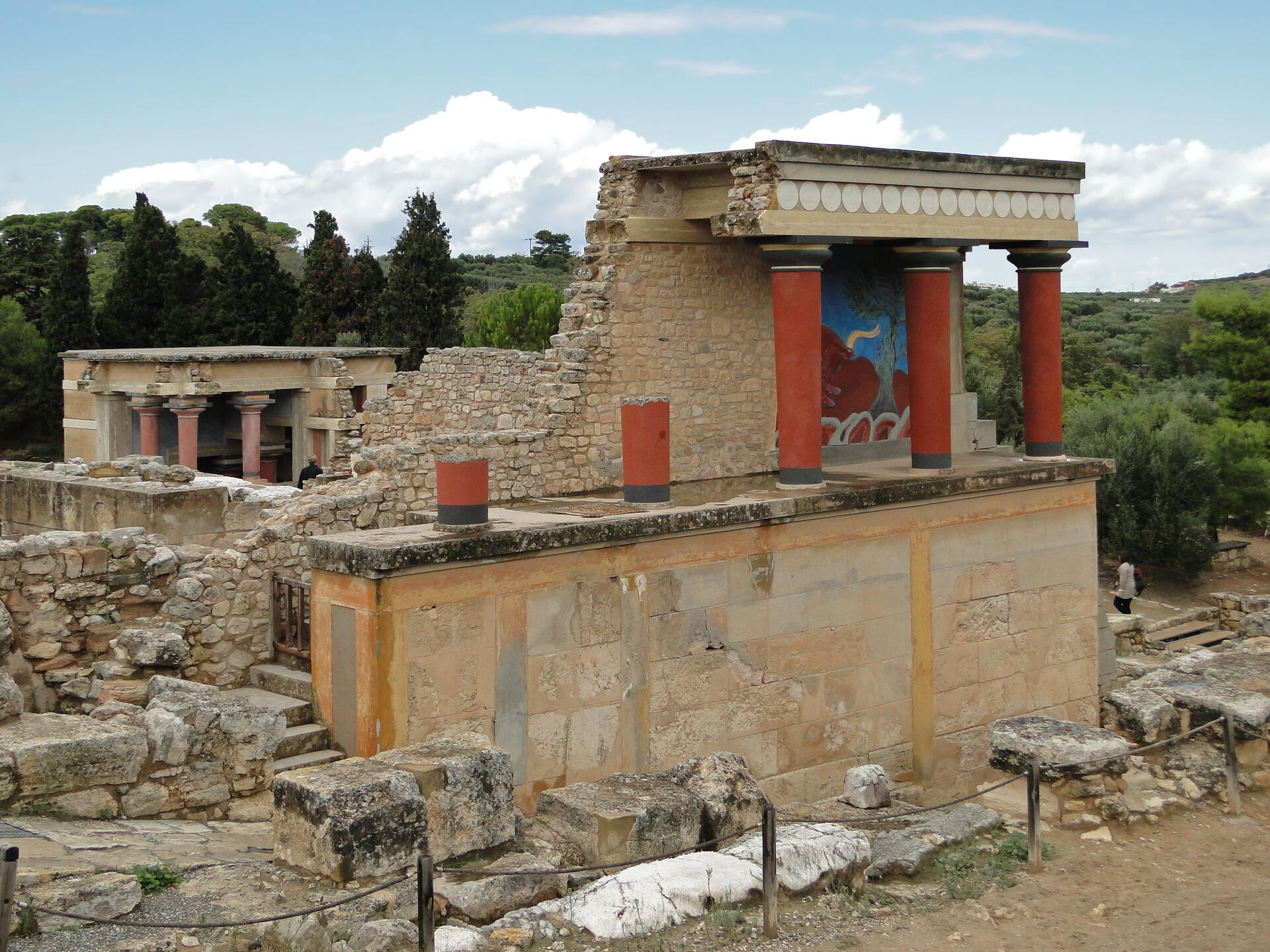
© Bernard Gagnon, CC BY-SA 3.0 Resized from original. (This derivative is under the same CC BY-SA license.)
World Heritage Research
Discover scientific research and academic studies that deepen our understanding of Minoan Palatial Centres from its history and significance to its conservation, management, and contemporary challenges.
-
The Uneven and Controversial Character of ‘Minoan’ Culture in the Central and Eastern Aegean: A Contextual Analysis
Minoan culture, long perceived as a unified and centralized phenomenon originating from Crete, is revealed to be far more complex and heterogeneous. This study challenges the notion of a cohesive 'core' by demonstrating that Minoanisation—defined as the adoption of Cretan material culture traits beyond Crete during the Late Bronze Age (LBA)—was a multi-sited, multi-directional process with no uniform distribution or political control. While Knossos played a leading role in legitimizing territorial expansion and promoting ideological propaganda during the Neopalatial period (LM IA–IB), palatial Crete itself was a composite political landscape characterized by gradual hierarchization and formalization in its systems. The research employs case studies from the Cycladic islands, south-east, and north-east Aegean to analyze ceramic production, mobility of people and ideas, and ritual behaviors, highlighting the uneven and controversial nature of Minoan culture across the Aegean.
Girella, L. (2026). The Uneven and Controversial Character of ‘Minoan’ Culture in the Central and Eastern Aegean: A Contextual Analysis. Pax Minoica Revisited, 81–104. https://doi.org/10.13173/9783447123273.081
View Publication Record | Read Publication -
On Aegean spices: decipherment prospects on Linear A and B spice-related signs
New interpretations of undeciphered spice-related signs in Linear A and B scripts reveal that Mycenaean palatial administrators prioritized precise, unambiguous logogram rendering for commodity tracking. This suggests the Linear B script, while not suited to Greek linguistic complexity, effectively facilitated clear record-keeping of trade goods like perfumed oils—particularly prominent at Pylos. The study cross-references Linear A and B signs, offering potential breakthroughs in deciphering previously obscure ingredients. These findings underscore the palaces' sophisticated administrative practices during the Late Bronze Age.
Ferrara, S., Salgarella, E., & Bellinato, L. (2025). On Aegean spices: decipherment prospects on Linear A and B spice-related signs. Kadmos, 64(1-2), 29–44. https://doi.org/10.1515/kadmos-2025-0002
View Publication Record | Read Publication -
East of Knossos, West of Malia. Changing Settlement Patterns Between Two Major Minoan Polities
A shift in power and settlement patterns between the Minoan palatial centres of Knossos and Malia is evident from the second millennium BCE, with Malia dominating during the Protopalatial period before Knossos expanded its influence. This study reveals a centralization trend in habitation models during the late Neopalatial period, likely due to Knossos's expansionist policies, supported by new archaeological data from rescue excavations and existing knowledge. The research highlights continuous habitation from Late Minoan IB to IIIB near Gournes and sparse settlements in MM IIIB–LM IA, contrasting with dense Protopalatial installations. The findings underscore the dynamic balance of power between these two major Minoan polities over time.
Mandalaki, S. (2025). EAST OF KNOSSOS, WEST OF MALIA. CHANGING SETTLEMENT PATTERNS BETWEEN TWO MAJOR MINOAN POLITIES. The Annual of the British School at Athens, 120, 91–135. https://doi.org/10.1017/s0068245425100312
View Publication Record | Read Publication -
The Late Helladic III Period
The Late Helladic III Period marks a significant shift in Crete, where Mycenaean influence replaces the Minoan Palatial Centers after the destruction of Knossos around 1375 BC. This era introduces fortified citadels with Cyclopean walls and palaces characterized by megaron structures, courtyards, and workshops, adorned with frescoes depicting scenes of palatial life. Mycenaean palaces, distinct from their Minoan predecessors, exhibit hierarchical organization centered around the 'wanax,' serving as administrative, economic, military, political, and religious hubs. Notably, Mycenae emerges as a leader in power and artistic innovation, exemplified by the Lion Gate and advanced metalwork and ivory carving traditions. Clay figurines further highlight the era's artistic expression, blending functional complexity with cultural homogeneity.
(Ed.). (2026). The Late Helladic III Period. Mycenaean Civilization, 238–427. https://doi.org/10.1017/9781009493154.006
View Publication Record | Read Publication -
'O Brother, Where Art Thou?' Investigating the Role of Religious Specialists in the Early Minoan Tholos Cemeteries of South-Central Crete
A groundbreaking study challenges the traditional view of religious specialists in Minoan Crete, arguing that they were craft experts integral to early tholos cemeteries. These monumental structures, among the island's first, served as centers for mortuary rituals and religious practices, reflecting evolving belief systems. Through landscape archaeology and architectural energetics, the research reveals that these cemeteries required coordinated labor and sensory manipulation, suggesting a sophisticated role for specialists in translating religious ideologies into built spaces. The findings reshape our understanding of early Minoan society by highlighting the significance of craft production and communal architecture in shaping religious experiences.
Gaynor, J. (2024). 'O Brother, Where Art Thou?' Investigating the Role of Religious Specialists in the Early Minoan Tholos Cemeteries of South-Central Crete. University of Liverpool Repository. https://doi.org/10.17638/03041786
View Publication Record | Read Publication -
Pottery traditions in Kydonia: Preliminary results from the petrographic analysis of three pottery assemblages in Chania
Petrographic analysis of pottery from Chania, Crete, reveals distinct continuity and discontinuity in the use of fabrics and clay recipes during the Late Minoan III period (LM IIIA1-B2), following the collapse of the Minoan palatial system. The study examines three assemblages, highlighting regional variations in raw material selection for coarse wares—used for domestic purposes—and semi-fine/fine wares, which were integral to transportation and consumption of staples. Findings underscore the resilience of Kydonia's pottery traditions, including the technological characteristics of its renowned 'Kydonian workshop,' by comparing contexts across different chronological horizons.
Fouriki, S., & Nodarou, E. (2023). Pottery traditions in Kydonia: Preliminary results from the petrographic analysis of three pottery assemblages in Chania. Journal of Archaeological Science: Reports, 48, 103863. https://doi.org/10.1016/j.jasrep.2023.103863
View Publication Record | Read Publication -
A Canaanite jar with a Cypro-Minoan inscription from Tiryns: TIRY Avas 001
A rare Canaanite jar with a Cypro-Minoan inscription, discovered at the Minoan palatial site of Tiryns, sheds new light on ancient trade and communication networks. The reconstruction of the entire vessel—including its handle, rim, base, and body sherds—reveals previously unpublished details about its fabric and origin, tracing its journey from the Levantine coast to Cyprus before being deposited in Tiryns' Lower Citadel during a palatial destruction event. Macroscopic analysis of the jar's fabric provides clues about its place of manufacture, while the inscription offers insights into its probable uses and meanings. This study significantly expands our understanding of cross-cultural interactions in the Bronze Age Mediterranean.
Davis, B., Maran, J., Prillwitz, S., & Wirghová, S. (2023). A Canaanite jar with a Cypro-Minoan inscription from Tiryns: TIRY Avas 001. Kadmos, 62(1-2), 1–32. https://doi.org/10.1515/kadmos-2023-0001
View Publication Record | Read Publication