World Heritage Identification Number: 1027
World Heritage since: 2001
Category: Cultural Heritage
WHE Type: Infrastructure & Industry
Transboundary Heritage: No
Endangered Heritage: No
Country: 🇸🇪 Sweden
Continent: Europe
UNESCO World Region: Europe and North America
Map
The Mining Area of the Great Copper Mountain in Falun: A Testament to Centuries of Mining History
The Mining Area of the Great Copper Mountain in Falun, inscribed as a UNESCO World Heritage Site in 2001, offers a unique insight into the rich history of copper mining that spans over a thousand years. Located in the picturesque landscape of Dalarna, Sweden, this site serves as a testament to the significant role mining played in shaping the region's economy, culture, and technological advancements.
More to come…UNESCO Description of the World Heritage Site
The enormous mining excavation known as the Great Pit at Falun is the most striking feature of a landscape that illustrates the activity of copper production in this region since at least the 13th century. The 17th-century planned town of Falun with its many fine historic buildings, together with the industrial and domestic remains of a number of settlements spread over a wide area of the Dalarna region, provide a vivid picture of what was for centuries one of the world's most important mining areas.
UNESCO Justification of the World Heritage Site
Criterion (ii): Copper mining at Falun was influenced by German technology, but this was to become the major producer of copper in the 17th century and exercised a profound influence on mining technology in all parts of the world for two centuries.
Criterion (iii): The entire Falun landscape is dominated by the remains of copper mining and production, which began as early as the 9th century and came to an end in the closing years of the 20th century.
Criterion (v): The successive stages in economic and social evolution of the copper industry in the Falun region, from a form of “cottage industry” to full industrial production, can be seen in the abundant industrial, urban, and domestic remains characteristic of this industry that still survive.
Encyclopedia Record: Falun Mine
Falun Mine was a mine in Falun, Sweden, that operated for a millennium from the 10th century to 1992. It produced as much as two-thirds of Europe's copper needs and helped fund many of Sweden's wars in the 17th century. Technological developments at the mine had a profound influence on mining globally for two centuries. The mine is now a museum and in 2001 was designated a UNESCO World Heritage Site.Additional Site Details
Area: 42.82 hectares
Number of Components: 1
(iii) — Unique or exceptional testimony to a cultural tradition
(v) — Outstanding example of traditional human settlement
Coordinates: 60.60472 , 15.63083
Image
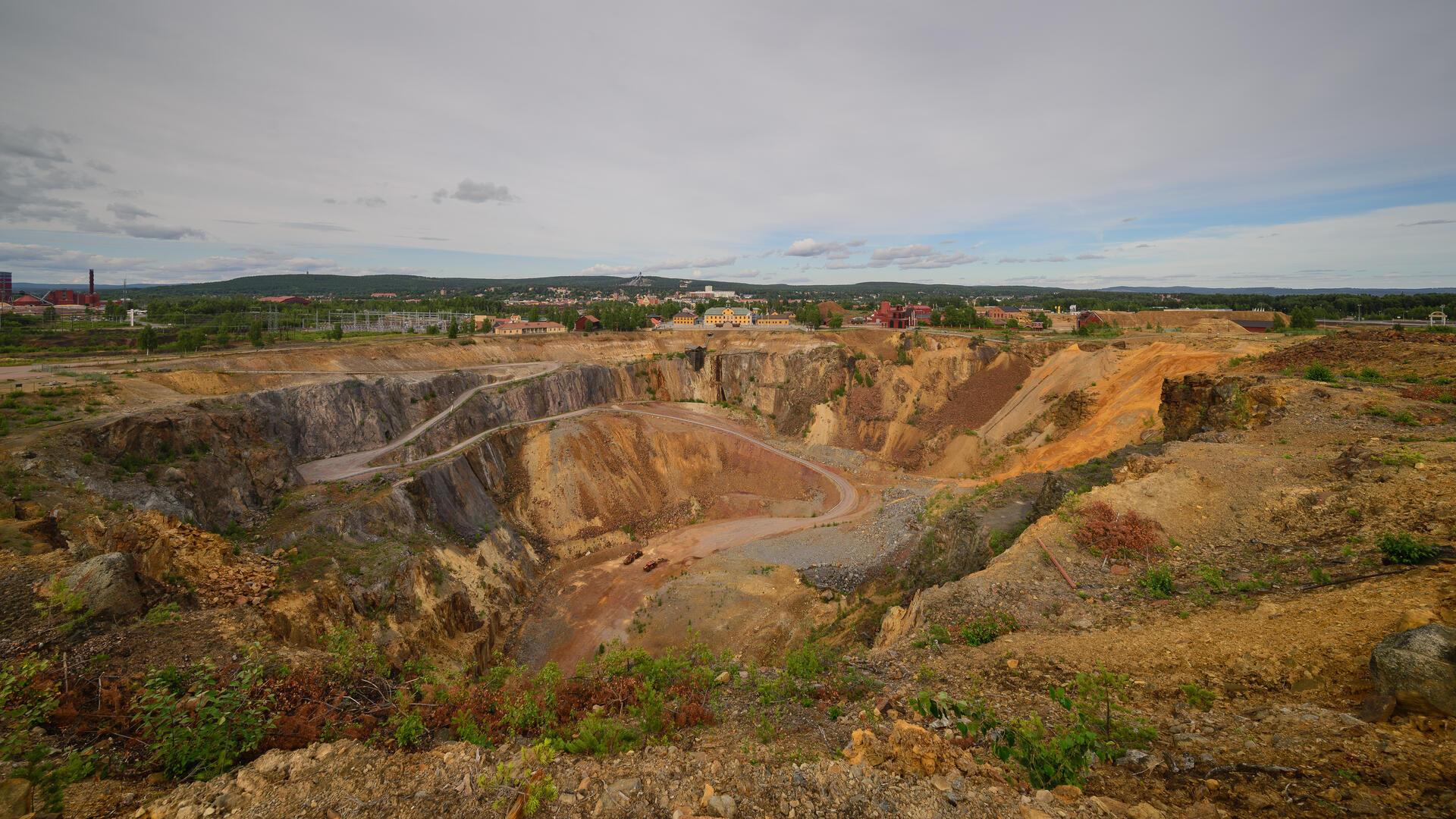
© Arild Vågen, CC BY-SA 4.0 Resized from original. (This derivative is under the same CC BY-SA license.)
World Heritage Research
Discover scientific research and academic studies that deepen our understanding of Mining Area of the Great Copper Mountain in Falun from its history and significance to its conservation, management, and contemporary challenges.
-
Från den gruvliga till den ljuvliga sidan
Recent archaeological research in Falun, Sweden, has challenged the long-standing perception of the town's western 'mine side' as barren and devoid of vegetation due to industrial pollution. Instead, new methods have uncovered evidence of historical urban cultivation, revealing a more complex environmental history. The study highlights that even though the copper mine, Sweden's oldest known source of environmental contamination, is now closed, its legacy continues to influence the landscape. By examining traces of plant growth and comparing them with the lush 'delightful side' on the east bank of Faluån, researchers have reshaped our understanding of Falun's past, demonstrating that resilience and adaptation were possible even in contaminated environments.
Axelsson Karlqvist, J., & Berger, Å. (2025). Från den gruvliga till den ljuvliga sidan. META – Historiskarkeologisk Tidskrift, 130–146. https://doi.org/10.59008/meta.2025.44443
View Publication Record | Read Publication -
How commodity prices and technical development has influenced exploration strategies: a case study from Sweden
Exploration strategies in Sweden's mining industry have been significantly shaped by commodity prices, technical advancements, and legislative changes over the past 500 years. The study reveals that metal prices, driven by demand from industrialization and green technology, have heavily influenced exploration focus, particularly in the last century. Technical innovations, notably in drilling technology and geophysical methods, have also played a pivotal role, with Swedish contributions being notable. Additionally, evolving mining legislation has impacted private investment and the state's role in exploration. This case study of Falun's Great Copper Mountain provides insights into how these factors interact to drive mineral resource discovery.
Weihed, P. (2022). How commodity prices and technical development has influenced exploration strategies: a case study from Sweden. Mineral Economics, 35(3-4), 409–427. https://doi.org/10.1007/s13563-022-00299-2
View Publication Record | Read Publication -
The bourgeois family's loving education as a theoretical foundation for educational systems with roots in long-term memory and reservoirs of oblivion
A study links the educational innovations of the bourgeois family in Falun, Sweden, to long-term cultural and institutional memory, tracing how 18th- and 19th-century pedagogical practices shaped Sweden's first civil technical college, Fahlu Bergsskola (founded 1819). The research analyzes Johan Henrik Munktell's educational travels (1828–30) against the backdrop of Falun’s copper mining heritage, revealing how the Gahn family—descendants of Carl von Linné and bearers of progressive scientific education—established a radical pedagogical culture. This approach suggests that Falun’s colonial-era success as an educational hub was rooted in its pre-industrial organizational structures and the legacy of Linné’s scientific tradition. The study combines historical analysis with theoretical frameworks from Swedish pedagogy to argue for the enduring influence of bourgeois family-based education on modern systems.
Liljas, M., & Liljas, M. (2022). The bourgeois family’s loving education as a theoretical foundation for educational systems with roots in long-term memory and reservoirs of oblivion. Academia Letters. https://doi.org/10.20935/al5069
View Publication Record | Read Publication -
Time constraints on the deposition of a mineralisation-proximal metavolcaniclastic rock at Byngsbodberget, northwest of Falun, Bergslagen, Sweden
A metavolcaniclastic rock at Byngsbodberget, northwest of Falun in Bergslagen, Sweden, has been dated to approximately 1900 ± 9 million years using U-Pb SIMS zircon analysis. This age is interpreted as representing the main volcanic event that contributed material to the studied rock, providing a key time constraint for the local volcanic stratigraphy. The study utilized way-up indicators to determine the position of the rock within the volcanic sequence, suggesting it marks the lower parts of the local stratigraphy. This research contributes crucial data to understanding the stratigraphic framework of mineralization-proximal metavolcanic rocks in the region, which host numerous historic mines and mineralizations.
Lewerentz, A., Ripa, M., & Morris, G. (2021). Time constraints on the deposition of a mineralisation-proximal metavolcaniclastic rock at Byngsbodberget, northwest of Falun, Bergslagen, Sweden. Gff, 143(4), 321–327. https://doi.org/10.1080/11035897.2021.1896573
View Publication Record | Read Publication -
Mining Folklore
A study of mining folklore reveals persistent supernatural beliefs surrounding underground mines, particularly the notion that they serve as habitats for mythical creatures such as dwarfs, gnomes, or 'knockers.' In Sweden's Great Copper Mountain in Falun, accounts like 'The Mines of Falun' from Hoffmann's Tales depict ghostlike appearances, reflecting widespread superstitions. Despite cultural prohibitions against women entering mines—beliefs that endure even today—historical records show women were actively employed in European coal mines until the mid-19th century, a practice later banned by law following inquiries. This research underscores how folklore and societal norms intersect with labor practices, challenging modern perceptions of gender roles in industrial settings.
Gregory, C. E. (2021). Mining Folklore. A Concise History of Mining, 161–162. https://doi.org/10.1201/9781003211327-23
View Publication Record | Read Publication -
Toxic modernity
Large-scale metal production in seventeenth-century Scandinavia, exemplified by the Falun Copper Mine, left a legacy of toxic waste that reshaped local landscapes and communities. This study reveals how the early modern demand for metals contributed to environmental degradation across Sweden, Norway, Finland, and Sápmi, serving as a foundation for towns like Falun. By analyzing the local significance of metal production alongside its global connections—including ties to the slave trade and plantation economy—the research redefines the Scandinavian experience as pivotal in the emergence of modernity and globalization. The findings challenge conventional narratives by highlighting the profound environmental and social impacts of early industrialization.
Nordin, J. M. (2020). Toxic modernity. The Scandinavian Early Modern World, 239–251. https://doi.org/10.4324/9780429328176-9
View Publication Record | Read Publication