World Heritage Identification Number: 558
World Heritage since: 1994
Category: Cultural Heritage
WHE Type: Agriculture Landscapes, Parks & Gardens
Transboundary Heritage: No
Endangered Heritage: No
Country: 🇸🇪 Sweden
Continent: Europe
UNESCO World Region: Europe and North America
Map
A Journey Through Time and Space: Exploring Skogskyrkogården, Stockholm's Architectural Marvel
In the heart of Stockholm, nestled amidst the vibrant cityscape and verdant forests, lies a unique testament to the harmonious blend of nature and architecture – Skogskyrkogården (Woodland Cemetery). Inscribed as a UNESCO World Heritage Site in 1994, this cemetery stands as a timeless monument to the ingenuity and vision of its creators, Gunnar Asplund and Sigurd Lewerentz.
More to come…UNESCO Description of the World Heritage Site
This Stockholm cemetery was created between 1917 and 1920 by two young architects, Asplund and Lewerentz, on the site of former gravel pits overgrown with pine trees. The design blends vegetation and architectural elements, taking advantage of irregularities in the site to create a landscape that is finely adapted to its function. It has had a profound influence in many countries of the world.
UNESCO Justification of the World Heritage Site
Criterion (ii): The creation of Swedish architects Gunnar Asplund and Sigurd Lewerentz at Skogskyrkogården established a new form of cemetery that has exerted a profound influence on cemetery design throughout the world.
Criterion (iv): The merits of Skogskyrkogården lie in its qualities as an early 20th century landscape and architectural design adapted to a cemetery.
Encyclopedia Record: Skogskyrkogården
Skogskyrkogården is a cemetery located in the Gamla Enskede district south of central Stockholm, Sweden. It was inaugurated in 1920 and was inscribed on the UNESCO World Heritage List in 1994. Its design, by Gunnar Asplund and Sigurd Lewerentz, reflects the development of architecture from Nordic Classicism to mature functionalism.Additional Site Details
Area: 108.08 hectares
Number of Components: 1
(iv) — Outstanding example of a type of building or landscape
Coordinates: 59.27556 , 18.09944
Image
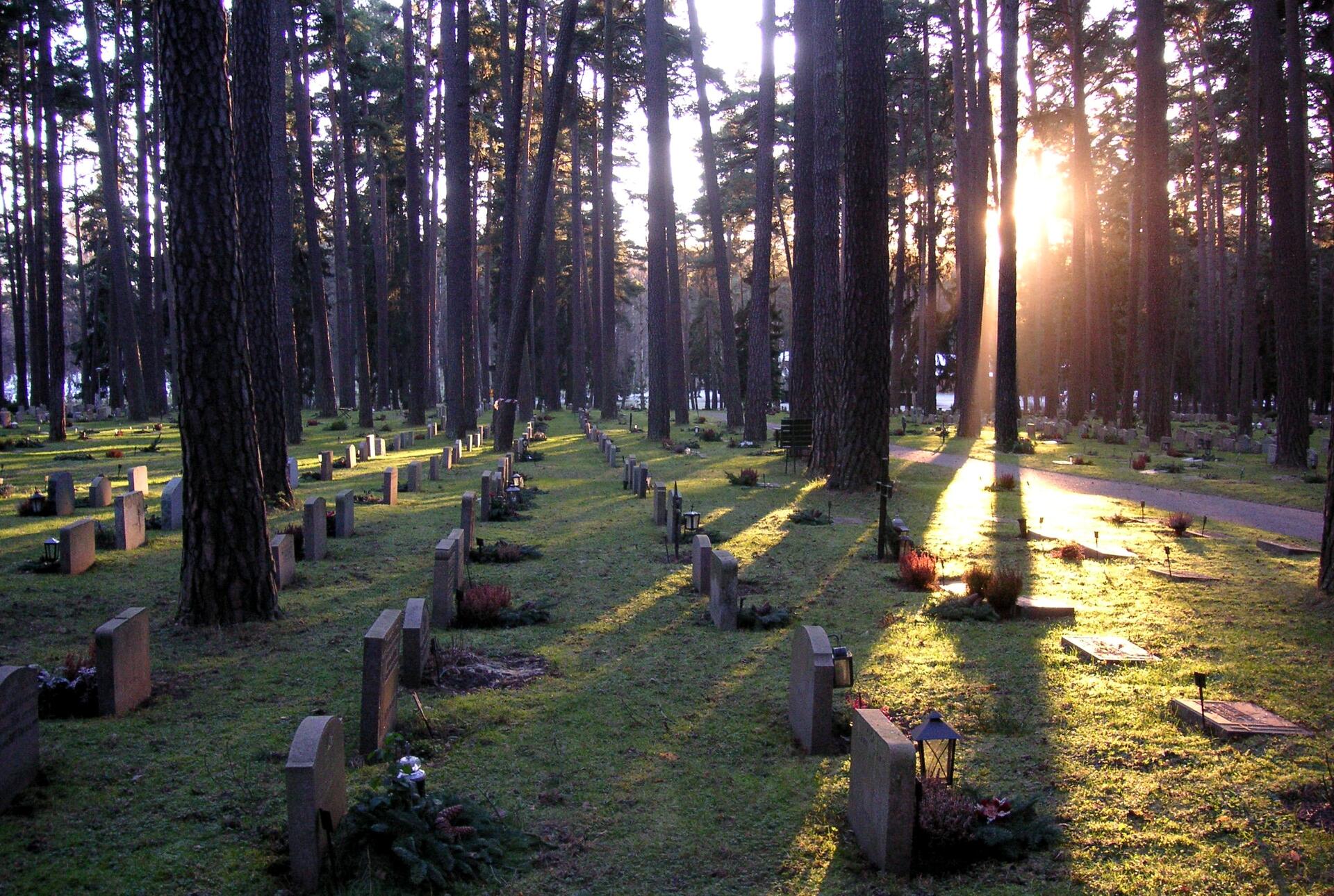
© Holger Ellgaard  , CC BY-SA 3.0 Resized from original. (This derivative is under the same CC BY-SA license.)
World Heritage Research
Discover scientific research and academic studies that deepen our understanding of Skogskyrkogården from its history and significance to its conservation, management, and contemporary challenges.
-
Between Arbitration and Engineering: Concepts and Contingencies in the Shaping of Heritage Regimes
World Heritage Sites, including Skogskyrkogården, are constructed through highly standardized, transnational processes that transcend national boundaries and redefine heritage as a global phenomenon. This study reveals that UNESCO and expert bodies act as powerful producers of culture, providing a 'global grammar' to coordinate dispersed local phenomena into a unified World Heritage framework. Unlike traditional heritage regimes tied to nations, World Heritage reflects humankind as an imagined moral community, allowing sites from diverse times and places to take on new global significance. The research employs qualitative analysis of institutional routines, beliefs, and practices, alongside historical context, to demonstrate how World Heritage is engineered through expertise while serving a broader socializing project.
Kuutma, K. Between Arbitration and Engineering: Concepts and Contingencies in the Shaping of Heritage Regimes. Heritage Regimes and the State, 21–36. https://doi.org/10.4000/books.gup.367
View Publication Record | Read Publication -
Tallum’s Syncretic Topography: To Death – To Life
Skogskyrkogården, designed by Sigurd Lewerentz and Erik Gunnar Asplund, exemplifies how syncretic topography can bridge the living and the dead. This study reveals that the cemetery's design, rooted in a profound preoccupation with the site's actual ground, was not merely stylistic but a deliberate attempt to re-establish meaningful linkages between life and death within a modern socio-cultural context. By examining the architects' alignment of the site's topography with contemporary efforts to create more authentic realities, this research sheds light on how physical spaces can facilitate existential renewal. The approach involved analyzing the site's ground as a dynamic element rather than a static backdrop, offering insights into its role in shaping human experience and memory.
Coyne-Jensen, C. D. (2015). Tallum’s Syncretic Topography: To Death – To Life. IN_BO. Ricerche e Progetti per Il Territorio, la città e l'architettura, a cura di Luigi Bartolomei e Gilda Giancipoli. https://doi.org/10.6092/ISSN.2036-1602/6079
View Publication Record | Read Publication -
Workshop om ljud vid Skogskyrkogården 2-3 november 2015
A workshop held at Skogskyrkogården highlighted the complex interplay between auditory and visual experiences in urban planning. The event, part of the Vinnova-funded research project 'Stadens hållbara ljudrum,' explored innovative approaches to integrating soundscapes into design, particularly for cemeteries where tranquility is paramount. Participants developed conceptual frameworks to describe sound environments, proposed enhancements to mitigate noise from surrounding roads, and tested practical solutions like speaker-based masking techniques. The workshop underscored the need for tools that balance simplicity with the nuanced demands of acoustic planning, emphasizing that successful interventions must harmonize with existing visual and architectural qualities.
Cerwén, G., Tunbjörk, M., Jergmo, F., Hedfors, P., & Wingren, C. (2016). Workshop om ljud vid Skogskyrkogården 2-3 november 2015. SLU. https://doi.org/10.13140/RG.2.1.3770.6644
View Publication Record | Read Publication -
Ripensando il paesaggio: il Cimitero nel Bosco di Ewrik Gunnar Asplund e Sigurd Lewerentz
Skogskyrkogården, the Forest Cemetery in Stockholm, redefines the relationship between architecture and landscape, marking a significant shift from traditional scenographic approaches. Designed by Erik Gunnar Asplund and Sigurd Lewerentz between 1915 and 1940, this UNESCO World Heritage Site challenges conventional notions of landscape by integrating architectural elements with natural surroundings in an innovative, site-responsive manner. The study traces the evolution of their design process, revealing how the cemetery's compositional approach transforms both the physical space and the conceptual understanding of landscape. By analyzing the project's development phases, the research highlights its pioneering role in Scandinavian 20th-century landscape architecture.
Maggioni, M. (2014). Ripensando il paesaggio: il Cimitero nel Bosco di Ewrik Gunnar Asplund e Sigurd Lewerentz. Zarch, (2), 104–117. https://doi.org/10.26754/ojs_zarch/zarch.201429337
View Publication Record | Read Publication