World Heritage Identification Number: 1282
World Heritage since: 2012
Category: Cultural Heritage
WHE Type: Buildings & Architectural Ensembles
Transboundary Heritage: No
Endangered Heritage: No
Country: 🇸🇪 Sweden
Continent: Europe
UNESCO World Region: Europe and North America
Map
The Decorated Farmhouses of Hälsingland: A Unique Blend of Folk Art and Noble Styles
The Decorated Farmhouses of Hälsingland, inscribed as a UNESCO World Heritage Site in 2012, offer a captivating glimpse into the rich cultural heritage of eastern Sweden. This collection of seven timber houses, built between the late 18th and early 20th centuries, stands as testament to the prosperity and artistic ambitions of the region's independent farmers during the 19th century.
More to come…UNESCO Description of the World Heritage Site
Seven timber houses are listed in this site located in the east of Sweden, representing the zenith of a regional timber building tradition that dates back to the Middle Ages. They reflect the prosperity of independent farmers who in the 19th century used their wealth to build substantial new homes with elaborately decorated ancillary houses or suites of rooms reserved for festivities. The paintings represent a fusion of folk art with the styles favoured by the landed gentry of the time, including Baroque and Rococo. Decorated by painters, including known and unknown itinerant artists, the listed properties represent the final flowering of a long cultural tradition.
UNESCO Justification of the World Heritage Site
Criterion (v): The large, impressive farmhouses of Hälsingland, with their highly decorative rooms for festivities, reflect an extraordinary combination of timber building and folk art traditions, the wealth and social status of the independent farmers who built them, and the final flowering of a long cultural tradition in Hälsingland.
Encyclopedia Record: Decorated Farmhouses of Hälsingland
The Decorated Farmhouses of Hälsingland is a World Heritage Site inscribed on 1 July 2012 as Sweden's fifteenth entry on the list. Seven farmhouses erected in the 19th century were eventually selected to represent the most distinguished and well preserved examples of local architectural and decorative tradition.Additional Site Details
Area: 14.84 hectares
Number of Components: 7
Coordinates: 61.7072222222 , 16.1958333333
Image
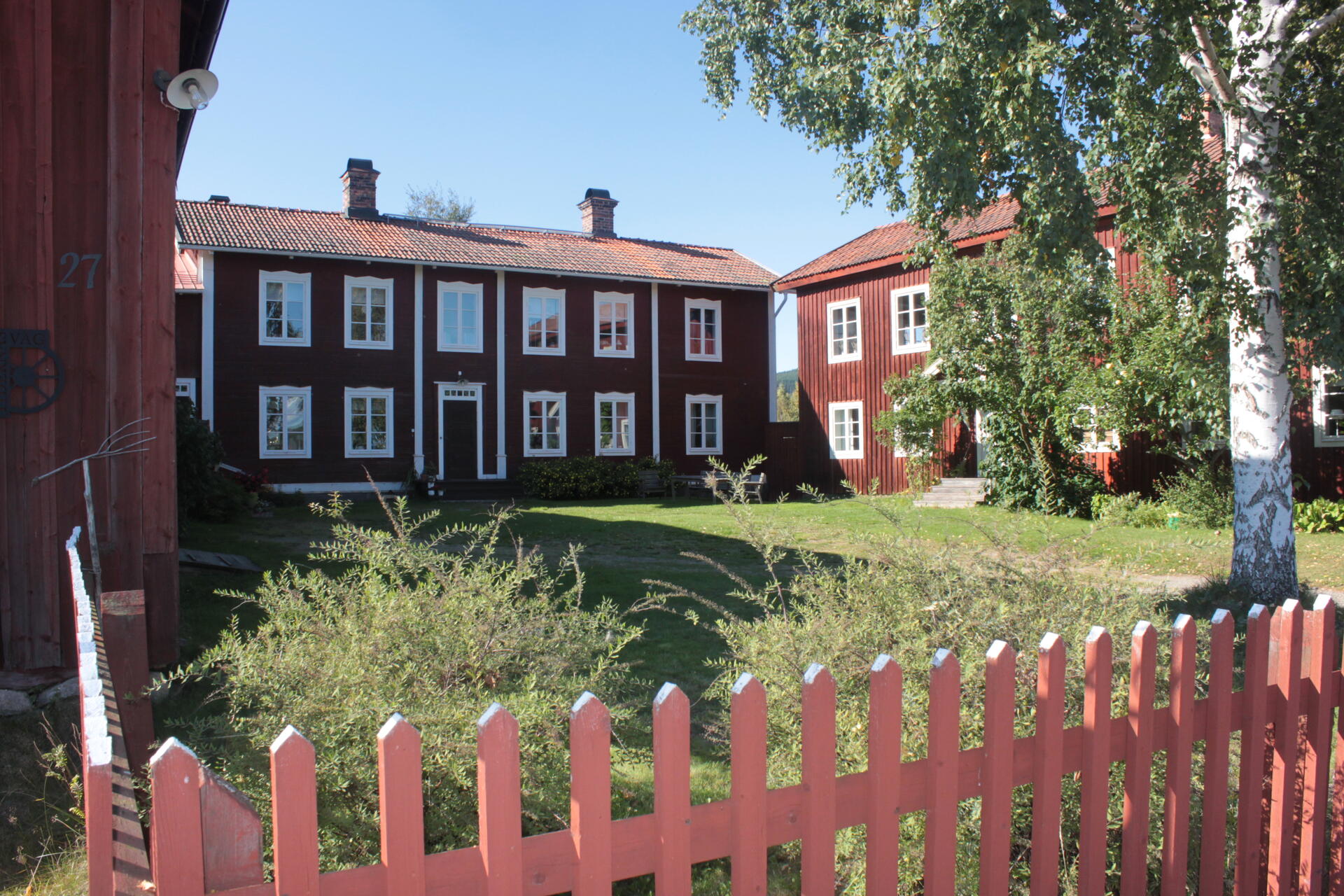
© Catasa, CC BY-SA 3.0 Resized from original. (This derivative is under the same CC BY-SA license.)
World Heritage Research
Discover scientific research and academic studies that deepen our understanding of Decorated Farmhouses of Hälsingland from its history and significance to its conservation, management, and contemporary challenges.
-
Field test of dehumidifiers for avoiding condensation in unheated historical wooden houses
A field test of sorption dehumidifiers in the UNESCO World Heritage site 'Decorated Farmhouses of Hälsingland' successfully mitigated condensation risk, a threat to valuable wall paintings. The study found that dehumidifiers, programmed to limit indoor relative humidity (RH) to 80%, effectively prevented condensation across all rooms despite high air change rates (~0.8 ACH). While RH peaks occurred locally and temporarily due to transient wind or stack conditions, the overall effectiveness was demonstrated through climate logging and tracer gas measurements. The research provides practical guidance for dehumidifier installation in unheated historical wooden structures, balancing preservation needs with environmental control.
Mattsson, M., Akander, J., & Björling, M. (2025). Field test of dehumidifiers for avoiding condensation in unheated historical wooden houses. E3S Web of Conferences, 672, 5005. https://doi.org/10.1051/e3sconf/202567205005
View Publication Record | Read Publication -
Exploring Folk Art in Historical Interiors
A multidisciplinary research project, supported by the Swedish Research Council and conducted at the University of Gothenburg's Department of Conservation, revealed significant insights into the decorative folk arts and crafts of Hälsingland's farmhouses. These interiors, designated as a UNESCO World Heritage Site in 2012, were analyzed using craft science methods to interpret their historical and cultural significance. The study, concluded in 2019, aimed to understand the intricate patterns and techniques employed in these farmhouses, contributing valuable knowledge to the field of craft sciences.
Nyström, I., Palmsköld, A., & Knutsson, J. (2022). Exploring Folk Art in Historical Interiors. Craft Sciences, 140–154. https://doi.org/10.21524/kriterium.40.g
View Publication Record | Read Publication -
Forensic Art History: the Ädel Painting Dispute 1839-1841
A multidisciplinary investigation combining forensic art history and scientific analysis has resolved an 180-year-old dispute over the pigments used by 19th-century Swedish painter Anders Erik Ädel. The study, which analyzed judicial protocols alongside non-invasive X-ray fluorescence (XRF) and spectroscopic methods, revealed that Ädel indeed used more costly pigments than agreed upon in his contract with client Erik Olofsson. This finding not only validates Ädel's claim from 1839 but also provides unprecedented insights into his painting techniques and materials, contributing to a deeper understanding of his artistic practice. The research underscores the value of integrating historical records with advanced scientific methods to reinterpret art history, particularly for UNESCO-listed sites like Hälsingland's decorated farmhouses.
Nyström, I., Thomas, J., Fors, Y., Friis, L., Assis, A., & Thuresson, K. (2018). Forensic Art History: the Ädel Painting Dispute 1839-1841. Conservation Science in Cultural Heritage, Vol 17 (2017). https://doi.org/10.6092/ISSN.1973-9494/7941
View Publication Record | Read Publication