
World Heritage Identification Number: 1363
World Heritage since: 2011
Category: Cultural Heritage
WHE Type: Archaeological Sites
Transboundary Heritage: Yes
Endangered Heritage: No
Country: Austria, France, Germany, Italy, Slovenia, Switzerland
Continent: Europe
UNESCO World Region: Europe and North America
Map
Discovering the Past: Prehistoric Pile Dwellings around the Alps
The Prehistoric Pile Dwellings around the Alps is a remarkable UNESCO World Heritage Site that offers a glimpse into the lives of early agrarian societies in Alpine Europe during the Neolithic and Bronze Age. Spanning over 4,500 years, this extensive serial property comprises 111 small individual sites, each containing the remains of prehistoric pile-dwelling settlements built on the edges of lakes, rivers, or wetlands. These settlements, which date back to approximately 5000 to 500 BC, provide valuable insights into the daily lives, social structures, and environmental interactions of our ancient ancestors.
Located primarily in Switzerland, with additional sites in Italy, Germany, France, Austria, and Slovenia, the Prehistoric Pile Dwellings around the Alps represent a unique and culturally rich archaeological resource. While excavations have been carried out at only a fraction of these sites, the discoveries made there have shed light on the various aspects of prehistoric life, including agriculture, craftsmanship, and social organization.
One of the most intriguing aspects of these pile dwellings is their construction. Built on wooden piles driven deep into the water or mud, these structures allowed their inhabitants to live in close proximity to the abundant resources provided by the surrounding bodies of water. Evidence suggests that these settlements were not only used for residential purposes but also served as centers for trade and communication between neighboring communities.
The Prehistoric Pile Dwellings around the Alps offer a wealth of information regarding the development of early agricultural practices. Archaeological findings indicate that these communities cultivated crops such as wheat, barley, and flax, as well as kept domesticated animals like cattle, sheep, and pigs. This shift towards agriculture marked a significant turning point in human history, as it enabled populations to settle in one place rather than being constantly on the move in search of food.
Moreover, the pile dwellings themselves offer a testament to the advanced engineering skills of our prehistoric ancestors. The careful selection and arrangement of the piles ensured that the structures remained stable despite the changing water levels. Additionally, the presence of various artifacts, such as pottery, tools, and jewelry, demonstrates the high level of craftsmanship and artistic expression that existed during this period.
To bring it all together, the Prehistoric Pile Dwellings around the Alps serve as a vital link to our past, offering invaluable insights into the lives of early agrarian societies in Alpine Europe during the Neolithic and Bronze Age. Through their exploration, we can gain a deeper understanding of the social structures, economic systems, and environmental interactions that shaped the course of human history. As we continue to uncover the secrets hidden within these ancient settlements, we are reminded of the ingenuity, resilience, and adaptability of our ancestors – qualities that remain essential to us today.
UNESCO Description of the World Heritage Site
This serial property of 111 small individual sites encompasses the remains of prehistoric pile-dwelling (or stilt house) settlements in and around the Alps built from around 5000 to 500 B.C. on the edges of lakes, rivers or wetlands. Excavations, only conducted in some of the sites, have yielded evidence that provides insight into life in prehistoric times during the Neolithic and Bronze Age in Alpine Europe and the way communities interacted with their environment. Fifty-six of the sites are located in Switzerland. The settlements are a unique group of exceptionally well-preserved and culturally rich archaeological sites, which constitute one of the most important sources for the study of early agrarian societies in the region.
UNESCO Justification of the World Heritage Site
Criterion (iv): The series of pile dwelling sites are one of the most important archaeological sources for the study of early agrarian societies in Europe between 5,000 and 500 BC. The waterlogged conditions have preserved organic matter that contributes in an outstanding way to our understanding of significant changes in the Neolithic and Bronze Age history of Europe in general, and of the interactions between the regions around the Alps in particular.
Criterion (v): The series of pile dwelling sites has provided an extraordinary and detailed insight into the settlement and domestic arrangements of pre-historic, early agrarian lake shore communities in the Alpine and sub-Alpine regions of Europe over almost 5,000 years. The revealed archaeological evidence allows an unique understanding of the way these societies interacted with their environment, in response to new technologies, and also to the impact of climate change.
Encyclopedia Record: Prehistoric pile dwellings around the Alps
Prehistoric pile dwellings around the Alps are a series of prehistoric pile dwelling settlements in and around the Alps built from about 5000 to 500 BC on the edges of lakes, rivers or wetlands. In 2011, 111 sites located variously in Switzerland (56), Italy (19), Germany (18), France (11), Austria (5) and Slovenia (2) were added to the UNESCO World Heritage Site list. In Slovenia, these were the first World Heritage Sites to be listed for their cultural value.Additional Site Details
Area: 274.2 hectares
Number of Components: 111
(v) — Outstanding example of traditional human settlement
Coordinates: 47.2783333333 , 8.2075
Image
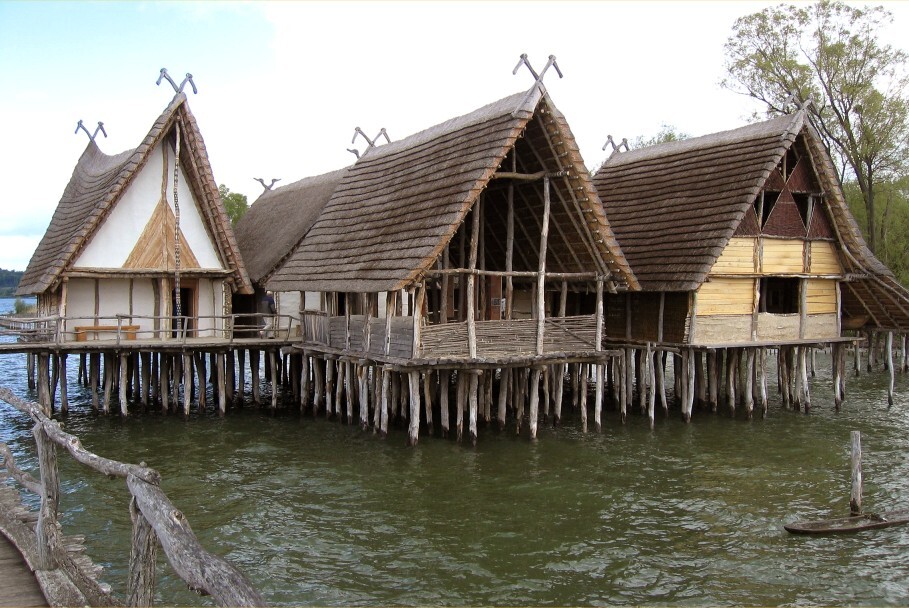
Gerhard Schauber, Public domain
World Heritage Research
Discover scientific research and academic studies that deepen our understanding of Prehistoric Pile Dwellings around the Alps from its history and significance to its conservation, management, and contemporary challenges.
-
Ancient Wood and Climate Resilience: Prehistoric Pile Dwellings around the Alps
Prehistoric pile dwellings around the Alps offer resilient solutions to modern climate challenges, demonstrating how ancient architectural innovations can mitigate flooding and hydrological impacts. These settlements, tested over 7000 years, employ elevated structures, natural ventilation, and minimal environmental disruption—strategies that align with sustainable development goals when integrated with contemporary technology. The study highlights their potential as actionable blueprints for climate adaptation, bridging past practices with modern needs to safeguard heritage sites globally.
Dworsky, C., & Fath, B. (2026). Ancient Wood and Climate Resilience: Prehistoric Pile Dwellings around the Alps. Blue Papers, 4(2). https://doi.org/10.58981/bluepapers.2025.2.13
View Publication Record | Read Publication -
Surfaced—The Digital Pile Dwellings
A digital revolution is unlocking Austria's hidden UNESCO-listed pile dwellings, preserving 7000 years of submerged and bog-buried heritage. The project 'Surfaced—the Digital Pile Dwellings' has digitized 500 high-resolution artefacts from five sites, transforming them into interactive 3D models accessible via the open-access web application PfahlbauKompass. This innovative approach bridges physical inaccessibility with virtual exploration, offering unprecedented access to finds from national museums, regional heritage houses, and private collections. Beyond archiving, it serves as a platform for scientific research, virtual exhibitions, and educational initiatives, significantly enhancing public awareness of these underwater archaeological treasures.
Leipold, F., Seidl da Fonseca, H., Dworsky, C., & Weßling, R. (2025). Surfaced—The Digital Pile Dwellings. Heritage, 8(5), 145. https://doi.org/10.3390/heritage8050145
View Publication Record | Read Publication -
Found in Sursee-Zellmoos (Switzerland) but from where did it come?
Recent excavations at Sursee-Zellmoos, part of the UNESCO-listed Prehistoric Pile Dwellings around the Alps, have uncovered lithic artefacts that challenge assumptions about Neolithic trade networks. While most silicite tools originate from local sources, two axe blades—one of unknown origin—suggest long-distance exchange or mining contexts. Preliminary analyses hint at a non-local provenance for one blade, though further investigation is needed to confirm its exact source. This discovery sheds light on the complexity of raw material procurement and inter-regional connections during the Neolithic period.
Wehren, H. (2025). Found in Sursee-Zellmoos (Switzerland) but from where did it come? Zenodo. https://doi.org/10.5281/ZENODO.15332514
View Publication Record | Read Publication -
Assessment of the Archaeological Potential of Prehistoric Settlement Areas along the Lake Shores and Wetlands of Carinthia, Southern Austria
A pilot project in Carinthia, southern Austria, has uncovered new evidence of prehistoric settlement dynamics along lake shores and wetlands, bridging gaps in the region's archaeological record. The study, conducted between 2021 and 2024, combined archival research, underwater surveys, sediment coring, and laboratory analyses to identify and document submerged archaeological structures dating from the 5th to 3rd millennia BC. Notably, the discovery of a pile-dwelling site on Kapuzinerinsel in Lake Wörthersee highlights the potential for targeted assessments to reveal previously unknown heritage. The research provides new radiocarbon dates and insights into human-environment interactions during the Neolithic and Copper Age, reinforcing Carinthia's significance as an inner-Alpine corridor linking Europe's archaeological landscapes. This interdisciplinary approach sets a foundation for future heritage protection and regional studies.
Ries, M.-C. (2025). Assessment of the Archaeological Potential of Prehistoric Settlement Areas along the Lake Shores and Wetlands of Carinthia, Southern Austria. AnaLecta ArchaEoloGica RessoViensia, 20, 19–42. https://doi.org/10.15584/anarres.2025.20.2
View Publication Record | Read Publication -
Il sito Unesco Palu di Livenza-Santissima. Tutela e valorizzazione tra archeologia e paesaggio
The Palù di Livenza-Santissima site, part of the UNESCO World Heritage transnational series 'Prehistoric Pile Dwellings around the Alps,' showcases a unique intersection of archaeological, landscape, and natural significance in Friuli Venezia Giulia's wetland area. This study highlights how legal protections, landscape planning, and management practices interact to preserve this site's cultural and environmental value. By analyzing historical evolution and legal frameworks, it underscores the critical connections between landscape preservation and regulatory measures, offering insights into sustainable heritage management for similar sites.
Lovison, F. (2026). Il sito Unesco Palù di Livenza-Santissima. Tutela e valorizzazione tra archeologia e paesaggio (1 ed.). DAUB. https://doi.org/10.69150/Lovison
View Publication Record | Read Publication -
Prehistoric Recycling Explained in a Playful Way: The Pfahlbauten Wimmelbild—An Interactive Digital Mediation Tool Designed by Young People
A playful digital tool, the Pfahlbauten Wimmelbild, reveals prehistoric recycling practices through interactive animations created by young students. This project, part of the FFG Talents Internship program, engaged 14- to 17-year-old students in researching and communicating sustainability concepts related to UNESCO World Heritage Site 'Prehistoric Pile Dwellings around the Alps.' Using scientific literature, museum collections, and historical records, students developed an augmented illustration that brings a prehistoric lake shore settlement to life. The tool, featuring animations and descriptive texts, educates users about artifact recycling processes while introducing young participants to scientific research and communication. This innovative approach was recognized with the Creative App Award at CHNT 2023.
da Fonseca, H. S., Leipold, F., & Grömer, K. (2024). Prehistoric Recycling Explained in a Playful Way: The Pfahlbauten Wimmelbild—An Interactive Digital Mediation Tool Designed by Young People. Heritage, 7(9), 4617–4630. https://doi.org/10.3390/heritage7090217
View Publication Record | Read Publication -
Detailed historic analysis of the 'pile-dwelling wheat' Triticum compactum (Binkel)
A critical analysis of historical accounts and archaeological evidence reveals that the prehistoric pile-dwelling wheat, Triticum compactum (Binkel), shares significant genetic similarities with Neolithic pile-dwelling wheat (Triticum antiquorum), though not absolute identity. The study synthesizes numerous historic records and compares them to modern findings, focusing on the predominance of tetraploid types in Alpine prehistoric settlements while also noting the presence of hexaploid forms. While genetic accuracy is limited by current literature, the research underscores Binkel's enduring nutritional value and its role in European agricultural history.
Kwich, M. (2024). Detailed historic analysis of the ‘pile-dwelling wheat’ Triticum compactum (Binkel). International Journal of Global Environmental Issues, 23(2/3), 108–132. https://doi.org/10.1504/ijgenvi.2024.142201
View Publication Record | Read Publication