World Heritage Identification Number: 974
World Heritage since: 2000
Category: Cultural Heritage
WHE Type: Buildings & Architectural Ensembles
Transboundary Heritage: No
Endangered Heritage: No
Country: 🇩🇪 Germany
Continent: Europe
UNESCO World Region: Europe and North America
Map
The Monastic Island of Reichenau: A Medieval Cultural Hub
The Monastic Island of Reichenau, nestled within Lake Constance in southern Germany, presents a unique blend of history, culture, and natural beauty. This 4.3 square kilometer island, located approximately 4.5 kilometers west of the town of Konstanz, has been a significant center of spiritual, intellectual, and artistic influence since the founding of a Benedictine monastery there in 724.
The island's rich history can be traced back to the establishment of this monastery by Saint Pirmin, who was supported by early Carolingian rulers. Over the centuries, the monastery flourished under the guidance of various abbots, becoming a hub for learning, art, and religion in Central Europe.
Three major medieval churches on the island serve as testaments to this period of growth and prosperity. The Church of St Mary and St Mark, constructed primarily during the 9th and 11th centuries, showcases early medieval monastic architecture. The Church of St Peter and St Paul, dating from the same period, reflects similar architectural traditions, though its interior was later remodeled in the Baroque era.
The churches on the island feature artistic decoration from various periods. In particular, the Church of St George preserves the most significant and complete early-medieval wall-paintings on the island. Its 10th-century narrative fresco cycle is particularly renowned as the most complete pre-1000 scenic wall-painting program north of the Alps
The artistic legacy of the Monastic Island of Reichenau extends beyond its churches. Manuscripts produced on the island have been preserved, providing valuable insights into the intellectual pursuits of the monks. These manuscripts, adorned with illuminations and miniatures, demonstrate the high level of craftsmanship achieved during this era.
In addition to its cultural significance, the island boasts a diverse ecosystem. Its varied landscapes, ranging from open fields to dense forests, support a rich array of flora and fauna. The island's highest point, the Hochwart, offers breathtaking views of the surrounding landscape, including Lake Constance and the Alpine foothills.
Today, the Monastic Island of Reichenau stands as a UNESCO World Heritage Site, recognized for its exceptional cultural and historical value. Visitors can explore the well-preserved churches, walk through the picturesque countryside, and gain a deeper understanding of the island's storied past. The island serves as a living testament to the enduring influence of the Benedictine monastery and the remarkable achievements of the monks who called it home.
UNESCO Description of the World Heritage Site
The island of Reichenau on Lake Constance preserves the traces of the Benedictine monastery, founded in 724, which exercised remarkable spiritual, intellectual and artistic influence. The churches of St Mary and Marcus, St Peter and St Paul, and St George, mainly built between the 9th and 11th centuries, provide a panorama of early medieval monastic architecture in central Europe. Their wall paintings bear witness to impressive artistic activity.
UNESCO Justification of the World Heritage Site
Criterion (iii): The remains of the Reichenau foundation bear outstanding witness to the religious and cultural role of a great Benedictine monastery in the early Middle Ages.
Criterion (iv): The churches on the island of Reichenau retain remarkable elements of several stages of construction and thus offer outstanding examples of monastic architecture in Central Europe from the 9th to the 11th centuries.
Criterion (vi): The Monastery of Reichenau was an important artistic centre of great significance to the history of art in Europe in the 10th and 11th centuries, as is superbly illustrated by its monumental wall paintings and its illuminations.
Encyclopedia Record: Reichenau Island
Reichenau Island is an island in Lake Constance in Southern Germany. It lies almost due west of the city of Konstanz, between the Gnadensee and the Untersee, two parts of Lake Constance. With a total land surface of 4.3 km2 (1.7 sq mi) and a circumference of 11 km (6.8 mi), the island is 4.5 km (2.8 mi) long and 1.5 km (0.93 mi) wide at its greatest extent. The highest point, the Hochwart, stands some 43 m (141 ft) above the lake surface and 438.7 m (1,439 ft) above mean sea level.Additional Site Details
Area: Not available
Number of Components: 1
(iv) — Outstanding example of a type of building or landscape
(vi) — Directly associated with events or living traditions
Coordinates: 47.69872222 , 9.061305556
Image
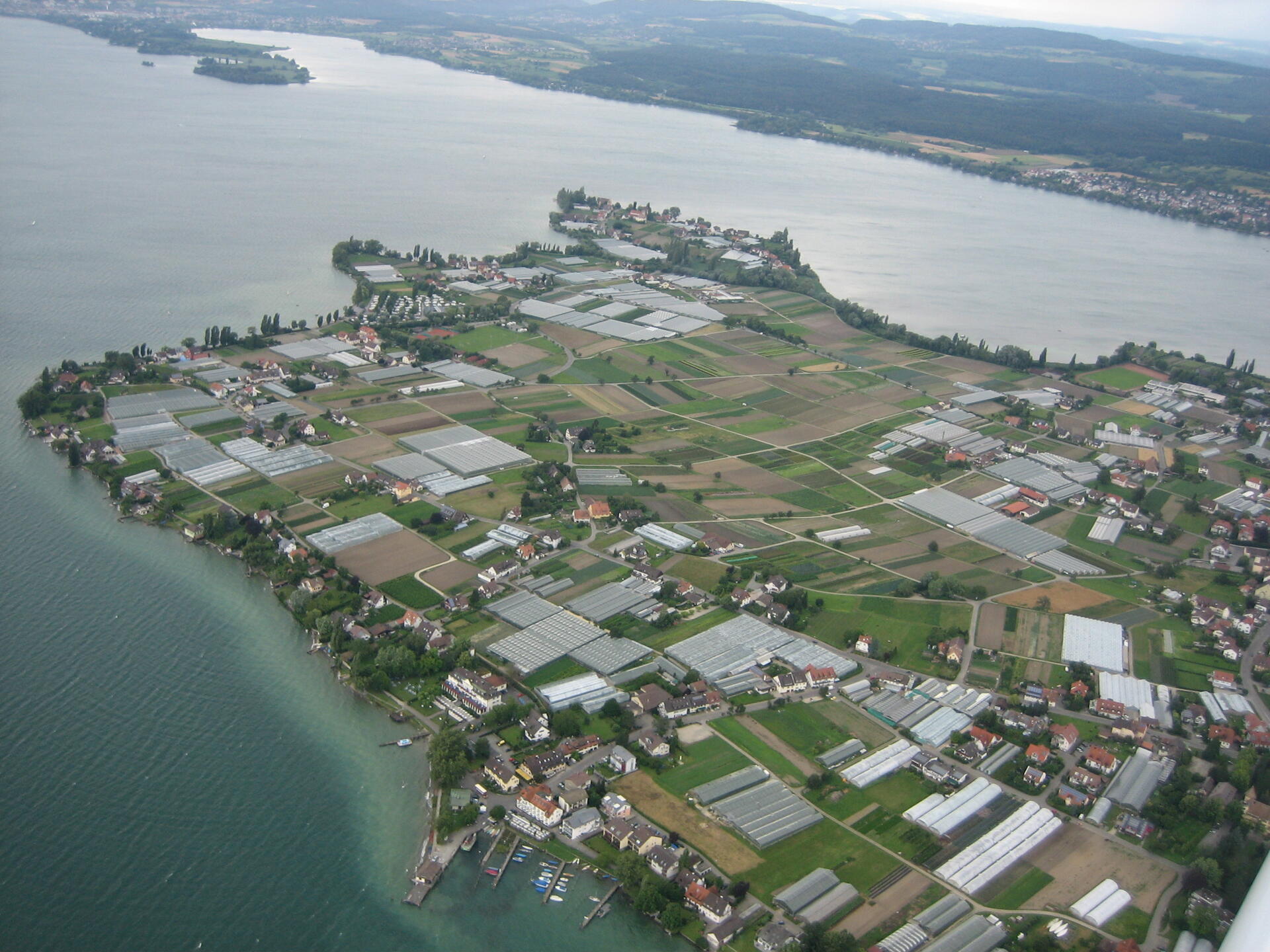
© Martin Steiger, CC BY-SA 4.0 Resized from original. (This derivative is under the same CC BY-SA license.)
World Heritage Research
Discover scientific research and academic studies that deepen our understanding of Monastic Island of Reichenau from its history and significance to its conservation, management, and contemporary challenges.
-
Image and Society at Reichenau c. 1000
A study of the paintings at Sankt Georg, Oberzell, on the UNESCO-listed Monastic Island of Reichenau reveals that the Liuthar Group of painters, active around 1000 AD, crafted iconography with dual ecclesiological and redemptive intentions. These works were designed to support a model of society favorable to clerics and monks, mirroring ambitions seen in contemporary abbeys like Cluny and Fleury during the Capetian kingdom. The research employs close observation of narrative ruptures and iconographic singularities to decipher the painters' programmatic intentions, offering new insights into the interplay between visual art and societal structures in early medieval Europe.
Franzé, B. (2025). Image and Society at Reichenau c. 1000. Romanesque and the Year 1000, 1–19. https://doi.org/10.4324/9781003571476-1
View Publication Record | Read Publication -
Was Gallus Anonymous, author of the famous Cronica et gesta ducum sive principum Polonorum, of Croatian origin?
Gallus Anonymous, the renowned chronicler behind the Cronica et gesta ducum sive principum Polonorum and Historia de translatione sanctorum Magni Nicolai, was of Croatian origin. This conclusion stems from detailed analysis of his writings and historical context, suggesting he hailed from an aristocratic clerical family linked to the Croatian royal court, likely originating from the royal monastery of St Bartholomew in Knin. Gallus, a Benedictine monk, probably supported Hungarian intervention in Croatia in 1091 and engaged in diplomatic activities across Europe, including participation in the Venetian expedition to Palestine. His association with the Benedictine monastery on Reichenau Island in Germany and subsequent move to Poland, likely facilitated by Almos' connections, provide further evidence of his Croatian roots and political affiliations.
Jasinski, T. (2024). Je li Gallus Anonymous, autor glasovite Cronica et gesta ducum sive principum Polonorum, hrvatskoga podrijetla? Kroatologija, 15(1), 11–55. https://doi.org/10.59323/k.15.1.1
View Publication Record | Read Publication -
Images et société à Reichenau, vers l’an mil : les peintures d’Oberzell et les manuscrits apparentés
A new interpretation of the Pre-Romanesque frescoes in the Church of Saint George at Oberzell, part of the UNESCO-listed Monastic Island of Reichenau, reveals a coherent programmatic meaning centered on the role of the priesthood and its intermediation in salvation. The study, analyzing eight scenes decorating the church's walls, suggests that these murals reflect the Benedictine monks' vision of ecclesiastical society around the year 1000, mirroring contemporary reforms at Cluny and Fleury. This finding is supported by a comparative analysis with illuminated manuscripts from the Liuthar group, particularly the Bamberg Collection (Msc. Bibl. 22), which share similar theological and societal intentions.
Franzé, B. (2021). Images et société à Reichenau, vers l’an mil : les peintures d’Oberzell et les manuscrits apparentés. Zeitschrift Für Kunstgeschichte, 84(2), 147–180. https://doi.org/10.1515/zkg-2021-2001
View Publication Record | Read Publication -
Gnadensee
A study published in Grana reveals that the Gnadensee, a basin within Lake Constance's Bodensee-Untersee, is significantly influenced by the geological and ecological dynamics of the surrounding peninsulas and the Island Reichenau. The research identifies how these landforms divide the lake into distinct basins, affecting water movement, sediment distribution, and ecosystem structure. The study employs a combination of hydrological modeling and field observations to map these interactions, providing critical insights for understanding the lake's environmental complexity. This work contributes to broader efforts in studying UNESCO World Heritage Sites by integrating geological and ecological perspectives.
Ryabogina, N., Marinova, E., & Rösch, M. (2021). 56. Gnadensee. Grana, 60(6), 477–479. https://doi.org/10.1080/00173134.2021.1944302
View Publication Record | Read Publication