World Heritage Identification Number: 491
World Heritage since: 1988
Category: Cultural Heritage
WHE Type: Archaeological Sites
Transboundary Heritage: No
Endangered Heritage: No
Country: 🇬🇷 Greece
Continent: Europe
UNESCO World Region: Europe and North America
Map
The Sanctuary of Asklepios at Epidaurus: A Pure Masterpiece of Greek Architecture
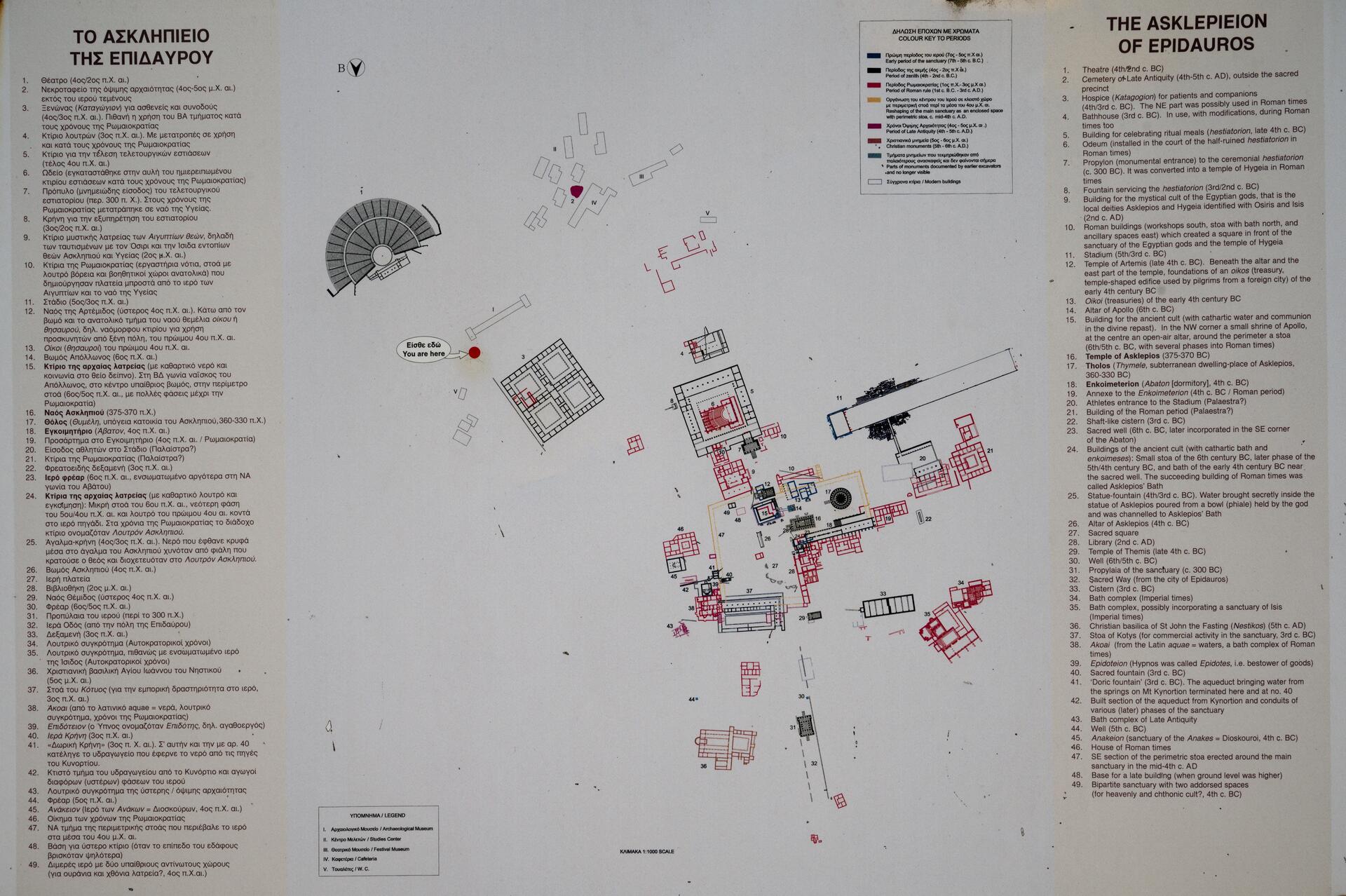
The Sanctuary of Asklepios at Epidaurus, located in the Peloponnese region of Greece, is a remarkable testament to ancient Greek culture and the reverence for the god of healing, Asklepios. This significant archaeological site was inscribed as a UNESCO World Heritage Site in 1988 due to its exceptional architecture and its role in the development and propagation of healing sanctuaries across classical antiquity.
More to come…UNESCO Description of the World Heritage Site
In a small valley in the Peloponnesus, the shrine of Asklepios, the god of medicine, developed out of a much earlier cult of Apollo (Maleatas), during the 6th century BC at the latest, as the official cult of the city state of Epidaurus. Its principal monuments, particularly the temple of Asklepios, the Tholos and the Theatre - considered one of the purest masterpieces of Greek architecture – date from the 4th century. The vast site, with its temples and hospital buildings devoted to its healing gods, provides valuable insight into the healing cults of Greek and Roman times.
UNESCO Justification of the World Heritage Site
Criterion (i): The Theatre of Epidaurus is an architectural masterpiece designed by the architect from Argos, Polykleitos the Younger, and represents a unique artistic achievement through its admirable integration into the site as well as the perfection of its proportions and acoustics. The Theatre has been revived thanks to an annual festival held there since 1955.
Criterion (ii): The Sanctuary of Asklepios at Epidaurus exerted an influence on all the Asklepieia in the Hellenic world, and later, on all the Roman sanctuaries of Esculape.
Criterion (iii): The group of buildings comprising the Sanctuary of Epidaurus bears exceptional testimony to the healing cults of the Hellenic and Roman worlds. The temples and the hospital facilities dedicated to the healing gods constitute a coherent and complete ensemble. Excavations led by Cavvadias, Papadimitriou and other archaeologists have greatly contributed to our knowledge of this ensemble.
Criterion (iv): The Theatre, the Temples of Artemis and Asklepios, the Tholos, the Enkoimeterion and the Propylaia make the Sanctuary of Epidaurus an eminent example of a Hellenic architectural ensemble of the 4th century BCE.
Criterion (vi): The emergence of modern medicine in a sanctuary originally reputed for the psychically-based miraculous healing of supposedly incurable patients is directly and tangibly illustrated by the functional evolution of the Sanctuary of Epidaurus and is strikingly described by the engraved inscriptions on the remarkable stelai preserved in the Museum.
Encyclopedia Record: Sanctuary of Asclepius, Epidaurus
The Sanctuary of Asclepius was a sanctuary in Epidaurus dedicated to Asclepius. Especially in the Classical and Hellenistic periods, it was the main holy site of Asclepius. The sanctuary at Epidaurus was the rival of such major cult sites as the Sanctuary of Zeus at Olympia and Apollo at Delphi. The temple was built in the early 4th century BC. If still in use by the 4th century AD, the temple would have been closed during the persecution of pagans in the late Roman Empire, when the Christian Emperors issued edicts prohibiting non-Christian worship. In 1988, the temple was inscribed on the UNESCO World Heritage List because of its exceptional architecture and its importance in the development and spread of healing sanctuaries throughout classical antiquity. It was excavated between 1881 and 1928 by Panagiotis Kavvadias, and between 1948 and 1951 by John Papadimitriou.Additional Site Details
Area: 1,393.8 hectares
Number of Components: 1
(ii) — Significant interchange of human values
(iii) — Unique or exceptional testimony to a cultural tradition
(iv) — Outstanding example of a type of building or landscape
(vi) — Directly associated with events or living traditions
Coordinates: 37.6 , 23.0805555556
Image
© Zde, CC BY-SA 4.0 Resized from original. (This derivative is under the same CC BY-SA license.)
World Heritage Research
Discover scientific research and academic studies that deepen our understanding of Sanctuary of Asklepios at Epidaurus from its history and significance to its conservation, management, and contemporary challenges.
-
A Value-Based Risk Assessment of Water-Related Hazards: The Archaeological Site of the Sanctuary of Asklepios at Epidaurus
Intensified surface water runoff and localized water inundation pose significant threats to key monuments at the Sanctuary of Asklepios at Epidaurus. Projections indicate that climate change will exacerbate hydroclimatic extremes in the Mediterranean region, particularly affecting the Roman Odeion and central parts of the site's ensemble. This study employs a value-based risk assessment approach, integrating GIS-based hydrological modeling (HAND), field observations, material assessments, and NARA Grids to link exposure, vulnerability, and potential value loss. The findings highlight the need for site-specific climate change adaptation strategies, prioritizing drainage enhancement, preventive conservation, and continuous monitoring to preserve the site's Outstanding Universal Values under changing climatic conditions.
Balatsoukas, A., Miltiadou-Fezans, A., Van Balen, K., & Kazolias, E. (2025). A Value-Based Risk Assessment of Water-Related Hazards: The Archaeological Site of the Sanctuary of Asklepios at Epidaurus. Buildings, 15(24), 4573. https://doi.org/10.3390/buildings15244573
View Publication Record | Read Publication -
Moving down the mountain: pathways for sacred landscape transformation at ancient Epidaurus and Nemea
Sacred mountains retained their spiritual significance even after worship shifted to monumental sanctuaries on flat ground, revealing the enduring power of collective memory and sensory experience. The study compares Epidaurus and Nemea in Greece’s Peloponnese, tracing how attention moved from mountain peaks to new temenoi below while mountains remained visually and culturally dominant. Using archaeological data, ancient texts, tourist reviews, and GIS analysis, researchers quantified the sanctuaries' visual impact against topography. This challenges assumptions about landscape transformation, showing that sacred landmarks persist through human perception rather than physical presence alone.
Susmann, N. M. (2021). Moving down the mountain: pathways for sacred landscape transformation at ancient Epidaurus and Nemea. Time and Mind, 14(1), 73–109. https://doi.org/10.1080/1751696x.2021.1891367
View Publication Record | Read Publication -
The Afterlife of a Dream and the Ritual System of the Epidaurian Asklepieion
Healing inscriptions at the Epidaurian Asklepieion transform private dreams of supplicants into enduring public tributes, amplifying their influence far beyond individual experience. The study reveals that Mnēmosyne, a goddess associated with memory, plays a pivotal role in this process by preserving the dream's significance for both the dreamer and the sanctuary. She facilitates the articulation of dreams to officials, enabling their inscription and public display, while also creating lasting opportunities for others to honor Asklepios, the god of healing. This ritual system reflects a sophisticated interplay between human action and divine agency, demonstrating how individual experiences are intellectually ordered and ritually integrated into a broader framework that benefits both mortal and immortal realms.
Ahearne-Kroll, S. P. (2014). The Afterlife of a Dream and the Ritual System of the Epidaurian Asklepieion. Archiv Für Religionsgeschichte, 15(1), 35–52. https://doi.org/10.1515/arege-2013-0004
View Publication Record | Read Publication