World Heritage Identification Number: 1502
World Heritage since: 2016
Category: Cultural Heritage
WHE Type: Archaeological Sites
Transboundary Heritage: No
Endangered Heritage: No
Country: 🇮🇳 India
Continent: Asia
UNESCO World Region: Asia and the Pacific
Map
The Archaeological Site of Nalanda Mahavihara: A Beacon of Knowledge and Culture in Ancient India
The Archaeological Site of Nalanda Mahavihara, located in the state of Bihar, northeastern India, stands as a testament to the rich cultural and intellectual history of ancient India. Inscribed as a UNESCO World Heritage Site in 2016, this monumental complex dates back to the 3rd century BCE and continues to captivate scholars and visitors alike with its intricate architecture, stunning artwork, and significant contributions to the development of Buddhism.
More to come…UNESCO Description of the World Heritage Site
The Nalanda Mahavihara site is in the State of Bihar, in north-eastern India. It comprises the archaeological remains of a monastic and scholastic institution dating from the 3rd century BCE to the 13th century CE. It includes stupas, shrines, viharas (residential and educational buildings) and important art works in stucco, stone and metal. Nalanda stands out as the most ancient university of the Indian Subcontinent. It engaged in the organized transmission of knowledge over an uninterrupted period of 800 years. The historical development of the site testifies to the development of Buddhism into a religion and the flourishing of monastic and educational traditions.
UNESCO Justification of the World Heritage Site
Criterion (iv): The Archaeological Site of Nalanda Mahavihara established and developed planning, architectural, artistic principles that were adopted later by many similar institutions in the Indian Subcontinent, South Asia and Southeast Asia. Standardisation of the architecture of viharas and the evolution of temple-like chaitya into Nalanda prototypes manifests the sustained interchange and patronage towards the expansion of physical infrastructure. The quadrangular free-standing vihara of Gandhara period evolved into a complete residential cum-educational infrastructure borrowed by monastic-cities of South Asia such as Paharpur, Vikramshila, Odantapuri and Jagaddala. Nalanda shows emergence and mainstreaming of a chaitya having quincuxial (five-fold) form. As a reflection and representation of changing religious practices, this new form replaced the traditionally dominant stupa and influenced Buddhist temples in the region.
Criterion (vi): Nalanda Mahavihara, as a centre for higher learning marks the zenith in the evolution of sangharama (monastic establishment) into the earliest higher learning establishment of early medieval India. Its merit-based approach said to have embraced all contemporary sources of knowledge and systems of learning practiced in the Indian subcontinent. Nalanda remains one of the earliest and longest serving extraordinary institution-builder. Its systems of pedagogy, administration, planning and architecture were the basis on which later Mahaviharas were established. Nalanda continues to inspire modern university establishments in the region like Nava Nalanda Mahavihara, Nalanda University and several others across Asia.
Encyclopedia Record: Nalanda mahavihara
Nalanda was a renowned Buddhist mahavihara in medieval Magadha, eastern India. Widely considered to be among the greatest centres of learning in the ancient world and often referred to as "the world's first residential university", it was located near the city of Rajagriha, roughly 90 kilometres (56 mi) southeast of Pataliputra. Operating for almost a thousand years from 427 CE until around 1400 CE, Nalanda mahavihara played a vital role in promoting the patronage of arts, culture and academics during the 5th and 6th century CE, a period that has since been described as the "Golden Age of India" by scholars. The characterisation of Nalanda as a "university" in the modern sense has been challenged by scholars. They argue that while it was undoubtedly a major centre of learning, comparing it directly to a modern university is historically imprecise.Additional Site Details
Area: 23 hectares
Number of Components: 1
(vi) — Directly associated with events or living traditions
Coordinates: 25.1366666667 , 85.4438888889
Image
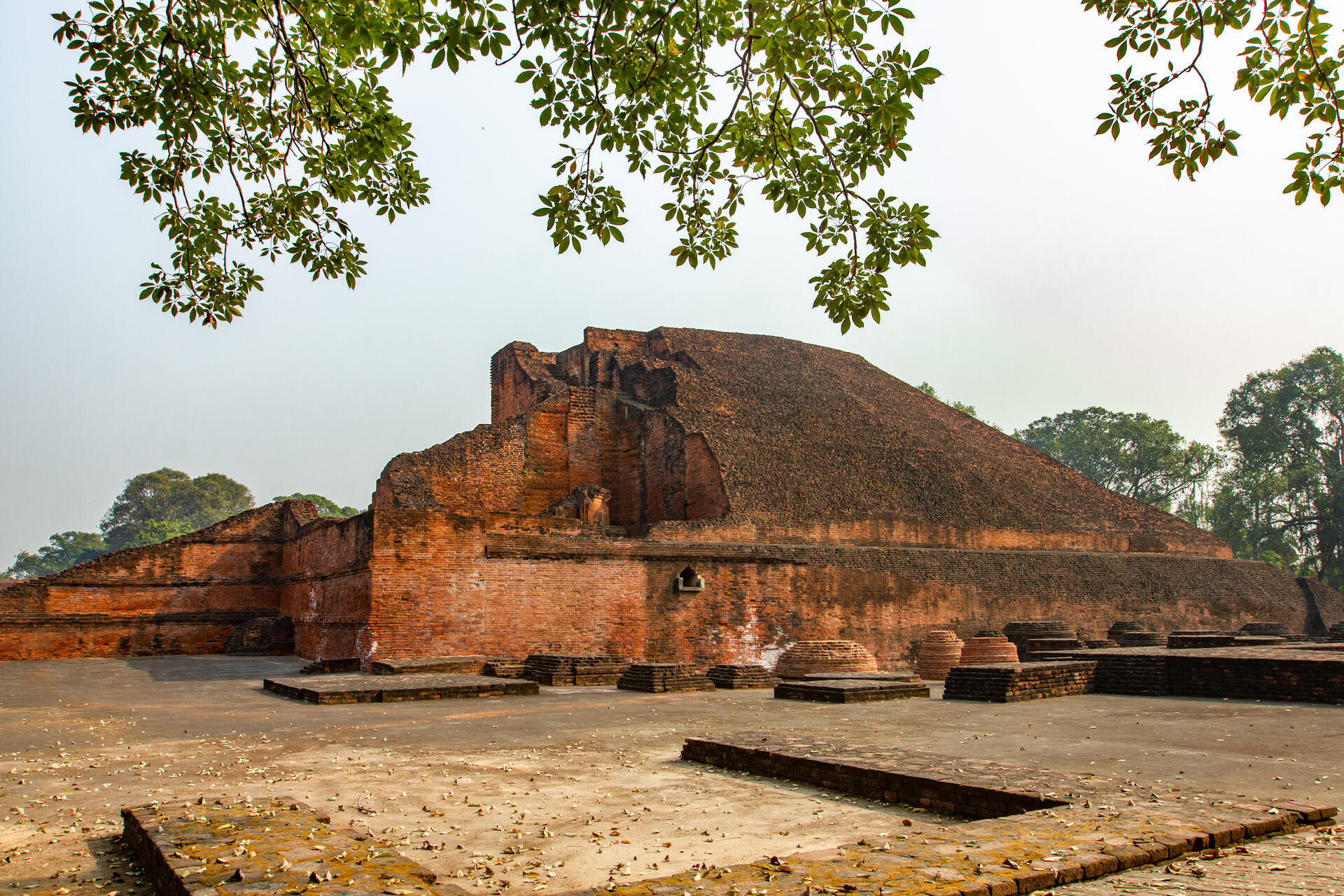
© Uphogaphy, CC BY-SA 4.0 Resized from original. (This derivative is under the same CC BY-SA license.)