World Heritage Identification Number: 284
World Heritage since: 1984
Category: Natural Heritage
WHE Type: Protected Areas & National Parks
Transboundary Heritage: No
Endangered Heritage: No
Country: 🇳🇵 Nepal
Continent: Asia
UNESCO World Region: Asia and the Pacific
Map
Exploring the Biodiversity Haven: Chitwan National Park
Chitwan National Park, located at the base of the Himalayan range in south-central Nepal, stands as a testament to the richness and diversity of the Terai region that once stretched across the foothills of Nepal and India. Established in 1973 as the Royal Chitwan National Park, it was later designated as a UNESCO World Heritage Site in 1984, acknowledging its significant role in preserving unique ecosystems and endangered species. Covering an expanse of approximately 952.63 square kilometers (367.81 square miles), this protected area offers a captivating blend of diverse landscapes, abundant wildlife, and cultural heritage.
More to come…UNESCO Description of the World Heritage Site
At the foot of the Himalayas, Chitwan is one of the few remaining undisturbed vestiges of the 'Terai' region, which formerly extended over the foothills of India and Nepal. It has a particularly rich flora and fauna. One of the last populations of single-horned Asiatic rhinoceros lives in the park, which is also one of the last refuges of the Bengal tiger.
UNESCO Justification of the World Heritage Site
Criteria (vii): The spectacular landscape, covered with lush vegetation and the Himalayas as the backdrop makes the park an area of exceptional natural beauty. The forested hills and changing river landscapes serve to make Chitwan one of the most stunning and attractive parts of Nepal’s lowlands. Situated in a river valley basin and characterized by steep cliffs on the south-facing slopes and a mosaic of riverine forest and grasslands along the river banks of the natural landscape makes the property amongst the most visited tourist destination of its kind in the region. The property includes the Narayani (Gandaki) river, the third-largest river in Nepal which originates in the high Himalayas and drains into the Bay of Bengal providing dramatic river views and scenery as well as the river terraces composed of layers of boulders and gravels. The property includes two famous religious areas: Bikram Baba at Kasara and Balmiki Ashram in Tribeni, pilgrimage places for Hindus from nearby areas and India. This is also the land of the indigenous Tharu community who have inhabited the area for centuries and are well known for their unique cultural practices.
Criteria (ix): Constituting the largest and least disturbed example of sal forest and associated communities, Chitwan National Park is an outstanding example of biological evolution with a unique assemblage of native flora and fauna from the Siwalik and inner Terai ecosystems. The property includes the fragile Siwalik-hill ecosystem, covering some of the youngest examples of this as well as alluvial flood plains, representing examples of ongoing geological processes. The property is the last major surviving example of the natural ecosystems of the Terai and has witnessed minimal human impacts from the traditional resource dependency of people, particularly the aboriginal Tharu community living in and around the park.
Criteria (x): The combination of alluvial flood plains and riverine forest provides an excellent habitat for the Great One-horned Rhinoceros and the property is home for the second largest population of this species in the world. It is also prime habitat for the Bengal Tiger and supports a viable source population of this endangered species. Exceptionally high in species diversity, the park harbours 31% of mammals, 61% of birds, 34% of amphibians and reptiles, and 65% of fishes recorded in Nepal. Additionally, the park is famous for having one of the highest concentrations of birds in the world (over 350 species) and is recognized as one of the worlds’ biodiversity hotspots as designated by Conservation International and falls amongst WWFs’ 200 Global Eco-regions.
Encyclopedia Record: Chitwan National Park
Chitwan National Park is the first national park of Nepal. It was established in 1973 as the Royal Chitwan National Park and was granted the status of a World Heritage Site in 1984. It covers an area of 952.63 km2 (367.81 sq mi) in the Terai of south-central Nepal. It ranges in elevation from about 100 m (330 ft) in the river valleys to 815 m (2,674 ft) in the Sivalik Hills.Additional Site Details
Area: 93,200 hectares
Number of Components: 1
(ix) — Outstanding example representing ecological and biological processes
(x) — Contains most important habitats for biodiversity
Coordinates: 27.5 , 84.33333
IUCN World Heritage Outlook
The 2025 Conservation Outlook on Chitwan National Park reports the following assessment:
Source: International Union for Conservation of Nature (IUCN) · View assessment
Image
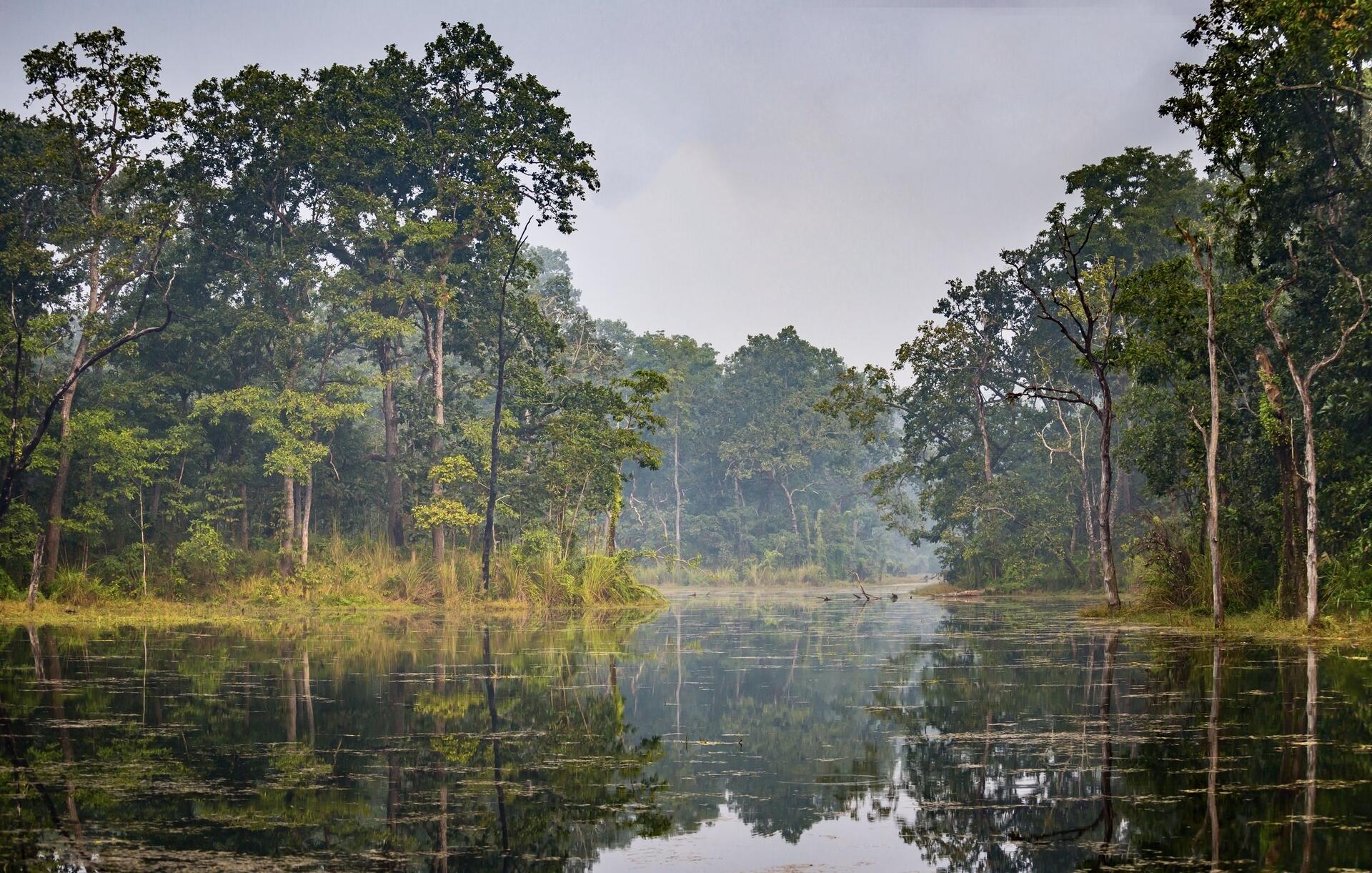
© Vadim Tolbatov, CC BY-SA 4.0 Resized from original. (This derivative is under the same CC BY-SA license.)
World Heritage Research
Discover scientific research and academic studies that deepen our understanding of Chitwan National Park from its history and significance to its conservation, management, and contemporary challenges.
-
Contribution of Buffer Zone Programs to Reduce Human-Wildlife Impacts: the Case of the Chitwan National Park, Nepal
Buffer zone programs around Chitwan National Park, Nepal, significantly reduce human-wildlife conflicts when funds are directed toward direct interventions for prevention and mitigation. A study found that only 13.7% of the buffer zone budget was allocated to such measures, yet this small investment inversely correlated with conflict levels. While residents generally held positive attitudes toward wildlife conservation and were aware of the programs, they expressed dissatisfaction with current practices. The research highlights the need for prioritizing direct intervention funds in buffer zones to effectively minimize human-wildlife impacts, offering a practical approach for similar conservation efforts worldwide.
Lamichhane, B. R., Persoon, G. A., Leirs, H., Poudel, S., Subedi, N., Pokheral, C. P., Bhattarai, S., Gotame, P., Mishra, R., & de Iongh, H. H. (2019). Contribution of Buffer Zone Programs to Reduce Human-Wildlife Impacts: the Case of the Chitwan National Park, Nepal. Human Ecology, 47(1), 95–110. https://doi.org/10.1007/s10745-019-0054-y
View Publication Record | Read Publication -
Livestock depredation by leopards around Chitwan National Park, Nepal
A decade-long analysis of leopard livestock depredation around Chitwan National Park, Nepal, revealed that goats were disproportionately targeted (87.3% of cases), leading to significant economic losses and compensation payments totaling $24,621 over ten years. Despite a general decline in incidents from 2007–2016, no clear correlation was found between depredation and factors such as human or livestock population density, forest area, or environmental variables like rainfall or temperature. Depredation hotspots were identified through a conflict map, highlighting clustering in specific buffer zone areas. The study suggests that improved husbandry practices, livestock insurance schemes, and conservation education could mitigate conflicts and enhance public support for leopard conservation.
Dhungana, R., Lamichhane, B. R., Savini, T., Dhakal, M., Poudel, B. S., & Karki, J. B. (2019). Livestock depredation by leopards around Chitwan National Park, Nepal. Mammalian Biology, 96, 7–13. https://doi.org/10.1016/j.mambio.2019.03.006
View Publication Record | Read Publication -
Spatio-temporal patterns of attacks on human and economic losses from wildlife in Chitwan National Park, Nepal
A study analyzing wildlife attacks on humans and economic losses in Chitwan National Park, Nepal (1998–2016) found that while rhinos and elephants caused the most human-wildlife conflicts during full moon periods, increasing wildlife populations did not correlate with rising incidents. Underprivileged ethnic communities were disproportionately affected, and carnivores like tigers and leopards accounted for over 90% of livestock depredation, primarily targeting medium-sized animals near forest edges. Decreases in livestock holdings and conflict mitigation measures (e.g., fences) helped control incidents, though challenges persisted. The research suggests strengthening fencing, predator-proof corrals, and community education to reduce conflicts effectively.
Lamichhane, B. R., Persoon, G. A., Leirs, H., Poudel, S., Subedi, N., Pokheral, C. P., Bhattarai, S., Thapaliya, B. P., & de Iongh, H. H. (2018). Spatio-temporal patterns of attacks on human and economic losses from wildlife in Chitwan National Park, Nepal. Plos One, 13(4), e0195373. https://doi.org/10.1371/journal.pone.0195373
View Publication Record | Read Publication -
When, where and whom: assessing wildlife attacks on people in Chitwan National Park, Nepal
A significant portion of wildlife attacks on people in and around Chitwan National Park, Nepal, occurs outside the protected area, with 89% of incidents recorded between 2003 and 2013 happening beyond its boundaries. These attacks are unevenly distributed across seasons and months, predominantly occurring during the day, particularly in the morning. Rhinos (38%), tigers (21%), sloth bears (18%), elephants (9%), and wild boar (8%) were the primary perpetrators. Victims were mostly male, engaged in resource collection or farming, and lacked knowledge of animal behavior. The study used data from stakeholders, field observations, and surveys to identify key correlates such as site, season, time, activity, gender, and awareness. Mitigation strategies are recommended, including habitat management within the Park and raising public awareness about wildlife behavior, along with forming a participatory emergency rescue team for high-risk areas.
Silwal, T., Kolejka, J., Bhatta, B. P., Rayamajhi, S., Sharma, R. P., & Poudel, B. S. (2016). When, where and whom: assessing wildlife attacks on people in Chitwan National Park, Nepal. Oryx, 51(2), 370–377. https://doi.org/10.1017/s0030605315001489
View Publication Record | Read Publication -
Invasive mikania in Chitwan National Park, Nepal: the threat to the greater one-horned rhinoceros Rhinoceros unicornis and factors driving the invasion
Invasive mikania (Mikania micrantha) poses a significant threat to the greater one-horned rhinoceros (Rhinoceros unicornis) in Chitwan National Park, Nepal. The study found that 44% of surveyed habitats are infested with mikania, with nearly 15% exhibiting high infestation levels (>50% coverage). Riverine forests, tall grasslands, and wetlands—habitats critical for rhinoceros survival—show the highest densities of this invasive plant. Anthropogenic activities, particularly annual grassland burning (25–50% of the park's area) and natural resource collection by local communities, are key drivers of mikania spread. The research highlights the urgent need for management strategies to control burning, mitigate spread, and promote sustainable resource use practices among local communities.
Murphy, S. T., Subedi, N., Jnawali, S. R., Lamichhane, B. R., Upadhyay, G. P., Kock, R., & Amin, R. (2013). Invasive mikania in Chitwan National Park, Nepal: the threat to the greater one-horned rhinoceros Rhinoceros unicornis and factors driving the invasion. Oryx, 47(3), 361–368. https://doi.org/10.1017/s003060531200124x
View Publication Record | Read Publication