World Heritage Identification Number: 1375
World Heritage since: 2023
Category: Cultural Heritage
WHE Type: Historic Cities & Urban Areas
Transboundary Heritage: No
Endangered Heritage: No
Country: 🇮🇳 India
Continent: Asia
UNESCO World Region: Asia and the Pacific
Map
The Cultural Oasis of Santiniketan: A Unique Blend of Tradition and Modernity
The small town of Santiniketan, nestled in the Birbhum district of West Bengal, India, stands as a testament to the harmonious fusion of tradition and modernity. Inscribed as a UNESCO World Heritage Site in 2023, this cultural oasis was the brainchild of Rabindranath Tagore, the revered poet and philosopher, who envisioned a space that transcended religious and cultural boundaries.
More to come…UNESCO Description of the World Heritage Site
Established in rural West Bengal in 1901 by the renowned poet and philosopher Rabindranath Tagore, Santiniketan was a residential school and centre for art based on ancient Indian traditions and a vision of the unity of humanity transcending religious and cultural boundaries. A ‘world university’ was established at Santiniketan in 1921, recognizing the unity of humanity or “Visva Bharati”. Distinct from the prevailing British colonial architectural orientations of the early 20th century and of European modernism, Santiniketan represents approaches toward a pan-Asian modernity, drawing on ancient, medieval and folk traditions from across the region.UNESCO Justification of the World Heritage Site
Criterion (iv): Santiniketan was an experimental settlement in education and communal life in a rural setting. The community was in many ways meant to represent a uniquely Indian example of a ‘total work of art’ (Gesamtkunstwerk) where life, learning, work and art along with the local and the global intertwined seamlessly. The built and open spaces constitute an exceptional global testimony to ideas of environmental art and educational reform where progressive education and visual art are intertwined with architecture and landscape: with the Ashram, Uttarayan, and Kala-Bhavana areas forming the prime sites of these practices in the most significant periods of development. Santiniketan represents in an outstanding way, the emergence of post-colonial centres of cultural, philosophical and spiritual exploration in the early 20th century in south Asia.
Criterion (vi): Santiniketan is directly and tangibly associated with the ideas, works and vision of Rabindranath Tagore and his associates, pioneers of the Bengal School of Art and early Indian Modernism. Against the backdrop of the Partition of Bengal, Santiniketan became the crucible for an artistic and intellectual renaissance in the early 20th century. As a cultural and intellectual incubator, it had an indelible imprint on the leaders of the Indian Freedom Movement, including Mahatma Gandhi, Nehru and Indira Gandhi. The significant influence of the ideals and philosophies represented in Santiniketan are demonstrated at other early 20th-century locations of cultural learning in south Asia. Santiniketan represents the distillation of the ideas and continuing legacy of a unique model of education recalling ancient Indian ideas as well as internationalism through a living institution, embodied in the buildings, landscape, artworks and continuing festivals and traditions. And while many of Tagore’s art and literary works bear a unique association with Santiniketan, his experimentation through education with an internationalist humanist ideology finds its manifest reflection in Santiniketan.
Encyclopedia Record: Shantiniketan
Shantiniketan is a neighbourhood of Bolpur town in the Bolpur subdivision of Birbhum district in West Bengal, India, approximately 152 km north of Kolkata. It was established by Debendranath Tagore, and later expanded by his son, Rabindranath Tagore whose vision became what is now a university town with the creation of Visva-Bharati. It is also the birthplace of Indian Nobel Laureate and Amartya Sen, who was also an alumnus of the school.Additional Site Details
Area: 36 hectares
Number of Components: 1
(vi) — Directly associated with events or living traditions
Coordinates: 23.6802777778 , 87.6849722222
Image
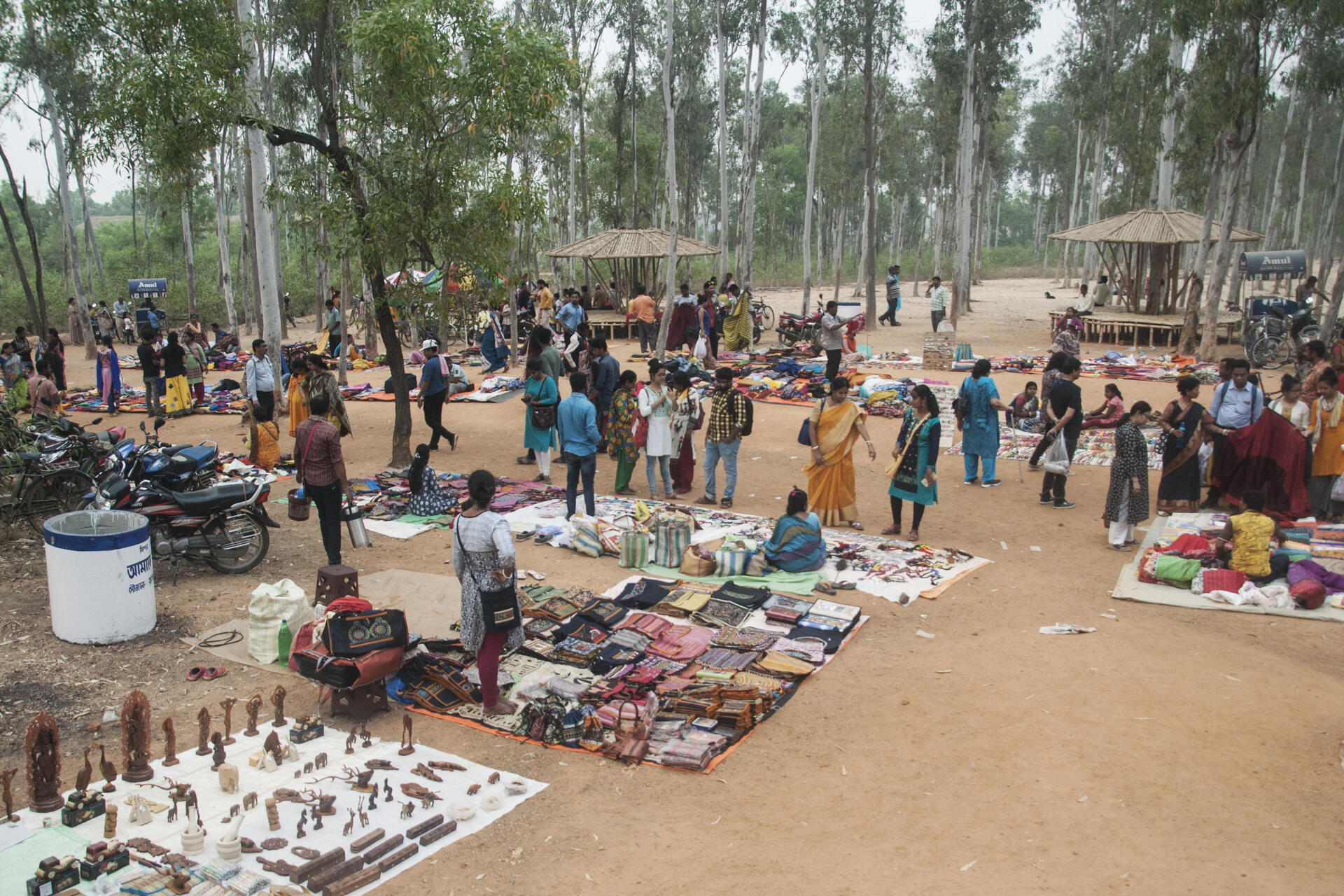
© Name - Sagnik Samanta Email Address - sagniksamanta1@gmail.com, CC BY-SA 4.0 Resized from original. (This derivative is under the same CC BY-SA license.)
World Heritage Research
Discover scientific research and academic studies that deepen our understanding of Santiniketan from its history and significance to its conservation, management, and contemporary challenges.
-
Dharmashiksha and swadeshbhakti at the Santiniketan ashram
Rabindranath Tagore's Santiniketan ashram uniquely blended spiritual cultivation (dharmashiksha) with a form of patriotism (swadeshbhakti), distinct from conventional nationalism. This study reveals how Tagore's curricular design fostered creative devotion to one's 'own country' (swadesh) rather than mechanical national identity, diverging from the political nationalism prevalent in Bengal during his time. By analyzing Tagore's tracts on 'desh' and 'samaj,' the research demonstrates that swadeshbhakti aimed to cultivate a personal, empathetic connection to place and society, contrasting with the impersonal machinery of nation-states. The ashram itself served as a microcosm of this ideal, offering a model for broader societal transformation.
Banerjee, A. (2026). Dharmashiksha and swadeshbhakti at the Santiniketan ashram. Pedagogy as Politics in Rabindranath Tagore’s Santiniketan Ashram, 90–113. https://doi.org/10.4324/9781003363965-4
View Publication Record | Read Publication -
Santiniketan ashram's political context
Rabindranath Tagore's Santiniketan ashram emerges as a pivotal laboratory for his political thought, offering alternative conceptual frameworks to dominant nationalist narratives of early 20th-century Bengal. Analyzing the Swadeshi Movement and post-partition politics (1905), this study identifies 'swadeshbhakti,' 'mukti,' and 'manush' as Tagore's proposed counter-narratives to prevalent notions like swaraj and parochial identities. By tracing influences from literary, religious, and national movements, the research situates Santiniketan within the complex political landscape of Swadeshi Bengal, providing a foundation for understanding its educational experiment's political dimensions.
Banerjee, A. (2026). Santiniketan ashram’s political context. Pedagogy as Politics in Rabindranath Tagore’s Santiniketan Ashram, 62–89. https://doi.org/10.4324/9781003363965-3
View Publication Record | Read Publication -
Pedagogy as Politics in Rabindranath Tagore's Santiniketan Ashram
Rabindranath Tagore's educational pedagogy at Santiniketan Ashram was not merely an academic endeavor but a profound political statement, reflecting his distinctive vision of politics. The study identifies three key pillars—swadeshbhakti (patriotism to one's homeland), mukti (liberation), and manush (humanism)—as the foundation of Tagore's political thought. Through meticulous analysis of archival sources, including manuscripts, letters, journals, newspapers, and magazines, alongside Tagore's extensive body of work, this research uncovers the ashram's role in shaping his political ideology during twentieth-century India. This innovative approach bridges the gap between education and politics, offering valuable insights for scholars of South Asian history, global conceptual history, and those studying Tagore's legacy.
Banerjee, A. (2026). Pedagogy as Politics in Rabindranath Tagore’s Santiniketan Ashram. https://doi.org/10.4324/9781003363965
View Publication Record | Read Publication -
Revisiting the Santiniketan Model: Educational Synergies with NEP 2020
A striking alignment exists between Rabindranath Tagore's educational experiment at Santiniketan and the goals of India's National Education Policy (NEP) 2020. The study reveals that Tagore's emphasis on multidisciplinary learning, environmental integration, and holistic development—rooted in ancient Indian wisdom—mirrors NEP 2020's focus on inclusive education, critical thinking, and sustainable development (SDG-4). Through analysis of Tagorian writings and Santiniketan's experiential model, the research demonstrates how his 'education for fullness' philosophy, inspired by Vedic principles like the Isha Upanishad, champions 360-degree child development. This synergy underscores NEP 2020's relevance in modern education, particularly its eco-centric approach and integration of ancient knowledge systems (Gayana, Pragyana, Satya). The findings highlight Santiniketan as a timeless model for contemporary educational reform.
Ojha, P., & Gope, L. (2026). Revisiting the Santiniketan Model: Educational Synergies with NEP 2020. International Journal for Multidisciplinary Research, 8(2). https://doi.org/10.36948/ijfmr.2026.v08i02.71227
View Publication Record | Read Publication -
Relief Mural in Santiniketan: Ramkinkar Baij’s Sculptural Language
Ramkinkar Baij, a pioneering figure in Indian sculpture, revolutionized relief mural art by integrating dynamic forms, expressive textures, and innovative techniques that reflect emotion and movement. His work in Santiniketan, including notable pieces like Mill Call and Santhal Family, merges with local environments to create a profound connection between art and community. This study highlights Baij's enduring impact on modern Indian sculpture, emphasizing his contributions to society and the lasting influence of his techniques on contemporary artistic language. By analyzing his visual language, concepts, and media innovations, the research underscores how his mural journey has inspired future generations, solidifying his legacy in both sculptural and mural art history.
Biswas, P., & Singh, U. N. (2026). RELIEF MURAL IN SANTINIKETAN: RAMKINKAR BAIJ’S SCULPTURAL LANGUAGE. ShodhKosh: Journal of Visual and Performing Arts, 7(8s), 24–39. https://doi.org/10.29121/shodhkosh.v7.i8s.2026.7924
View Publication Record | Read Publication -
The therapeutic dimension of cultural heritage: insights from Santiniketan, India
Santiniketan, India, emerges as a living cultural-therapeutic space where art, nature, and pedagogy converge to evoke positive emotional experiences that enhance tourists' psychological well-being. The study reveals dominant themes of serenity, joy, and trust, reflecting its restorative atmosphere through four interrelated experiential dimensions: Educational-Cognitive, Aesthetic-Cultural, Natural-Restorative, and Relational-Experiential. Unlike traditional therapeutic landscape studies, this research integrates computational text analytics—such as lexical sentiment analysis, Plutchik emotion detection, and Structural Topic Modelling (STM)—with qualitative field engagement to analyze 587 TripAdvisor reviews and 15 on-site interviews. The findings extend theoretical frameworks into heritage contexts while offering actionable insights for sustainable destination management that preserves the multisensory and community-embedded essence of living sites.
Jana, S. K., & Abdul Sofique, M. (2026). The therapeutic dimension of cultural heritage: insights from Santiniketan, India. Tourism Recreation Research, 1–15. https://doi.org/10.1080/02508281.2026.2670287
View Publication Record | Read Publication -
‘The Message of the Forest’: Santiniketan and the Idea of Tapovana
Santiniketan embodies the ancient concept of 'tapovana'—a sacred hermitage where humanity connects with nature. This study reveals Santiniketan's role as a bridge between human civilization and the natural world, rooted in India’s literary traditions. The research explores how this site, founded by Rabindranath Tagore, serves as both an intellectual hub and a spiritual retreat, emphasizing its significance in fostering harmony between people and the environment. By analyzing historical texts and cultural narratives, the study underscores Santiniketan's enduring legacy as a model for sustainable coexistence with nature.
Chanda, S. (2025). ‘The Message of the Forest’: Santiniketan and the Idea of Tapovana. A Poet’s Ashram, 70–94. https://doi.org/10.4324/9781003335566-4
View Publication Record | Read Publication