World Heritage Identification Number: 452
World Heritage since: 1987
Category: Natural Heritage
WHE Type: Protected Areas & National Parks
Transboundary Heritage: No
Endangered Heritage: No
Country: 🇮🇳 India
Continent: Asia
UNESCO World Region: Asia and the Pacific
Map
Sundarbans National Park: A Unique Mangrove Ecosystem and Home to Endangered Species
The Sundarbans National Park, spanning over 10,000 square kilometers across the Bay of Bengal, is a unique and vital ecosystem that straddles the border between India and Bangladesh. This vast expanse of interconnected waterways, islands, and mangrove forests forms the world's largest single block of tidal halophytic mangrove forest, making it a globally significant habitat.
More to come…UNESCO Description of the World Heritage Site
The Sundarbans covers 10,000 km2 of land and water (more than half of it in India, the rest in Bangladesh) in the Ganges delta. It contains the world's largest area of mangrove forests. A number of rare or endangered species live in the park, including tigers, aquatic mammals, birds and reptiles.
UNESCO Justification of the World Heritage Site
Criterion (ix): The Sundarbans is the largest area of mangrove forest in the world and the only one that is inhabited by the tiger. The land area in the Sundarbans is constantly being changed, moulded and shaped by the action of the tides, with erosion processes more prominent along estuaries and deposition processes along the banks of inner estuarine waterways influenced by the accelerated discharge of silt from sea water. Its role as a wetland nursery for marine organisms and as a climatic buffer against cyclones is a unique natural process.
Criterion (x): The mangrove ecosystem of the Sundarbans is considered to be unique because of its immensely rich mangrove flora and mangrove-associated fauna. Some 78 species of mangroves have been recorded in the area making it the richest mangrove forest in the world. It is also unique as the mangroves are not only dominant as fringing mangroves along the creeks and backwaters, but also grow along the sides of rivers in muddy as well as in flat, sandy areas. The Sundarbans support a wealth of animal species including the single largest population of tiger and a number of other threatened aquatic mammals such as the Irrawaddy and Ganges River dolphins. The site also contains an exceptional number of threatened reptiles including the king cobra and significant populations of the endemic river terrapin which was once believed to be extinct. The property provides nesting grounds for marine turtles including the olive riley, green and hawksbill. Two of the four species of highly primitive horseshoe crab (Tachypleus gigas and Carcinoscorpius rotundicauda) are found here. The Sajnakhali area, listed as an Important Bird Area, contains a wealth of waterfowl and is of high importance for migratory birds.
Encyclopedia Record: Sundarbans National Park
Sundarbans National Park is a national park in West Bengal, India, and core part of tiger reserve and biosphere reserve. It is part of the Sundarbans on the Ganges Delta and adjacent to the Sundarban Reserve Forest in Bangladesh. It is located to south-west of Bangladesh. The delta is densely covered by mangrove forests, and is one of the largest reserves for the Bengal tiger. It is also home to a variety of bird, reptile and invertebrate species, including the salt-water crocodile. The present Sundarban National Park was declared as the core area of Sundarban Tiger Reserve in 1973 and a wildlife sanctuary in 1977. On 4 May 1984 it was declared a national park. It is a UNESCO World Heritage Site inscribed in 1987, and it has been designated as a Ramsar site since 2019. It is considered as a World Network of Biosphere Reserve from 10 November 2001.Additional Site Details
Area: 133,010 hectares
Number of Components: 1
(x) — Contains most important habitats for biodiversity
Coordinates: 21.945 , 88.89583333
IUCN World Heritage Outlook
The 2025 Conservation Outlook on Sundarbans National Park reports the following assessment:
Source: International Union for Conservation of Nature (IUCN) · View assessment
Image
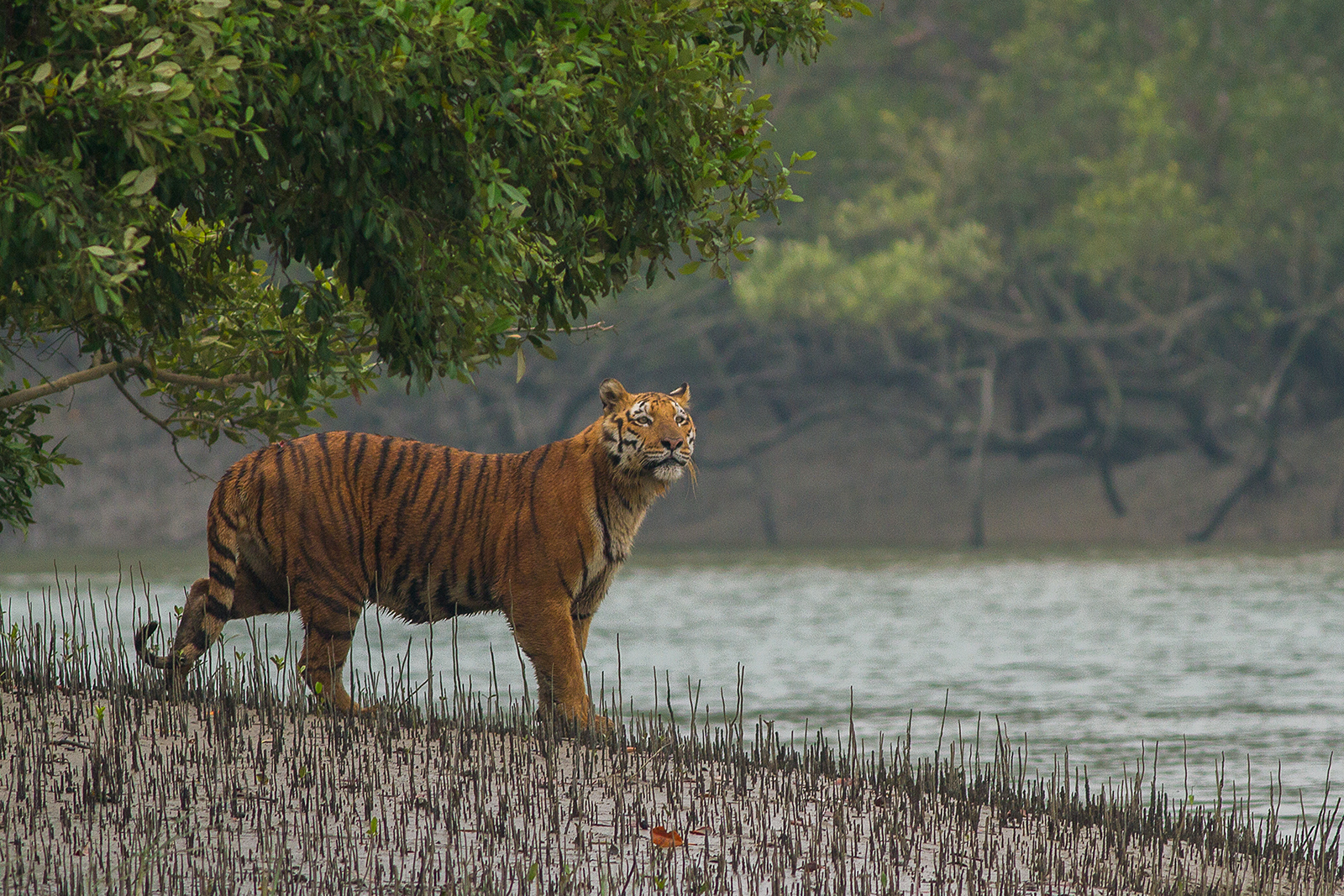
© Soumyajit Nandy, CC BY-SA 4.0 Resized from original. (This derivative is under the same CC BY-SA license.)
World Heritage Research
Discover scientific research and academic studies that deepen our understanding of Sundarbans National Park from its history and significance to its conservation, management, and contemporary challenges.
-
Exploring the Rich Diverse: Freshwater Fish Diversity and Bionomics in the Sundarbans, India
The Sundarbans, a UNESCO-listed mangrove ecosystem spanning India and Bangladesh, harbors remarkable freshwater fish diversity, including 120 species. This review synthesizes existing data on fish bionomics—life history traits such as reproduction, growth, and migration—and their conservation status within the delta formed by the Ganges-Brahmaputra-Meghna rivers. It highlights threats to sustainable fisheries, including habitat degradation and climate change, while emphasizing the ecological importance of mangroves in supporting fish biodiversity. The study also provides a foundational database for future research on life history parameters critical for conservation strategies.
Jana, A., Kumar, A., Lal, J., Mandal, S., Karmakar, S., Bhattacharjee, S., Amrutal, T. M., Singh, K., Acharjya, N. K., & Vaishnav, A. (2024). Exploring the Rich Diverse: Freshwater Fish Diversity and Bionomics in the Sundarbans, India. Journal of Scientific Research and Reports, 30(6), 795–808. https://doi.org/10.9734/jsrr/2024/v30i62096
View Publication Record | Read Publication -
Annual Mangrove Vegetation Cover Changes (2014–2020) in Indian Sundarbans National Park Using Landsat 8 and Google Earth Engine
A six-year analysis of the Sundarbans National Park, using Landsat 8 satellite data and Google Earth Engine, revealed no significant overall change in mangrove vegetation cover between 2014 and 2020. However, coastal regions, particularly the southern end, experienced notable shifts due to land accretion and natural disturbances like cyclones. The study leveraged normalized difference vegetation index (NDVI) and its derivative (dNDVI) to quantify these changes, providing critical insights for long-term monitoring and conservation efforts in this ecologically vital mangrove ecosystem.
Karsch, G., Mukul, S. A., & Srivastava, S. K. (2023). Annual Mangrove Vegetation Cover Changes (2014–2020) in Indian Sundarbans National Park Using Landsat 8 and Google Earth Engine. Sustainability, 15(6), 5592. https://doi.org/10.3390/su15065592
View Publication Record | Read Publication -
A three decade assessment of forest cover changes in Nijhum dwip national park using remote sensing and GIS
Over three decades, the Nijhum Dwip National Park (NDNP), part of the Sundarbans mangrove forest, experienced significant forest cover loss, with more than 42% (1781 ha) deforested between 1990 and 2011. Specifically, nearly 1235 ha and over 856 ha disappeared from an initial 4217.5 ha in 1990 to 2982.5 ha in 2001 and 2126.16 ha in 2011. However, a slight recovery of 310 ha was recorded between 2011 and 2020. The study used Landsat images (1990, 2001, 2011, 2020) with maximum likelihood classification to assess changes, finding that NDVI outperformed SAVI in detecting forest cover shifts. This research highlights the need for continuous monitoring and informed decision-making to protect this critical mangrove ecosystem.
Islam, Md. R., Khan, Md. N. I., Khan, Md. Z., & Roy, B. (2021). A three decade assessment of forest cover changes in Nijhum dwip national park using remote sensing and GIS. Environmental Challenges, 4, 100162. https://doi.org/10.1016/j.envc.2021.100162
View Publication Record | Read Publication -
Ecosystem service assessment of selected wetlands of Kolkata and the Indian Gangetic Delta: multi-beneficial systems under differentiated management stress
A comprehensive ecosystem service assessment of wetlands in the Sundarbans National Park and East Kolkata Wetlands reveals that 32 out of 36 possible ecosystem services are produced across these sites, with significant variations attributed to differing wetland characteristics and management regimes. The study highlights critical gaps in existing literature, particularly in recognizing provisioning, regulating, cultural, and supporting services, and demonstrates the importance of systemic approaches like the Rapid Assessment of Wetland Ecosystem Services (RAWES) in capturing interdependent service production. This method not only supports the protection of ecological character but also challenges the underrepresentation of peri-urban wetlands' values, offering a practical framework for informed decision-making.
Everard, M., Kangabam, R., Tiwari, M. K., McInnes, R., Kumar, R., Talukdar, G. H., Dixon, H., Joshi, P., Allan, R., Joshi, D., & Das, L. (2019). Ecosystem service assessment of selected wetlands of Kolkata and the Indian Gangetic Delta: multi-beneficial systems under differentiated management stress. Wetlands Ecology and Management, 27(2-3), 405–426. https://doi.org/10.1007/s11273-019-09668-1
View Publication Record | Read Publication -
Resident’s Awareness Towards Sustainable Tourism for Ecotourism Destination in Sundarban Forest, Bangladesh
Sustainable tourism, when paired with public awareness, can offer economic and long-term conservation benefits for the Sundarbans, the world's largest contiguous mangrove forest. This study highlights that well-planned ecotourism, combined with resident education, could mitigate threats like deforestation, overfishing, and environmental degradation while supporting local communities and regional economies. The research focuses on addressing the growing human pressure on the Sundarbans, where illegal logging, overfishing, and chemical-intensive agriculture pose significant risks to biodiversity. By analyzing current practices and their impacts, the study suggests that increased awareness among residents—particularly regarding sustainable fishing methods, reduced pesticide use, and waste management—could help preserve this UNESCO World Heritage Site for future generations.
Subrato Sarker. (2018). Resident’s Awareness Towards Sustainable Tourism for Ecotourism Destination in Sundarban Forest, Bangladesh. Pacific International Journal, 1(1), 32–45. https://doi.org/10.55014/pij.v1i1.38
View Publication Record | Read Publication -
Tourism governance in protected areas: investigating the application of the adaptive co-management approach
Adaptive co-management (ACM) significantly enhances governance in protected areas, particularly through its adaptive elements that foster iterative learning among stakeholders. A study on Bangladesh's Lawachara National Park and Sundarbans East Wildlife Sanctuary found that ACM improved key governance principles such as participation, accountability, transparency, power dynamics, rule of law, and social learning. The approach successfully broadened stakeholder engagement and collaboration, with the adaptive component proving most impactful by enabling behavior change and attitude shifts toward conservation. This research provides empirical evidence for developing countries on how ACM can sustainably improve governance in nature-based tourism destinations.
Islam, Md. W., Ruhanen, L., & Ritchie, B. W. (2018). Tourism governance in protected areas: investigating the application of the adaptive co-management approach. Journal of Sustainable Tourism, 26(11), 1890–1908. https://doi.org/10.1080/09669582.2018.1526291
View Publication Record | Read Publication -
Sustainable Hospitality and Tourism as Motors for Development
Sustainable tourism can drive development while preserving biodiversity, as demonstrated by global case studies. The research highlights successful models such as community-based ecotourism in the Amazon and eco-lodges that integrate conservation with economic growth. It explores innovative approaches like integrated circuits for sustainable tourism planning, eco-retrofits in vulnerable regions (e.g., Sundarbans), and stakeholder perspectives in protected areas (e.g., Masai Mara). Key challenges—such as balancing luxury with sustainability or addressing rural ethnic tourism development—are also addressed. The study combines qualitative analyses of diverse projects, including private-communal partnerships, restoration preferences, and volunteer tourism models, to derive actionable insights for policymakers and industry stakeholders.
Legrand, W., Simons-Kaufmann, C., & Sloan, P. (Eds.). (2012). Sustainable Hospitality and Tourism as Motors for Development. https://doi.org/10.4324/9780123851970
View Publication Record | Read Publication -
Status of the Mammal Fauna in Sundarban Tiger Reserve, West Bengal - India
A one-year study conducted from January to December 2010 in the Sundarban Tiger Reserve, West Bengal, revealed significant shrinkage of mangrove swamp habitat and a decline in mammal species due to extensive anthropogenic and natural threats. The research, involving literature review, questionnaires, and ground surveys with frontline forest department staff, recorded 49 extant mammal species, including four globally endangered, four vulnerable, and two near-threatened species according to the IUCN Red List. Alarmingly, 15 species were found only rarely, while six species had become extinct in the last two centuries. Tiger sightings were more frequent in Sajnekhali Wildlife Sanctuary and buffer areas than in the core Sundarban National Park. The study underscores the urgent need for high-priority wildlife conservation, proper implementation of tiger action plans, infrastructural development, and effective joint forest management to preserve this unique ecosystem.
Mallick, J. K. (2011). STATUS OF THE MAMMAL FAUNA IN SUNDARBAN TIGER RESERVE, WEST BENGAL - INDIA. Taprobanica, 3(2), 52–68. https://doi.org/10.47605/tapro.v3i2.48
View Publication Record | Read Publication