
Sun Temple, Konârak


World Heritage Identification Number: 246

World Heritage since: 1984

Category: Cultural Heritage

WHE Type: Religious Sites & Sacred Architecture

Transboundary Heritage: No

Endangered Heritage: No

Country: 🇮🇳 India

Continent: Asia

UNESCO World Region: Asia and the Pacific

Map

Sun Temple, Konarak: A Monumental Representation of the Sun God Surya

The Sun Temple at Konarak, located on the eastern coast of India in the state of Odisha, is a remarkable testament to the architectural prowess and artistic brilliance of ancient Indian craftsmanship. Inscribed as a UNESCO World Heritage Site in 1984, this 13th-century temple is dedicated to the Sun God, Surya, and stands as a significant example of the Odisha or Kalinga architectural style.

More to come…

UNESCO Description of the World Heritage Site

On the shores of the Bay of Bengal, bathed in the rays of the rising sun, the temple at Konarak is a monumental representation of the sun god Surya's chariot; its 24 wheels are decorated with symbolic designs and it is led by a team of six horses. Built in the 13th century, it is one of India's most famous Brahman sanctuaries.

UNESCO Justification of the World Heritage Site

Criterion (i): A unique artistic achievement, the temple has raised up those lovely legends which are affiliated everywhere with absolute works of art: its construction caused the mobilization of 1,200 workers for 12 years. The architect, Bisu Moharana, having left his birthplace to devote himself to his work, became the father of a son while he was away. This son, in his turn, became part of the workshop and after having constructed the cupola of the temple, which his father was unable to complete, immolated himself by jumping into space.

Criterion (iii): Konârak is an outstanding testimony to the 13th-century kingdom of Orissa.

Criterion (vi): Directly and materially linked to the Brahman beliefs, Konârak is the invaluable link in the history of the diffusion of the cult of Surya, which originating in Kashmir during the 8th century, finally reached the shores of Eastern India.

Encyclopedia Record: Konark Sun Temple

Konark Sun Temple is a 13th-century CE Hindu Sun temple at Konark about 35 kilometres (22 mi) northeast from Puri city on the coastline in Puri district, Odisha, India. The temple is attributed to king Narasingha Deva I of the Eastern Ganga dynasty about 1250 CE. It is the pinnacle of Hindu Orissan architecture. Dedicated to the Hindu Sun-god Surya, it reflects the pinnacle of kalingan architecture and artistic excellence, what remains of the temple complex has the appearance of a 100-foot (30 m) high chariot with immense wheels and horses, all carved from stone. Once over 200 feet (61 m) high, much of the temple is now in ruins, in particular the large shikara tower over the sanctuary; at one time this rose much higher than the mandapa that remains. The structures and elements that have survived are famed for their intricate artwork, iconography, and themes, including erotic kama and mithuna scenes. Also called the Surya Devalaya, it is a classic illustration of the Odisha style of Architecture or Kalinga architecture.

Read more on Wikipedia

Additional Site Details

Area: 10.62 hectares

Number of Components: 1

UNESCO Criteria: (i) — Masterpiece of human creative genius
(iii) — Unique or exceptional testimony to a cultural tradition
(vi) — Directly associated with events or living traditions

Coordinates: 19.8875 , 86.09472

Image
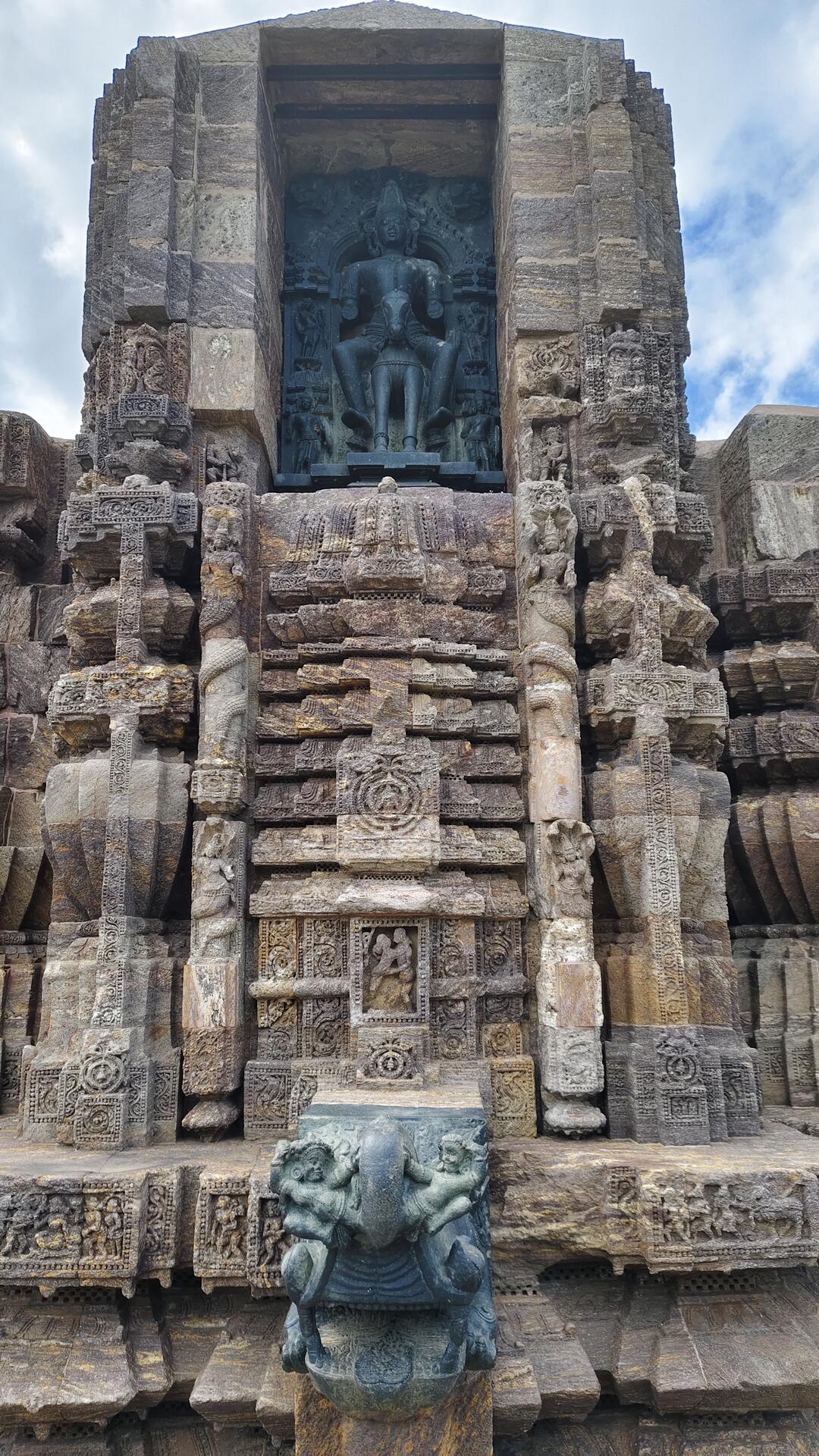
Image of Sun Temple, Konârak

© Aliva Sahoo, CC BY-SA 4.0 Resized from original. (This derivative is under the same CC BY-SA license.)

World Heritage Research

Discover scientific research and academic studies that deepen our understanding of Sun Temple, Konârak from its history and significance to its conservation, management, and contemporary challenges.

  • Cultural identity, does it matter? A study on Konark Sun Temple, India

    Cultural identity significantly enhances the economic value and moderately influences emotional value and destination loyalty intentions among visitors to the Konark Sun Temple, India. This study, using structural equation modeling, reveals that cultural identity plays a pivotal role in shaping visitor behavior and commitment, offering valuable insights for both theoretical frameworks and practical applications in tourism marketing. The findings underscore the importance of leveraging cultural heritage to foster economic growth and emotional connections with destinations.

    Verma, A. (2024). Cultural identity, does it matter? A study on Konark Sun Temple, India. Asia Pacific Journal of Tourism Research, 29(10), 1254–1271. https://doi.org/10.1080/10941665.2024.2379323

    View Publication Record | Read Publication
  • Staging Statecraft: Dance Festivals and Cultural Representations in Konark, Odisha, India

    Dance festivals at the UNESCO World Heritage-listed Sun Temple of Konark, India, serve as choreographed spaces that shape cultural heritage and statecraft. The study reveals how these festivals juxtapose the temple's archaeological value with the cultural significance of dance, raising critical questions about negotiations, appropriations, and discomfort inherent in such processes. It also examines broader cultural discourses, including historical, diplomatic, and touristic networks, influenced by the festival. Through ethnography, visual analysis, and choreographic examination, the research explores how Odissi dance—remodeled into a state-recognized classical form post-1936—has become an anthropomorphic symbol of Odisha's geopolitical identity. This work highlights the representational aspects of regional-state dynamics in dance, which inform the staging of the Konark Dance Festival.

    Banerjee, M. (2024). Staging Statecraft: Dance Festivals and Cultural Representations in Konark, Odisha, India. Arts, 13(6), 166. https://doi.org/10.3390/arts13060166

    View Publication Record | Read Publication
  • Study on Art and Architectural Pattern of the Sun Temple of Konark in Eastern India

    The Sun Temple of Konârak, a UNESCO World Heritage Site in Odisha, India, stands as a monumental example of Kalinga-style architecture, designed to resemble the chariot of the Sun God. Its unique eastward slope ensures that the first light of dawn strikes its main entrance, flanked by massive lions crushing an elephant and a man beneath them. The temple's exterior is adorned with intricate carvings depicting erotica, mythical creatures, warriors, and animals, while its interior features notable sculptures like the 'Mithuna.' Despite a partial collapse in 1837 due to structural and soil issues, remnants of the Vimana (main sanctum), Jagamohana (porch), and Nata Mandir (Dancing Hall) provide insights into its original grandeur. The study highlights the temple's significance as part of Odisha's 'golden triangle,' alongside other historic sites like Jagannath Puri and Bhubaneswar Lingaraj Temple. Additionally, the nearby Navagraha Temple houses a chlorite stone slab with carvings of the nine planets, originally displayed above the main entrance.

    Mohapatra, R. (2023). STUDY ON ART AND ARCHITECTURAL PATTERN OF THE SUN TEMPLE OF KONARK IN EASTERN INDIA. ShodhKosh: Journal of Visual and Performing Arts, 4(1). https://doi.org/10.29121/shodhkosh.v4.i1.2023.2211

    View Publication Record | Read Publication
  • The Study on Socio-Economic Impacts of Tourism in the Golden Triangle of Odisha

    Odisha's Golden Triangle, encompassing Puri, Konark, and Bhubaneswar, holds significant potential as a tourist destination due to its rich cultural and natural heritage. However, despite attracting millions of visitors annually—particularly for religious pilgrimages like the Sun Temple at Konark—a marked increase in visitor numbers has not been realized. This study reveals that while Odisha boasts iconic landmarks such as the Jagannath Temple in Puri, the Lingaraj Temple in Bhubaneswar, and the UNESCO-listed Sun Temple, its tourism growth remains underutilized relative to its assets. The research employs a socio-economic analysis to assess the impacts of tourism in this region, highlighting both opportunities and challenges. By examining visitor trends, economic contributions, and cultural significance, it underscores the need for strategic development to unlock Odisha's full tourism potential.

    MOHANTY, R., & SAMAL, A. (2023). The Study on Socio-Economic Impacts of Tourism in the Golden Triangle of Odisha. Theoretical and Practical Research in the Economic Fields, 14(1), 94. https://doi.org/10.14505/tpref.v14.1(27).09

    View Publication Record | Read Publication
  • Konark Sun Temple

    A critical assessment of the Konark Sun Temple's conservation needs, based on unpublished 1997 observations by M.N. Deshpande and colleagues, highlights urgent structural vulnerabilities and proposes evidence-based strategies for preserving this UNESCO World Heritage Site. The study emphasizes the necessity for targeted interventions that address both aesthetic degradation and structural instability while maintaining historical integrity. By analyzing architectural deterioration patterns and environmental impacts, the research offers a framework for sustainable conservation, balancing scientific rigor with cultural heritage preservation.

    Lahiri, N. (2021). Konark Sun Temple. Archaeology and the Public Purpose, 280–284. https://doi.org/10.1093/oso/9780190130480.003.0021

    View Publication Record | Read Publication
  • Original Anatomy of the Temple: Sun Temple Konark, India

    The Sun Temple of Konark, a magnificent example of India's ancient architecture, was originally designed with intricate geometric planning, spatial arrangements, and elaborate sculptures. Despite its current ruined state, the remaining foundations and ornate carvings reveal exceptional architectural details, including sundials and reliefs that highlight its historical significance. Built by King Narasimhadeva I to glorify the Sun god 'Surya Dev,' this temple once stood as a symbol of devotion and power in Kalinga (modern-day Odisha). The study reconstructs its original anatomy, focusing on its design, ornamentation, and spatial organization, offering insights into its former grandeur.

    Joshi, A., & Srivastava, A. (2021). Original Anatomy of the Temple: Sun Temple Konark, India. International Journal of Architectural Heritage. https://doi.org/10.37628/.v4i2.862

    View Publication Record | Read Publication
  • Lichens growth on Sun Temple of Konark in Odisha, India- A curse or blessing

    A survey of lichen growth on the Sun Temple at Konark, Odisha, revealed over 500 distinct spots across the main temple, sculptures, and boundary walls. Fifteen lichen species from 14 genera and 11 families were identified, with crustose lichens dominating—ten species tightly adhering to substrates and producing secondary metabolites—while only four foliose and one quamulose species were recorded. The study suggests that while lichen growth may be perceived as a curse due to potential substrate degradation, it also signifies ecological resilience and biodiversity within this UNESCO World Heritage Site.

    Nayak, S. K., Behera, P. K., Bajpai, R., Upreti, D. K., & Satapathy, K. B. (2017). Lichens growth on Sun Temple of Konark in Odisha, India- A curse or blessing. Cryptogam Biodiversity and Assessment, 2(02). https://doi.org/10.21756/cab.v2i02.10817

    View Publication Record | Read Publication
  • Multi-Pronged Search for Palaeo-Channels near Konark Temple, Odisha - Implications for the Mythical River Chandrabhaga

    A multi-disciplinary investigation reveals the likely presence of a palaeo-channel near the 13th-century Konark Sun Temple, Odisha, India, supporting historical accounts of the mythical River Chandrabhaga. Using remote sensing data (Landsat, ASTER Terra Look, and SRTM images), thematic mapping, GIS analysis, and ground-penetrating radar (GPR), researchers delineated a probable palaeo-channel extending north of the temple, parallel to the coast. This finding aligns with ancient literature describing Chandrabhaga as a river flowing near Konark, now absent from the region. The study combines geological, geophysical, and historical evidence, offering new insights into the temple's historical context and the fate of this legendary river.

    Jana, S., Mohanty, W. K., Gupta, S., Rath, C. S., Behera, R. R., & Patnaik, P. (2016). Multi-Pronged Search for Palaeo-Channels near Konark Temple, Odisha - Implications for the Mythical River Chandrabhaga. Current Science, 111(8), 1387. https://doi.org/10.18520/cs/v111/i8/1387-1393

    View Publication Record | Read Publication
  • Sun Temple Konark Orissa, India

    The Sun Temple at Konârak, India, stands as a remarkable architectural marvel designed to align with the sun's first rays, symbolizing its celestial significance. Built by King Langula Nar Singh Dev around 1200 AD, this 'black pagoda' is structured in the form of a chariot pulled by eight horses, reflecting advanced engineering and artistic innovation of the era. The temple's design ensures that sunlight illuminates its sanctum at dawn, underscoring its spiritual and astronomical importance. This study highlights the temple's unique alignment and symbolic representation, offering insights into ancient Kalinga's architectural prowess and cultural heritage.

    Das, K. (2015). Sun Temple Konark Orissa, India. Spine, 40(5), i. https://doi.org/10.1097/01.brs.0000461891.76737.29

    View Publication Record | Read Publication

About World Heritage Explorer

World Heritage Explorer is an independent educational project designed to uncover and share the richness of our world’s cultural and natural heritage. Dive into detailed site profiles, immersive imagery, interactive maps, and tools that help you explore UNESCO World Heritage Sites across the globe. Drawing extensively on open data sources, the project delivers authoritative, well-structured information for learners, educators, travelers, and younger explorers alike.

Learn more about the project

Nearby World Heritage Sites

Sundarbans National Park
370 km — India
The Sundarbans
394 km — Bangladesh
Santiniketan
453 km — India
Historic Mosque City of Bagerhat
493 km — Bangladesh
Mahabodhi Temple Complex at Bodh Gaya
546 km — India
Flag of India

India and the World Heritage Convention

State Party since: November 14, 1977

Status: Ratification

Mandates to the World Heritage Committee: 1985-1991, 2001-2007, 2011-2015, 2021-2025

Total of Mandate Years: 20

Total of Mandates: 4

WHC Electoral Group: IV (Asia/Pacific)

Learn more about India

Weather at the World Heritage Site

Last updated: September 8, 2026

Portions of the page Sun Temple, Konârak are based on data from UNESCO — World Heritage List Dataset and on text from the Wikipedia article Konark Sun Temple, licensed under CC BY-SA 4.0. Changes made. Additional original content by World Heritage Explorer (WHE), licensed under CC BY-SA 4.0. WHE is not affiliated with UNESCO or the World Heritage Committee. Legal Notice. Privacy Policy.

Open Data for an Open World