
World Heritage Identification Number: 798
World Heritage since: 1997
Category: Natural Heritage
WHE Type: Protected Areas & National Parks
Transboundary Heritage: No
Endangered Heritage: No
Country: 🇧🇩 Bangladesh
Continent: Asia
UNESCO World Region: Asia and the Pacific
Map
The Sundarbans: A Unique Mangrove Forest Ecosystem in South Asia
The Sundarbans, located in the Bay of Bengal, is a remarkable mangrove forest that straddles the border between India and Bangladesh. This extensive forest, covering approximately 10,000 square miles, is the world's largest single block of mangrove forest, making it a significant global ecosystem.
More to come…UNESCO Description of the World Heritage Site
The Sundarbans mangrove forest, one of the largest such forests in the world (140,000 ha), lies on the delta of the Ganges, Brahmaputra and Meghna rivers on the Bay of Bengal. It is adjacent to the border of India’s Sundarbans World Heritage site inscribed in 1987. The site is intersected by a complex network of tidal waterways, mudflats and small islands of salt-tolerant mangrove forests, and presents an excellent example of ongoing ecological processes. The area is known for its wide range of fauna, including 260 bird species, the Bengal tiger and other threatened species such as the estuarine crocodile and the Indian python.
UNESCO Justification of the World Heritage Site
Criterion (ix): The Sundarbans provides a significant example of on-going ecological processes as it represents the process of delta formation and the subsequent colonization of the newly formed deltaic islands and associated mangrove communities. These processes include monsoon rains, flooding, delta formation, tidal influence and plant colonization. As part of the world’s largest delta, formed from sediments deposited by three great rivers; the Ganges, Brahmaputra and Meghna, and covering the Bengal Basin, the land has been moulded by tidal action, resulting in a distinctive physiology.
Criterion (x): One of the largest remaining areas of mangroves in the world, the Sundarbans supports an exceptional level of biodiversity in both the terrestrial and marine environments, including significant populations of globally endangered cat species, such as the Royal Bengal Tiger. Population censuses of Royal Bengal Tigers estimate a population of between 400 to 450 individuals, a higher density than any other population of tigers in the world. The property is the only remaining habitat in the lower Bengal Basin for a wide variety of faunal species. Its exceptional biodiversity is expressed in a wide range of flora; 334 plant species belonging to 245 genera and 75 families, 165 algae and 13 orchid species. It is also rich in fauna with 693 species of wildlife which includes; 49 mammals, 59 reptiles, 8 amphibians, 210 white fishes, 24 shrimps, 14 crabs and 43 mollusks species. The varied and colourful bird-life found along the waterways of the property is one of its greatest attractions, including 315 species of waterfowl, raptors and forest birds including nine species of kingfisher and the magnificent white-bellied sea eagle.
Encyclopedia Record: Sundarbans
Sundarbans is a mangrove forest area in the Ganges Delta formed by the confluence of the Ganges, Brahmaputra and Meghna Rivers in the Bay of Bengal. It spans the area from the Hooghly River in India's state of West Bengal to the Baleswar River in Bangladesh's Khulna Division. It comprises closed and open mangrove forests, land used for agricultural purpose, mudflats and barren land, and is intersected by multiple tidal streams and channels. Spread across 10,277 km2 (3,968 sq mi), it is the world's largest mangrove forest. It covers over 6,017 km2 (2,323 sq mi) in Bangladesh's Khulna Division. In West Bengal's Presidency division, they extend over 4,260 km2 (1,640 sq mi) in the South 24 Parganas and North 24 Parganas districts. Four protected areas in the Sundarbans are enlisted as UNESCO World Heritage Sites, viz. Sundarbans West, Sundarbans South, Sundarbans East in Bangladesh and Sundarbans National Park in India. The Indian Sundarbans were considered endangered in a 2020 assessment under the IUCN Red List of Ecosystems framework. The most abundant tree species are sundri and gewa. The forests provide habitat to 453 fauna wildlife, including 290 bird, 120 fish, 42 mammal, 35 reptile and eight amphibian species. Despite a total ban on all killing or capture of wildlife other than fish and some invertebrates, there has been a consistent pattern of depleted biodiversity or loss of species in the 20th century, with the ecological quality of the forest declining.Additional Site Details
Area: 139,500 hectares
Number of Components: 3
(x) — Contains most important habitats for biodiversity
Coordinates: 21.95 , 89.18333
IUCN World Heritage Outlook
The 2025 Conservation Outlook on The Sundarbans reports the following assessment:
Source: International Union for Conservation of Nature (IUCN) · View assessment
Image
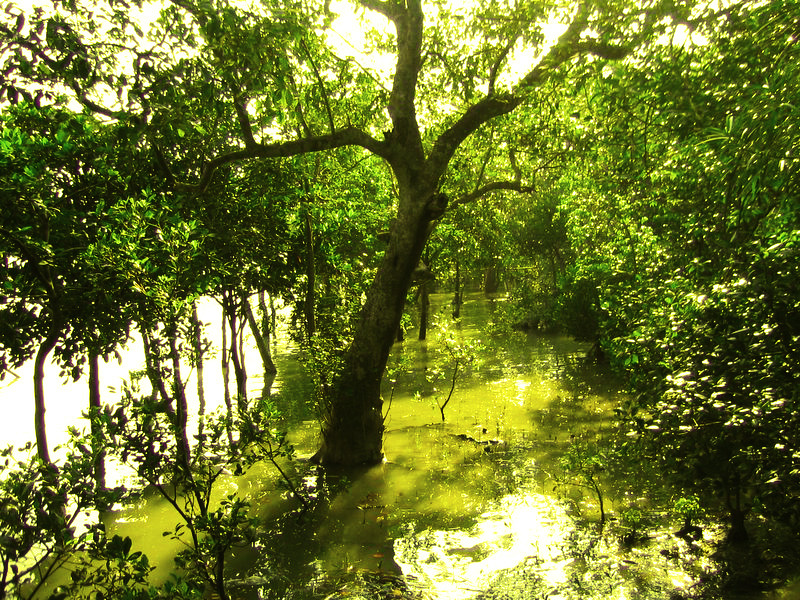
© Monster eagle, CC BY-SA 3.0 Resized from original. (This derivative is under the same CC BY-SA license.)
World Heritage Research
Discover scientific research and academic studies that deepen our understanding of The Sundarbans from its history and significance to its conservation, management, and contemporary challenges.
-
Drivers of mangrove ecosystem service change in the Sundarbans of Bangladesh
A significant decline in ecosystem services provided by the Sundarbans mangrove forest, driven by climatic change, rapid environmental shifts, global demand for mangrove products, infrastructure development, and governance failures, has been identified. The study, conducted through secondary data analysis and primary fieldwork across three districts in Bangladesh, reveals that most ecosystem services have deteriorated over the past two decades. Time series analysis and community perceptions highlighted these drivers, emphasizing the urgent need for transformative stewardship to mitigate irreversible environmental impacts.
Islam, M. M., Sunny, A. R., Hossain, M. M., & Friess, D. A. (2018). Drivers of mangrove ecosystem service change in the Sundarbans of Bangladesh. Singapore Journal of Tropical Geography, 39(2), 244–265. Portico. https://doi.org/10.1111/sjtg.12241
View Publication Record | Read Publication -
Bangladesh Sundarbans: Present Status of the Environment and Biota
A significant decline in sediment-laden freshwater discharge through the Bangladesh Sundarbans Mangrove Forests (BSMF) since the Farakka Barrage's operation in 1975 has led to increased polyhaline conditions, threatening the growth and distribution of Heritiera fomes (sundri), a commercially important mangrove. This study reveals that the BSMF has lost approximately 66 km² of forestland, with a decrease in tree cover from 296 plants per hectare in 1959 to 144 by 1996 and a projected further decline to 109 plants per hectare by 2020. The research utilized Landsat satellite data and GIS analysis from 1970s to 2010, demonstrating that reduced freshwater discharge has altered the mangrove ecosystem, favoring less commercially valuable species like Bruguiera sexangula, Excoecaria agallocha, and Sonneratia apetala. The study suggests restoring pre-1975 sediment flow conditions through water sharing agreements and dredging to mitigate salinity and erosion, potentially funding such efforts through carbon trading, given the BSMF's substantial carbon reserve of 56 million metric tons.
Aziz, A., & Paul, A. (2015). Bangladesh Sundarbans: Present Status of the Environment and Biota. Diversity, 7(3), 242–269. https://doi.org/10.3390/d7030242
View Publication Record | Read Publication -
The Indian Sundarban Mangrove Forests: History, Utilization, Conservation Strategies and Local Perception
Despite maintaining its vast extent, the Indian Sundarbans mangrove forest has experienced significant changes in health and structure over the past two-and-a-half centuries due to human interference, upstream development, extreme weather events, and climate change effects. This study reveals that while the areal coverage of the mangroves has remained relatively stable recently, their ecological integrity is under threat. Researchers used a multi-temporal and multi-scale approach, combining historical maps and remote sensing data, to trace these changes. The findings underscore the complex interplay between conservation strategies, local livelihoods, and environmental pressures, highlighting the need for adaptive management to protect this critical ecosystem.
Ghosh, A., Schmidt, S., Fickert, T., & Nüsser, M. (2015). The Indian Sundarban Mangrove Forests: History, Utilization, Conservation Strategies and Local Perception. Diversity, 7(2), 149–169. https://doi.org/10.3390/d7020149
View Publication Record | Read Publication -
Dynamics of Sundarban estuarine ecosystem: eutrophication induced threat to mangroves
Eutrophication poses a significant threat to the Sundarbans, the world's largest mangrove forest and only tiger habitat. A 2010 study revealed that high nutrient levels, particularly during winter, led to eutrophic conditions (Chlorophyll-a ≥10 μg/L), which negatively impacted phytoplankton biomass and species diversity. The research identified diatoms as the dominant phytoplankton group, with 46 taxa recorded across six groups. Key findings included the presence of bio-indicator species such as Polykrikos schwartzil and Dinophysis norvegica, signaling moderately polluted water quality. The study also highlighted that high salinity levels (21.2PSU) in May favored more resilient phytoplankton species. These insights underscore the deteriorating marine status of the Sundarban estuary, which threatens the ecology of this UNESCO World Heritage Site and raises concerns about the sustainability of its mangroves.
Manna, S., Chaudhuri, K., Bhattacharyya, S., & Bhattacharyya, M. (2010). Dynamics of Sundarban estuarine ecosystem: eutrophication induced threat to mangroves. Saline Systems, 6(1). https://doi.org/10.1186/1746-1448-6-8
View Publication Record | Read Publication
