World Heritage Identification Number: 347
World Heritage since: 1985
Category: Cultural Heritage
WHE Type: Religious Sites & Sacred Architecture
Transboundary Heritage: No
Endangered Heritage: No
Country: 🇪🇸 Spain
Continent: Europe
UNESCO World Region: Europe and North America
Map
Santiago de Compostela (Old Town): A Spiritual and Architectural Gem in Northwest Spain
The Old Town of Santiago de Compostela, located in the autonomous community of Galicia in northwest Spain, stands as a testament to the rich history, spiritual significance, and architectural prowess of the Iberian Peninsula. Inscribed as a UNESCO World Heritage Site in 1985, this urban area has captivated visitors for centuries with its intricate blend of Romanesque, Gothic, and Baroque structures, making it one of Europe’s most remarkable historic urban landscapes.
The Old Town's claim to fame revolves around the tomb of Saint James the Great, traditionally believed to be the apostle who preached Christianity in the Iberian Peninsula. According to Christian legend, his remains were discovered in the 9th century, leading to the establishment of Santiago de Compostela as a major pilgrimage destination. Over time, the city became one of the three principal Christian pilgrimage centres—alongside Rome and Jerusalem—and the focal point of the vast network of routes known as the Camino de Santiago, which connected it to the rest of medieval Europe.
The Camino de Santiago routes are recognized by UNESCO through two separate World Heritage inscriptions: in Spain, inscribed in 1993 as the “Routes of Santiago de Compostela: Camino Francés and Routes of Northern Spain,” and in France, inscribed in 1998 as the “Routes of Santiago de Compostela in France.” Pilgrims traveling along these routes from across Europe converged on Santiago de Compostela, bringing with them artistic influences, religious practices, and rich cultural exchange. As the culmination of this extensive network, the city grew into a major spiritual, architectural, and cultural center, shaped over centuries by the constant flow of pilgrims.
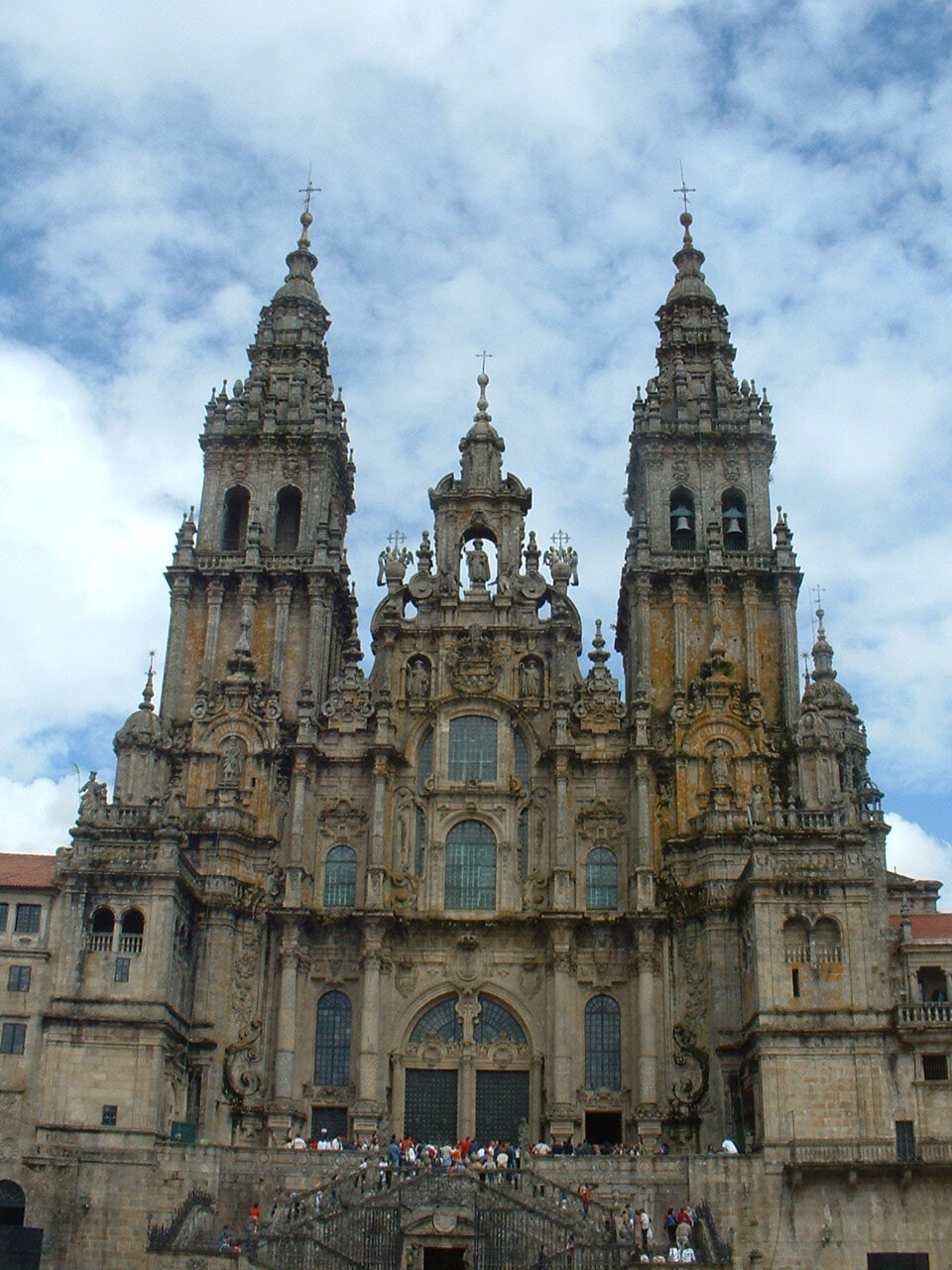
The heart of the Old Town lies around the Cathedral of Santiago de Compostela, a masterpiece of Romanesque architecture that dates back to the 11th century, with later Gothic and Baroque additions. One of its most notable features is the Pórtico de la Gloria, an elaborately carved sculptural ensemble depicting biblical figures in extraordinary detail. This remarkable work is attributed to Master Mateo, one of the leading artists of the Middle Ages.
Beyond the cathedral, the Old Town offers a wealth of other historical landmarks. Among them is the Monastery of San Martiño Pinario, one of the largest monastic complexes in Spain, and the Church of San Francisco, known for its later architectural transformations. The historic university buildings and former ecclesiastical institutions further reflect the city’s long-standing religious and intellectual importance.
The Old Town's layout reflects its long and storied past. Its narrow, winding streets, known as "rúas," are lined with traditional Galician buildings shaped by centuries of development. These cobbled streets open onto historic squares such as the Praza do Obradoiro, where the cathedral stands majestically, and the Praza da Quintana, closely linked to the cathedral complex.
In addition to its architectural beauty, Santiago de Compostela's Old Town boasts a vibrant cultural scene. The city plays host to numerous festivals throughout the year, including the annual Feast of Saint James, which attracts thousands of pilgrims from around the world. Visitors can also enjoy local cuisine, such as pulpo a feira (octopus dish), empanadas gallegas (Galician pasties), and albariño wine, while exploring the Old Town's bustling markets and lively tapas bars.
Today, Santiago de Compostela's Old Town continues to attract visitors seeking spiritual experience, historical insight, and architectural richness. Its enduring role as the culmination of the Camino de Santiago, combined with its well-preserved urban fabric, makes it one of Europe’s most significant cultural destinations.
UNESCO Description of the World Heritage Site
This famous pilgrimage site in north-west Spain became a symbol in the Spanish Christians' struggle against Islam. Destroyed by the Muslims at the end of the 10th century, it was completely rebuilt in the following century. With its Romanesque, Gothic and Baroque buildings, the Old Town of Santiago is one of the world's most beautiful urban areas. The oldest monuments are grouped around the tomb of St James and the cathedral, which contains the remarkable Pórtico de la Gloria.
UNESCO Justification of the World Heritage Site
Criterion (i): Around its cathedral, which is a world renowned masterpiece of Romanesque art, Santiago de Compostela conserves a valuable historic centre, known as one of Christianity´s greatest holy cities. All European cultural and artistic currents, from the Middle Ages to the present day, left extraordinary works of art in Santiago de Compostela.
Criterion (ii): During both the Romanesque and Baroque periods, the sanctuary of Santiago de Compostela exerted a decisive influence on the development of architecture and art, not only in Galicia, but also in the north of the Iberian Peninsula.
Criterion (vi): Santiago de Compostela is associated with one of the major themes of medieval history. From the shores of the North and Baltic Seas, thousands of pilgrims carrying the symbol of the scallop and the pilgrim's staff walked, for centuries, to the Galician sanctuary along the paths of Santiago de Compostela, veritable roads of the Faith.
Encyclopedia Record: Old Town of Santiago de Compostela
The Old Town of Santiago de Compostela is an urban area of the Galician capital that is characterized by its ancient and monumental architecture.Additional Site Details
Area: 107.59 hectares
Number of Components: 2
(ii) — Significant interchange of human values
(vi) — Directly associated with events or living traditions
Coordinates: 42.88076 , -8.54468
Image
© Vasco Roxo, CC BY-SA 3.0 Resized from original. (This derivative is under the same CC BY-SA license.)
World Heritage Research
Discover scientific research and academic studies that deepen our understanding of Santiago de Compostela (Old Town) from its history and significance to its conservation, management, and contemporary challenges.
-
Cathedrals in the Digital Age: a Case Study of Santiago de Compostela and Canterbury
Information and Communication Technologies (ICT) have become pivotal in modern tourism strategies, particularly for UNESCO World Heritage Sites like Santiago de Compostela's Old Town. A study comparing the cathedrals of Santiago de Compostela and Canterbury reveals that both sites leverage digital tools to attract tourists, with a notable increase in online visits and ICT service provision since 2010. These technologies have transformed the way information is shared and managed, reflecting the shift towards 'smart cities' and modern travel practices. Despite significant changes from historical pilgrimage routes, these cathedrals remain prominent cultural and religious destinations, drawing vast numbers of visitors. The research highlights the adaptability of ancient attractions in embracing digital advancements while maintaining their historical significance.
Santomil, D., & O’Donoghue, D. (2016). Cathedrals in the Digital Age: a Case Study of Santiago de Compostela and Canterbury. Journal of Tourism and Hospitality Management, 4(1). https://doi.org/10.15640/jthm.v4n1a2
View Publication Record | Read Publication -
‘When Going to Saint James’: An Old Russian Graffito from the 12th Century in Aquitania
A significant epigraphic discovery from the 12th century provides direct evidence of Russian pilgrimages to Santiago de Compostela. An Old Russian graffito, inscribed by Ivan Zavidovich on the wall of St. Vivien church in Pons (France), reads: 'Ivan Zavidovich wrote this when going to Saint James.' The inscription, dated to the 1160s–1180s, is the second such finding in France and offers valuable insights into medieval pilgrimage routes and cultural exchanges between Eastern Europe and Western Christendom. The study combines palaeographic analysis with historical context, linking the name Zavidovich to Novgorod boyars and highlighting the shrine's prominence in Old Russia.
Gordin, A. M., & Rozhdestvenskaya, T. V. (2016). ‘When Going to Saint James’: An Old Russian Graffito from the 12th Century in Aquitania. Slovene, 5(1), 126–147. https://doi.org/10.31168/2305-6754.2016.5.1.4
View Publication Record | Read Publication