World Heritage Identification Number: 803
World Heritage since: 1997
Category: Cultural Heritage
WHE Type: Archaeological Sites
Transboundary Heritage: No
Endangered Heritage: No
Country: 🇪🇸 Spain
Continent: Europe
UNESCO World Region: Europe and North America
Map
The Ancient Gold Mining Landscape of Las Médulas: A UNESCO World Heritage Site
The ancient gold mining landscape of Las Médulas, located in the north-western region of Spain, stands as a testament to the ingenuity and ambition of the Roman Empire. This historic site, inscribed as a UNESCO World Heritage Site in 1997, offers a unique insight into the mining techniques employed during the 1st century AD.
More to come…UNESCO Description of the World Heritage Site
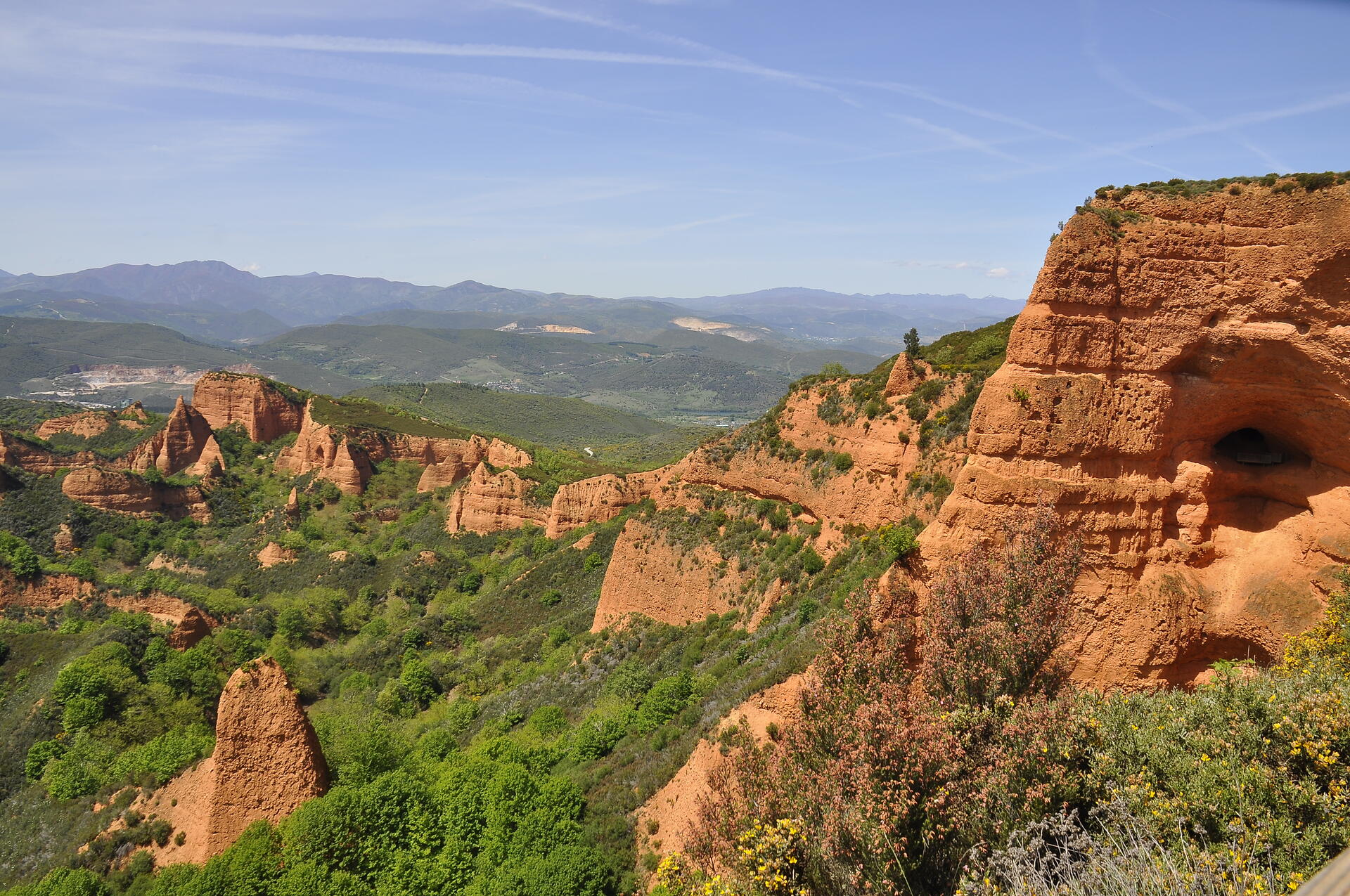
In the 1st century A.D. the Roman Imperial authorities began to exploit the gold deposits of this region in north-west Spain, using a technique based on hydraulic power. After two centuries of working the deposits, the Romans withdrew, leaving a devastated landscape. Since there was no subsequent industrial activity, the dramatic traces of this remarkable ancient technology are visible everywhere as sheer faces in the mountainsides and the vast areas of tailings, now used for agriculture.
UNESCO Justification of the World Heritage Site
Criterion (i): Las Médulas is a major work of human creative genius in the field of mining, and specifically the technology of ruina montium, the application of water power, and systems of gold mining on a scale, efficiency, and economic importance that were of decisive economic importance for the Roman Empire in the first two centuries AD.
Criterion (ii): Las Médulas is a remarkable example of the application of Roman mining techniques to exploit precious metals. It is exceptional that subsequent works, which have largely destroyed such evidence elsewhere, were here limited or non-existent, so that this property is unquestionably the best preserved and most representative of all the mining areas of the Greco-Roman world in classical times.
Criterion (iii): The Roman gold-mining operations in the Las Médulas area were the most extensive ones in Antiquity. The spectacular remains illustrate both the remarkable technology and the administration of this Imperial estate in every detail.
Criterion (iv): The Las Médulas gold-mining area is an outstanding example of innovative Roman technology, in which all the elements of the ancient landscape, both industrial and domestic, have survived to an exceptional degree.
Encyclopedia Record: Las Médulas
Las Médulas is a historic gold-mining site near the town of Ponferrada in the comarca of El Bierzo. It was the most important gold mine, as well as the largest open-pit gold mine, in the entire Roman Empire. Las Médulas Cultural Landscape is listed by UNESCO as a World Heritage Site. Advanced aerial surveys conducted in 2014 using LIDAR have confirmed the wide extent of the Roman-era works.Additional Site Details
Area: 2,208.2 hectares
Number of Components: 4
(ii) — Significant interchange of human values
(iii) — Unique or exceptional testimony to a cultural tradition
(iv) — Outstanding example of a type of building or landscape
Coordinates: 42.46939 , -6.77075
World Heritage Research
Discover scientific research and academic studies that deepen our understanding of Las Médulas from its history and significance to its conservation, management, and contemporary challenges.
-
El patrimonio Industrial y Minero
Patrimonio industrial y minero emerges as a strategic tool for sustainable territorial development, offering a multidisciplinary approach to revitalize post-industrial and depopulated regions. The work demonstrates that material and immaterial legacies—such as landscapes, infrastructures, worker culture, collective memory, and technological heritage—can be leveraged for economic, cultural, and social regeneration. Through case studies like Las Médulas (a Roman gold-mining site), the book illustrates how conservation can integrate with contemporary projects, including sustainable tourism and knowledge transfer. Coordinated by the Cátedra de Territorios Sostenibles y Desarrollo Local at UNED, this critical reflection challenges traditional notions of industrial heritage, advocating for an inclusive vision that bridges history, technology, landscape, and community to shape the future of post-industrial territories.
Balado Insunza, F. M. (2026). El patrimonio Industrial y Minero. https://doi.org/10.14679/4997
View Publication Record | Read Publication -
Patrimonio mundial en contextos rurales. Reflexiones y recomendaciones para su gestión (v. 2.0)
A collaborative effort among nine UNESCO World Heritage Sites (WHS) in rural Spain and Portugal has identified three critical challenges: climate change, depopulation, and sustainable management. The study, led by the Ministry of Culture of Spain and focusing on Las Médulas—a unique WHS in León—highlights practical measures implemented to address these issues. These include strategies for resilience against environmental changes, community engagement to combat rural decline, and the adoption of sustainable practices that balance conservation with economic viability. This research provides actionable insights for other rural WHS facing similar pressures, emphasizing the need for adaptive management frameworks that integrate ecological, social, and cultural dimensions.
Andonegui Navarro, Mariola, Chaín Pérez, Manuel, Corpas Cívicos, Nekbet, Fernández Palacios, Alfonso, Fuentes Ferrera, Demetrio, Jiménez Díaz, Pablo E., Jurado Merchán, Raquel, Orejas Saco del Valle, Almudena, Posse, Patrícia, Rivero González, Carolina M., Romero Perona, Damián, Royo Lasarte, José, Serpa, Vanda MA., Teles, Helena, & Trasobares Ruiz, Victoria E. (2026). Patrimonio mundial en contextos rurales. Reflexiones y recomendaciones para su gestión (v. 2.0). DIGITAL.CSIC. https://doi.org/10.20350/DIGITALCSIC/18543
View Publication Record | Read Publication -
Mining Heritage: Characteristics. Value. Potential. Romanian Tradition and European Experience
A comparative analysis of mining heritage sites reveals key similarities and potential for adaptive reuse, offering valuable insights for preservation and community integration. The study identifies invariants linking underground and aboveground features across different raw materials, while also highlighting unique patterns specific to each extraction type. Drawing on international examples—such as Las Médulas in Spain, Sardinia’s metal mines, and Belgium’s Genk region—the research proposes strategies for transforming abandoned sites into cultural or tourist attractions. Romanian mining sites, including the Bucium gold galleries and Anina coal mine, serve as case studies, demonstrating parallels with European counterparts. The paper advocates for a shared database to support sustainable preservation and landscape integration.
DUŞOIU, E.-C. (2026). MINING HERITAGE: CHARACTERISTICS. VALUE. POTENTIAL. ROMANIAN TRADITION AND EUROPEAN EXPERIENCE. Analele Universitatii Bucuresti Geografie/Annals of the University of Bucharest – Geography Series, 75(1/2026), 59–75. https://doi.org/10.5719/aub-g/75.1/3
View Publication Record | Read Publication -
Absent Voices and Unwarranted Presences: A Combined Multi-Approach to Mapping the Roman Hydraulic System Supplying Las Médulas Gold Mine (NW, Iberia)
A groundbreaking study reveals that the Roman hydraulic system supplying Las Médulas gold mine, spanning 1110 km, served purposes beyond mining. Using advanced geomatic techniques and a novel Matlab script, researchers identified 41 canals—33 in La Cabrera and eight in El Bierzo—with 14 directly feeding Las Médulas. The findings challenge long-held assumptions about water sources and construction methods, providing a detailed map that also serves as a methodological model for studying ancient hydraulic systems worldwide.
Fernández-Lozano, J., González-Pérez, I., González-Abajo, Á., Sanz-Ablanedo, E., & Rodríguez-Pérez, J. R. (2025). Absent Voices and Unwarranted Presences: A Combined Multi-Approach to Mapping the Roman Hydraulic System Supplying Las Médulas Gold Mine (NW, Iberia). Geosciences, 15(1), 13. https://doi.org/10.3390/geosciences15010013
View Publication Record | Read Publication -
Arqueología del agua en la minería aurífera romana: los canales de abastecimiento
Roman gold mining in NW Iberia, marking the first major 'gold rush' in history, relied on extensive canal networks spanning over 1,500 km to supply essential water for extraction. Recent research at Las Médulas and Sierra del Teleno, using advanced cartographic techniques like Digital Terrain Models (DTM), has revealed the scale and evolution of these hydraulic systems. The study highlights the ingenuity of Roman engineering in overcoming geographical challenges to sustain large-scale mining operations.
Matías, R. (2025). Arqueologia da água na mineração do ouro romano: os canais de abastecimento. Agua Y Territorio / Water and Landscape, (25), 47–69. https://doi.org/10.17561/at.25.7934
View Publication Record | Read Publication -
Resiliencia y cultura del riesgo mediante talleres participativos
A strong sense of community identity in Las Médulas, Spain, significantly enhances both vulnerability to disasters and willingness to engage in prevention and recovery efforts. This was revealed through participatory workshops following the 2025 wildfire, which also highlighted emotional responses such as loss and institutional distrust that shape collective resilience. The study identifies citizen-led proposals—like protective plantings and evacuation routes—as key to fostering a local risk culture, while noting governance challenges due to overlapping responsibilities. Effective prevention strategies must integrate social participation, local knowledge, and clear institutional coordination to build collaborative, multi-level resilience.
García - Aracil, A., & Osoro Fernández, A. (2025). Resiliencia y cultura del riesgo mediante talleres participativos. Creativity and Educational Innovation Review, (9), 267–284. https://doi.org/10.7203/creativity.9.32426
View Publication Record | Read Publication -
El Patrimonio Mundial de la UNESCO en el Bierzo: situación, gestión, amenazas y desafíos
UNESCO World Heritage Sites in the Bierzo region, Spain, face significant challenges that threaten their long-term preservation. These include climate change, tourist pressure, population decline, and institutional collaboration gaps. The study highlights critical threats such as seasonal tourism fluctuations and environmental degradation, while also identifying opportunities for digital transformation, sustainable tourism, and international promotion. It emphasizes the need for coordinated strategies to balance conservation with economic development, ensuring the sites' cultural and ecological integrity.
Parra Faba, J. (2025). El Patrimonio Mundial de la UNESCO en el Bierzo: situación, gestión, amenazas y desafíos. III Simposio de Patrimonio Cultural ICOMOS España. https://doi.org/10.4995/icomos2025.2025.20965
View Publication Record | Read Publication