World Heritage Identification Number: 874
World Heritage since: 1998
Category: Cultural Heritage
WHE Type: Archaeological Sites
Transboundary Heritage: No
Endangered Heritage: No
Country: 🇪🇸 Spain
Continent: Europe
UNESCO World Region: Europe and North America
Map
Prehistoric Rock Art of the Mediterranean Basin on the Iberian Peninsula: A Unique Testimony of Human Development
The Rock Art of the Mediterranean Basin on the Iberian Peninsula, inscribed as a UNESCO World Heritage Site in 1998, offers a captivating glimpse into the lives of our ancestors during a crucial stage of human evolution. This extensive collection of over 750 sites, also recognized as Levantine art, is primarily found in the eastern regions of modern-day Spain, providing a significant insight into the Upper Paleolithic or Mesolithic periods of the Stone Age.
The artistry displayed in these prehistoric rock paintings is remarkable, with small, intricate depictions of humans and animals that are among the most sophisticated and widespread surviving from this era, not just in Europe but potentially worldwide. The unique style and subject matter of these artworks set them apart, making them a valuable resource for understanding early human societies.
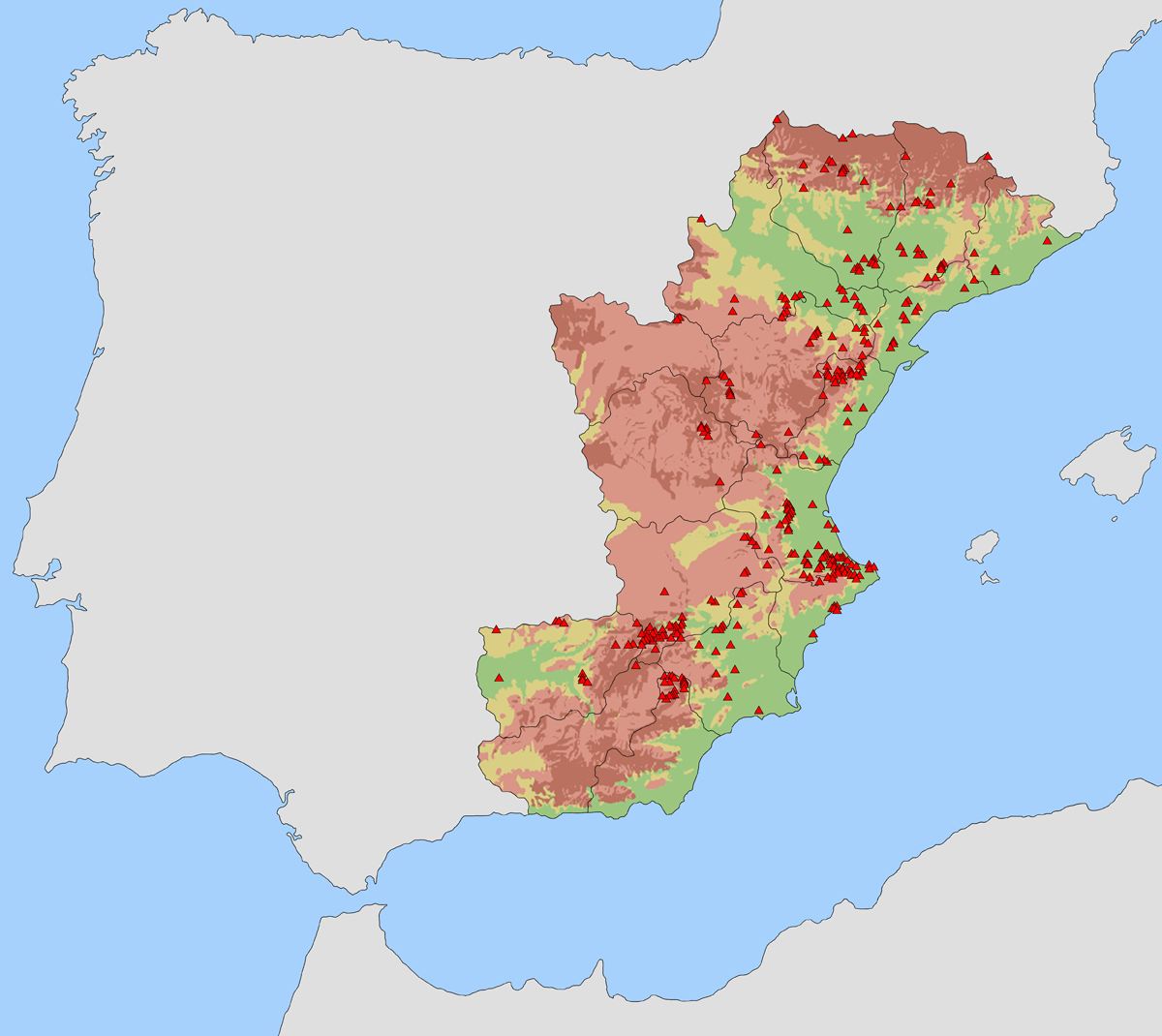
The Rock Art of the Mediterranean Basin is particularly renowned for its broad geographical distribution. Although its name suggests proximity to the Mediterranean Sea, many of the sites are actually located inland, especially in Aragón and Castilla–La Mancha. In total, the rock art is spread across six autonomous communities in eastern and southeastern Spain: Andalusia, Aragón, Castilla-La Mancha, Catalonia, Murcia, and Valencia. This extensive dispersal across the landscape likely reflects the mobility of the prehistoric groups who created these artworks, moving seasonally in response to resources and environmental conditions.
The Rock Art of the Mediterranean Basin is particularly renowned for its geographical distribution. Although the name suggests proximity to the Mediterranean Sea, many of the sites are actually situated inland, particularly in Aragon and Castilla–La Mancha, and overall distributed across six autonomous communities in eastern/central Spain (Andalusia, Aragón, Castilla-La Mancha, Catalonia, Murcia, and Valencia). This wide dispersal across the Iberian Peninsula reflects the nomadic lifestyle of the people who created these artworks, moving with the changing seasons and resources.
One of the most striking aspects of these rock paintings is their diversity. Each site presents a unique blend of images, ranging from abstract symbols to detailed representations of animals, humans, and scenes of daily life. Some of the most common motifs include bovids (cattle-like creatures), equids (horses and other members of the horse family), and wild boars. These images often display a high level of detail, suggesting a deep understanding of the natural world and a keen observational skill.
Despite the passage of thousands of years, these ancient artworks continue to fascinate scholars and visitors alike. They offer a window into the past, providing insights into the beliefs, customs, and daily lives of our distant ancestors. By studying these rock paintings, we can gain a better understanding of the cultural and technological developments that shaped our species' journey from hunter-gatherers to settled agricultural communities.
In conclusion, the Rock Art of the Mediterranean Basin on the Iberian Peninsula stands as a testament to the creativity, ingenuity, and resilience of our ancestors. These prehistoric masterpieces serve as a reminder of our shared human history and the enduring power of art to connect us across time and space. As we continue to unravel the mysteries hidden within these ancient images, we deepen our appreciation for the rich tapestry of human culture and the incredible journey of our species.
UNESCO Description of the World Heritage Site
The late prehistoric rock-art sites of the Mediterranean seaboard of the Iberian peninsula form an exceptionally large group. Here the way of life during a critical phase of human development is vividly and graphically depicted in paintings whose style and subject matter are unique.
UNESCO Justification of the World Heritage Site
Criterion (iii): The corpus of late prehistoric mural paintings in the Mediterranean basin of eastern Spain is the largest group of rock-art sites anywhere in Europe and provides an exceptional picture of human life in a seminal period of human cultural evolution.
Encyclopedia Record: Rock art of the Iberian Mediterranean Basin
The group of over 700 sites of prehistoric Rock art of the Iberian Mediterranean Basin, also known as Levantine art, were collectively declared a World Heritage Site by UNESCO in 1998. The sites are in the eastern part of Spain and contain rock art dating to the Upper Paleolithic or Mesolithic periods of the Stone Age. The art consists of small painted figures of humans and animals, which are the most advanced and widespread surviving from this period, certainly in Europe, and arguably in the world, at least in the earlier works. It is notable for the number of places included, the largest concentration of such art in Europe. Its name refers to the Mediterranean Basin; however, while some sites are located near the sea, many of them are inland in Aragon and Castilla–La Mancha; it is also often referred to as Levantine Art.Additional Site Details
Area: Not available
Number of Components: 758
Coordinates: 39.78995 , -1.03331
Image
© Falconaumanni, CC BY-SA 3.0 Resized from original. (This derivative is under the same CC BY-SA license.)
World Heritage Research
Discover scientific research and academic studies that deepen our understanding of Rock Art of the Mediterranean Basin on the Iberian Peninsula from its history and significance to its conservation, management, and contemporary challenges.
-
A methodological approach to rock art survey and recording via drone. The application to the Rock Art of the Mediterranean Basin of the Iberian Peninsula assemblage
Advancements in drone technology, particularly the use of LiDAR imagery, have revolutionized archaeological surveying, especially for inaccessible open-air rock art shelters. This study introduces a refined methodology using the DJI Mavic 3 drone to survey and record prehistoric rock art within UNESCO’s World Heritage List property: Rock Art of the Mediterranean Basin on the Iberian Peninsula. The approach not only enhances documentation but also addresses conservation challenges and manages human activity threats in these fragile environments. By leveraging cutting-edge drone capabilities, researchers demonstrate its potential for broader applications in preserving and studying vulnerable archaeological sites.
Hernández, F. J. M., González, V. B., López, J. F. R., & Briz, X. M. (2024). A methodological approach to rock art survey and recording via drone. The application to the Rock Art of the Mediterranean Basin of the Iberian Peninsula assemblage. Drone Systems and Applications, 12, 1–18. https://doi.org/10.1139/dsa-2023-0134
View Publication Record | Read Publication -
Making a Difference: Palaeolithic Iconography as a Trait of Identity in the Iberian Peninsula
Palaeolithic iconography on the Iberian Peninsula reveals distinct cultural identities through animal motif preferences. Research shows that while horse, ibex, and deer were universally depicted across Cantabrian, inland Iberia, and Mediterranean regions, bison, hind, and aurochs motifs varied significantly, suggesting a blend of palaeoecological and cultural influences. The study analyzed 3,341 graphic units using multivariate statistics to classify figurative themes by their discriminating power, offering new insights into Palaeolithic artistic expression and its regional variations.
García‐Bustos, M., & Rivero, O. (2023). MAKING A DIFFERENCE: PALAEOLITHIC ICONOGRAPHY AS A TRAIT OF IDENTITY IN THE IBERIAN PENINSULA. Oxford Journal of Archaeology, 42(4), 282–300. Portico. https://doi.org/10.1111/ojoa.12281
View Publication Record | Read Publication -
Portable X-ray Fluorescence Analysis of Levantine and Schematic Art Pigments from the River Vero Shelters (Huesca, NE Spain)
Researchers have uncovered significant insights into the pigments used in prehistoric cave paintings within the UNESCO-listed 'Rock Art of the Mediterranean Basin on the Iberian Peninsula.' Using portable X-ray fluorescence spectroscopy (pXRF), a non-destructive and multi-elemental analysis technique, they examined eight rock shelters in the River Vero canyon, Huesca, Spain. The study revealed that red pigments, primarily based on iron minerals, were the most prevalent across all shelters, with varying iron contents suggesting differences in conservation states. Black pigments, lacking manganese, were linked to bone char or carbon black, while phosphorus content indicated the use of bone phosphates as a filler or binder. Additionally, gypsum detected was determined to be of external origin, likely from atmospheric dust. This pXRF analysis provides a foundation for future characterization studies involving other portable chemical techniques.
Martín-Ramos, P., Cuchí-Oterino, J. A., & Bea-Martínez, M. (2023). Portable X-ray Fluorescence Analysis of Levantine and Schematic Art Pigments from the River Vero Shelters (Huesca, NE Spain). Heritage, 6(4), 3789–3800. https://doi.org/10.3390/heritage6040201
View Publication Record | Read Publication -
Macro Photogrammetry & Surface Features Extraction for Paleolithic Portable Art Documentation
A groundbreaking methodology using macro photogrammetry has been developed to document Paleolithic portable art with unprecedented accuracy. This approach generates 3D models and orthorectified images at a spatial resolution of tens of microns, enabling the detailed documentation of faint paintings and fine engravings on limestone plaquettes. The study focuses on plaquette number 16330 from Cova del Parpalló, a significant Paleolithic site in Spain's UNESCO-listed Rock Art of the Mediterranean Basin. By leveraging HyperCube and DStretch software for data processing, researchers have created an objective and reproducible documentation that challenges and reinterprets earlier graphic records from the 1990s. This methodology not only advances the field of archaeological documentation but also provides a new standard for preserving and analyzing delicate Paleolithic art.
Cabrelles, M., Lerma, J. L., & Villaverde, V. (2020). Macro Photogrammetry & Surface Features Extraction for Paleolithic Portable Art Documentation. Applied Sciences, 10(19), 6908. https://doi.org/10.3390/app10196908
View Publication Record | Read Publication -
Difusión del Arte Rupestre a Través de Aplicaciones Móviles de Realidad Aumentada: Un Enfoque Práctico
Augmented Reality (AR) applications offer a promising solution for the dissemination and conservation of rock art, as demonstrated by their successful implementation at the Cova dels Cavalls site. This study presents two innovative AR approaches: one using marker recognition to display virtual content, and another that overlays information directly onto recognized real paintings. These techniques enhance visitor engagement while promoting non-invasive conservation by eliminating direct contact with the fragile surfaces. The research evaluates the effectiveness of these methods, providing a methodology for their development and application in cultural heritage contexts.
Blanco Pons, S., & Lerma, J. L. (2017). DIFUSIÓN DEL ARTE RUPESTRE A TRAVÉS DE APLICACIONES MÓVILES DE REALIDAD AUMENTADA: UN ENFOQUE PRÁCTICO. Proceedings - 1st Congress in Geomatics Engineering - CIGeo, 1–7. https://doi.org/10.4995/cigeo2017.2017.6598
View Publication Record | Read Publication -
Documentación 3D de la Cova dels Cavalls y de su Entorno (Tírig, Castellón)
A groundbreaking geomatics workflow successfully documented the complex rock art of Cova dels Cavalls, part of the UNESCO-listed Rock Art of the Mediterranean Basin on the Iberian Peninsula. This 3D digital representation method offers a reliable way to preserve and transmit archaeological heritage to future generations. The study meticulously captured the site's intricate details through various stages, from data acquisition to producing photorealistic models. These high-precision models provide unprecedented insights into the rock art, ensuring its conservation and accessibility for both academic research and public engagement.
Cabrelles, M., & Lerma, J. L. (2017). DOCUMENTACIÓN 3D DE LA COVA DELS CAVALLS Y DE SU ENTORNO (TÍRIG, CASTELLÓN). Proceedings - 1st Congress in Geomatics Engineering - CIGeo, 54–59. https://doi.org/10.4995/cigeo2017.2017.6627
View Publication Record | Read Publication -
Documentación 3D de abrigos rupestres a partir de láser escáner y de procesos fotogramétricos automatizados
A groundbreaking geomatic approach combining laser scanning and automated photogrammetry has revolutionized the metric documentation of archaeological rock art. This method, applied to Coves de la Saltadoraenables high-precision archiving, visualization, analysis, management, and monitoring of cultural heritage. The workflow, from data acquisition to final outputs like 3D models, photorealistic models, and orthophoto mosaics, sets a new standard for preserving and studying such sites with unprecedented detail.
Cabrelles López, M., & Lerma García, J. L. (2015). Documentación 3D de abrigos rupestres a partir de láser escáner y de procesos fotogramétricos automatizados. Virtual Archaeology Review, 4(8), 64. https://doi.org/10.4995/var.2013.4320
View Publication Record | Read Publication -
Documenting the light sensitivity of Spanish Levantine rock art paintings
Microfading spectrometry (MFS) proves effective for assessing the light sensitivity of prehistoric rock art pigments, offering valuable insights into their photostability. A study at Cova Remígia, a UNESCO-listed Levantine rock art site in Spain, measured reflectance curves and evaluated pigment response to natural daylight exposure. Preliminary findings suggest MFS is a promising technique for studying the degradation risks posed by environmental factors such as sunlight, wind, and rain—key concerns for preserving these culturally significant paintings. While advantages and limitations of the method are discussed, this approach provides a scientific basis for monitoring and protecting vulnerable rock art systems in Mediterranean Basin sites.
del Hoyo-Meléndez, J. M., Lerma, J. L., López-Montalvo, E., & Villaverde, V. (2015). Documenting the light sensitivity of Spanish Levantine rock art paintings. ISPRS Annals of the Photogrammetry, Remote Sensing and Spatial Information Sciences, II-5/W3, 53–59. https://doi.org/10.5194/isprsannals-ii-5-w3-53-2015
View Publication Record | Read Publication -
Rock art of the Mediterranean basin on the Iberian Peninsula. From El Cogul to Kyoto
Roca dels Moros in El Cogul, the first documented prehistoric rock art site in Catalonia, stands as a pivotal discovery in Iberian Peninsula's prehistoric art history. Its significance rivals that of Altamira's bison paintings and has driven international recognition for Mediterranean basin rock art. This study synthesizes over a century of research on post-Palaeolithic rock art in the region, highlighting its cultural importance and the conservation efforts by public administrations. These efforts culminated in the inclusion of these sites on UNESCO’s World Heritage list, underscoring their global heritage value.
Hernández, G., & Hernández, M. S. (2013). Rock art of the Mediterranean basin on the Iberian Peninsula. From El Cogul to Kyoto [JD]. Catalan Historical Review, 6, 11–31. https://doi.org/10.2436/20.1000.01.83
View Publication Record | Read Publication