
World Heritage Identification Number: 352
World Heritage since: 1985
Category: Cultural Heritage
WHE Type: Archaeological Sites
Transboundary Heritage: No
Endangered Heritage: No
Country: 🇳🇴 Norway
Continent: Europe
UNESCO World Region: Europe and North America
Map
The Rock Art of Alta: A Prehistoric Treasure Trove in Northern Norway
The Rock Art of Alta, located in the Alta Fjord region of Finnmark County, Norway, stands as a testament to the rich cultural history of prehistoric societies that once inhabited the far north. Inscribed as a UNESCO World Heritage Site in 1985, this collection of over 6,000 petroglyphs offers a unique glimpse into the lives, beliefs, and interactions of these ancient communities.
More to come…UNESCO Description of the World Heritage Site
This group of petroglyphs in the Alta Fjord, near the Arctic Circle, bears the traces of a settlement dating from c. 4200 to 500 B.C. The thousands of paintings and engravings add to our understanding of the environment and human activities on the fringes of the Far North in prehistoric times.
UNESCO Justification of the World Heritage Site
Criterion (iii): The Rock Art of Alta, with its thousands of paintings and engravings, is an exceptional testimony of the aspects of life, the environment and the activities of hunter-gatherer societies in the Arctic in prehistoric times. The wide range of motifs and scenes of high artistic quality reflect a long tradition of hunter-gatherer societies and their interaction with landscape, as well as the evolution of their symbols and rituals from approximately 5000 B.C. to about the year 0.
Encyclopedia Record: Rock carvings at Alta
The Rock art of Alta are located in and around Alta Municipality in Finnmark county in northern Norway. Since the first carvings were discovered in 1973, more than 6,000 carvings have been found on several sites around Alta. The largest locality, at Jiepmaluokta about five kilometers (3.1 mi) from Alta, contains thousands of individual carvings and has been turned into an open-air museum. The site, along with the sites Storsteines, Kåfjord, Amtmannsnes, and Transfarelv, was placed on the UNESCO list of World Heritage Sites on 3 December 1985. It is Norway's only prehistoric World Heritage Site.Additional Site Details
Area: 53.59 hectares
Number of Components: 5
Coordinates: 69.95 , 23.18333
Image
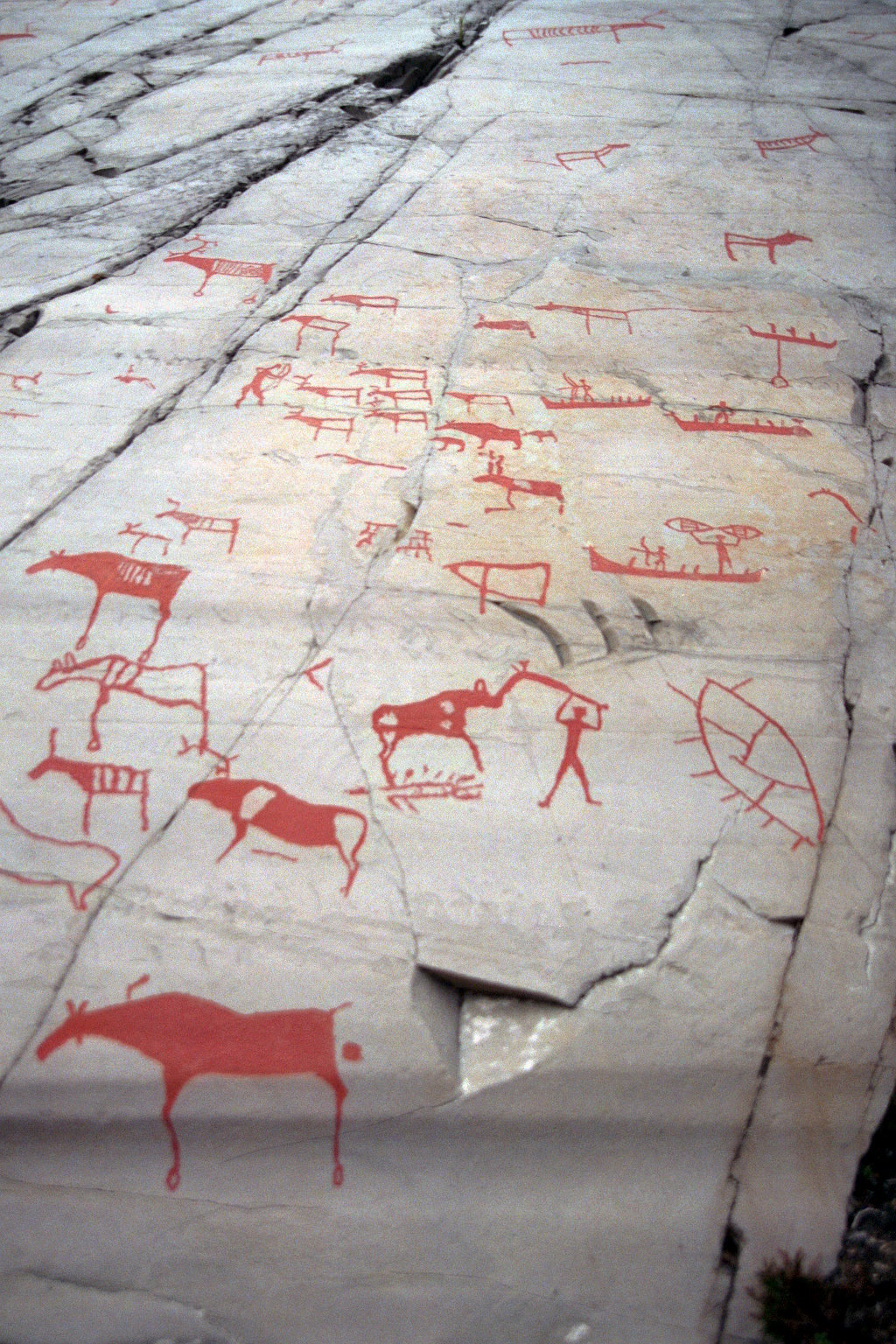
© Karl Brodowsky, CC BY-SA 3.0 Resized from original. (This derivative is under the same CC BY-SA license.)
World Heritage Research
Discover scientific research and academic studies that deepen our understanding of Rock Art of Alta from its history and significance to its conservation, management, and contemporary challenges.
-
Frequency, Phases and Chronology of Rock Art: Spatiotemporal Studies of the Alta Rock Carvings, Northernmost Europe
The rock art of Alta, Norway, spans approximately 5500 years and includes over 7000 carvings, making it the longest continuous record of rock art production in Europe. This study reveals that the carvings were created between c. 5300 BC and AD 100, with a significant finding that the material can be divided into four distinct chronological phases of activity. Notably, around 60% of the rock art was produced during the earliest phase (c. 5300–4000 BC), suggesting periods of intense activity rather than a gradual accumulation over millennia. The research utilized detailed elevation measurements from 92 panels and 442 individual figures to analyze the spatio-temporal distribution, providing new insights into the patterns of rock art production in northern Europe.
Gjerde, J. M. (2024). FREQUENCY, PHASES AND CHRONOLOGY OF ROCK ART: SPATIOTEMPORAL STUDIES OF THE ALTA ROCK CARVINGS, NORTHERNMOST EUROPE. Oxford Journal of Archaeology, 43(2), 108–134. Portico. https://doi.org/10.1111/ojoa.12293
View Publication Record | Read Publication -
Doarrás – eit nytt område med helleristningar i Alta
A new rock art site, Doarrás (Kongsvika), has been discovered outside the well-established UNESCO World Heritage areas of Alta, Northern Norway. This site features three previously unknown panels with rock carvings, enriching the existing knowledge of Alta's rock art. The study compares the motifs and stylistic similarities to those found at known sites, providing insights into their dating and relation to the shoreline. It also underscores the importance of ongoing rock art surveying for both research and heritage management.
Gjerde, J. M., & Tansem, K. (2023). Doarrás – eit nytt område med helleristningar i Alta. Viking, 87(1). https://doi.org/10.5617/viking.10578
View Publication Record | Read Publication -
Always Ritual, Symbolic and Religious? An Essay on the Alta Rock Art and the Archaeological Quest for Meaning
A critical examination of the Alta rock art in Northern Norway reveals that interpretations, while diverse, share a common framework centered on ritual, circumpolar cosmology, and symbolic communication. The study questions the reliance on ethnographic sources and concepts like shamanism to assign 'deeper meaning' to the art, challenging the assumption that such art is inherently religious or world-shaping. It proposes alternative approaches to understanding rock art beyond traditional interpretative imperatives.
Tansem, K. (2022). Always Ritual, Symbolic and Religious? An Essay on the Alta Rock Art and the Archaeological Quest for Meaning. Norwegian Archaeological Review, 55(2), 159–185. https://doi.org/10.1080/00293652.2022.2101938
View Publication Record | Read Publication -
Red‐coated rocks on the seashore: The esthetics and geology of prehistoric rock art in Alta, Arctic Norway
A new geological analysis of the UNESCO World Heritage rock engravings in Alta, Arctic Norway, reveals that the red iron films on the bedrock—once prominent along the prehistoric seashore—have faded due to land uplift and colonization by lichen and moss. The study suggests that these red-coated rocks were likely the primary surfaces for ancient carvings, now situated up to 26 meters above sea level after postglacial rebound. By examining sites like Hjemmeluft through field observations and mineralogical analysis, researchers determined that the red coloration stems from magnetite-rich sandstone, providing insights into the aesthetic choices of prehistoric artists and challenging current interpretations of site location. These findings have implications for conservation efforts, as they highlight the need to account for geological changes in managing and preserving these cultural heritage sites.
Tansem, K., & Storemyr, P. (2020). Red‐coated rocks on the seashore: The esthetics and geology of prehistoric rock art in Alta, Arctic Norway. Geoarchaeology, 36(2), 314–334. Portico. https://doi.org/10.1002/gea.21832
View Publication Record | Read Publication -
Scenes of Human Control of Reindeer in the Alta Rock Art. An Event of Early Domestication in the far North?
Alta's rock art reveals a shift from scenes depicting human control over reindeer, possibly indicating early domestication practices around 5200–4200 cal BC, to a later phase (4200–3000 cal BC) where such depictions vanish. This suggests a transition from hierarchical, hunter-dominated societies to more egalitarian social structures, accompanied by a reevaluation of animistic beliefs. The study analyzes the differences between Phase 1 and Phase 2 rock art compositions, correlating the absence of control imagery with broader societal changes.
Fuglestvedt, I. (2020). Scenes of Human Control of Reindeer in the Alta Rock Art. An Event of Early Domestication in the far North? Current Swedish Archaeology, (28), 121–146. https://doi.org/10.37718/csa.2020.06
View Publication Record | Read Publication -
Rock Art and the Wild Mind. Visual Imagery in Mesolithic Northern Europe
A groundbreaking reinterpretation of Mesolithic rock art in northern Europe, particularly at sites like Alta, Vingen, and Nämforsen, reveals a sophisticated visual culture rooted in shamanic or altered states of consciousness. Ingrid Fuglestvedt's work synthesizes extensive archaeological data with diverse theoretical frameworks—ranging from cognitive archaeology to ethnographic analogies—to propose that these ancient images were not merely symbolic but likely represented ritualistic practices tied to spiritual experiences. Unlike traditional summaries, this research avoids mere description, instead offering a nuanced, highly detailed analysis that challenges conventional interpretations of the region's rock art.
Taçon, P. (2019). Rock Art and the Wild Mind. Visual Imagery in Mesolithic Northern Europe. Norwegian Archaeological Review, 52(2), 182–184. https://doi.org/10.1080/00293652.2019.1669696
View Publication Record | Read Publication -
‘The world as we know it’ – revisiting the rock art at Bergbukten 4B in Alta, northern Norway
The Bergbukten 4B panel in Alta, northern Norway, reveals a sophisticated cosmographical representation by Stone Age hunter-fisher-gatherers, dated to approximately 6000–7000 years ago. This panel, one of the largest in northern Europe with over 200 figures, integrates real and imaginary landscapes within a three-tiered cosmological framework. The rock art's figures interact with natural features, suggesting a visual depiction of activities and places mirroring actual locations. This 'world as we know it' reflects a complex memoryscape stored in the rocks, blending practical knowledge with cosmographical understanding.
Gjerde, J. M. (2019). ‘The world as we know it’ – revisiting the rock art at Bergbukten 4B in Alta, northern Norway. Time and Mind, 12(3), 197–206. https://doi.org/10.1080/1751696x.2019.1645521
View Publication Record | Read Publication -
Climate Change, Rock Coatings, and the Archaeological Record
Rock varnish, commonly found in arid environments, provides a novel method for dating prehistoric stone artifacts and rock art that are otherwise undateable. This study demonstrates that thin sections of varnish coatings reveal microlaminations that reflect significant shifts between wet and dry paleoclimates. These microlaminations can be used to assign minimum ages to the underlying rock surfaces, offering crucial insights into the peopling of the Americas and how native populations adapted to changing climatic conditions over time.
Whitley, D. S., Santoro, C. M., & Valenzuela, D. (2017). Climate Change, Rock Coatings, and the Archaeological Record. Elements, 13(3), 183–186. https://doi.org/10.2113/gselements.13.3.183
View Publication Record | Read Publication -
Rock Art and the Wild Mind
Rock art from the Mesolithic era in Scandinavian World Heritage Sites, such as Alta, reveals a transition from animism to totemism, reflecting evolving human societal structures. The study identifies recurring visual motifs ('motemes') that depict humans and big game animals in dynamic interactions, suggesting these were products of a complex 'wild mind' at work. By analyzing repetitions, variations, and transformations of these motemes, the research demonstrates how totemic art became more prevalent during the Late Mesolithic, indicating an increasing focus on human society. This shift is interpreted as part of broader social development in northern Europe, offering insights into the cognitive and cultural evolution of prehistoric hunter-gatherers.
Fuglestvedt, I. (2017). Rock Art and the Wild Mind. https://doi.org/10.4324/9781315108582
View Publication Record | Read Publication -
Knut Helskog. Communicating with the World of Beings: The World Heritage Rock Art Sites in Alta, Arctic Norway (Oxford and Philadelphia: Oxbow Books, 2014, 240pp., 222 colour and 41 b/w figs., hbk, ISBN 978-1-78297-411-6)
The Rock Art of Alta reveals a profound connection between ancient Arctic communities and the natural world. Knut Helskog's work demonstrates that these petroglyphs, spanning over 4,000 years, depict not only animals and humans but also spiritual interactions with beings from the natural environment. The research integrates archaeological, ethnographic, and historical perspectives to interpret the art as a form of communication with the world of beings, challenging traditional views on its purpose. By analyzing motifs, distribution, and contextual evidence, Helskog provides insights into the cosmological beliefs and social structures of past societies in Alta, Norway.
Díaz-Guardamino, M. (2016). Knut Helskog. Communicating with the World of Beings: The World Heritage Rock Art Sites in Alta, Arctic Norway (Oxford and Philadelphia: Oxbow Books, 2014, 240pp., 222 colour and 41 b/w figs., hbk, ISBN 978-1-78297-411-6). European Journal of Archaeology, 19(3), 545–548. https://doi.org/10.1080/14619571.2016.1192772
View Publication Record | Read Publication
