World Heritage Identification Number: 1472
World Heritage since: 2015
Category: Cultural Heritage
WHE Type: Archaeological Sites
Transboundary Heritage: No
Endangered Heritage: No
Country: 🇸🇦 Saudi Arabia
Continent: Asia
UNESCO World Region: Arab States
Map
Rock Art in the Hail Region of Saudi Arabia: A Window into Ancient Cultures
The Rock Art in the Hail Region of Saudi Arabia, inscribed as a UNESCO World Heritage Site in 2015, offers a unique glimpse into the rich cultural history of the Arabian Peninsula. Situated within the arid landscapes of the Ha'il Region, this site comprises two distinct components: Jabel Umm Sinman at Jubbah and the Jabal al-Manjor and Raat at Shuwaymis.
More to come…UNESCO Description of the World Heritage Site
This property includes two components situated in a desert landscape: Jabel Umm Sinman at Jubbah and the Jabal al-Manjor and Raat at Shuwaymis. A lake once situated at the foot of the Umm Sinman hill range that has now disappeared used to be a source of fresh water for people and animals in the southern part of the Great Narfoud Desert. The ancestors of today’s Arab populations have left traces of their passages in numerous petroglyphs and inscriptions on the rock face. Jabal al-Manjor and Raat form the rocky escarpment of a wadi now covered in sand. They show numerous representations of human and animal figures covering 10,000 years of history.
UNESCO Justification of the World Heritage Site
Criterion (i): The rock art of Jabal Umm Sinman Jubbah and Jabal Al-Major and Jabal Raat near Shuwaymis contain an exceptionally large number of petroglyphs, created by using a range of techniques with simple stone hammers, against a background of gradual environmental deterioration, and are visually stunning expressions of the human creative genius.
Criterion (iii): The rock art at Jabal Umm Sinman at Jubbah and Jabal Al-Major and Jabal Raat at Shuwaymis provide an exceptional testimony to the challenges of past societies in response to environmental catastrophes. In addition, the petroglyphs at Shuwaymis provide an exceptional testimony of a society that vanished, leaving behind an exceptionally detailed record of its existence.
Encyclopedia Record: Rock Art in the Ha'il Region
Rock Art in the Ha'il Region is the fourth site in Saudi Arabia to be inscribed on the UNESCO List of World Heritage Sites. The rock art includes two components situated in the desert of the Ha'il Region: the first is Om Sinman mountain at the city of Jubbah, and the second is al-Manjor and Raat at Al-Shuwaymis. An ancient population left traces of their passings in petroglyphs on the rock's surface, holding 8,000 years of history.Additional Site Details
Area: 2,043.8 hectares
Number of Components: 2
(iii) — Unique or exceptional testimony to a cultural tradition
Coordinates: 28.0105555556 , 40.9130555556
Image
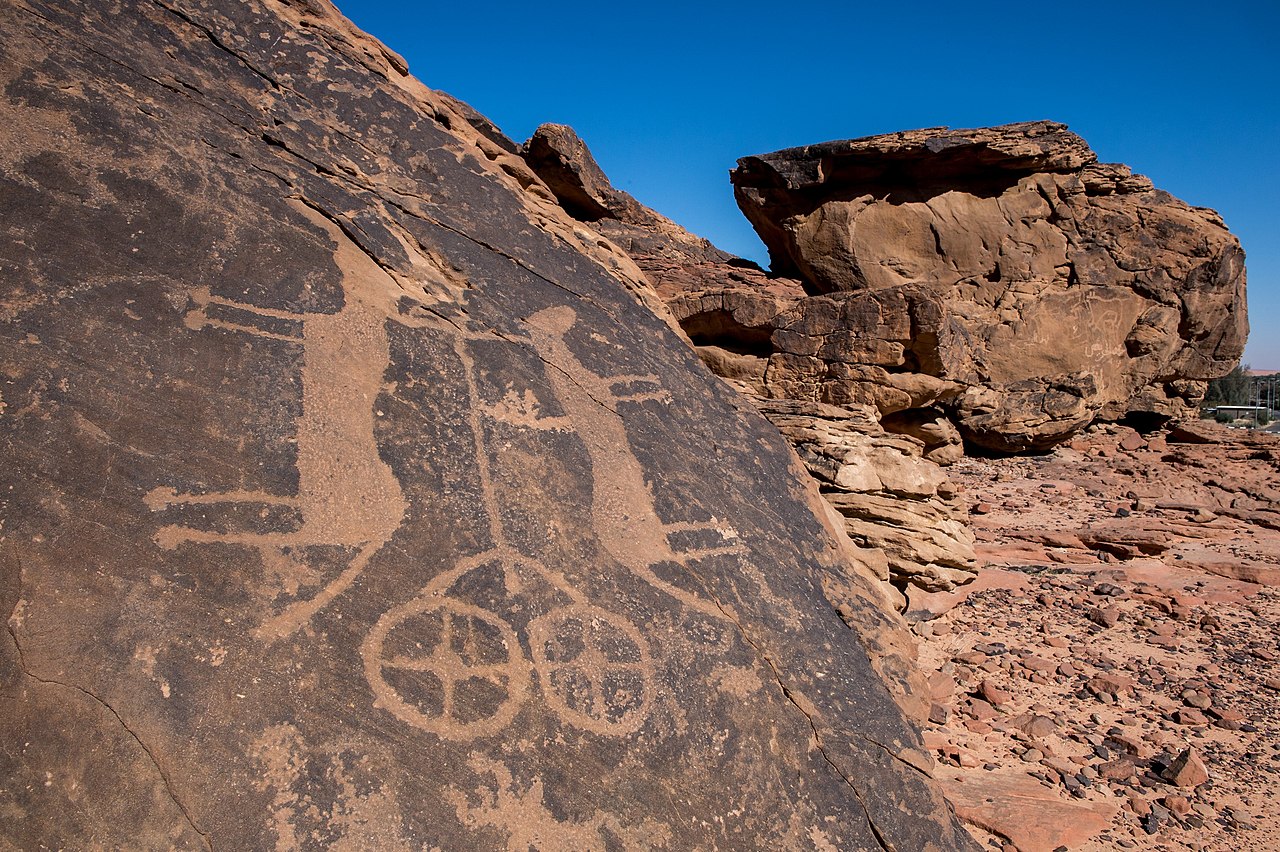
© Heritage Commission , CC BY-SA 4.0 Resized from original. (This derivative is under the same CC BY-SA license.)
World Heritage Research
Discover scientific research and academic studies that deepen our understanding of Rock Art in the Hail Region of Saudi Arabia from its history and significance to its conservation, management, and contemporary challenges.
-
Infrastructure, accessibility, and regional challenges in sustainable tourism: Evidence from Ha'il, Saudi Arabia
Sustainable tourism development (STD) in Ha'il, Saudi Arabia, is significantly enhanced by infrastructure and accessibility quality (IAQ), while regional challenges (RC) impede its growth. A 2024 survey of 282 tourists analyzed via PLS-SEM revealed IAQ strongly supports STD (β = 0.538, p < 0.001), whereas RC negatively impacts it (β = -0.424, p < 0.001). The model explained 66.6% of the variance in STD, underscoring the critical role of governance and environmental stewardship alongside infrastructure investments. Policymakers are urged to integrate conservation principles with participatory planning for long-term viability. This study provides actionable insights for sustainable tourism in arid peripheral regions under Vision 2030.
Alanazi, S. Q., & Rahim, A. A. (2026). Infrastructure, accessibility, and regional challenges in sustainable tourism: Evidence from Ha’il, Saudi Arabia. International Journal of Asian Social Science, 16(3), 158–172. https://doi.org/10.55493/5007.v16i3.5845
View Publication Record | Read Publication -
Exploring the impact of smart tourism technologies on tourist satisfaction in Hail region, Saudi Arabia: The roles of perceived usefulness and cultural familiarity
Smart tourism technologies (STTs) significantly enhance tourist satisfaction, both directly and indirectly through perceived usefulness, with cultural familiarity acting as a positive moderator. This finding, derived from a survey of 273 tourists in Hail, Saudi Arabia, reveals that the effectiveness of STTs is not solely functional but deeply influenced by cultural context. The study highlights the importance of culturally resonant smart tourism strategies to maximize tourist satisfaction and offers a human-centered perspective on technology adoption in tourism.
Jazim, F., Goaill, M. M., & Al-Hakimi, M. A. (2026). Exploring the impact of smart tourism technologies on tourist satisfaction in Hail region, Saudi Arabia: The roles of perceived usefulness and cultural familiarity. Journal of Project Management, 11(2), 421–438. https://doi.org/10.5267/j.jpm.2026.2.005
View Publication Record | Read Publication -
Local people’s participation in Jubbah Heritage Site conservation: extending the motivation, opportunity, and ability (MOA) theory
A study on the Jubbah Heritage Site in Saudi Arabia reveals that negative perceptions significantly hinder local community participation in conservation efforts, while positive factors such as opportunities, awareness, and place attachment enhance engagement. Contrary to expectations, positive perception alone did not significantly boost participation levels. The research extends the motivation, opportunity, and ability (MOA) theory by incorporating place attachment, using a questionnaire-based approach with statistical analysis to assess resident attitudes and behaviors. Findings highlight the complex interplay between perceptions, decision-making interest, and environmental factors in shaping heritage conservation involvement.
Abdelazim, T., Alfraidi, Y., Tueaiman, A., Alhamli, F., Elhassan, A., & Nassr, A. (2025). Local people’s participation in Jubbah Heritage Site conservation: extending the motivation, opportunity, and ability (MOA) theory. Npj Heritage Science, 13(1). https://doi.org/10.1038/s40494-025-01554-9
View Publication Record | Read Publication -
Spatial distribution of archeological sites in the Kingdom of Saudi Arabia and the application of the theory of planned behavior to predict pro-environmental behavioral intention among Saudi citizens
A significant positive influence of attitude, subjective norms, perceived behavioral control, and awareness of negative consequences on pro-environmental behavioral intention was found to predict conservation efforts for four UNESCO World Heritage Sites in Saudi Arabia—Jeddah, Mada’in Saleh, Diriyah, and Jubbah. The study applied the Theory of Planned Behavior (TPB) through a survey of 2,342 local residents, achieving an 85.1% response rate. Structural analysis revealed that attitude significantly moderates the impact of awareness of negative consequences on pro-environmental intentions. Additionally, the research mapped the spatial distribution of archaeological sites in Saudi Arabia, providing insights into heritage conservation priorities.
Sulaiman Mohammed Alali, N., Abdel Azim Ahmed, T., & Sarhan Shaker, E. (2025). Spatial distribution of archeological sites in the Kingdom of Saudi Arabia and the application of the theory of planned behavior to predict pro-environmental behavioral intention among Saudi citizens. Humanities and Social Sciences Communications, 12(1). https://doi.org/10.1057/s41599-025-05309-6
View Publication Record | Read Publication -
Local Visitors’ Pro-Environmental Intentions at Hail Heritage Sites: An Extended Norm Activation Model
Place attachment is the strongest predictor of pro-environmental behavioral intentions among local visitors to Hail heritage sites in Saudi Arabia, according to a study that extended norm activation theory (NAT). The research, based on data from 503 valid responses out of 600 questionnaires, revealed significant relationships within the adapted NAT model. This finding highlights the importance of cultural connection in shaping environmental behavior at heritage sites and provides valuable insights for effective site management strategies.
Abdel Azim Ahmed, T. S., Nassr, A. H., Kassem, A. M., Ragab, A. M., & Njoya, E. (2025). Local Visitors’ Pro-Environmental Intentions at Hail Heritage Sites: An Extended Norm Activation Model. https://doi.org/10.20944/preprints202510.0837.v1
View Publication Record | Read Publication -
Rock Arts of Arfaa Precinct in Taif City, Saudi Arabia
A recent study has provided the first comprehensive scientific documentation of eleven previously undocumented rock arts located at the sandstone hills of Arfaa Citadel, north of Taif City, Saudi Arabia. These rock arts offer significant archaeological evidence suggesting that Taif served as a crucial station for both settlement and trade since at least the second millennium BC, acting as a vital link between southern and northern regions. The research combines local knowledge with scientific analysis to reveal insights into the historical significance of Taif as a cultural and commercial hub, bridging gaps in its archaeological narrative.
El-Tonssy, M. A. (2024). Rock Arts of Arfaa Precinct in Taif City, Saudi Arabia. حولية الاتحاد العام للآثاريين العرب “دراسات فى آثار الوطن العربى”, 27(1), 27–54. https://doi.org/10.21608/cguaa.2024.263378.1212
View Publication Record | Read Publication -
Assessment of Rock Art Preservation Awareness among Hail University Students for Sustainable Development Purpose in Ksa
A recent study reveals that Hail University students in Saudi Arabia exhibit low awareness of rock art preservation, despite its significance as a UNESCO-listed cultural heritage and potential for sustainable tourism. The research, using quantitative surveys with 204 participants, underscores the need for targeted educational initiatives to enhance community engagement in preserving these Paleolithic and Neolithic sites—including Jubbah, Shuwaymis, and Himma—which are vital to Saudi Arabia's archaeological legacy. The findings highlight practical strategies to boost student awareness, aligning with broader efforts by Saudi authorities to integrate heritage conservation into sustainable development goals.
A., B. (2024). ASSESSMENT OF ROCK ART PRESERVATION AWARENESS AMONG HAIL UNIVERSITY STUDENTS FOR SUSTAINABLE DEVELOPMENT PURPOSE IN KSA. Egyptian Journal of Archaeological and Restoration Studies, 14(2), 349–360. https://doi.org/10.21608/ejars.2024.396705
View Publication Record | Read Publication