World Heritage Identification Number: 326
World Heritage since: 1985
Category: Cultural Heritage
WHE Type: Archaeological Sites
Transboundary Heritage: No
Endangered Heritage: No
Country: 🇯🇴 Jordan
Continent: Asia
UNESCO World Region: Arab States
Map
Petra: The Rose-Red City of Stone
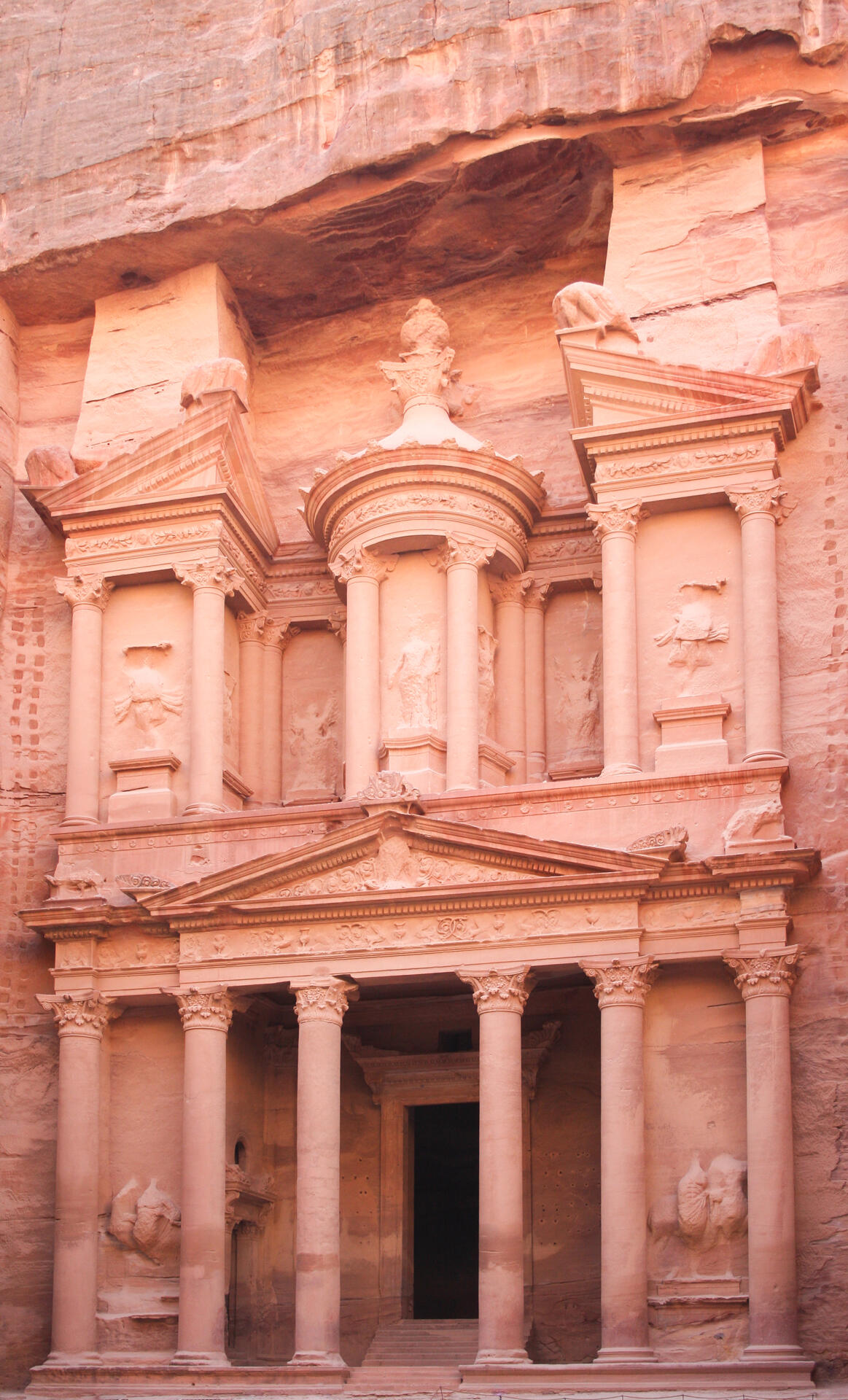
Petra, officially known as Raqmu, is a remarkable archaeological site located in southern Jordan. This ancient city, renowned for its rock-cut architecture and ingenious water conduit systems, has earned the nickname "The Rose City" due to the distinctive red hue of the sandstone from which it is carved. Designated as a UNESCO World Heritage Site in 1985, Petra stands out as one of the world's most significant historical landmarks.
Inhabited since prehistoric times, Petra served as a vital crossroads between Arabia, Egypt, and Syria-Phoenicia. Its strategic location made it a bustling hub for trade, culture, and religious exchange. The city flourished under the rule of the Nabateans, an Arab kingdom that thrived from the 4th century BCE to the 1st century CE.
The Nabateans were skilled architects and engineers who developed innovative methods to adapt their urban planning to the harsh desert environment. They built Petra into the surrounding mountains, creating a labyrinthine network of tombs, temples, and monumental structures. The city's most iconic feature is the Al-Khazneh (The Treasury), a magnificent facade adorned with intricate Greek and Egyptian influences.
One of the most striking aspects of Petra is its unique water management system. The Nabateans constructed a complex network of dams, cisterns, and channels to collect and distribute rainwater. These engineering feats ensured the survival of the city during prolonged droughts and enabled the cultivation of crops in the arid landscape.
Petra's rich history extends beyond the Nabatean period. The city was later occupied by the Romans, Byzantines, and Umayyad Caliphs before eventually being abandoned around the 10th century CE. Re-discovered in 1812 by Swiss explorer Johann Ludwig Burckhardt, Petra has since captivated travelers and scholars alike with its enigmatic beauty and fascinating past.
Today, Petra remains an essential destination for those seeking to explore the wonders of human ingenuity and resilience in the face of adversity. As a testament to the enduring spirit of the Nabateans and the countless civilizations that followed, Petra continues to inspire awe and wonder among visitors from around the globe.
To wrap it up, Petra, the Rose City of Stone, offers a glimpse into the rich tapestry of human history. Its rock-cut architecture, ingenious water management systems, and strategic location have contributed to its status as a UNESCO World Heritage Site and one of the New Seven Wonders of the World, chosen in 2007. The city's enduring legacy serves as a reminder of the indomitable human spirit and our ability to create lasting monuments amidst the harshest conditions.
UNESCO Description of the World Heritage Site
Inhabited since prehistoric times, this Nabataean caravan-city, situated between the Red Sea and the Dead Sea, was an important crossroads between Arabia, Egypt and Syria-Phoenicia. Petra is half-built, half-carved into the rock, and is surrounded by mountains riddled with passages and gorges. It is one of the world's most famous archaeological sites, where ancient Eastern traditions blend with Hellenistic architecture.
UNESCO Justification of the World Heritage Site
Criterion (i): The dramatic Nabataean/Hellenistic rock-cut temple/tombs approached via a natural winding rocky cleft (the Siq), which is the main entrance from the east to a once extensive trading city, represent a unique artistic achievement. They are masterpieces of a lost city that has fascinated visitors since the early 19th century. The entrance approach and the settlement itself were made possible by the creative genius of the extensive water distribution and storage system.
Criterion (iii): The serried rows of numerous rock-cut tombs reflecting architectural influences from the Assyrians through to monumental Hellenistic; the sacrificial and other religious high places including on Jebels Madbah, M'eisrah, Khubtha, Habis and Al Madras; the remains of the extensive water engineering system, city walls and freestanding temples; garden terraces; funerary stelae and inscriptions together with the outlying caravan staging posts on the approaches from the north (Barid or Little Petra) and south (Sabra) also containing tombs, temples, water cisterns and reservoirs are an outstanding testament to the now lost Nabataean civilization of the fourth century BC to the first century AD. Remains of the Neolithic settlement at Beidha, the Iron Age settlement on Umm al Biyara, the Chalcolithic mining sites at Umm al Amad, the remains of Graeco-Roman civic planning including the colonnaded street, triple-arched entrance gate, theatre, Nymphaeum and baths; Byzantine remains including the triple-apses basilica church and the church created in the Urn Tomb; the remnant Crusader fortresses of Habis and Wueira; and the foundation of the mosque on Jebel Haroun, traditionally the burial place of the Prophet Aaron, all bear exceptional testimony to past civilizations in the Petra area.
Criterion (iv): The architectural ensemble comprising the so-called royal tombs in Petra (including the Khasneh, the Urn Tomb, the Palace Tomb and the Corinthian Tomb), and the Deir (monastery) demonstrate an outstanding fusion of Hellenistic architecture with Eastern tradition, marking a significant meeting of East and West at the turn of the first millennium of our era. The Umm al Amad copper mines and underground galleries are an outstanding example of mining structures dating from the fourth millennium BC. The remnants of the diversion dam, Muthlim tunnel, water channels, aqueducts, reservoirs and cisterns are an outstanding example of water engineering dating from the first centuries BC to AD.
Encyclopedia Record: Petra
Petra, originally known to its inhabitants as Raqmu, is an ancient city and archaeological site in southern Jordan. Famous for its rock-cut architecture and water conduit systems, Petra is also called the "Rose City" because of the colour of the sandstone from which it is carved. The city is one of the New 7 Wonders of the World and a UNESCO World Heritage Site.Additional Site Details
Area: 26,171 hectares
Number of Components: 1
(iii) — Unique or exceptional testimony to a cultural tradition
(iv) — Outstanding example of a type of building or landscape
Coordinates: 30.33056 , 35.44333
World Heritage Research
Discover scientific research and academic studies that deepen our understanding of Petra from its history and significance to its conservation, management, and contemporary challenges.
-
Point–Axis System Theory with GIS Spatial Analysis in Geospatial Big Data: A Case Study of the Petra World Heritage Site
A new framework integrating Point–Axis System (PAS) Theory with GIS and geospatial big data reveals how high-capacity corridors, such as Petra's Siq passage, redistribute tourist flows and intensify exposure around iconic heritage sites like Al-Khazneh. This approach quantifies pole attraction and axis strength, enabling precise identification of leverage points for congestion management and conservation. The study introduces a composite Pole–Axis Index (PAI) that fuses gravity, performance, and accessibility metrics, offering actionable insights for heritage-sensitive tourism planning. Practical applications include optimized visitor infrastructure siting, route design, and policy scenario monitoring, while social benefits extend to spatial equity in access and protection of outstanding universal value.
JAWABREH, O., Al FAHMAWEE, E. A. D., MAHMOUD, R., ALQADER, S. A., & HARAZNEH, I. (2026). POINT–AXIS SYSTEM THEORY WITH GIS SPATIAL ANALYSIS IN GEOSPATIAL BIG DATA: A CASE STUDY OF THE PETRA WORLD HERITAGE SITE. Geojournal of Tourism and Geosites, 67(3), 1980–1993. https://doi.org/10.30892/gtg.67314-1826
View Publication Record | Read Publication -
Tourism impacts and well-being in heritage tourism: the role of discrete emotions and site sustainability characteristics
International visitors' perceptions of tourism impacts at Petra, Jordan, significantly influence their emotions and intentions to recommend the site. Positive experiences, such as happiness, love, and contentment, enhance evaluations of the site's sustainability and overall travel well-being, while negative emotions like anger or unpleasantness diminish these perceptions. The study, using cognitive appraisal theory (CAT) and the PERMA model, analyzed data from 1531 visitors to reveal that better sustainability perceptions and higher well-being directly contribute to positive recommendations for heritage sites. These findings underscore the importance of balancing tourism impacts with sustainability efforts to foster visitor satisfaction and long-term site preservation.
Alrawadieh, Z., Prayag, G., Adie, B. A., & Alrawadieh, Z. (2025). Tourism impacts and well-being in heritage tourism: the role of discrete emotions and site sustainability characteristics. Journal of Heritage Tourism, 20(5), 642–660. https://doi.org/10.1080/1743873x.2025.2502350
View Publication Record | Read Publication -
Geophysical Surveys at Petra World Heritage Site
A buried tomb containing the remains of at least 11 human skeletons was discovered beneath Petra, Jordan, following geophysical surveys using ground-penetrating radar (GPR). The GPR identified a subsurface chamber, which subsequent excavations confirmed as an ancient burial site. This discovery sheds new light on Petra's historical significance and funerary practices, contributing to ongoing research at the UNESCO World Heritage Site. The study demonstrates the effectiveness of non-invasive geophysical techniques in uncovering hidden archaeological features without causing damage to the site.
Bates, R., Langton, M., & Viberg, A. (2025). Geophysical Surveys at Petra World Heritage Site. ArchéoSciences, 49-1, 55–56. https://doi.org/10.4000/14nqw
View Publication Record | Read Publication -
A Comprehensive Exploration of the Jordan Tourism Board's 2023 Strategic Planning, News, and Social Media
A content analysis of Jordan Tourism Board's 2023 news and social media reveals that cultural tourism, particularly at sites like Petra and Jerash, dominates narratives. The study identifies prevailing themes—architectural heritage, natural attractions, adventure, religious tourism, and seasonal events—and examines how these are strategically constructed to diversify Jordan’s tourism offerings. Key findings suggest a strong emphasis on leveraging digital platforms for global outreach while maintaining cultural authenticity, with implications for shaping Jordan's sustainable tourism growth.
Arabeyyat, A. R., & Aldweik, R. (2024). A Comprehensive Exploration of the Jordan Tourism Board’s 2023 Strategic Planning, News, and Social Media. Emirati Journal of Business, Economics, and Social Studies, 3(1), 32–41. https://doi.org/10.54878/79sfh467
View Publication Record | Read Publication -
Harnessing Heritage BIM for Enhanced Architectural Documentation of Ad Deir in Petra
Heritage Building Information Modeling (BIM) emerges as a transformative tool for preserving intricate architectural details of UNESCO World Heritage Sites, exemplified by its application at Ad Deir ('The Monastery') in Petra. This study demonstrates that integrating laser scanning technology with BIM workflows enables precise 3D documentation of complex heritage structures, surpassing traditional manual surveys and 2D drawings. The resulting digital model not only captures geometric and material data but also serves as a dynamic platform for future data integration, including historical records and conservation insights. This approach significantly enhances quality control in restoration efforts and supports evidence-based decision-making, offering a scalable solution for heritage preservation challenges.
Baik, A., & Alshawabkeh, Y. (2024). Harnessing Heritage BIM for Enhanced Architectural Documentation of Ad Deir in Petra. Applied Sciences, 14(11), 4562. https://doi.org/10.3390/app14114562
View Publication Record | Read Publication -
The Nabataean monumental rock‐cut tombs of Mughāyir Shuʿayb and al‐Aṣīfir in the oasis of al‐Badʿ (Saudi Arabia): Preliminary architectural study and spatial organisation of the necropolis
A new study reveals that the Nabataean rock-cut tombs in al-Badʿ oasis, Saudi Arabia, exhibit standardized architectural and decorative techniques while also reflecting local cultural adaptations. Analyzing 35 tombs across two necropolises—Mughāyir Shuʿayb and al-Aṣīfir—the research provides the first comprehensive overview of their construction processes, investment levels, and social hierarchy within the Nabataean world. The findings highlight the site's strategic economic, political, and cultural significance along the Red Sea caravan route to Petra and other Levantine centers. This multiscalar examination underscores both regional standardization and individual or topographical influences in funerary architecture.
Bigot‐Démereau, L., Charloux, G., Badaiwi, W., Guadagnini, K., Larché, F., Naggiar, L., & Sahlah, S. A. (2024). The Nabataean monumental rock‐cut tombs of Mughāyir Shuʿayb and al‐Aṣīfir in the oasis of al‐Badʿ (Saudi Arabia): Preliminary architectural study and spatial organisation of the necropolis. Arabian Archaeology and Epigraphy, 35(1), 155–204. Portico. https://doi.org/10.1111/aae.12252
View Publication Record | Read Publication -
Integrating User-Generated Content (UGC) with the Normative Approach to Define Indicators of Quality for Visitor Experience at Archaeodestinations
A novel integration of User-Generated Content (UGC) with the normative approach has successfully defined indicators for assessing visitor experience quality at Petra. This study leveraged 618 TripAdvisor reviews to extract insights that complement traditional on-site assessments, offering a more dynamic and adaptive methodology for heritage management. The findings highlight the potential of UGC in providing real-time, data-driven evaluations of visitor experiences while balancing preservation needs. This approach not only enhances the understanding of visitor perceptions but also equips managers with actionable recommendations for sustainable tourism practices at archaeodestinations.
Alazaizeh, M. M. (2024). Integrating User-Generated Content (UGC) with the Normative Approach to Define Indicators of Quality for Visitor Experience at Archaeodestinations. Conservation and Management of Archaeological Sites, 26(2-3), 155–174. https://doi.org/10.1080/13505033.2024.2400626
View Publication Record | Read Publication