World Heritage Identification Number: 1377
World Heritage since: 2011
Category: Mixed Cultural Heritage and Natural Heritage
WHE Type: Protected Areas & National Parks
Transboundary Heritage: No
Endangered Heritage: No
Country: 🇯🇴 Jordan
Continent: Asia
UNESCO World Region: Arab States
Map
Wadi Rum: A Landscape Written in Stone
The Wadi Rum Protected Area, often referred to as the Valley of the Moon, is a geographical marvel located in southern Jordan, bordering Saudi Arabia and approximately 60 kilometers east of the city of Aqaba. Covering an expansive area of approximately 742 square kilometers, it is one of the largest protected areas in Jordan. This protected area was inscribed as a UNESCO World Heritage Site in 2011, acknowledging its unique blend of natural beauty and rich cultural history.
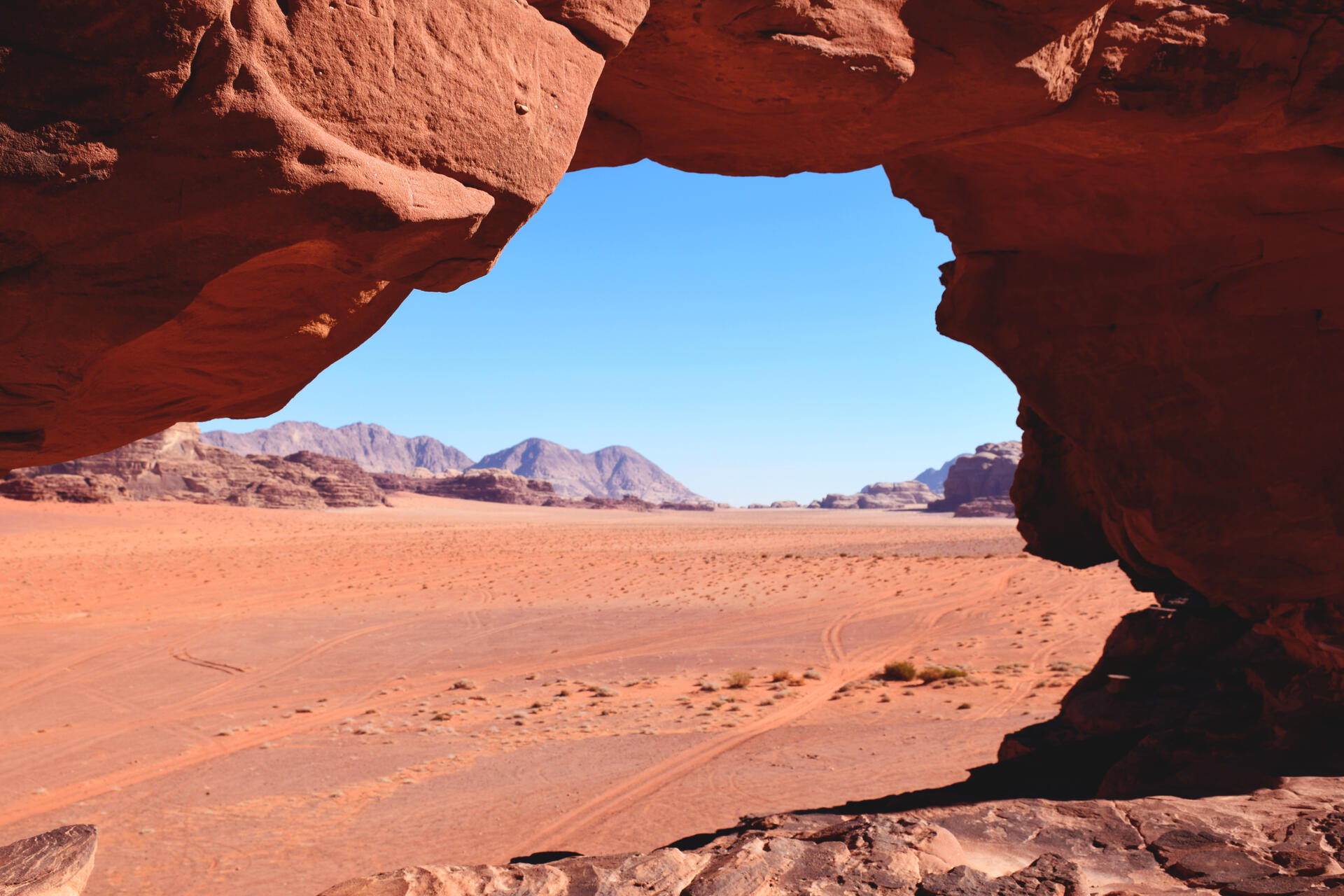
The Wadi Rum's diverse landscape is characterized by a series of narrow gorges, natural arches, towering cliffs, ramps, massive landslides, and caverns. These geological formations, shaped over millions of years by tectonic activity, weathering, and erosion, create a breathtakingly beautiful and otherworldly terrain that has earned the area the nickname 'Valley of the Moon'. The area's red, orange, and brown hues, particularly during sunrise and sunset, further contribute to this ethereal atmosphere.
Among its most dramatic features is Jabal Umm ad Dami, the highest peak in Jordan, which rises to approximately 1,854 meters above sea level. Visitors also frequently encounter iconic rock formations like the Seven Pillars of Wisdom—named after T.E. Lawrence’s famous autobiographical work, which chronicled his experiences in the Arabian desert during the Arab Revolt. These sweeping sandstone mountains and deep canyons serve as a striking backdrop to the region's rich human footprint.
Beyond its visual appeal, the Wadi Rum Protected Area offers insights into the region's ancient human history. Archaeological evidence suggests that the area has been inhabited for at least 12,000 years. Petroglyphs, inscriptions, and various archaeological remains found within the World Heritage Site provide a tangible connection to the pastoral, agricultural, and urban activities that have shaped the region over thousands of years.
One of the most significant aspects of the Wadi Rum's cultural heritage is its collection of rock carvings and inscriptions. Approximately 25,000 rock carvings and 20,000 inscriptions can be found throughout the site. These engravings serve as a chronicle of human thought and the early development of the alphabet. They offer a fascinating glimpse into the intellectual and social evolution of the region's inhabitants.
These profound records were left behind by a succession of ancient civilizations and local communities, including the Nabataeans, who famously carved monumental architecture into the rock at nearby Petra. The inscriptions themselves span multiple distinct scripts and languages—including Thamudic, Nabataean, and numerous Arabic inscriptions in four different scripts—illustrating an astonishingly high level of literacy among ancient pastoral and nomadic societies long before the modern era.
The Wadi Rum Protected Area also provides valuable insights into the region's Bedouin culture. The Bedouins, traditionally nomadic tribes who live in the Arabian desert, have long called the Wadi Rum their home. Their way of life, closely intertwined with the harsh yet bountiful desert environment, has been shaped by centuries of survival strategies and adaptations. Today, Bedouin communities continue to reside in the Wadi Rum, offering visitors a unique opportunity to experience their customs and traditions firsthand.
In addition to its historical and cultural significance, the Wadi Rum Protected Area boasts a wealth of natural resources. Its diverse ecosystem supports a variety of plant and animal species, including several rare and endemic plant species. The area's unique climate, characterized by extreme temperatures and limited rainfall, has led to the development of hardy, drought-resistant flora and fauna. UNESCO records 158 plant species in the protected area, including rare and endemic species, as well as 26 mammal species, several of which have conservation importance.
This unique combination of deep human heritage and pristine desert wilderness is precisely why UNESCO inscribed Wadi Rum as a mixed World Heritage Site, recognizing it for both its cultural and natural significance. It stands out globally as a place where the history of human survival, artistic expression, and geological evolution are preserved in harmony.
To sum it up, the Wadi Rum Protected Area stands as a testament to the enduring beauty and rich history of southern Jordan. Its stunning landscapes, coupled with its wealth of archaeological and cultural treasures, make it a must-visit destination for anyone seeking to immerse themselves in the wonders of the Middle East. As a UNESCO World Heritage Site, the Wadi Rum serves as a reminder of our shared human history and the importance of preserving these precious cultural and natural resources for future generations.
UNESCO Description of the World Heritage Site
The 74,000-hectare property, inscribed as a mixed natural and cultural site, is situated in southern Jordan, near the border with Saudi Arabia. It features a varied desert landscape consisting of a range of narrow gorges, natural arches, towering cliffs, ramps, massive landslides and caverns. Petroglyphs, inscriptions and archaeological remains in the site testify to 12,000 years of human occupation and interaction with the natural environment. The combination of 25,000 rock carvings with 20,000 inscriptions trace the evolution of human thought and the early development of the alphabet. The site illustrates the evolution of pastoral, agricultural and urban activity in the region.
UNESCO Justification of the World Heritage Site
Criterion (iii): The rock art, inscriptions and archaeological evidence in WRPA can be considered an exceptional testimony of the cultural traditions of its early inhabitants. The combination of 25,000 petroglyphs, 20,000 inscriptions, and 154 archaeological sites provides evidence to continuity of habitation and land-use over a period of at least 12,000 years. The petroglyphs, representing human and animal figures, are engraved on boulders, stones, and cliff faces. They provide evidence of long-term patterns of pastoral, agricultural and urban human activity in the property. Engravings indicate an elaborate sense of aesthetics in a pictorial culture, and the archaeological findings span all eras from the Neolithic to the Nabataean. Thamudic, Nabataean and numerous Arabic inscriptions in four different scripts testify to the widespread literacy among its pastoral societies.
Criterion (v): The variety of landforms at WRPA has played an essential role in fostering human settlement. The rock art, inscriptions and water catchment systems document the settlements of successive communities, which developed in areas of mobile animal husbandry and agriculture and form part of a wider context of human interaction with the semi-arid eastern desert environment of the Arabian Peninsula. WRPA assists the understanding of the continuum of settled and mobile lifestyles in a desert landscape illustrating the adaptability and ingenuity of human communities who have made the most of scarce resources to sustain continuous presence after the climate became dryer in the Bronze Age (3rd millennium BC).
Criterion (vii): WRPA is recognised globally as an iconic desert landscape, renowned for its spectacular series of sandstone mountains and valleys, natural arches, and the range of narrow gorges, towering cliffs, massive landslides, and dramatic cavernous weathering forms displayed. Key attributes of the aesthetic values of the property include the diversity and sheer size of its landforms, together with the mosaic of colours, vistas into both narrow canyons and very large wadis, and the scale of the cliffs. The property displays, in a protected setting, an exceptional combination of landforms resulting from drainage incision, severe weathering by salt, biological and other processes, and the undermining of steep sandstone cliffs by these weathering processes, together with the world’s most spectacular networks of honeycomb weathering features. Its associations with the writings of T.E. Lawrence, stressed strongly in the nomination, have ensured a high profile for the property and have reinforced its reputation of the area as a classic desert landscape both globally and within the Arab States.
Encyclopedia Record: Wadi Rum
Wadi Rum (Arabic: وادي رم Wādī Ramm, also Wādī al-Ramm, known also as the Valley of the Moon or Red mountains, is a valley cut into the sandstone and granite rock in southern Jordan, near the border with Saudi Arabia and about 60 km to the east of the city of Aqaba. With an area of 720 km2 it is the largest wadi in Jordan.Additional Site Details
Area: 74,179.7 hectares
Number of Components: 1
(v) — Outstanding example of traditional human settlement
(vii) — Contains superlative natural phenomena or beauty
Coordinates: 29.6397222222 , 35.4338888889
IUCN World Heritage Outlook
The 2025 Conservation Outlook on Wadi Rum Protected Area reports the following assessment:
Source: International Union for Conservation of Nature (IUCN) · View assessment
World Heritage Research
Discover scientific research and academic studies that deepen our understanding of Wadi Rum Protected Area from its history and significance to its conservation, management, and contemporary challenges.
-
Application of Controlled-Source Audio-Frequency Magnetotellurics (CSAMT) for Subsurface Structural Characterization of Wadi Rum, Southwest Jordan
Research using controlled-source audio-frequency magnetotellurics (CSAMT) reveals that Wadi Rum, a UNESCO World Heritage Site in Jordan, features a graben-like subsurface structure with two prominent faults trending northeast and southwest. The study identified four distinct layers based on resistivity values: a surface layer of alluvial sediments and mud flats (<200 Ω·m), an intermediate layer of medium-grained sandstone (80–100 Ω·m), another intermediate layer of coarse conglomerates and sandstone (100–800 Ω·m), and a deep basement rock layer (>1000 Ω·m). These findings provide critical insights for urban sustainability, hazard assessment, and infrastructure planning in the protected area.
Basaloom, A., & Alzahrani, H. (2025). Application of Controlled-Source Audio-Frequency Magnetotellurics (CSAMT) for Subsurface Structural Characterization of Wadi Rum, Southwest Jordan. Sustainability, 17(5), 2107. https://doi.org/10.3390/su17052107
View Publication Record | Read Publication -
Ecosystem Restoration as a Nature-Based Solution: A Case Study of Wadi Rum
Ecosystem restoration, when integrated as a nature-based solution (NbS), significantly enhances ecosystem resilience and community well-being, particularly in arid and semi-arid regions like Wadi Rum Protected Area (WRPA) in southern Jordan. The study highlights that passive and active restoration techniques—such as habitat protection and community engagement—have led to measurable improvements in biodiversity distribution, soil stability, and local participation rates despite threats from tourism, aquifer depletion, overgrazing, and climate change. Geographical analysis further identified zones where restoration efforts yielded the greatest environmental impact. These findings underscore the importance of adaptive management, interdisciplinary approaches, and inclusive practices for scalable, sustainable outcomes globally.
JAWABREH, O., FAHMAWEE, E. A. D. A., JAHMANI, A., QADDHAT, R., ALQADER, S. A., SALEH, M.,. (2025). ECOSYSTEM RESTORATION AS A NATURE-BASED SOLUTION: A CASE STUDY OF WADI RUM. Geojournal of Tourism and Geosites, 61(3), 1430–1442. https://doi.org/10.30892/gtg.61303-1513
View Publication Record | Read Publication -
Geomorphological Structure of Landform Characteristics as a Reference for Development Recommendations in Wadi Rum Protected Area
Research identifies Wadi Rum's geomorphological features as critical indicators for sustainable development, linking landform characteristics to ecosystem dynamics and socioeconomic activities. The study reveals that these unique landforms, shaped by millennia of morphogenesis, offer valuable insights for preserving the area's ecological integrity while guiding responsible tourism and infrastructure planning. Utilizing advanced geospatial tools like Global Mapper and AutoCAD, the research combines qualitative and quantitative methods to analyze terrain evolution and its impact on local ecosystems. By integrating geomorphological data with socioeconomic factors, the findings provide a theoretical framework to assess temporal changes and formulate recommendations that balance development needs with environmental conservation, ensuring Wadi Rum's landform characteristics are safeguarded for future generations.
JAWABREH, O., Al FAHMAWEE, E. A. D., Al-ANSARI, R. W., MAHMOUD, R., NASSAR, U. A.,. (2025). GEOMORPHOLOGICAL STRUCTURE OF LANDFORM CHARACTERISTICS AS A REFERENCE FOR DEVELOPMENT RECOMMENDATIONS IN WADI RUM PROTECTED AREA. GeoJournal of Tourism and Geosites, 58(1), 433–445. https://doi.org/10.30892/gtg.58140-1425
View Publication Record | Read Publication -
Service Quality and Organizational Excellence and Their Relationships with the Wadi Rum Protected Area Employees' Job Satisfaction
A significant positive relationship exists between service quality, organizational excellence, and employee job satisfaction at Wadi Rum Protected Area (WRPA) in Jordan. The study, one of the first to examine these factors in a developing country context, found that fostering an organizational culture prioritizing service quality and excellence—through leadership development, employee engagement, growth opportunities, recognition, and work-life balance—enhances job satisfaction while supporting effective natural resource management and tourism experiences. This underscores WRPA's role in preserving Jordan's natural and cultural heritage by investing in both staff well-being and operational efficiency.
JAWABREH, O., Al FAHMAWEE, E. A. D., MASA’DEH, R., ABDELRAZAQ, H.,. (2024). SERVICE QUALITY AND ORGANIZATIONAL EXCELLENCE AND THEIR RELATIONSHIPS WITH THE WADI RUM PROTECTED AREA EMPLOYEES’ JOB SATISFACTION. GeoJournal of Tourism and Geosites, 53(2), 599–610. https://doi.org/10.30892/gtg.53223-1235
View Publication Record | Read Publication -
Utilizing Controlled Source Audio-Frequency Magnetotelluric (CSAMT) Method for Subsurface Structural Characterization of Wadi Rum, Southwest Jordan
Research using the Controlled Source Audio-Frequency Magnetotelluric (CSAMT) method reveals that Wadi Rum, a UNESCO World Heritage Site in Jordan, features a subsurface graben-like structure with two distinct fault systems trending northeast and southwest. The study identified four distinct subsurface layers, including low-resistivity alluvial sediments, medium-grained sandstone, coarse basal conglomerates, and high-resistivity basement rocks. These findings provide critical insights for hazard assessment and urban development planning in the protected area, which sits at the junction of the African and Arabian tectonic plates.
Basaloom, A., Alzahrani, H., & Elwaheidi, M. M. (2024). Utilizing Controlled Source Audio-Frequency Magnetotelluric (CSAMT) Method for Subsurface Structural Characterization of Wadi Rum, Southwest Jordan. https://doi.org/10.20944/preprints202412.0763.v1
View Publication Record | Read Publication -
Community Engagement in Geologic Assessments of Thamudic Inscriptions and Petroglyphs in the Wadi Rum Protected Area, Jordan
A collaborative project in Wadi Rum, Jordan, has demonstrated the effectiveness of community engagement and advanced geologic assessment techniques in preserving ancient Thamudic inscriptions and petroglyphs. By implementing GIS-based Rock Art Stability Index (RASI) analyses, researchers have created a baseline database to assess rock art deterioration, addressing challenges posed by increased tourism, human interaction, and climate change. This approach not only aids site management but also provides critical insights into polygenetic deterioration processes, ensuring the long-term protection of Wadi Rum's irreplaceable cultural heritage.
Groom, K. M., Bevan, G., Al-Noaimat, S., Al-Zalabiah, M., & Allen, C. D. (2022). Community Engagement in Geologic Assessments of Thamudic Inscriptions and Petroglyphs in the Wadi Rum Protected Area, Jordan. Global Perspectives for the Conservation and Management of Open-Air Rock Art Sites, 302–316. https://doi.org/10.4324/9780429355349-20
View Publication Record | Read Publication