World Heritage Identification Number: 958
World Heritage since: 2000
Category: Cultural Heritage
WHE Type: Buildings & Architectural Ensembles
Transboundary Heritage: No
Endangered Heritage: No
Country: 🇦🇿 Azerbaijan
Continent: Asia
UNESCO World Region: Europe and North America
Map
The Walled City of Baku: A Cultural Melting Pot and UNESCO World Heritage Site
The Walled City of Baku, located in the heart of the Azerbaijani capital, stands as a testament to the rich cultural history that has shaped this region for millennia. Inscribed as a UNESCO World Heritage Site in 2000, the Walled City offers a unique blend of architectural styles, reflecting the diverse influences that have left their mark on this ancient city.
More to come…UNESCO Description of the World Heritage Site
Built on a site inhabited since the Palaeolithic period, the Walled City of Baku reveals evidence of Zoroastrian, Sasanian, Arabic, Persian, Shirvani, Ottoman, and Russian presence in cultural continuity. The Inner City (Icheri Sheher) has preserved much of its 12th-century defensive walls. The 12th-century Maiden Tower (Giz Galasy) is built over earlier structures dating from the 7th to 6th centuries BC, and the 15th-century Shirvanshahs' Palace is one of the pearls of Azerbaijan's architecture.
UNESCO Justification of the World Heritage Site
Criterion (iv): The Walled City of Baku represents an outstanding and rare example of an historic urban ensemble and architecture with influence from Zoroastrian, Sassanian, Arabic, Persian, Shirvani, Ottoman, and Russian cultures.
Encyclopedia Record: Old City (Baku)
Old City or Inner City is the historical core of Baku, the capital of Azerbaijan. The Old City is the most ancient part of Baku, which is surrounded by walls. In 2007, the Old City had a population of about 3,000 people. In December 2000, the Old City of Baku, including the Palace of the Shirvanshahs and Maiden Tower, became the first location in Azerbaijan to be classified as a UNESCO World Heritage Site.Additional Site Details
Area: 21.5 hectares
Number of Components: 1
Coordinates: 40.36666667 , 49.83333333
Image
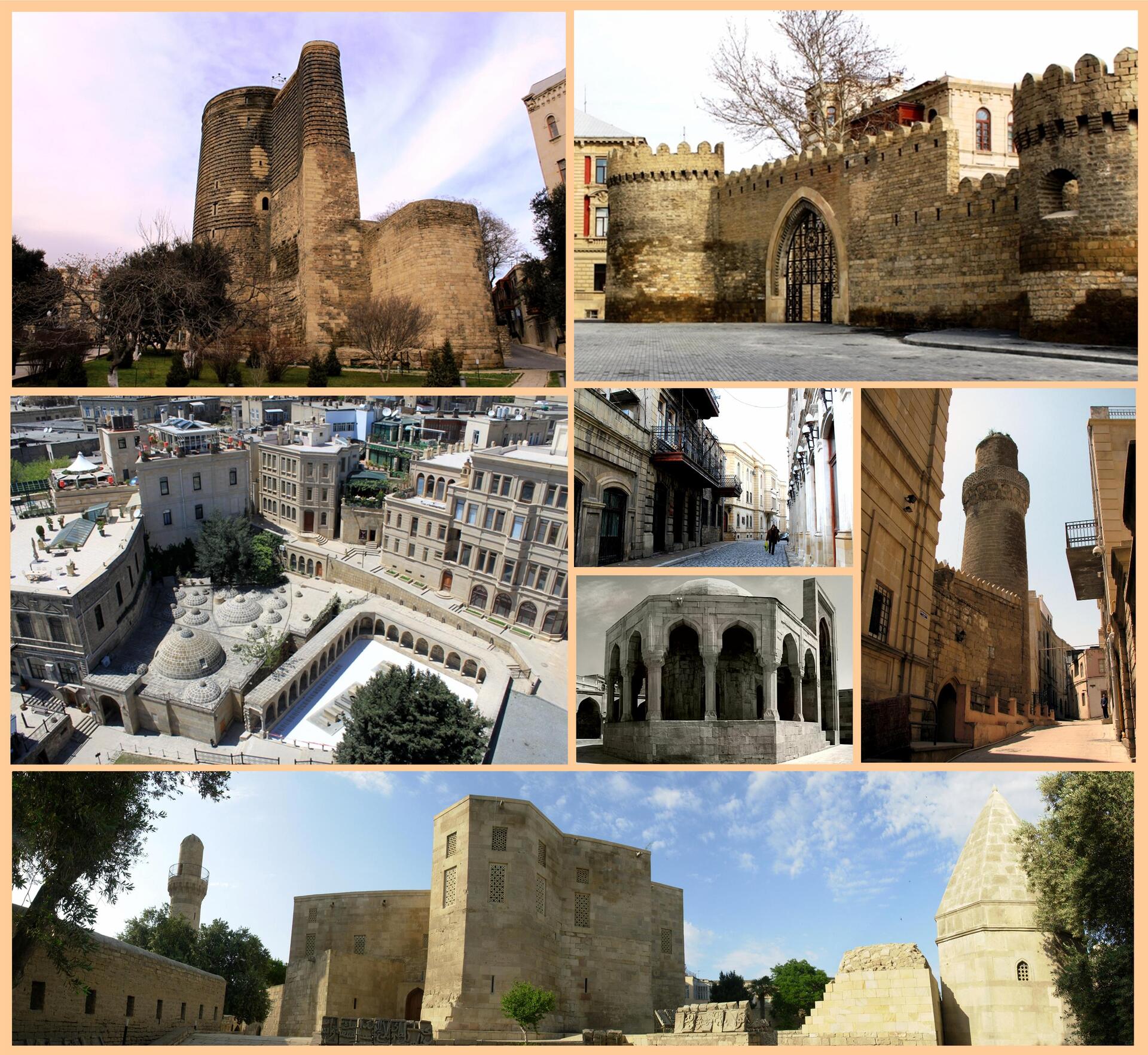
Interfase, Public domain
World Heritage Research
Discover scientific research and academic studies that deepen our understanding of Walled City of Baku with the Shirvanshah's Palace and Maiden Tower from its history and significance to its conservation, management, and contemporary challenges.
-
Fortress walls of Icherisheher: a symbol of resilience
Fortress walls of Icherisheher, a UNESCO World Heritage Site in Baku, stand as enduring symbols of resilience, reflecting the city's ancient history and cultural significance. This study reveals that these fortifications, despite their exposure to natural and external influences over centuries, have played a pivotal role in preserving historical memory and contributing to modern cultural tourism. The research delves into the construction history, restoration efforts, military significance, and usage purposes of the fortress walls, while also examining the factors leading to their destruction. Notably, the study highlights that the partial obliteration of these walls due to economic demands and natural circumstances has not only erased historical narratives but also impacted cultural tourism. The findings underscore the importance of fortress walls as 'stone chronicles' in studying the past and enhancing global recognition.
Huseynova, A. (2026). Fortress walls of Icherisheher: a symbol of resilience. Problems of Arts and Culture, (02), 83. https://doi.org/10.59849/2310-5399.2026.2.83
View Publication Record | Read Publication -
Examining the Characteristics of Outgoing Package Tours from Türkiye to Azerbaijan
Azerbaijan's tourism has seen significant growth, with Turkish package tours playing a crucial role. This study analyzed 47 outgoing tour programs from Türkiye to Azerbaijan, revealing that most are single-destination, cultural-oriented hybrid city tours departing primarily from major Turkish cities via transit air transport to Baku. Key attractions frequently included in these tours are the Alley of Martyrs, Ateshgah, Gobustan, Walled City (Icherisheher), and the Flame Towers. The research highlights the importance of historical and cultural ties between Azerbaijan and Türkiye in shaping tourism trends, with package tours facilitating diverse experiences while minimizing language barriers.
Çeşmeci, N., Özdemir, T., Askarov, T., & Habiba, N. S. (2024). Examining the Characteristics of Outgoing Package Tours from Türkiye to Azerbaijan. Artvin Çoruh Üniversitesi Uluslararası Sosyal Bilimler Dergisi. https://doi.org/10.22466/acusbd.1507218
View Publication Record | Read Publication -
Influence of High Temperature on the Physical and Mechanical Properties of Porous Limestone from Baku (Azerbaijan)
High temperatures significantly degrade the physical and mechanical properties of porous limestone, a common building material in Baku's historic walled city. Research reveals that exposure to temperatures up to 600 °C increases connected porosity and permeability while reducing P-wave velocity, thermal conductivity, specific heat capacity, uniaxial compressive strength, and Young’s modulus due to thermal microcracking. Samples heated to 800 °C disintegrated following decarbonation, forming portlandite. This study provides critical data for assessing fire-induced damage in limestone structures, particularly in seismically active areas prone to post-earthquake fires.
Jodry, C., Heap, M. J., Bayramov, K., Alizada, G., Rustamova, S., & Nabiyeva, S. (2023). Influence of High Temperature on the Physical and Mechanical Properties of Porous Limestone from Baku (Azerbaijan). Fire, 6(7), 263. https://doi.org/10.3390/fire6070263
View Publication Record | Read Publication -
Museum of Miniature Books: Baku, Azerbaijan
The Museum of Miniature Books in Baku, Azerbaijan, showcases over 5,000 ultra-small books from 83 countries, including texts as small as three-quarters of a millimeter square. This collection highlights the artistry and craftsmanship of miniature book creation, with examples ranging from religious texts like a 17th-century Qur’an to iconic literary works such as Shakespeare’s complete plays and L. Tolkien’s 'The Lord of the Rings.' The museum also features creative interpretations by global artists, reflecting on the significance of minibooks. While the smallest books serve no practical purpose due to their size, they likely originated as clandestine or decorative items during periods of censorship, such as Soviet-era Perm. The collection includes notable works like 'The Divine Comedy' and even a 2007 hotel directory, demonstrating both historical significance and whimsical charm.
Patterson, J. R. (2022). Museum of Miniature Books: Baku, Azerbaijan. World Literature Today, 96(2), 80. https://doi.org/10.1353/wlt.2022.0067
View Publication Record | Read Publication -
Gis and 3D Models as Support to Documentation and Planning of the Baku Historical Centre (Republic of Azerbaijan)
A three-dimensional model of Baku's historical center, combined with GIS and other geospatial technologies, has emerged as a powerful tool for documenting and planning the evolution of a UNESCO World Heritage Site. This approach enables systematic analysis of urban stratigraphy, revealing the city's transformation from the Khans to the Soviet period and beyond. By integrating iconographic studies with digital mapping, researchers have captured both major monuments and minor structures, providing a comprehensive framework for virtual navigation and design choices. The study also highlights the importance of standardized data formats and survey instruments in preserving and analyzing historical cities, offering valuable insights for future urban conservation efforts.
Baratin, L., Bertozzi, S., Moretti, E., & Spinella, M. (2012). Gis and 3D Models as Support to Documentation and Planning of the Baku Historical Centre (Republic of Azerbaijan). International Journal of Heritage in the Digital Era, 1(1_suppl), 71–76. https://doi.org/10.1260/2047-4970.1.0.71
View Publication Record | Read Publication