World Heritage Identification Number: 897
World Heritage since: 1999
Category: Cultural Heritage
WHE Type: Buildings & Architectural Ensembles
Transboundary Heritage: No
Endangered Heritage: No
Country: 🇩🇪 Germany
Continent: Europe
UNESCO World Region: Europe and North America
Map
Wartburg Castle: A Medieval Masterpiece and Cultural Icon
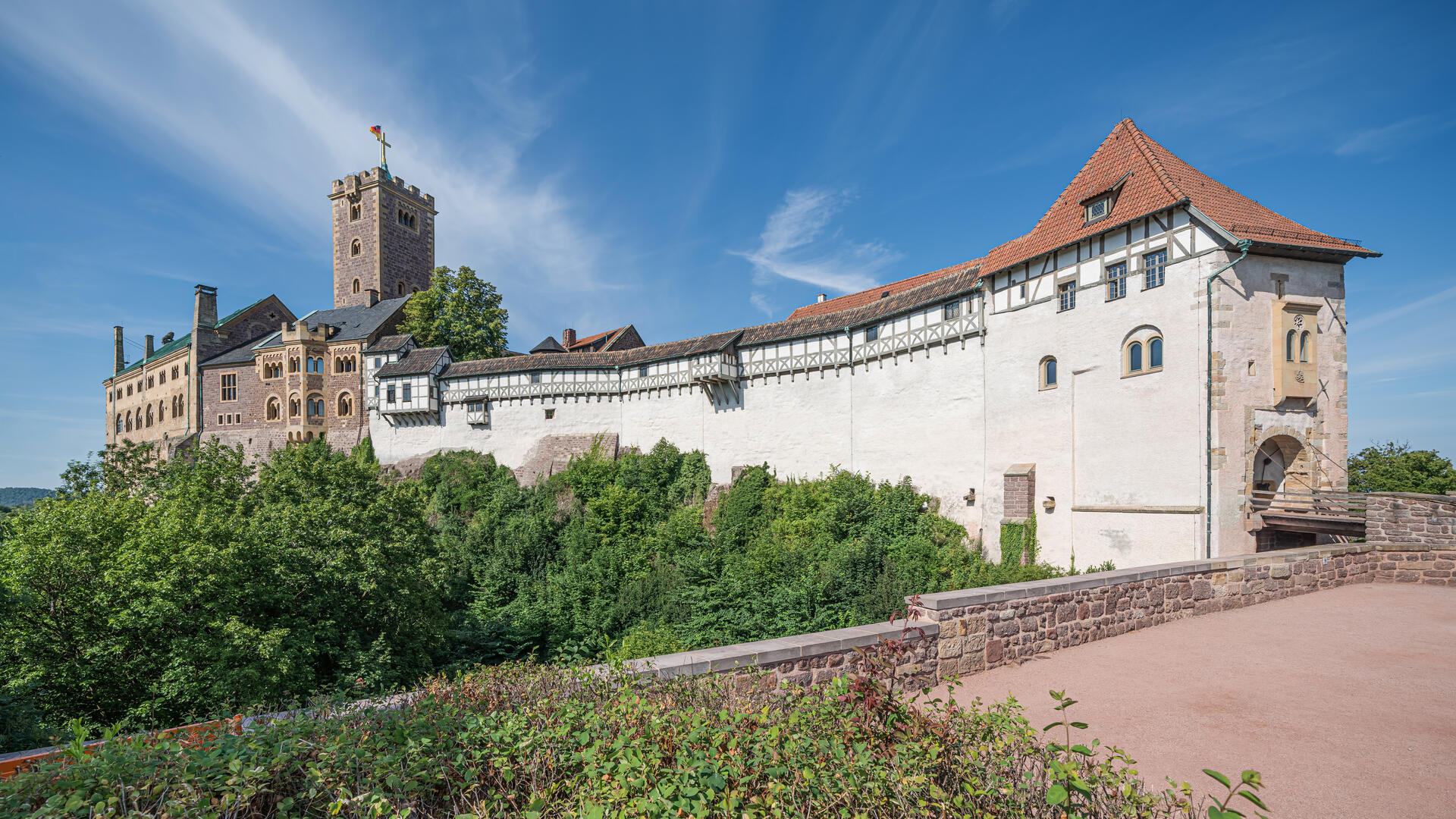
The Wartburg Castle, nestled within the dense forests of Thuringia, Germany, stands as a testament to the rich history and cultural significance of the region. Inscribed as a UNESCO World Heritage Site in 1999, the Wartburg Castle offers a unique blend of medieval architecture, historical events, and enduring legends that continue to captivate visitors and scholars alike.
Originally founded around 1067 by Ludwig der Springer, Wartburg Castle occupies a strategic location atop a 410-meter cliff overlooking the town of Eisenach. Its imposing structure, perched above the surrounding woodlands, provides natural defenses while offering commanding views of the valley below. Despite undergoing extensive renovations during the 19th century, the castle retains an authentic medieval atmosphere that transports visitors back to the era of knights, kings, and courtly intrigue.
One of the most significant chapters in the Wartburg's storied history revolves around Martin Luther, the father of the Protestant Reformation. In 1521, Luther sought refuge at the castle following the Edict of Worms, which declared him an outlaw. During his exile, Luther translated the New Testament into German, a groundbreaking achievement that made religious texts accessible to the common people for the first time.
This achievement did more than just spread religious text; it synthesized various German dialects into a single literary language, fundamentally shaping German identity and culture. This momentous event not only marked a turning point in the history of Christianity but also solidified the Wartburg Castle's status as a symbol of intellectual freedom and cultural transformation.
The Wartburg Castle has also left an indelible mark on European Romanticism, particularly inspiring the construction of Neuschwanstein Castle by King Ludwig II of Bavaria. Both castles share striking similarities in their romanticized Gothic revival styles, showcasing the enduring allure of the Middle Ages even in more modern times. Deeply moved by the legends of the medieval singing contests held at the Wartburg, Ludwig II used the castle's Singers' Hall as the primary blueprint for the interior of his "fairytale" Neuschwanstein Castle.
Beyond its religious and architectural significance, Wartburg Castle occupies a central place in German cultural identity. It was the stage for the legendary Sängerkrieg, the minstrels’ contest that inspired composers such as Richard Wagner, the home of the compassionate Saint Elizabeth, and the site of the 1817 Wartburg Festival, where students first championed the ideals of a unified, democratic Germany. During this festival, the modern German national colors—black, red, and gold—were prominently displayed by student fraternities, marking a formative moment in national history.
Visitors to Wartburg today can explore rooms steeped in history and adorned with intricate frescoes and furnishings. Highlights include The Palas (Great Hall), featuring the legendary Singers’ Hall; The Elisabeth Hallway, adorned with 19th-century frescoes depicting the life of Saint Elizabeth; and The Luther Room, the austere study where the New Testament was translated. The castle’s museum houses an extensive collection of artifacts, providing valuable insight into the lives of its former inhabitants and the broader historical context of the region.
In summary, the Wartburg Castle stands as a remarkable example of medieval architecture and a vital link to Germany's rich cultural heritage. From its role as a sanctuary for Martin Luther to its influence on subsequent architectural masterpieces like Neuschwanstein Castle, the Wartburg Castle remains a captivating destination that invites exploration and reflection on the enduring legacy of the Middle Ages.
UNESCO Description of the World Heritage Site
Wartburg Castle blends superbly into its forest surroundings and is in many ways 'the ideal castle'. Although it has retained some original sections from the feudal period, the form it acquired during the 19th-century reconstitution gives a good idea of what this fortress might have been at the height of its military and seigneurial power. It was during his exile at Wartburg Castle that Martin Luther translated the New Testament into German.
UNESCO Justification of the World Heritage Site
Criterion (iii): The Wartburg Castle is an outstanding monument of the feudal period in central Europe.
Criterion (vi): The Wartburg Castle is rich in cultural associations, most notably its role as the place of exile of Martin Luther, who composed his German translation of the New Testament there. It is also a powerful symbol of German integration and unity.
Encyclopedia Record: Wartburg
The Wartburg is a castle originally built in the Middle Ages. It is situated on a precipice of 410 metres (1,350 ft) to the southwest of and overlooking the town of Eisenach, in the state of Thuringia, Germany. It was the home of St. Elisabeth of Hungary, the place where Martin Luther translated the New Testament of the Bible into German, the site of the Wartburg festival of 1817 and the supposed setting for the possibly legendary Sängerkrieg. It was an important inspiration for Ludwig II when he decided to build Neuschwanstein Castle.Additional Site Details
Area: Not available
Number of Components: 1
(vi) — Directly associated with events or living traditions
Coordinates: 50.96677778 , 10.307
World Heritage Research
Discover scientific research and academic studies that deepen our understanding of Wartburg Castle from its history and significance to its conservation, management, and contemporary challenges.
-
Luther auf der Wartburg 1521/1522: Bibelübersetzung—Bibeldruck—Wirkungsgeschichte ed. by Werner Greiling, Uwe Schirmer, and Elke Anna Werner (review)
A comprehensive compilation of essays, 'Luther auf der Wartburg 1521/1522: Bibelübersetzung—Bibeldruck—Wirkungsgeschichte,' edited by Werner Greiling, Uwe Schirmer, and Elke Anna Werner, sheds light on the significant contributions of Martin Luther during his stay at Wartburg Castle. The book delves into the translation, printing, and illustration of Bibles in Europe before and after Luther's seminal works. It highlights Luther's rapid translation of the New Testament in just over eleven weeks, providing insights into his sources, processes, and the subsequent editing by his colleagues. Additionally, it explores the everyday life at Wartburg Castle, the history of woodcut editions featuring Luther as Junker Jörg, and the artistic contributions of Lucas Cranach. The collection also examines the reformers' 'Gospel-centric' approach to Bible translation, emphasizing its enduring impact on religious thought and practice.
(Ed.). (2024). Luther auf der Wartburg 1521/1522: Bibelübersetzung—Bibeldruck—Wirkungsgeschichte ed. by Werner Greiling, Uwe Schirmer, and Elke Anna Werner (review). Lutheran Quarterly, 38(1), 78–80. https://doi.org/10.1353/lut.2024.a921435
View Publication Record | Read Publication -
Heinrich's Two Great sons (Johann Christoph (13) and Johann Michael Bach)
Wartburg Castle, perched above Eisenach, served as a cultural hub for the Duchy of Eisenach from 1662 to 1741, attracting renowned musicians and artists despite limited resources. The study highlights the transient nature of this patronage, with figures like Daniel Eberlin, Johann Pachelbel, and Georg Telemann leaving due to constraints in funding and opportunities. Eberlin's multifaceted career—spanning music, military service, and banking—underscores the period's dynamic cultural exchanges. The research examines how Eisenach's small scale hindered sustained patronage, contrasting it with larger courts like Louis XIV's, where artists like Hebenstreit could thrive longer.
Geiringer, K., & Geiringer, I. (2024). Heinrich’s Two Great sons (Johann Christoph (13) and Johann Michael Bach). The Bach Family, 30–62. https://doi.org/10.4324/9781003543848-6
View Publication Record | Read Publication -
“True Sons of the Reformation”
The rivalry between religion and philosophy in German culture post-1800, particularly around the Reformation anniversary of 1817 and the tercentennial celebrations of 1830, was shaped by competing interpretations of the Reformation's legacy. The Wartburg Festival of 1817, held at Wartburg Castle—a site significant for Luther’s translation of the gospels during his exile—served as a pivotal moment where students and veterans gathered to reflect on the Reformation's impact. This chapter analyzes how new philosophical and historical ideas, notably in Friedrich Keyser’s Reformations-Almanach (1817, 1819), influenced public discourse. Additionally, it examines late-career works by Hegel and Schleiermacher, revealing how the Reformation was strategically invoked to legitimize intellectual pursuits and gain public and official support.
(Ed.). (2024). “True Sons of the Reformation”. Enlightenment’s Reformation, 187–222. https://doi.org/10.1017/9781009494038.009
View Publication Record | Read Publication -
Geschwinde Zeitläufte
The Reformation's trajectory diverged significantly between Electoral Saxony and the domain of Duke Johann, with distinct outcomes in urban centers across both regions. Volker Joestel's study reveals that while the reformation movement in Electoral Saxony waned rapidly due to complex interactions between theology and social realities, it persisted for two more years in Thuringia. This contrast underscores the nuanced relationship between religious reform and societal dynamics during Luther's tenure at Wartburg Castle in 1521/22.
Joestel, V. (2023). Geschwinde Zeitläufte. https://doi.org/10.5771/9783374073672
View Publication Record | Read Publication -
Komerad Martin: Luther as an East(ern) German
This study challenges the conventional narrative by emphasizing Martin Luther's strong ties to eastern Germany, highlighting his birthplace in Eisleben and his significant contributions during his time at Wartburg Castle. It reveals that Luther, often associated with western Germany, was deeply rooted in the region, particularly during his translation of the New Testament into German (1522) while in exile. The research also underscores Luther's use of middle German, a widely spoken dialect, and his role in shaping religious documents like the Torgau Articles, which laid the foundation for the Augsburg Confession (1530). Additionally, the study surveys East German historiography on Luther, providing a geographical context rooted in the former German Democratic Republic. This approach offers a nuanced perspective on Luther's influence and legacy within eastern Germany.
Johnson, W. G. (2021). Komerad Martin: Luther as an East(ern) German. Journal of Religious & Theological Information, 20(3), 69–84. https://doi.org/10.1080/10477845.2021.1924946
View Publication Record | Read Publication -
“Sites of Memory” – A Topic for Research and Communication?
The application of sociological and historical memory theories to monument preservation offers new perspectives for research and communication. This study demonstrates how concepts from Maurice Halbwachs and Pierre Nora can enrich discussions in ancient studies, using Wartburg Castle, Metz Cathedral, Didyma, and Pompeii as case studies. By analyzing these sites, the research reveals how spatial and temporal memory associations can generate innovative insights, bridging cultural studies with heritage preservation.
Steudtner, K. (2021). “Sites of Memory” – A Topic for Research and Communication? Freie Universität Berlin. https://doi.org/10.17169/REFUBIUM-29549
View Publication Record | Read Publication -
Luther’s Invocavit Sermons (Lent 1522)
Luther’s Invocavit Sermons (1522) highlight the pivotal role of faith, love, and the Word of God in driving a gospel-centered reformation, marking a turning point in the trajectory of early Lutheran reform. The study examines Luther's return to Wittenberg after his exile at Wartburg Castle, where he sought to reclaim his vision of reform amid growing conflicts with colleagues like Andreas Bodenstein von Karlstadt, who advocated for more radical changes. Using historical analysis and theological critique, the research reveals how Luther’s sermons during Lent 1522 aimed to moderate the volatile social and religious reforms in Wittenberg, addressing controversies such as iconoclasm and liturgical changes while reaffirming core Lutheran principles like justification by faith alone. The study also explores the political and interpersonal tensions that shaped the reform movement, offering insights into the complexities of early Reformation dynamics.
Lohrmann, M. J. (2021). Luther’s Invocavit Sermons (Lent 1522). Lutheran Quarterly, 35(4), 444–454. https://doi.org/10.1353/lut.2021.0090
View Publication Record | Read Publication