World Heritage Identification Number: 1107
World Heritage since: 2005
Category: Cultural Heritage
WHE Type: Natural Landscapes & Geographic Features
Transboundary Heritage: No
Endangered Heritage: No
Country: 🇮🇱 Israel
Continent: Asia
UNESCO World Region: Europe and North America
Map
Exploring the Incense Route - Desert Cities in the Negev: A Journey Through Ancient Trade Routes
The Incense Route - Desert Cities in the Negev, designated as a World Heritage Site by UNESCO in 2005, offers a fascinating glimpse into the ancient world of trade, culture, and civilization that thrived in the harsh yet fertile lands of the Negev Desert in southern Israel. This region, situated at the end of the Incense Route, served as a crucial nexus connecting Arabia to the Mediterranean during the Hellenistic-Roman period (3rd century BC to the 2nd century AD).
More to come…UNESCO Description of the World Heritage Site
The four Nabatean towns of Haluza, Mamshit, Avdat and Shivta, along with associated fortresses and agricultural landscapes in the Negev Desert, are spread along routes linking them to the Mediterranean end of the incense and spice route. Together they reflect the hugely profitable trade in frankincense and myrrh from south Arabia to the Mediterranean, which flourished from the 3rd century BC until the 2nd century AD. With the vestiges of their sophisticated irrigation systems, urban constructions, forts and caravanserai, they bear witness to the way in which the harsh desert was settled for trade and agriculture.
UNESCO Justification of the World Heritage Site
Criterion (iii): The Nabatean towns and their trade routes bear eloquent testimony to the economic, social and cultural importance of frankincense to the Hellenistic-Roman world. The routes also provided a means of passage not only for frankincense and other trade goods but also for people and ideas.
Criterion (v): The almost fossilized remains of towns, forts, caravanserais and sophisticated agricultural systems strung out along the Incense Route in the Negev desert, display an outstanding response to a hostile desert environment and one that flourished for five centuries.
Encyclopedia Record: Incense Route – Desert Cities in the Negev
Incense Route – Desert Cities in the Negev is a World Heritage-designated area near the end of the Incense Route in the Negev, southern Israel, which connected Arabia to the Mediterranean in the Hellenistic-Roman period, proclaimed as being of outstanding universal value by UNESCO in 2005. The trade led to the development of ancient towns, forts and caravanserai en route, apart from agricultural development.Additional Site Details
Area: 6,655 hectares
Number of Components: 4
(v) — Outstanding example of traditional human settlement
Coordinates: 30.5738888889 , 35.0091666667
Image
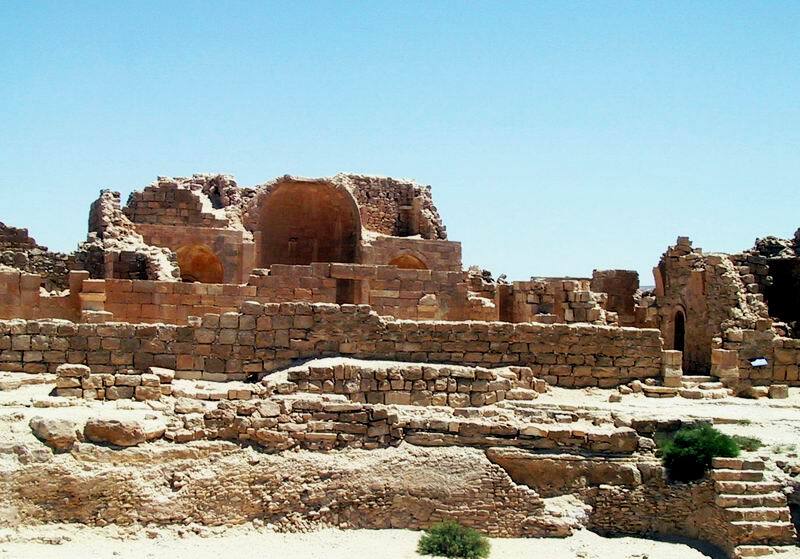
© Urij at English Wikipedia, CC BY-SA 3.0 Resized from original. (This derivative is under the same CC BY-SA license.)
World Heritage Research
Discover scientific research and academic studies that deepen our understanding of Incense Route - Desert Cities in the Negev from its history and significance to its conservation, management, and contemporary challenges.
-
Nabatean Tent Sites on the Ruhot Plain, Central Negev, and Nomadic Visibility
Research on Nabatean tent sites in the Ruhot Plain, Central Negev, reveals a lesser-known pastoral nomadic component of Nabatean society that contrasts with the established caravan route and urban centers. Analysis of architectural, geographic, and ceramic data from four sites shows these campsites differ significantly from those linked to the classic Incense Road, offering insights into the nomadic lifestyle of the Nabateans. The study compares these findings with earlier Timnian and later Byzantine/Early Islamic desert pastoral systems, as well as modern desert societies, providing a unique perspective on the archaeology of pastoral camps, often considered inaccessible.
Margulis, M., & Rosen, S. A. (2025). Nabatean Tent Sites on the Ruhot Plain, Central Negev, and Nomadic Visibility. Bulletin of the American Society of Overseas Research, 393, 1–22. https://doi.org/10.1086/734106
View Publication Record | Read Publication -
Shiqmim II: The Phase II Excavations at a Chalcolithic Settlement Center in the Northern Negev Desert, Israel (1987–1993)
The Phase II excavations at Shiqmim, a Chalcolithic settlement center in the northern Negev Desert, Israel (1987–1993), reveal a complex farming community with extensive above-ground and subterranean architectural features. The study challenges previous classifications of Ghassulian society as a chiefdom, instead emphasizing detailed analyses of subsystems like production, distribution, and spatial organization. Radiocarbon dating suggests the site was abandoned by 3800 cal BCE, aligning with broader Chalcolithic chronology. The research uses stratigraphic, architectural, and radiocarbon methods to reconstruct social structures and settlement dynamics.
Rosen, S. A. (2025). Shiqmim II: The Phase II Excavations at a Chalcolithic Settlement Center in the Northern Negev Desert, Israel (1987–1993). Journal of Eastern Mediterranean Archaeology and Heritage Studies, 13(3), 337–340. https://doi.org/10.5325/jeasmedarcherstu.13.3.0337
View Publication Record | Read Publication -
Deutsch-Israelischer Wissenstransfer und Begegnungsgeschichte
A two-decade German-Israeli academic exchange program, centered in Beer Sheva's desert edge, successfully fostered cross-cultural knowledge transfer and interdisciplinary learning. This initiative, documented in a volume of academic articles, essays, experience reports, and obituaries, demonstrated the profound impact of immersive educational experiences on participants' understanding of Jewish and Israel Studies, archaeology, history, geology, anthropology, and sociology. The program's unique blend of Hebrew language instruction, German-language lectures, and regular study visits to significant sites in the Negev desert highlighted the region's cultural and scientific significance, contributing valuable insights into the encounter between German and Israeli academic traditions.
Gelber, M. H., & Müller, J. (Eds.). (2025). Deutsch-Israelischer Wissenstransfer und Begegnungsgeschichte. https://doi.org/10.5771/9783987401749
View Publication Record | Read Publication -
A lifetime track of a griffon vulture: The moving story of Rehovot ( Y64 )
A griffon vulture named Rehovot, tracked for eight years using GPS technology, demonstrated age-related changes in movement and foraging behavior, providing critical insights into the species' ecology and conservation. The study revealed that juvenile vultures, like Rehovot, move greater distances and utilize thermals less efficiently than adults, highlighting the importance of learning in flight performance. Rehovot's data also aided in detecting poisoning incidents, showcasing the potential of long-term tracking for endangered species management. This research underscores the value of individual lifetime studies in understanding behavioral adaptation and ecological dynamics.
Acácio, M., Anglister, N., Vaadia, G., Harel, R., Nathan, R., Hatzofe, O., & Spiegel, O. (2023). A lifetime track of a griffon vulture: The moving story of
View Publication Record | Read PublicationRehovot (Y64 ). Ecology, 104(4). Portico. https://doi.org/10.1002/ecy.3985 -
The Southern Levant and Northern Arabia in the Iron Age
During the first millennium BCE, arid regions of the southern Levant and northern Arabia experienced significant societal transformation, marked by the emergence of independent polities with varying social complexities. These societies, often overlooked through the lens of Near Eastern empires' written records, were primarily organized around nomadic semi-pastoralism and limited agriculture, heavily influenced by environmental factors like aridity. The study reveals how these regions became integrated into broader Near Eastern economic systems, particularly through trade networks involving mineral resources such as copper from Wadi Arabah and incense from South Arabia. Neighboring empires, notably the Assyrian and Neo-Babylonian, sought to dominate these routes and co-opt tribal groups controlling them, though with mixed success. The research leverages local epigraphic and archaeological evidence to elucidate this pivotal period of political and economic organization.
Tebes, J. M. (2023). The Southern Levant and Northern Arabia in the Iron Age. The Oxford History of the Ancient near East Volume V, 231–298. https://doi.org/10.1093/oso/9780190687663.003.0052
View Publication Record | Read Publication -
Desert Depths
A critical architectural approach to the Negev/Naqab Desert challenges Eurocentric and settler colonial narratives of emptiness, revealing complex, layered histories and ecologies. The study employs hybrid mapping techniques to spatialize conditions of migration, erasure, and power, creating deep cartographies that expose interdependent cultural and climatic worlds. By centering marginalized perspectives and confronting the Western gaze, the research offers a more inclusive and empathetic understanding of desert landscapes, countering dominant perceptions through student-led, open-ended design exercises.
Bernbaum, P., & Colbert, Z. (2023). Desert Depths. Journal of Architectural Education, 77(2), 390–409. https://doi.org/10.1080/10464883.2023.2233387
View Publication Record | Read Publication -
The Perspectives of Nessana: New Studies of the “Caravan City” in Southern Israel
Nessana, a Byzantine and early Islamic period settlement in the Negev desert, emerges as a pivotal caravan junction on the Christian pilgrimage route to St. Catherine's Monastery in Sinai. This study highlights Nessana's transformation into an urbanized hub with a population of around five thousand people, supported by economic benefits from pilgrimage, numerous churches, and caravanserais. The research leverages unique archaeological evidence, including papyri, building inscriptions, and pilgrimage graffiti, to shed light on early Christian pilgrimage dynamics. Despite previous excavations, the site's stratigraphy and layout remain unclear, prompting a new expedition to address these gaps through systematic fieldwork and interdisciplinary analysis.
Tchekhanovets, Y. (2023). THE PERSPECTIVES OF NESSANA: NEW STUDIES OF THE “CARAVAN CITY” IN SOUTHERN ISRAEL. Rossiiskaia Arkheologiia, (2), 121–130. https://doi.org/10.31857/s0869606323020058
View Publication Record | Read Publication