World Heritage Identification Number: 916
World Heritage since: 1999
Category: Cultural Heritage
WHE Type: Memorial Sites
Transboundary Heritage: No
Endangered Heritage: No
Country: 🇿🇦 South Africa
Continent: Africa
UNESCO World Region: Africa
Map
Robben Island: A Symbol of Resistance and Freedom
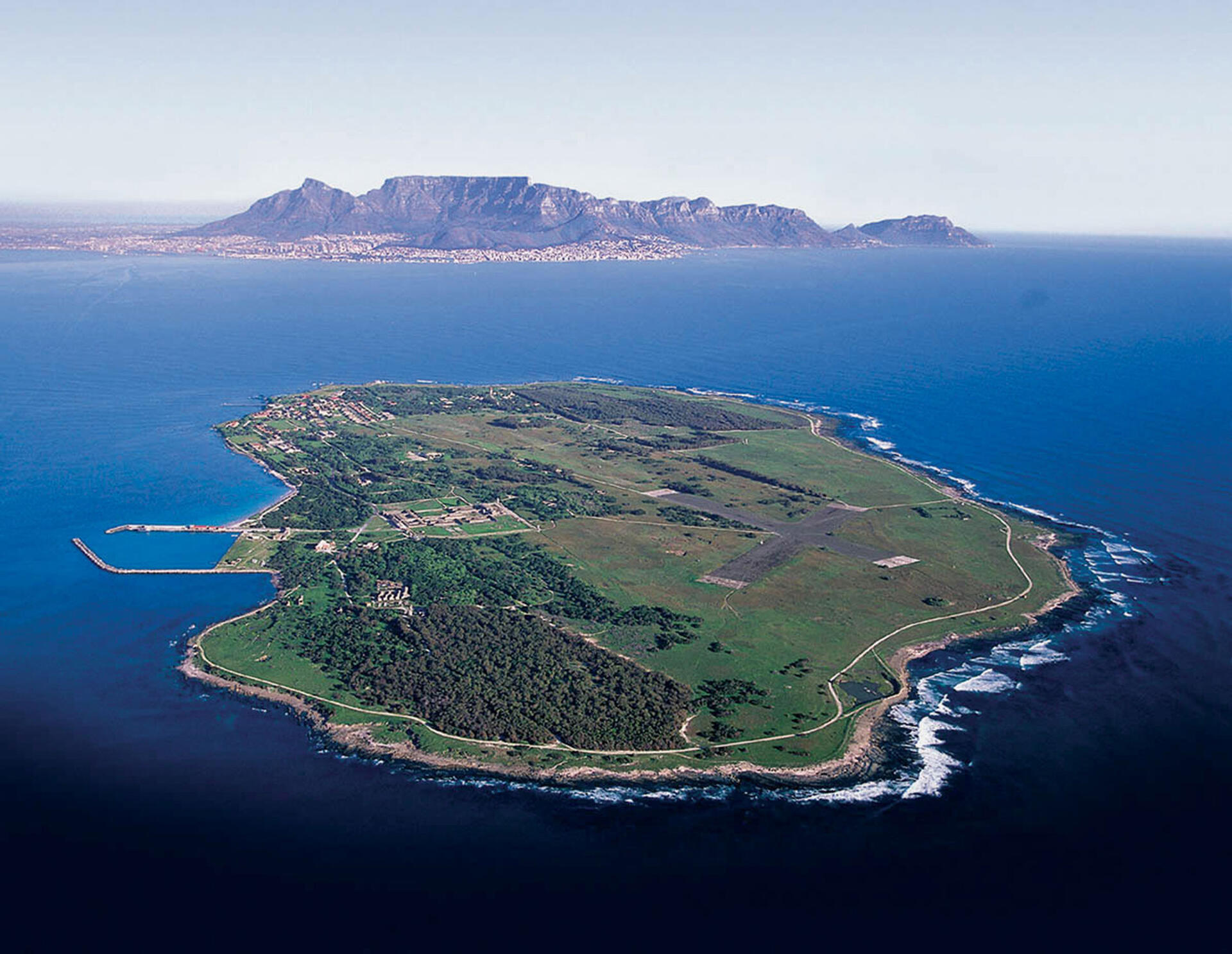
Robben Island, located approximately 6.9 kilometers west of the coast of Bloubergstrand, north of Cape Town, South Africa, holds significant historical and cultural importance that transcends its geographical location. Inscribed as a UNESCO World Heritage Site in 1999, this island has been a stage for some of the most poignant moments in South African history, serving as a prison, a place of exile, a hospital, and a military base throughout the 17th to 20th centuries.
Archaeological evidence suggests that the island was visited by indigenous peoples long before European colonization, although the archaeological record remains limited. From the 17th century, under Dutch colonial rule, the island became part of recorded history as a place of exile, isolation, and imprisonment, including for those who resisted colonial expansion. Among the earliest known prisoners were indigenous leaders such as the Xhosa prophet Makana, who was imprisoned there in the early 19th century following resistance against colonial forces.
Throughout its colonial history, Dutch authorities used the island not only as a center for exile and imprisonment—detaining political prisoners and rebellious slaves—but also, due to its isolation, as a quarantine station for individuals suffering from contagious diseases such as leprosy, smallpox, and tuberculosis.
During the 19th century, the British took control of the island and expanded its various functions, establishing a lighthouse station, a mental hospital, and a leper colony. Although Robben Island had long served as a place of imprisonment, it gained international notoriety during the apartheid era as a maximum-security prison for political activists who opposed the racist policies of the National Party government.
Among the most notable political prisoners incarcerated on Robben Island were Nelson Mandela, Walter Sisulu, Ahmed Kathrada, Govan Mbeki, and Robert Sobukwe. These individuals played crucial roles in the anti-apartheid movement, and their imprisonment on the island became emblematic of the broader struggle against racial discrimination and oppression.
Nelson Mandela spent 18 of his 27 years of imprisonment on Robben Island, where he endured harsh conditions while continuing to advocate for justice and equality. Mandela’s small prison cell has become one of the most iconic symbols of Robben Island, reflecting the severe restrictions placed on political prisoners while also standing as a powerful reminder of endurance and resistance.
The maximum-security prison used during the apartheid era stands as a testament to the resilience and determination of the political prisoners held there. Despite difficult living conditions, many prisoners continued to pursue education, political discussion, and intellectual development while incarcerated. Their determination transformed the prison into what some former inmates later described as a “university” of the liberation struggle.
One of the most significant features of the prison landscape was the limestone quarry, where prisoners were forced to perform hard labor under harsh conditions. The bright limestone dust and intense sunlight caused lasting damage to many prisoners’ eyesight, including Nelson Mandela. Despite the physically demanding work, the quarry also became a space of intellectual exchange and political discussion.
With the end of apartheid and the establishment of democratic rule in 1994, Robben Island came to symbolize the triumph of freedom, reconciliation, and human dignity over institutionalized racism and oppression. Today, the island serves as a museum and educational site visited by people from around the world. The Robben Island Museum offers guided tours that allow visitors to learn about the experiences of former prisoners and the history of South Africa’s struggle for democracy.
In 2024, UNESCO also inscribed the separate World Heritage Site “Human Rights, Liberation and Reconciliation: Nelson Mandela Legacy Sites,” which comprises a group of locations across South Africa associated with Nelson Mandela’s life, imprisonment, and the broader struggle against apartheid. This designation places Robben Island within a wider network of heritage sites that collectively document South Africa’s liberation history and its long journey toward democracy, human rights, and reconciliation.
Altogether, Robben Island stands as a powerful reminder of South Africa’s tumultuous past and its journey toward freedom and reconciliation. The island's designation as a UNESCO World Heritage Site recognizes its global significance in the fight against apartheid, oppression and racism. As a symbol of resistance, perseverance, and human dignity, it continues to inspire people around the world and remains one of the most important historical landmarks associated with the struggle for human rights and equality.
UNESCO Description of the World Heritage Site
Robben Island was used at various times between the 17th and 20th centuries as a prison, a hospital for socially unacceptable groups and a military base. Its buildings, particularly those of the late 20th century such as the maximum security prison for political prisoners, witness the triumph of democracy and freedom over oppression and racism.
UNESCO Justification of the World Heritage Site
Criterion (iii): The buildings of Robben Island bear eloquent witness to its sombre history.
Criterion (vi): Robben Island and its prison buildings symbolize the triumph of the human spirit, of freedom and of democracy over oppression.
Encyclopedia Record: Robben Island
Robben Island is an island in Table Bay, 6.9 kilometres (4.3 mi) west of the coast of Bloubergstrand, north of Cape Town, South Africa. It takes its name from the archaic Dutch word for seals (robben), hence the Dutch/Afrikaans name Robbeneiland, which translates to Seal(s) Island.Additional Site Details
Area: 475 hectares
Number of Components: 1
(vi) — Directly associated with events or living traditions
Coordinates: -33.8 , 18.36666667
World Heritage Research
Discover scientific research and academic studies that deepen our understanding of Robben Island from its history and significance to its conservation, management, and contemporary challenges.
-
Recurating Robben Island: cultural objects, digital memory, and the entropic afterlives of national heritage
A study of visitor-generated Instagram posts at Robben Island Museum reveals that digital artifacts challenge the museum’s official narrative of resilience and reconciliation, instead reflecting diverse interpretations of Apartheid’s legacy. Analyzing 500 South African visitors' posts, researchers found that these personal accounts—ranging from trauma to aesthetic appreciation—highlight the multivocality of public memory. This suggests a need for inclusive heritage management in post-conflict sites, where digital platforms mediate competing perspectives. The findings underscore how cultural entropy shapes national identity and call for participatory approaches to heritage conservation.
Coetzee, M. (2025). Recurating Robben Island: cultural objects, digital memory, and the entropic afterlives of national heritage. American Journal of Cultural Sociology, 14(2), 280–312. https://doi.org/10.1057/s41290-025-00260-0
View Publication Record | Read Publication -
Publications relating to biodiversity on Robben Island
A comprehensive bibliography of 200 publications on Robben Island, a UNESCO World Heritage Site since 1999, offers critical insights into its biodiversity, ecosystems, and human impacts. This curated collection serves as a foundational resource for researchers, enabling the design of more effective studies, the identification of knowledge gaps, and the avoidance of redundant work. It also provides long-term data sets and historical context to guide policy and management decisions, ensuring robust and informed conservation efforts on the island.
Romero Iraola, I., Underhill, L. G., & Sherley, R. B. (2025). Publications relating to biodiversity on Robben Island. Biodiversity Observations, 15, 99–101. https://doi.org/10.15641/bo.1860
View Publication Record | Read Publication -
Penguin population models for Robben Island
A strong link between adult penguin survival rates and sardine abundance off Cape Agulhas has been identified on Robben Island. The study, using moult count data, demonstrates that the reproductive success and survival of penguins are significantly influenced by pelagic fish availability. While this initial model provides valuable insights, challenges arise when applying Bayesian estimation due to biological constraints on demographic parameters. Future work aims to refine these models by incorporating a beta distribution and additional population data to improve accuracy.
Robinson, W., & Butterworth, D. (2024). Penguin population models for Robben Island. University of Cape Town. https://doi.org/10.25375/UCT.25998097
View Publication Record | Read Publication -
An Initial Analysis of the Power of Monitoring certain Indices to Determine the Effect of Fishing on Penguin Reproductive Success from an Experiment where Pelagic Fishing is Prohibited in the Neighbourhood of Robben Island, but Continues around Dassen Island.
A 30% reduction in fishing activity around Robben Island could take up to two decades to detect a statistically significant impact on penguin reproductive success, with fledging success requiring longer monitoring than the breeders per adult moulter ratio. Initial analysis suggests that pelagic fishing may enhance penguin reproduction by scattering large shoals, increasing predator-prey encounters, though these findings are not statistically significant. The study uses General Linear Modelling (GLM) to simulate the power of an experiment where fishing is prohibited near Robben Island but continues around Dassen Island, estimating a 20% process error for monitoring indices and a potential 3% annual population growth rate change.
Brandao, A., & Butterworth, D. (2024). An Initial Analysis of the Power of Monitoring certain Indices to Determine the Effect of Fishing on Penguin Reproductive Success from an Experiment where Pelagic Fishing is Prohibited in the Neighbourhood of Robben Island, but Continues around Dassen Island. University of Cape Town. https://doi.org/10.25375/UCT.25998091
View Publication Record | Read Publication -
Second bibliography of biodiversity research on Robben Island
A comprehensive second bibliography of biodiversity research on Robben Island has been compiled, covering the period from 2016 to 2024. This update builds upon the previous bibliography, which covered research up to 2016, providing an extensive record of scientific output related to the island's unique ecosystem. The bibliography highlights significant contributions to the understanding and preservation of Robben Island's biodiversity, supported by the Robben Island Museum. It serves as a valuable resource for researchers, conservationists, and policymakers, offering insights into the ecological dynamics and historical significance of this important site.
Sherley, R. B., Underhill, L. G., & Barham, P. J. (2024). Second bibliography of biodiversity research on Robben Island. Biodiversity Observations, 14, 44–49. https://doi.org/10.15641/bo.1565
View Publication Record | Read Publication -
Prison Tourism: The Emotional Responses to Robben Island, South Africa
A qualitative study of Western visitors to Robben Island, South Africa, reveals that sadness is the predominant emotional response, with motivations for visitation including historical interest, education, and remembrance. The research, conducted through semi-structured interviews with 25 participants, identifies key factors that evoke emotions and influence visitor behavior. These insights suggest that the Robben Island Museum can enhance the visitor experience by strategically evoking these emotions to create a more impactful and lasting impression.
Isaac, R. K. (2024). Prison Tourism: The Emotional Responses to Robben Island, South Africa. Dark Tourism, 41–59. https://doi.org/10.1108/978-1-83797-336-120241004
View Publication Record | Read Publication -
Virtue on Robben Island
Robben Island, a UNESCO World Heritage Site and former South African prison, paradoxically fostered communal virtues among political prisoners despite its status as a 'total institution.' The study reveals that the island's environment nurtured trust and virtues like honesty, humility, and generosity, akin to Aristotle's vision of communal friendship. However, it also highlights a tendency for such communities to define themselves by excluding others, regarded as alien or threatening. To counter this, the chapter introduces Levinas' ethical concept, emphasizing openness to otherness beyond Aristotelian bounds. A notable example is prisoners signing their names in Sonny Venkatrathnam's copy of Shakespeare's works, symbolizing an embrace of diversity and the stranger.
Schalkwyk, D. (2023). Virtue on Robben Island. Shakespeare and Virtue, 325–333. https://doi.org/10.1017/9781108918589.037
View Publication Record | Read Publication