World Heritage Identification Number: 774
World Heritage since: 1996
Category: Mixed Cultural Heritage and Natural Heritage
WHE Type: Protected Areas & National Parks
Transboundary Heritage: No
Endangered Heritage: No
Country: 🇸🇪 Sweden
Continent: Europe
UNESCO World Region: Europe and North America
Map
Laponian Area: A Cultural and Natural Legacy of the Saami People
The Laponian Area, officially recognized as a UNESCO World Heritage Site since 1996, is a vast and pristine wilderness located in the northernmost regions of Sweden. This expansive territory, spanning across Gällivare Municipality, Arjeplog Municipality, and Jokkmokk Municipality, bears the Latin name for Lapland – a testament to its historical significance.
More to come…UNESCO Description of the World Heritage Site
The Arctic Circle region of northern Sweden is the home of the Saami people. It is the largest area in the world (and one of the last) with an ancestral way of life based on the seasonal movement of livestock. Every summer, the Saami lead their huge herds of reindeer towards the mountains through a natural landscape hitherto preserved, but now threatened by the advent of motor vehicles. Historical and ongoing geological processes can be seen in the glacial moraines and changing water courses.
UNESCO Justification of the World Heritage Site
Criterion (iii): The Laponian Area bears exceptional testimony to the tradition of reindeer herding, and is one of the last and unquestionably the largest and best preserved examples of an area of transhumance, a practice once widespread in northern Europe and which dates back to an early stage in human economic and social development.
Criterion (v): The Laponian Area is an outstanding example of traditional land-use, a cultural landscape reflecting the ancestral way of life of the Saami people based around the seasonal herding of reindeer.
Criterion (vii): The property exhibits a great variety of natural phenomena of outstanding beauty. The snow-covered mountains in Sarek and Sulidälbmá are not only magnificent to see but are a textbook of glacial-related geomorphology. The large alpine lakes in Padjelanta, with the mountain backdrop on the Swedish/Norwegian border are of exceptional beauty. The extensive Rapa Valley provides a total contrast with the alpine areas. Particularly noteworthy is its very active delta area, surrounding cliffs and rocky outliers with sheer faces plunging into the delta. The existence of the Saami culture ranging from the traditional birch and turf kata to contemporary cabins adds to the aesthetic value of the property.
Criterion (viii): The nominated area contains all the processes associated with glacial activity such as U-shaped valleys, moraines, talus slopes, drumlins, presence of large erratics and rapidly flowing glacial streams. It has excellent examples of ice and frost action in a tundra setting including formation of polygons and an area of spectacularly collapsing and growing palsa mounds. Glacial rivers originating in the snowfields continue to cut through bedrock. Large unvegetated areas illustrate the phenomenon of weathering. The property also contains a record of humans being part of these ecosystems for seven thousand years.
Criterion (ix): The vast mire complex of Sjávnja/Sjaunja is the largest in Europe outside Russia. This area is virtually impenetrable by human beings except during winter. The Laponian area has primeval coniferous forest with dating indicating ages as old as 700 years. Natural succession continues here unimpaired.
Encyclopedia Record: Laponia
Laponia, or the Laponian Area, is a large mountainous wildlife area in the Lapland province in northern Sweden, more precisely in Gällivare Municipality, Arjeplog Municipality and Jokkmokk Municipality. The name comes from the Latin name for Lapland.Additional Site Details
Area: 940,900 hectares
Number of Components: 1
(v) — Outstanding example of traditional human settlement
(vii) — Contains superlative natural phenomena or beauty
(viii) — Outstanding example representing major earth stages
(ix) — Outstanding example representing ecological and biological processes
Coordinates: 67.33333 , 17.58333
IUCN World Heritage Outlook
The 2025 Conservation Outlook on Laponian Area reports the following assessment:
Source: International Union for Conservation of Nature (IUCN) · View assessment
Image
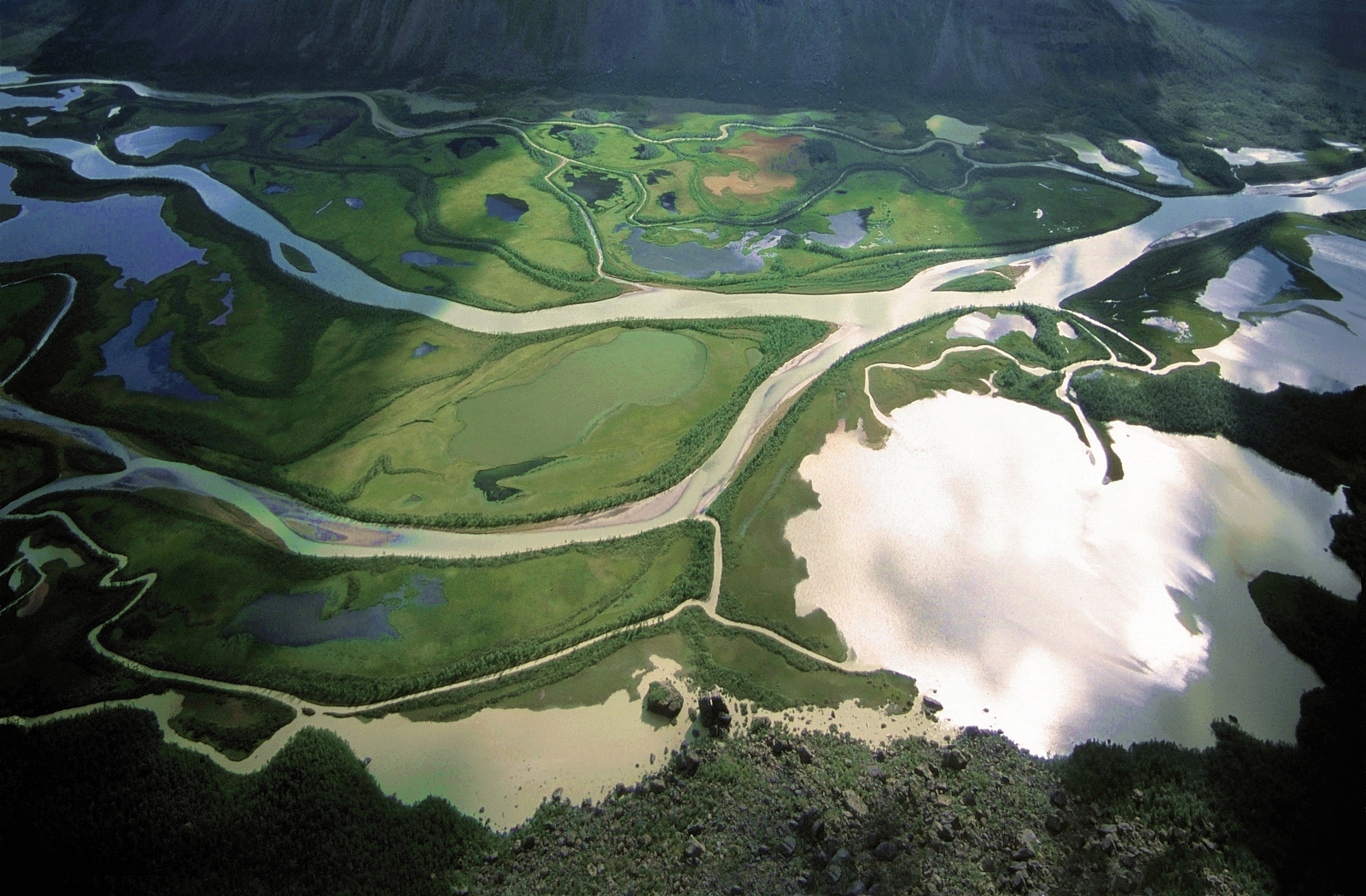
© Photographer: Mg-k., CC BY-SA 3.0 Resized from original. (This derivative is under the same CC BY-SA license.)
World Heritage Research
Discover scientific research and academic studies that deepen our understanding of Laponian Area from its history and significance to its conservation, management, and contemporary challenges.
-
Wilderness and Culture: Tourist Views and Experiences in the Laponian World Heritage Area
Tourists perceive the Laponian World Heritage Area as a pristine wilderness characterized by untouched nature, wild animals, and minimal human influence, even while acknowledging its use for Sami reindeer herding practices and tourism development. This study reveals that tourists do not view these uses as contradictory, highlighting a nuanced understanding of wilderness that balances natural preservation with cultural and economic activities. To explore these perceptions, researchers surveyed tourists about their views on landscape and the concept of wilderness, providing insights into how people interpret and experience protected areas in northern Sweden.
Wall-Reinius, S. (2012). Wilderness and Culture: Tourist Views and Experiences in the Laponian World Heritage Area. Society & Natural Resources, 25(7), 621–632. https://doi.org/10.1080/08941920.2011.627911
View Publication Record | Read Publication