
World Heritage Identification Number: 1448
World Heritage since: 2017
Category: Natural Heritage
WHE Type: Natural Landscapes & Geographic Features
Transboundary Heritage: Yes
Endangered Heritage: No
Country: Mongolia, Russian Federation
Continent: Asia, Europe
UNESCO World Region: Asia and the Pacific,Europe and North America
Map
The Landscapes of Dauria: A Transboundary Testimony to Steppe Ecosystem Diversity
The Landscapes of Dauria, inscribed as a UNESCO World Heritage Site in 2017, stands as a remarkable testament to the rich biodiversity and ecological complexity of the Daurian Steppe eco-region, spanning across eastern Mongolia and Russian Siberia, with extensions into northeastern China. This expansive region, encompassing over 35,000 square kilometers, is a veritable sanctuary for a myriad of flora and fauna, showcasing a breathtaking array of steppe ecosystems, including grasslands, forests, lakes, and wetlands.
More to come…UNESCO Description of the World Heritage Site
Shared between Mongolia and the Russian Federation, this site is an outstanding example of the Daurian Steppe eco-region, which extends from eastern Mongolia into Russian Siberia and northeastern China. Cyclical climate changes, with distinct dry and wet periods lead to a wide diversity of species and ecosystems of global significance. The different types of steppe ecosystems represented, such as grassland and forest, as well as lakes and wetlands serve as habitats for rare species of fauna, such as the White-naped crane, Great Bustard, Relict Gull and Swan goose, as well as millions of vulnerable, endangered or threatened migratory birds. It is also a critical site on the transboundary migration path for the Mongolian gazelle.
UNESCO Justification of the World Heritage Site
Criterion (ix): The Landscapes of Dauria contains substantial and relatively undisturbed areas of different types of steppe, ranging from grassland to forest, as well as many lakes and wetlands. All these habitats host a diversity of species and communities characteristic of the northern part of the vast Daurian Steppe ecoregion. Cyclic climate changes with distinct wet and dry periods lead to high species and ecosystem diversity which is globally significant and offers outstanding examples of ongoing ecological and evolutionary processes. The property also includes key natural habitats for many animal species during their annual migration, some of which also breed in the area. The high diversity of ecosystems, biotopes and their transition-zones in the property is indicative of the many evolutionary adaptive processes undergone by species living in this unique area.
Criterion (x): The transboundary serial property conserves an excellent example of Daurian steppe and its characteristic wildlife including a number of globally threatened bird species (White-naped Crane, Hooded Crane, Swan Goose, Relict Gull, Great Bustard and Saker Falcon) as well as the endangered Tarbagan Marmot. It also provides essential breeding and resting habitat for birds along the East Asian-Australasian Flyway, with up to 3 million birds in spring and 6 million in autumn using the area during migration. The property also provides critical winter grounds and seasonal transboundary migration routes of the emblematic Mongolian Gazelle.
Encyclopedia Record: Landscapes of Dauria
The Landscapes of Dauria is a World Heritage Site shared between Russia and Mongolia, part of the "Daurian forest steppe" ecoregion. It is part of the Dauria International Protected Area and includes the Torey Lakes.Additional Site Details
Area: 912,624 hectares
Number of Components: 5
(x) — Contains most important habitats for biodiversity
Coordinates: 49.9302222222 , 115.4254444444
IUCN World Heritage Outlook
The 2025 Conservation Outlook on Landscapes of Dauria reports the following assessment:
Source: International Union for Conservation of Nature (IUCN) · View assessment
Image
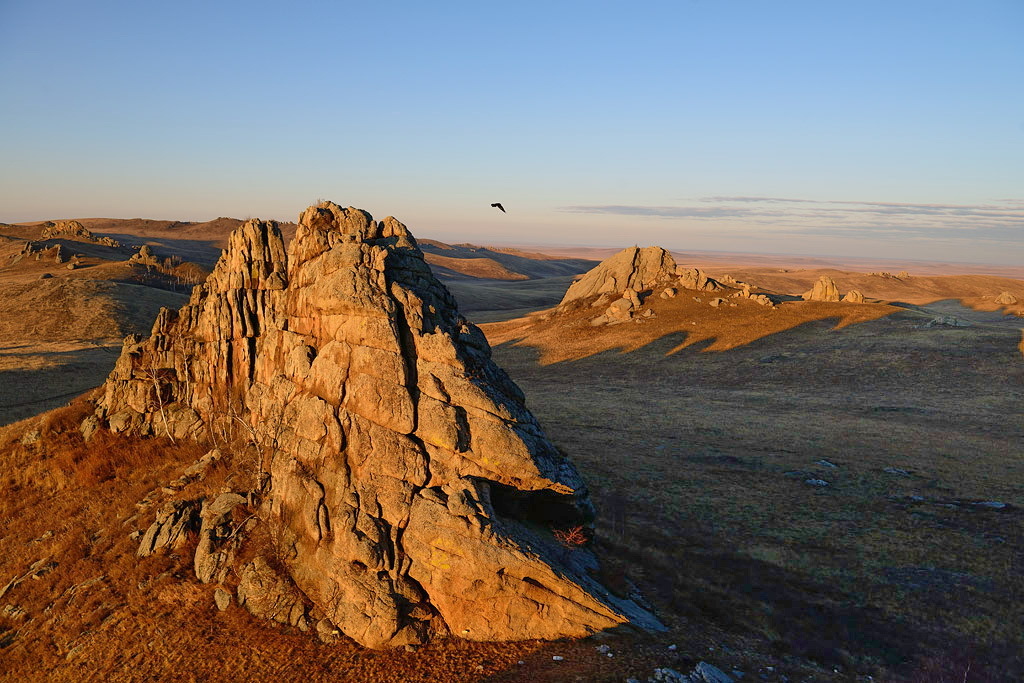
© Игорь Шпиленок, CC BY-SA 3.0 Resized from original. (This derivative is under the same CC BY-SA license.)
World Heritage Research
Discover scientific research and academic studies that deepen our understanding of Landscapes of Dauria from its history and significance to its conservation, management, and contemporary challenges.
-
Soils of the Floodplain–Estuary Part of the Transboundary Uldza River of the Endorheic Arid Uldza–Torei Basin (Southeastern Transbaikal, Dauria)
Research reveals that soils in the floodplain-estuary of the Uldza River, part of the UNESCO World Heritage Site 'Landscapes of Dauria,' exhibit unique characteristics shaped by cyclic arid and humid phases. Predominant soil types include alluvial dark-humus (meadow and sod-meadow) and alluvial light-humus (sod) carbonate soils, marked by heavy granulometric composition in upper layers and sandy-sandy loam beneath, with highly alkaline pH and carbonate saturation. These soils are slightly saline, dominated by magnesium-sodium cations and chloride-soda anions, yet low in fertility due to minimal nitrate nitrogen and mobile phosphorus. The study, conducted during a transition from arid to humid climatic phases, underscores the need for conservation efforts in this transboundary region, given its ecological significance and vulnerability to climate change.
Ubugunov, L. L., Ubugunova, V. I., Ayushina, T. A., Zhambalova, A. D., Ubugunov, V. L., & Nasatueva, Ts. N. (2026). Soils of the Floodplain–Estuary Part of the Transboundary Uldza River of the Endorheic Arid Uldza–Torei Basin (Southeastern Transbaikal, Dauria). Arid Ecosystems, 16(1), 67–77. https://doi.org/10.1134/s2079096126700083
View Publication Record | Read Publication -
Halomorphic Soils of Coastal Designs of Endorous Pulsating Chloride Lakes During the Regressive (Arid) Climatic Phase
Research in the Landscapes of Dauria reveals that saline soils along the shores of pulsating chloride lakes exhibit distinct genetic relationships and salinity patterns during arid climate phases. The study identified a series of genetically linked saline soils—quasi-gley solonchaks, humus-quasi-gley saline soils, and light humus saline soils—formed under the influence of highly mineralized lake waters. Notably, chloride–soda and soda-chloride salinization was observed in lower soil horizons, particularly during regressive (arid) climate phases. The findings highlight the dynamic interaction between climate cycles and soil formation, providing critical data for monitoring saline ecosystems in transboundary regions of Russia, Mongolia, and China amid global climate change.
Ubugunov, L. L., Zhambalova, A. D., Ubugunova, V. I., Ayushina, T. A., & Syrenzhapova, A. S. (2024). Halomorphic Soils of Coastal Designs of Endorous Pulsating Chloride Lakes During the Regressive (Arid) Climatic Phase. Arid Ecosystems, 14(1), 37–46. https://doi.org/10.1134/s2079096124010153
View Publication Record | Read Publication -
Aeolian Sands of the Temperate Boreal Zone (Northern Asia)
Aeolian sands in the temperate boreal zone of northern Asia, particularly in the Landscapes of Dauria (Western Transbaikalia), exhibit unique characteristics distinct from subtropical and tropical deserts. These sands, dominated by medium- and fine-grained, polymineral material with unstable minerals like feldspars and pyroxenes, form mini-deserts with active aeolian processes such as dunes and deflationary basins. The study reveals that the activation of these processes is driven by both natural factors—including neotectonic movements, semi-arid climate, and vegetation types—and anthropogenic activities like deforestation and land plowing. Radiocarbon dating indicates that aeolian activity has intensified during the Holocene, primarily sourced from river and lake beaches, floodplains, and terraces. Unlike tropical deserts, where sands are finer and monomineral, boreal zone sands are coarser and more diverse mineralogically, offering potential for ecotourism development.
Akulov, N., Rubtsova, M., Akulova, V., Ryzhov, Y., & Smirnov, M. (2024). Aeolian Sands of the Temperate Boreal Zone (Northern Asia). Quaternary, 7(4), 55. https://doi.org/10.3390/quat7040055
View Publication Record | Read Publication -
Features of protection of transboundary objects of the world natural heritage: Russian and foreign experience (Part 2)
A comparative analysis of transboundary World Heritage Sites reveals that while international obligations and UNESCO guidelines provide foundational frameworks, national legal adaptations are essential for effective protection. The study examines the V-Arly-Pendjari Complex (Benin, Niger, Burkina Faso) and the Wadden Sea (Germany, Denmark, Netherlands), identifying key management provisions and coordination measures to mitigate threats. Findings suggest that Russian transboundary sites like the Ubsunur Basin and Landscapes of Dauria require tailored legislative adjustments, as direct extrapolation of foreign models is insufficient. The research highlights the need for localized legal reforms to align with global conservation standards while addressing unique regional challenges.
Kolobov, R. Y., Ditsevich, Y. B., Cherdakova, L. A., & Suvorova, A. V. (2023). Features of protection of transboundary objects of the world natural heritage: Russian and foreign experience (Part 2). Международное Право И Международные Организации / International Law and International Organizations, (3), 55–66. https://doi.org/10.7256/2454-0633.2023.3.40947
View Publication Record | Read Publication -
Development of the system of transboundary protected areas in the Asian part of Russia
Five transboundary protected areas have been established in the Asian part of Russia through interstate agreements with Mongolia, China, and Kazakhstan, including the UNESCO World Heritage Site Landscapes of Dauria. These areas are crucial for preserving biotic and landscape diversity across administrative borders. The study identifies ten additional promising territories for future protection, emphasizing their high environmental significance. Cooperation with neighboring countries such as Kazakhstan, China, Mongolia, North Korea, Japan, and the United States is expected to further expand this network of protected zones.
Kalikhman, T. P. (2019). Development of the system of transboundary protected areas in the Asian part of Russia. IOP Conference Series: Earth and Environmental Science, 381(1), 12037. https://doi.org/10.1088/1755-1315/381/1/012037
View Publication Record | Read Publication -
Environmental Transboundary Territories of Siberia and the Far East
Transboundary specially protected natural areas (TSPNAs) offer a unique solution for preserving biotic and landscape diversity by minimizing economic activity near borders. Five TSPNAs, including Dauria, have been established through interstate agreements to date, with additional potential sites like the Amur Tiger and Leopard region being considered. Effective functioning of these areas requires bilateral or multilateral agreements to facilitate joint scientific and tourist programs while reducing border control. The study highlights the theoretical and practical aspects of establishing TSPNAs in Siberia and the Far East, emphasizing their role in conservation efforts.
Kalikhman, T. P. (2019). Environmental Transboundary Territories of Siberia and the Far East. Geography and Natural Resources, 40(4), 315–324. https://doi.org/10.1134/s1875372819040036
View Publication Record | Read Publication -
Russian Federation
In 2017, the transboundary area 'Landscapes of Dauria,' shared between Mongolia and Russia, was inscribed into the UNESCO World Heritage List, recognizing its significant ecological value. This designation followed Russia's proactive environmental initiatives, including the establishment of 24 strict natural reserves and proposals to expand protected areas under the Year of Ecology plan. Additionally, three Russian wetlands were proposed for inclusion in the Ramsar Convention list, while the Man and the Biosphere Program extended and renamed twelve existing biosphere reserves. These actions underscore Russia's commitment to global conservation efforts, aligning with its obligations under international environmental conventions.
Krasnova, I. (2017). 10. Russian Federation. Yearbook of International Environmental Law, 28, 353–357. https://doi.org/10.1093/yiel/yvy048
View Publication Record | Read Publication