World Heritage Identification Number: 782
World Heritage since: 1996
Category: Cultural Heritage
WHE Type: Buildings & Architectural Ensembles
Transboundary Heritage: No
Endangered Heritage: No
Country: 🇪🇸 Spain
Continent: Europe
UNESCO World Region: Europe and North America
Map
La Lonja de la Seda de Valencia: A Masterpiece of Late Gothic Architecture
The Lonja de la Seda, or Silk Exchange, located in the heart of Valencia, Spain, stands as a testament to the city's rich history and economic prowess during the Middle Ages. Inscribed as a UNESCO World Heritage Site in 1996, this architectural marvel offers a captivating blend of artistry, culture, and commerce that continues to enthrall visitors today.
More to come…UNESCO Description of the World Heritage Site
Built between 1482 and 1533, this group of buildings was originally used for trading in silk (hence its name, the Silk Exchange) and it has always been a centre for commerce. It is a masterpiece of late Gothic architecture. The grandiose Sala de Contratación (Contract or Trading Hall), in particular, illustrates the power and wealth of a major Mediterranean mercantile city in the 15th and 16th centuries.
UNESCO Justification of the World Heritage Site
Criterion (i): La Lonja de la Seda de Valencia represents a masterpiece of European Gothic art, a true temple of commerce based on a unique architectonic and symbolic programme.
Criterion (iv): La Lonja de la Seda de Valencia is an outstanding example of a secular building in late Gothic style, which dramatically illustrates the power and the wealth of the great Mediterranean mercantile cities.
Encyclopedia Record: Llotja de la Seda
The Llotja de la Seda is a late Valencian Gothic-style civil building in Valencia, Spain. It is a principal tourist attraction in the city.Additional Site Details
Area: 0.2 hectares
Number of Components: 1
(iv) — Outstanding example of a type of building or landscape
Coordinates: 39.47441667 , -0.378444444
Image
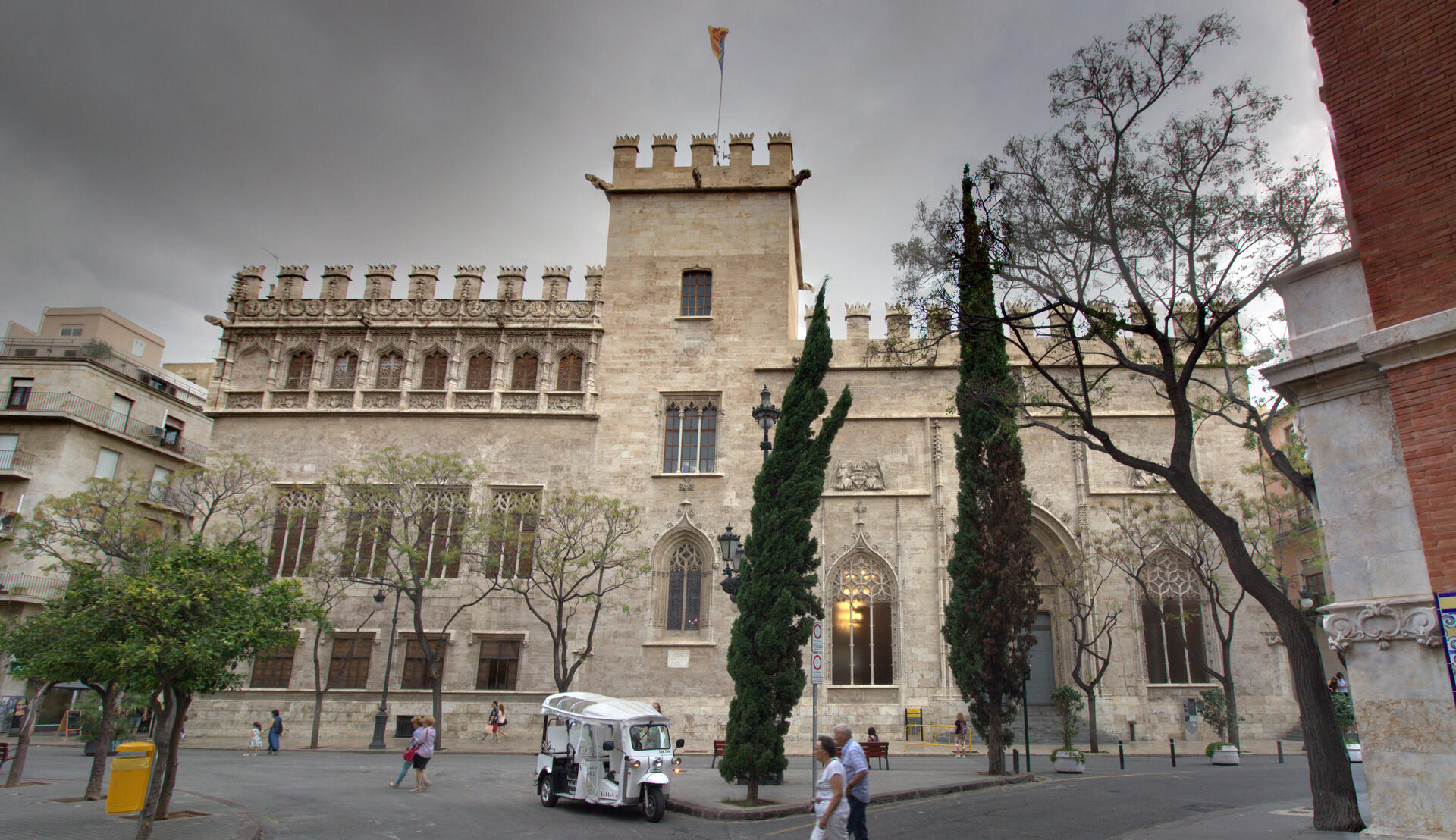
© Juan Mayordomo, CC BY-SA 4.0 Resized from original. (This derivative is under the same CC BY-SA license.)
World Heritage Research
Discover scientific research and academic studies that deepen our understanding of La Lonja de la Seda de Valencia from its history and significance to its conservation, management, and contemporary challenges.
-
The Protection of the Historic City: The Case of the Surroundings of the Lonja de la Seda in Valencia (Spain), UNESCO World Heritage
Historic cities often retain their core functions over centuries, even as buildings evolve. In Valencia, Spain, the commercial heart has long revolved around the Lonja de la Seda (Silk Exchange), a UNESCO World Heritage Site since 1996. However, its surrounding structures and urban spaces, despite their historical significance and close ties to the protected building, remain unprotected. This study combines material analysis of buildings with archival research to redefine the tangible and intangible values of this cultural heritage complex. By examining both physical fabric and documentary evidence, the research highlights how a broader understanding of historic cities can inform comprehensive preservation efforts, ensuring that residential areas and notable structures are not just seen as individual landmarks but as integral parts of urban development processes.
Mileto, C., & Vegas López-Manzanares, F. (2023). The Protection of the Historic City: The Case of the Surroundings of the Lonja de la Seda in Valencia (Spain), UNESCO World Heritage. Architecture, 3(4), 596–626. https://doi.org/10.3390/architecture3040033
View Publication Record | Read Publication -
La Lonja de la Seda de Valencia: Patrimonio Mundial y su proyección en el futuro tras su inscripción en 1996
La Lonja de la Seda de Valencia stands as the sole UNESCO World Heritage Site in the city, embodying the opulence of 15th- and 16th-century trade. Since its inscription in 1996, the site has undergone strategic urban transformations, including pedestrianization, to enhance public access and appreciation. Its exceptional architectural uniqueness and well-preserved state have solidified its status as a cherished landmark, drawing significant tourism while maintaining cultural respect. This study highlights the site's dual role as both a historical emblem and a dynamic component of Valencia's heritage landscape.
Ramón Fernández, F. (2022). La Lonja de la Seda de Valencia: Patrimonio Mundial y su proyección en el futuro tras su inscripción en 1996. Revista PH. https://doi.org/10.33349/2022.107.5182
View Publication Record | Read Publication -
The perceptive experience of the heritage landscape
A deeper connection between citizens and Valencia's cultural heritage can be fostered through experiential learning, as demonstrated by a study on the church of the Santos Juanes. This approach prioritizes sensory experience over traditional data-driven discourse to reduce digital divides and promote equal access to knowledge. The research proposes workshops and visits that focus on interpretation and perception, aiming to counteract alienation behaviors in the heritage landscape. Despite recent redevelopment efforts, the area has suffered from physical deterioration and poor urban connections, leading to a need for innovative educational interventions. Such initiatives not only strengthen civic engagement but also provide valuable insights into public perception and valuation of heritage environments.
Barranco Donderis, A. (2022). The perceptive experience of the heritage landscape. Proceedings HERITAGE 2022 - International Conference on Vernacular Heritage: Culture, People and Sustainability, 1–7. https://doi.org/10.4995/heritage2022.2022.15660
View Publication Record | Read Publication -
Didáctica de las matemáticas y arquitectura: la razón áurea en la Lonja de Valencia
A study reveals the presence of golden ratio proportions in the renowned La Lonja de la Seda, a UNESCO World Heritage Site in Valencia. The research documents a tutored undergraduate thesis process focusing on geometric analysis, highlighting the building's harmonic decomposition. This approach combines pedagogical methodology with architectural analysis to demonstrate how mathematical principles underpin the structure's aesthetic and functional design.
Donat, P., Rueda, P., & Sánchez-Pérez, E. A. (2016). Didáctica de las matemáticas y arquitectura: la razón áurea en la Lonja de Valencia. Modelling in Science Education and Learning, 9(2), 13. https://doi.org/10.4995/msel.2016.6337
View Publication Record | Read Publication -
El levantamiento gráfico arquitectónico de precisión. La jamba de la portada de acceso principal a la Lonja de La Seda de Valencia
A high-precision architectural survey of the main portal jamb of La Lonja de la Seda, a UNESCO World Heritage Site in Valencia, reveals insights into its original geometry and conservation challenges. Using advanced non-destructive methods—including 3D laser scanning and electronic total station technology—the study compares traditional measurement tools with modern instruments to assess accuracy and symmetry. Findings highlight the monument's adherence to historical metric systems while addressing conservation needs that balance authenticity with structural integrity. This approach sets a benchmark for documenting and preserving architectural heritage, offering practical solutions for maintaining the site's universal significance.
Hernández Muñoz, E. J. El levantamiento gráfico arquitectónico de precisión. La jamba de la portada de acceso principal a la Lonja de La Seda de Valencia. https://doi.org/10.4995/thesis/10251/59426
View Publication Record | Read Publication -
Experiencing Augmented Reality as an Accessibility Resource in the UNESCO Heritage Site Called “La Lonja”, Valencia
Augmented reality (AR) significantly enhances the accessibility and visitor experience at the UNESCO World Heritage Site 'La Lonja de la Seda' in Valencia. A study involving 145 participants of diverse backgrounds found that AR effectively addressed perception challenges such as poor lighting and distance, allowing users to interactively explore architectural details with positive feedback. The application was well-received, fostering a renewed appreciation for the monument's historical and cultural significance.
Puyuelo, M., Higón, J. L., Merino, L., & Contero, M. (2013). Experiencing Augmented Reality as an Accessibility Resource in the UNESCO Heritage Site Called “La Lonja”, Valencia. Procedia Computer Science, 25, 171–178. https://doi.org/10.1016/j.procs.2013.11.021
View Publication Record | Read Publication