World Heritage Identification Number: 930
World Heritage since: 2000
Category: Cultural Heritage
WHE Type: Cultural Landscapes
Transboundary Heritage: No
Endangered Heritage: No
Country: 🇪🇸 Spain
Continent: Europe
UNESCO World Region: Europe and North America
Map
The Palmeral of Elche: An Oasis of Arab Agricultural Practices in Europe
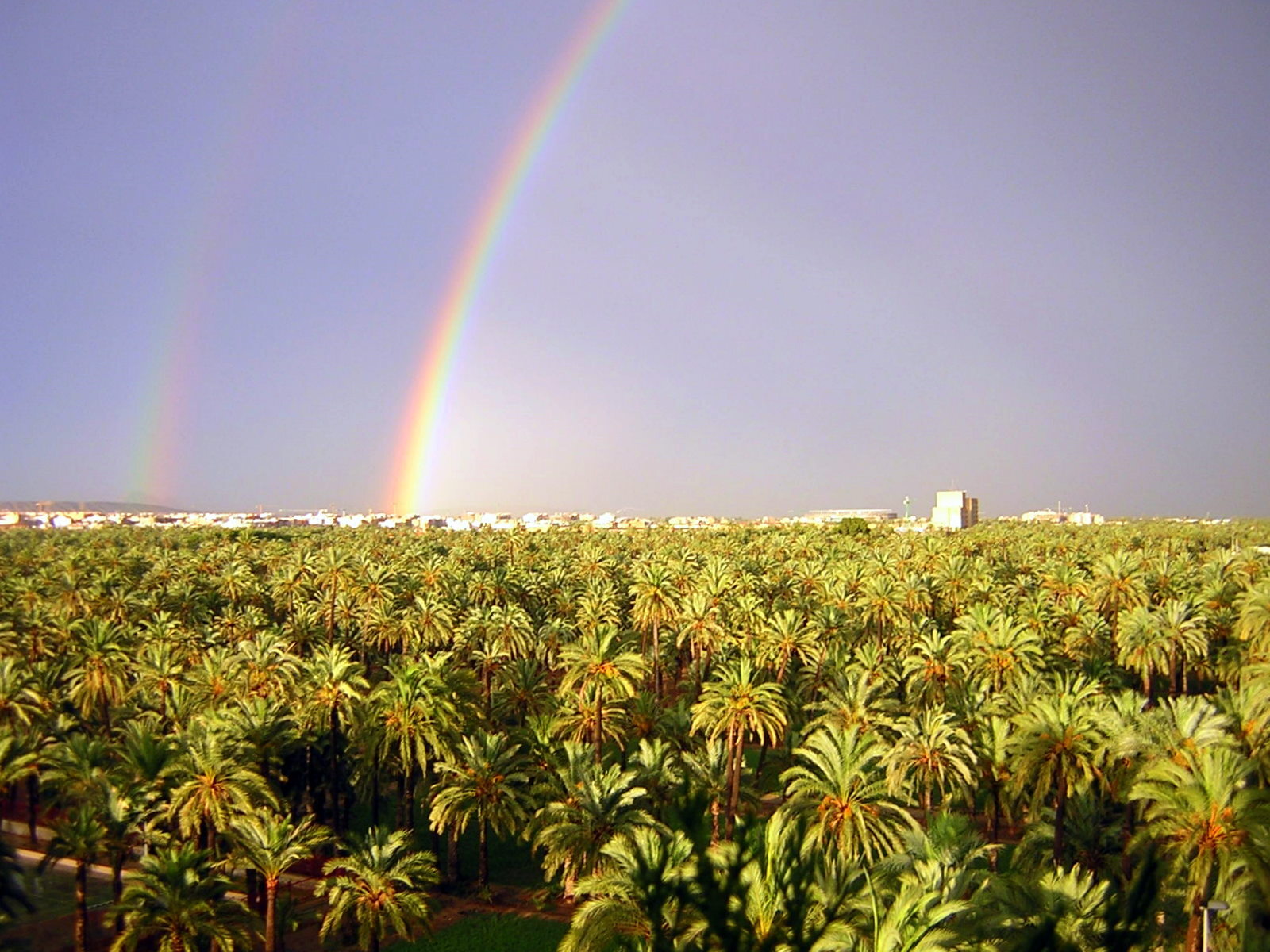
The Palmeral of Elche, located in the Spanish city of Elche, is a remarkable testament to the rich history of agricultural practices that have been cultivated across the Iberian Peninsula. Inscribed as a UNESCO World Heritage Site in 2000, this palm grove stands as a unique example of Arab agricultural techniques on the European continent.
More to come…UNESCO Description of the World Heritage Site
The Palmeral of Elche, a landscape of groves of date palms, was formally laid out, with elaborate irrigation systems, at the time the Muslim city of Elche was erected, towards the end of the tenth century A.C., when much of the Iberian peninsula was Arab. The Palmeral is an oasis, a system for agrarian production in arid areas. It is also a unique example of Arab agricultural practices on the European continent. Cultivation of date palms in Elche is known at least since the Iberian times, dating around the fifth century B.C.
UNESCO Justification of the World Heritage Site
Criterion (ii): The palm groves of Elche are a remarkable example of the transference of a characteristic landscape from one culture and continent to another, in this case from North Africa to Europe.
Criterion (v): The palm grove is a typical feature of the North African landscape which was brought to Europe during the Islamic occupation of much of the Iberian Peninsula and has survived to the present day. The ancient irrigation system, which is still functioning, is of special interest.
Encyclopedia Record: Palmeral of Elche
The Palmeral or Palm Grove of Elche is the generic name for a system of date palm orchards in the city of Elche, Spain.Additional Site Details
Area: 144 hectares
Number of Components: 1
(v) — Outstanding example of traditional human settlement
Coordinates: 38.26666667 , -0.716666667
World Heritage Research
Discover scientific research and academic studies that deepen our understanding of Palmeral of Elche from its history and significance to its conservation, management, and contemporary challenges.
-
Un oasis de vida: la cultura y el paisaje del agua en Elche
Water has been the cornerstone of Elche's cultural identity and landscape, shaping its heritage through centuries. This study reveals how historical hydraulic infrastructures from Roman and Andalusian periods have left a lasting imprint on local traditions, topography, and even gastronomy. The research identifies water as a defining element in the city's toponymy, festivals, and agricultural practices, with the UNESCO-listed Palmeral of Elche serving as a prime example of its enduring influence. By analyzing primary sources and specialized literature through a cultural and social history lens, the study underscores the need to preserve not only physical structures but also the intangible knowledge and collective memory tied to water, ensuring its role in sustaining both heritage and identity.
Ballina Romero, I. (2026). An An Oasis of Life: The Culture and Landscape of Water in Elche. Espacio Tiempo Y Forma. Serie VI, Geografía, (19), 151–171. https://doi.org/10.5944/etfvi.19.2026.46855
View Publication Record | Read Publication -
Traditional agroecosystems for urban temperature regulation: a remote sensing analysis of an historical palm grove
A historical date palm grove, the UNESCO World Heritage Palm Grove of Elche (Spain), demonstrates significant thermal regulation capacity, effectively mitigating urban heat island effects. Remote sensing analysis revealed that this traditional agroecosystem, characterized by its unique irrigation system, maintains lower land surface temperatures compared to surrounding urban areas, with cooling effects extending several hectares. The study highlights the potential of conserving or regenerating such traditional agroecosystems within cities to improve natural temperature regulation and provide essential ecosystem services, particularly in semi-arid regions with limited water resources.
Melendez-Pastor, I. (2025). Traditional agroecosystems for urban temperature regulation: a remote sensing analysis of an historical palm grove. Remote Sensing Applications: Society and Environment, 38, 101569. https://doi.org/10.1016/j.rsase.2025.101569
View Publication Record | Read Publication -
Plantaciones de Palmeras de Elche: Arte, Agricultura, Sociedad
Despite decades of legislative protection, the historic date palm plantations (Palmeral) of Elche, Spain, face severe decline due to urban encroachment and loss of traditional agricultural practices. A century-long corpus of laws—from 1933’s prohibition on felling living palms to UNESCO’s 2000 World Heritage designation—has failed to preserve the site's ecological and cultural integrity. While these measures aimed to safeguard the palm groves, urban development, including infrastructure like schools and hospitals, fragmented the landscape, eroding its structure without adequate enforcement. The study reveals that bureaucratic plans and symbolic recognition, such as UNESCO’s status, have had minimal practical impact on conservation, leaving the Palmeral in a state of ruin. Key challenges include the loss of traditional irrigation methods and the lack of effective urban planning to balance development with heritage preservation.
Jaén i Urban, G., & Vilella-Bas, S. (2025). Plantaciones de Palmeras de Elche: Arte, Agricultura, Sociedad. Proyecto Y Ciudad, (16), 133–146. https://doi.org/10.26754/ojs_pyc/pyc.202512729
View Publication Record | Read Publication -
Comportamiento de dátiles (phoenix dactylifera l.) de Elche a diferentes tratamientos de maduración exógena en postcosecha
Researchers found that acetic acid and freezing treatments effectively accelerated the ripening of dates from two out of three studied orchards (Caqui and Los Olmos) in Elche, Europe's largest date palm grove, without compromising organoleptic quality. This breakthrough could address key challenges in date production, including variability due to traditional seed reproduction, heterogeneous ripening within clusters, and seasonal rainfall risks. The study evaluated three post-harvest treatments—acetic acid, freezing, and vaporization—on dates during the khalal stage, measuring parameters like weight, firmness, soluble solids, acidity, ripeness index, color, and sensory quality. While acetic acid and freezing proved successful for certain orchards, vaporization failed to produce high-quality dates across all samples. The findings suggest potential for increasing date yield, reducing costs, and extending market availability by enabling whole-cluster harvests before rainy seasons.
A., A., M.T., P., M.A., B., M.S., A., & M., S. Comportamiento de dátiles (phoenix dactylifera l.) de Elche a diferentes tratamientos de maduración exógena en postcosecha. V Congreso Iberoamericano de Tecnología Postcosecha Y Agroexportaciones. https://doi.org/10.31428/10317/11843
View Publication Record | Read Publication -
Social Perspective about the Evolution of a Cultural Asset as a World Heritage Site. Case Study: The Palmeral of Elche
The Palmeral of Elche, recognized as a UNESCO World Heritage Site since 2000, exemplifies how cultural heritage can drive sustainable tourism growth while preserving its historical significance. This study identifies responsible and sustainable actions that balance the demands of tourism with the conservation of this Al-Andalus-era oasis landscape. Researchers employed qualitative methods—participant observation, thematic mapping, and in-depth interviews—to analyze interactions between social agents, heritage preservation, and tourism dynamics. The findings underscore the need for integrated strategies to safeguard cultural assets while maximizing their economic and societal benefits.
IRLES-QUIRANT, A., & RIQUELME-QUIÑONERO, M.-T. (2022). Social Perspective about the Evolution of a Cultural Asset as a World Heritage Site. Case Study: The Palmeral of Elche. Journal of Social Sciences: Transformations & Transitions. https://doi.org/10.52459/josstt24140422
View Publication Record | Read Publication -
Soil Sealing and Hydrological Changes during the Development of the University Campus of Elche (Spain)
A 25-year study reveals significant soil sealing and hydrological changes around the University Miguel Hernández of Elche, Spain, following rapid urbanization. The research analyzed aerial orthophotography data to track land cover transformations from periurban agricultural areas to dense university infrastructure, impacting ancient irrigation systems near the UNESCO-listed Palmeral of Elche. Findings highlight increased surface runoff risks due to soil sealing, with proposals for green infrastructure and landscape recovery to mitigate environmental impacts.
Navarro-Leblond, M., Meléndez-Pastor, I., Navarro-Pedreño, J., & Gómez Lucas, I. (2021). Soil Sealing and Hydrological Changes during the Development of the University Campus of Elche (Spain). International Journal of Environmental Research and Public Health, 18(18), 9511. https://doi.org/10.3390/ijerph18189511
View Publication Record | Read Publication -
Watermills in the historic irrigation system ‘Palmeral de Elche’, Spain: an example of early hydropower exploitation
A technical survey of 11 watermills in the UNESCO-listed Palmeral de Elche, Spain, reveals early hydropower exploitation within a historic Islamic-era irrigation system. These mills, operational until the last century, featured horizontal turbine-type waterwheels with hydraulic heads ranging from 2 to over 15 meters, demonstrating sophisticated engineering for flour production and energy dissipation in a multipurpose canal network. The study provides dimensions and technical parameters, offering insights into mill operation, power yield, and flour production within this unique European palm grove.
Melendez-Pastor, I., Pedreño, J. N., & Wittenberg, H. (2015). Watermills in the historic irrigation system ‘Palmeral de Elche’, Spain: an example of early hydropower exploitation. Water Supply, 15(5), 1140–1151. https://doi.org/10.2166/ws.2015.067
View Publication Record | Read Publication