World Heritage Identification Number: 1115
World Heritage since: 2008
Category: Natural Heritage
WHE Type: Natural Landscapes & Geographic Features
Transboundary Heritage: No
Endangered Heritage: No
Country: 🇫🇷 France
Continent: Europe
UNESCO World Region: Europe and North America
Map
Lagoons of New Caledonia: A Coral Paradise of Exceptional Natural Beauty
The Lagoons of New Caledonia, inscribed as a UNESCO World Heritage Site in 2008, present a breathtaking underwater panorama that showcases the rich biodiversity and unique ecosystems found within this French Pacific Ocean archipelago. Comprising six marine clusters, these lagoons represent the primary diversity of coral reefs and associated ecosystems in New Caledonia, making it one of the three most extensive reef systems globally.
More to come…UNESCO Description of the World Heritage Site
This serial site comprises six marine clusters that represent the main diversity of coral reefs and associated ecosystems in the French Pacific Ocean archipelago of New Caledonia and one of the three most extensive reef systems in the world. These Lagoons are of exceptional natural beauty. They feature an exceptional diversity of coral and fish species and a continuum of habitats from mangroves to seagrasses with the world’s most diverse concentration of reef structures. The Lagoons of New Caledonia display intact ecosystems, with healthy populations of large predators, and a great number and diversity of big fish. They provide habitat to a number of emblematic or threatened marine species such as turtles, whales or dugongs whose population here is the third largest in the world.
UNESCO Justification of the World Heritage Site
Criterion (vii): Superlative natural phenomena or natural beauty: The tropical lagoons and coral reefs of New Caledonia are considered to be some of the most beautiful reef systems in the world due to their wide variety of shapes and forms within a comparatively small area. This ranges from extensive double barrier systems, offshore reefs and coral islands, to the near-shore reticulate reef formations in the west coast zone. The richness and diversity of landscapes and coastal backdrops gives a distinctive aesthetic appeal of exceptional quality. This beauty continues below the surface with dramatic displays of coral diversity, massive coral structures, together with arches, caves and major fissures in the reefs.
Criterion (ix): Ongoing biological and ecological processes: The reef complex within this serial property is globally unique in that it is free-standing in the ocean and encircles the island of New Caledonia, providing a variety of different kinds of oceanographic exposure, including both warm and cold currents. The coral reef complex has a great diversity of forms including all the major reef types from fringing reefs to atolls, as well as associated ecosystems in both coastal and oceanic situations. Extending over important oceanic gradients, it is one of the planet's best examples of the ecological and biological processes underlying tropical lagoon and coral reef ecosystems, themselves one of the most ancient and complex ecosystem types.
Criterion (x): Biological diversity and threatened species: The property is a marine site of exceptional diversity with a continuum of habitats from mangroves to seagrasses and a wide range of reef forms. The barrier reefs and atolls in New Caledonia form one of the three most extensive reef systems in the world, and together with the reefs of Fiji, are the most significant coral reefs in Oceania. They are the location for the world’s most diverse concentration of reef structures, 146 types based on a global classification system, and they equal or even surpass the much larger Great Barrier Reef in coral and fish diversity. They provide habitat to a number of threatened fish, turtles, and marine mammals, including the third largest population of dugongs in the world.
Encyclopedia Record: New Caledonian barrier reef
The New Caledonian barrier reef is a barrier reef located in New Caledonia in the South Pacific, being the longest continuous barrier reef in the world and the third largest after the Great Barrier Reef of Australia and the Mesoamerican Barrier Reef.Additional Site Details
Area: 1,574,300 hectares
Number of Components: 6
(ix) — Outstanding example representing ecological and biological processes
(x) — Contains most important habitats for biodiversity
Coordinates: -20.4119444444 , 164.5663888889
IUCN World Heritage Outlook
The 2025 Conservation Outlook on Lagoons of New Caledonia: Reef Diversity and Associated Ecosystems reports the following assessment:
Source: International Union for Conservation of Nature (IUCN) · View assessment
Image
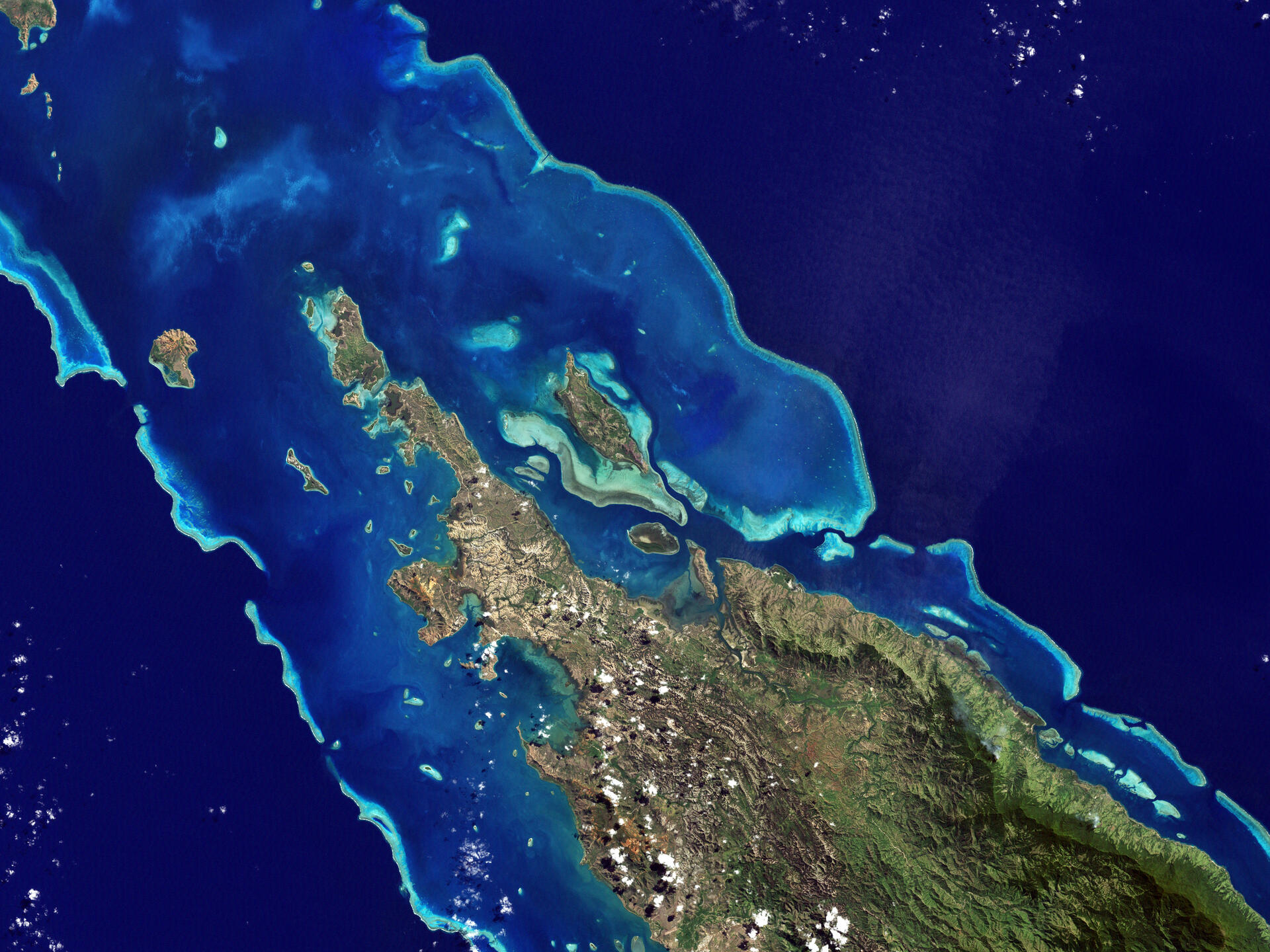
the Enhanced Thematic Mapper Plus on NASA’s Landsat 7 satellite, Jesse Allen, Michon Scott., Public domain
World Heritage Research
Discover scientific research and academic studies that deepen our understanding of Lagoons of New Caledonia: Reef Diversity and Associated Ecosystems from its history and significance to its conservation, management, and contemporary challenges.
-
Spaghetti worms from the reef: two new species of Loimia (Polychaeta: Terebellidae) from Bora-Bora and Moorea (Society Islands, French Polynesia) and a range extension of L. tuberculata Nogueira, Hutchings & Carrerette, 2015
Researchers have identified two new species of spaghetti worms, Loimia poraporaensis and L. aimehoensis, from the lagoons of Bora-Bora and Moorea (Society Islands, French Polynesia). These species exhibit distinct morphological traits, such as large lateral lobes and banded buccal tentacles, which differentiate them from other known Pacific coral reef worms. The study also extends the known range of L. tuberculata, previously documented only in Australia and Papua New Guinea, to include New Caledonia. Using molecular analysis (COI and 16S genes) alongside morphological comparisons, the team constructed phylogenetic trees and provided an identification key for these species. Their findings highlight the biodiversity of UNESCO-listed lagoons while emphasizing the importance of coral associations in their habitats.
HUTCHINGS, P., DAFFE, G., GLASBY, C., & LAVESQUE, N. (2025). Spaghetti worms from the reef: two new species of Loimia (Polychaeta: Terebellidae) from Bora-Bora and Moorea (Society Islands, French Polynesia) and a range extension of L. tuberculata Nogueira, Hutchings & Carrerette, 2015. Zootaxa, 5583(2), 328–352. https://doi.org/10.11646/zootaxa.5583.2.6
View Publication Record | Read Publication -
Assessment of spatial distribution of organic contaminants and metallic compounds on a tropical island’ coral reef fish communities
Contamination by mining-related elements (Ni, Cr) and persistent organic pollutants (POPs) is widespread throughout New Caledonia's lagoon, extending from coastal areas to the barrier reef. A study analyzing 36 contaminants in ~400 coral reef fish revealed that fish body size was the strongest predictor of contaminant concentrations, followed by monthly rainfall for POPs and reef area for metallic compounds (MTEs). Mining activity significantly influenced contamination levels, particularly for Ni and Cr, while mercury (Hg) contamination showed strong dependence on biological variables. The research used boosted regression trees modeling to predict and map contaminant distribution at the community level, providing critical spatial data for policy-making.
Wejieme, N., Vigliola, L., Parravicini, V., Nicolay, A., Wafo, E., Bustamante, P., & Letourneur, Y. (2025). Assessment of spatial distribution of organic contaminants and metallic compounds on a tropical island’ coral reef fish communities. Marine Pollution Bulletin, 217, 118031. https://doi.org/10.1016/j.marpolbul.2025.118031
View Publication Record | Read Publication -
The role of barrier reef protection to storm surge during tropical cyclones in a narrow lagoon, New Caledonia, south west Pacific
Storm surge in the narrow, shallow lagoon of Poe, New Caledonia, is primarily driven by wave setup—accounting for 70% to 90% of extreme water levels during tropical cyclones. This finding, derived from a coupled numerical model and synthetic cyclone tracks, reveals that irregular reef structures can mitigate wave setup intensity while tidal variations over the reef crest further influence surge dynamics. The study highlights the critical role of reef morphology in coastal hazard prediction, offering insights for climate-resilient land use planning in reef island environments.
Duphil, M., Lefèvre, J., Jullien, S., Roger, J., Dumas, P., Le Gendre, R., Aucan, J., Vendé-Leclerc, M., Bénébig, M., & Menkes, C. (2025). The role of barrier reef protection to storm surge during tropical cyclones in a narrow lagoon, New Caledonia, south west Pacific. Continental Shelf Research, 294, 105540. https://doi.org/10.1016/j.csr.2025.105540
View Publication Record | Read Publication -
Geomorphological patterns and sedimentary facies in a modern mixed carbonate-siliciclastic lagoon (New Caledonia)
A detailed sedimentary mapping of the New Caledonian lagoon reveals distinct geomorphological patterns and sedimentary facies between its southwestern and southeastern zones, highlighting differences likely driven by inherited morphologies and contrasting hydrodynamic conditions. The southwestern lagoon, bordered by a massive barrier reef, is more prone to fine-grained sedimentation, while the narrower eastern lagoon exhibits meandering channels parallel to the shore due to a discontinuous and partially submerged barrier reef. This high-resolution mapping at a 1/70,000 scale, utilizing bathymetric imagery and seabed sampling, provides insights into the surface sediment distribution, bioconstructed morphologies, and drainage network architecture in this mixed carbonate-siliciclastic system.
Tournadour, E., Ehrhold, A., Le Roy, P., Etienne, S., Jorry, S. J., Jouet, G., Collot, J., Patriat, M., Guérin, C., Michel, G., Decultot, C., Tertrais, E., & Champilou, N. (2025). Geomorphological patterns and sedimentary facies in a modern mixed carbonate-siliciclastic lagoon (New Caledonia). Journal of Maps, 21(1). https://doi.org/10.1080/17445647.2025.2494855
View Publication Record | Read Publication -
Effects of physical forcing on short-term plankton dynamics in a narrow coral reef lagoon (Ouano, New Caledonia): a two-week high-frequency study
A two-week high-frequency study in the narrow coral reef lagoon of Ouano, New Caledonia, revealed that short-term climatic events—such as wind, waves, and rainfall—significantly alter plankton dynamics at a lagoon scale. These events disrupted typical tidal and diel patterns by increasing nutrient concentrations, leading to rapid growth of microphytoplankton (dominated by diatoms) and opportunistic herbivorous zooplankton (e.g., tintinnids, appendicularians). Unlike larger lagoons where spatial variability dominates, this study demonstrated that physical forcing in channel-like lagoons drives large-scale biological responses, highlighting the sensitivity of these ecosystems to external environmental changes.
Rodier, M., Pagano, M., Lhomond, L., Péricaud, J.-B., Guilloux, L., Devenon, J.-L., & Chevalier, C. (2024). Effects of physical forcing on short-term plankton dynamics in a narrow coral reef lagoon (Ouano, New Caledonia): a two-week high-frequency study. Journal of Plankton Research, 46(2), 202–218. https://doi.org/10.1093/plankt/fbae004
View Publication Record | Read Publication -
Ecoregional and temporal dynamics of dugong habitat use in a complex coral reef lagoon ecosystem
Research reveals distinct ecoregional and temporal patterns in dugong habitat use within the complex coral reef lagoon ecosystems of New Caledonia, offering critical insights for conservation. By analyzing 9371 hourly positions from 16 satellite-tagged dugongs, scientists identified significant differences in the intensity of dugong presence across shallow waters, deeper lagoon areas, and fore-reef shelves. These findings were validated using aerial survey data, extending our understanding of dugong distribution beyond traditional surveys, particularly highlighting their nocturnal preference for shallow waters during high tide. This study underscores the potential of satellite tracking and dynamic habitat modeling to inform effective spatial management strategies for elusive marine mammals like the dugong.
Derville, S., Cleguer, C., & Garrigue, C. (2022). Ecoregional and temporal dynamics of dugong habitat use in a complex coral reef lagoon ecosystem. Scientific Reports, 12(1). https://doi.org/10.1038/s41598-021-04412-3
View Publication Record | Read Publication -
Unsupervised Optical Classification of the Seabed Color in Shallow Oligotrophic Waters from Sentinel-2 Images: A Case Study in the Voh-Koné-Pouembout Lagoon (New Caledonia)
Research demonstrates that unsupervised optical classification using Sentinel-2 images can effectively distinguish seabed colors in shallow, oligotrophic waters, even in complex bathymetric settings. The study applied Lyzenga correction and spectral standardization to separate water column reflectance from seabed signals, revealing five distinct seafloor clusters when standardized data were used—an improvement over the three clusters identified without standardization. This method achieved over 75% explanatory power for each wavelength band and improved classification accuracy, highlighting its potential for remote sensing of biogeochemical indicators like chlorophyll-a concentration in fragile coastal ecosystems such as New Caledonia's lagoons.
Wattelez, G., Dupouy, C., & Juillot, F. (2022). Unsupervised Optical Classification of the Seabed Color in Shallow Oligotrophic Waters from Sentinel-2 Images: A Case Study in the Voh-Koné-Pouembout Lagoon (New Caledonia). Remote Sensing, 14(4), 836. https://doi.org/10.3390/rs14040836
View Publication Record | Read Publication