World Heritage Identification Number: 987
World Heritage since: 2000
Category: Cultural Heritage
WHE Type: Historic Cities & Urban Areas
Transboundary Heritage: No
Endangered Heritage: No
Country: 🇪🇸 Spain
Continent: Europe
UNESCO World Region: Europe and North America
Map
The Roman Walls of Lugo: A Remarkable Testimony of Ancient Roman Engineering
The Roman Walls of Lugo, located in the northwestern region of Spain, stand as a remarkable testimony to the ingenuity and architectural prowess of the ancient Romans. Inscribed as a UNESCO World Heritage Site in 2000, these impressive fortifications offer a unique glimpse into the defensive strategies employed by the Roman Empire during its expansion across Europe.
More to come…UNESCO Description of the World Heritage Site
The walls of Lugo were built in the later part of the 3rd century to defend the Roman town of Lucus. The entire circuit survives intact and is the finest example of late Roman fortifications in western Europe.
UNESCO Justification of the World Heritage Site
Criterion (iv): The Roman walls of Lugo are the finest surviving example of late Roman military fortifications.
Encyclopedia Record: Roman walls of Lugo
The Roman walls of Lugo are the ancient Roman defensive walls of the Roman colonia of Lucus Augusti –present-day Lugo, Spain–, in the Roman province of Hispania Tarraconensis. Stretching 2,120 metres (6,960 ft), they were built in the third century AD to defend the ancient Roman town. The fortifications, still largely intact, were declared a UNESCO World Heritage Site in 2000 and are a popular tourist attraction.Additional Site Details
Area: 1.68 hectares
Number of Components: 1
Coordinates: 43.0106407944 , -7.5530699413
Image
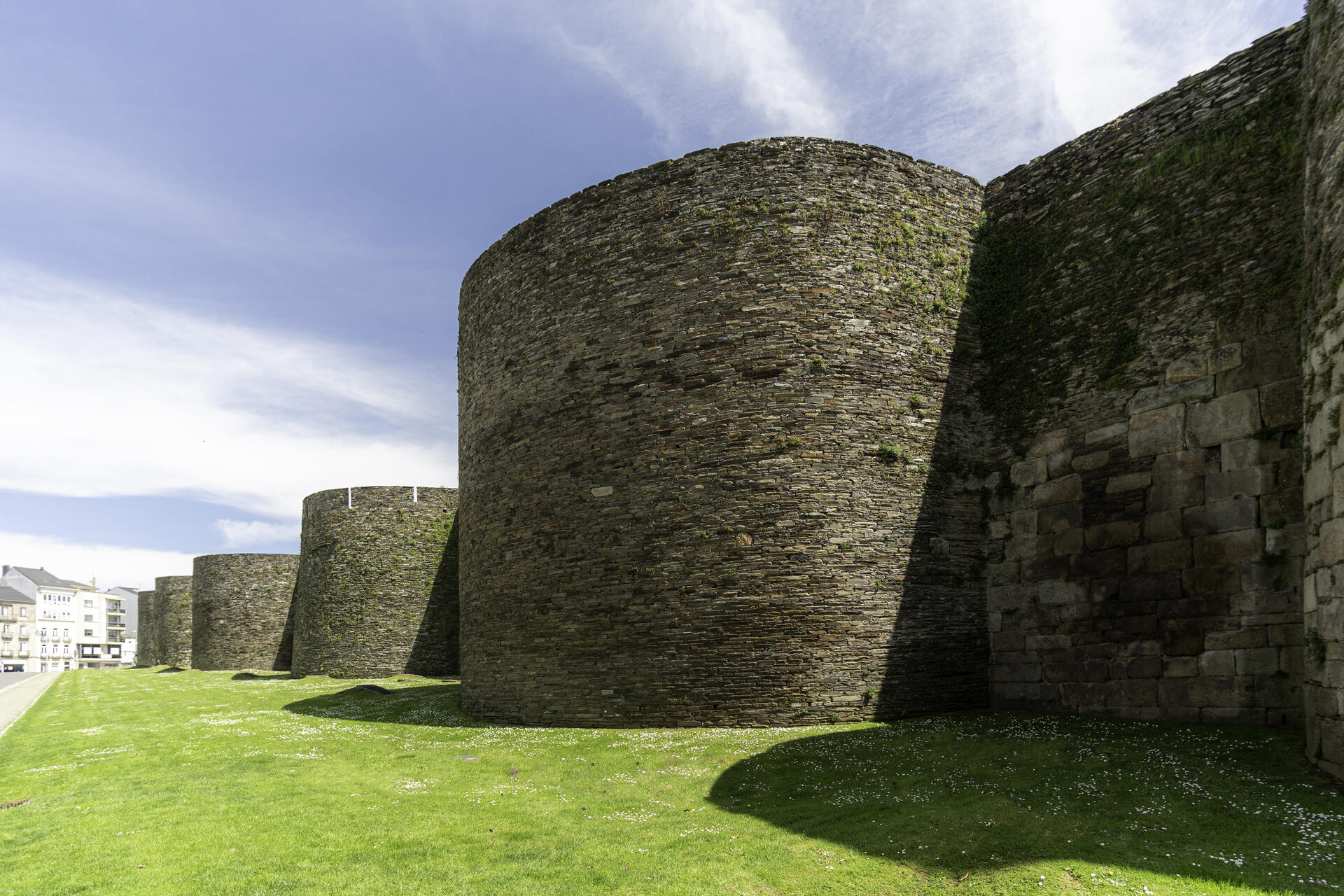
© Fernando Pascullo, CC BY-SA 4.0 Resized from original. (This derivative is under the same CC BY-SA license.)
World Heritage Research
Discover scientific research and academic studies that deepen our understanding of Roman Walls of Lugo from its history and significance to its conservation, management, and contemporary challenges.
-
Impact of Herbicide Treatments on the Construction Materials in the Roman Wall of Lugo, Spain (UNESCO World Heritage Site)
Herbicide treatments applied to the Roman Wall of Lugo were found to have minimal mineralogical impact on its construction materials. A 20-year study involving glyphosate, sulphosate, glufosinate–ammonium, oxyfluorfen (Goal Supreme®), and essential oils from Origanum vulgare, Thymus zygis, and Thymus vulgaris revealed that only glyphosate and physical treatments (infrared and burning) altered vermiculite clay minerals in schist. Oxyfluorfen increased chloride, nitrate, and sulphate contents in granite but caused no significant mineralogical changes. The most recent study found that Thymus zygis essential oil slightly lightened granite. These findings highlight the need for cautious herbicide use to preserve the integrity of historic structures.
Prieto, B., Sanmartín, P., Cancelo-González, J., Torres, L., & Silva, B. (2021). Impact of Herbicide Treatments on the Construction Materials in the Roman Wall of Lugo, Spain (UNESCO World Heritage Site). Applied Sciences, 11(11), 5276. https://doi.org/10.3390/app11115276
View Publication Record | Read Publication -
Ensuring the Conservative Process: The Roman Walls of Lugo Maintenance Plan
The Roman Walls of Lugo, the only UNESCO World Heritage Site in Spain with a dedicated maintenance plan, demonstrate how systematic conservation can ensure long-term preservation and public enjoyment. This study highlights that the walls, added to the World Heritage List in 2000, benefit from a structured approach combining regular inspections, data management tools, and allocated human and financial resources. Unlike other Spanish UNESCO sites, this model guarantees efficient and safe use of the ancient structure while integrating it as a beloved urban park. The research underscores that planned maintenance not only preserves heritage but also enhances its value for future generations.
Faraci, G. (2016). Ensuring the Conservative Process: The Roman Walls of Lugo Maintenance Plan. Conservation and Management of Archaeological Sites, 18(4), 411–421. https://doi.org/10.1080/13505033.2016.1290472
View Publication Record | Read Publication -
From pseudo‐3D to full‐resolution GPR imaging of a complex Roman site
A high-resolution ground-penetrating radar (GPR) survey of the Roman Walls of Lugo, Spain, revealed intricate details of a Roman villa previously obscured by a pseudo-3D imaging strategy. The study demonstrated that ultra-dense grid data acquisition—with GPR lines spaced just 0.1 meters apart—could capture fine structures such as walls, apses, and chambers with unprecedented clarity. Initial surveys in May 2007 used a more spaced grid (0.5 m), which only identified broad areas of interest. A follow-up survey in July 2008, focusing on a smaller area with ultra-dense sampling, uncovered the villa's full architectural complexity. This case highlights how advanced GPR techniques can significantly enhance archaeological interpretations in complex semi-urban environments.
Novo, A., Lorenzo, H., Rial, F. I., & Solla, M. (2012). From pseudo‐3D to full‐resolution GPR imaging of a complex Roman site. Near Surface Geophysics, 10(1), 11–15. Portico. https://doi.org/10.3997/1873-0604.2011016
View Publication Record | Read Publication -
From Pseudo-3D to full-resolution GPR imaging in archaeology: A complex Roman site in Lugo, Spain
Advanced ground-penetrating radar (GPR) imaging revealed intricate details of a Roman villa's architecture, including walls, apses, and chambers, at the UNESCO-listed Roman Walls of Lugo site in Spain. The study demonstrated that ultra-dense grid surveys significantly enhance the resolution and interpretability of 3D GPR data compared to pseudo-3D strategies. Conducted over two campaigns (May 2007 and July 2008), the research initially mapped a broad area using a pseudo-3D approach, which identified key features for further investigation. A subsequent ultra-dense grid survey focused on a smaller section, uncovering high-resolution images that provided unprecedented insights into the villa's structure. This case study underscores the importance of meticulous data acquisition in archaeological GPR surveys, particularly in complex semi-urban settings.
Novo, A., Lorenzo, H., Rial, F. I., & Solla, M. (2010). From Pseudo-3D to full-resolution GPR imaging in archaeology: A complex Roman site in Lugo, Spain. Proceedings of the XIII Internarional Conference on Ground Penetrating Radar, 1–6. https://doi.org/10.1109/icgpr.2010.5550185
View Publication Record | Read Publication