World Heritage Identification Number: 1312
World Heritage since: 2009
Category: Cultural Heritage
WHE Type: Buildings & Architectural Ensembles
Transboundary Heritage: No
Endangered Heritage: No
Country: 🇪🇸 Spain
Continent: Europe
UNESCO World Region: Europe and North America
Map
The Tower of Hercules: An Enduring Symbol of Antiquity and Navigation
The Tower of Hercules, situated on a peninsula approximately 2.4 kilometers from the heart of A Coruña, Galicia, in northwestern Spain, stands as a testament to the ingenuity and architectural prowess of the ancient Romans. This monumental structure, completed in the 1st century AD, holds the distinction of being the oldest known extant Roman lighthouse. Known historically as the Farum Brigantium, the tower's name was later changed to its current moniker in honor of the mythological Greek hero, Heracles, or Hercules, whose statue once adorned the top of the structure.
More to come…UNESCO Description of the World Heritage Site
The Tower of Hercules has served as a lighthouse and landmark at the entrance of La Coruña harbour in north-western Spain since the late 1st century A.D. when the Romans built the Farum Brigantium. The Tower, built on a 57 metre high rock, rises a further 55 metres, of which 34 metres correspond to the Roman masonry and 21 meters to the restoration directed by architect Eustaquio Giannini in the 18th century, who augmented the Roman core with two octagonal forms. Immediately adjacent to the base of the Tower, is a small rectangular Roman building. The site also features a sculpture park, the Monte dos Bicos rock carvings from the Iron Age and a Muslim cemetery. The Roman foundations of the building were revealed in excavations conducted in the 1990s. Many legends from the Middle Ages to the 19th century surround the Tower of Hercules, which is unique as it is the only lighthouse of Greco-Roman antiquity to have retained a measure of structural integrity and functional continuity.
UNESCO Justification of the World Heritage Site
Criterion (iii): The Tower of Hercules is testimony to the use of lighthouses in antiquity. The Tower is also proof of the continuity of the Atlantic route from when it was first organised by the Romans, during a large part of the Middle Ages, and through to its considerable development in the modern and contemporary eras.
Encyclopedia Record: Tower of Hercules
The Tower of Hercules is the oldest known extant Roman lighthouse. Built in the 1st century, the tower is located on a peninsula about 2.4 km (1.5 mi) from the center of A Coruña, Galicia, in northwestern Spain. Until the 20th century, it was known as the Farum Brigantium. The Latin word farum is derived from the Greek Φάρος, Pharos, for the Lighthouse of Alexandria. The structure stands 55 metres (180 ft) tall and overlooks the North Atlantic coast of Spain. The tower was renovated in 1791.Additional Site Details
Area: 233 hectares
Number of Components: 1
Coordinates: 43.3858333333 , -8.4063888889
Image
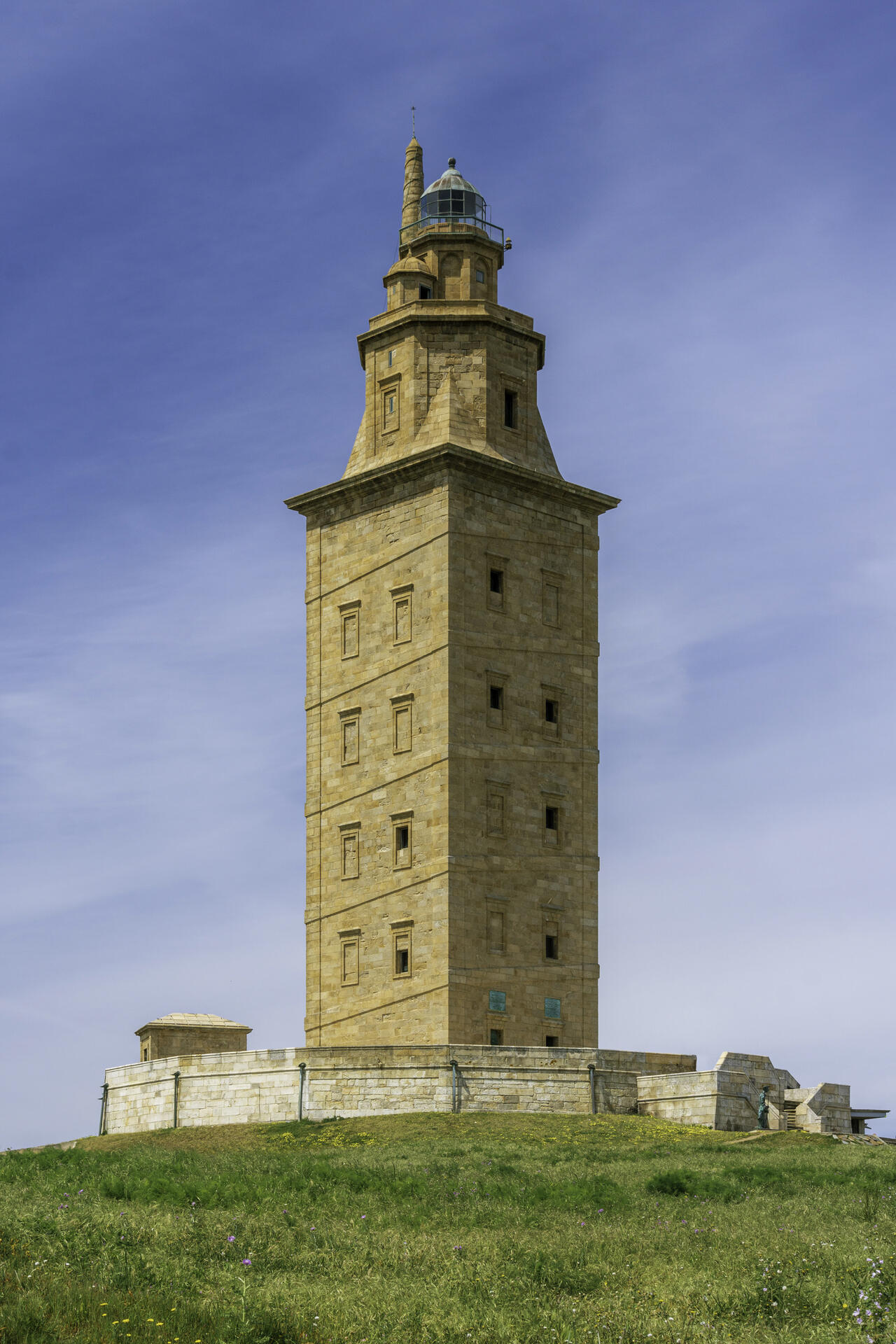
© Fernando, CC BY-SA 4.0 Resized from original. (This derivative is under the same CC BY-SA license.)
World Heritage Research
Discover scientific research and academic studies that deepen our understanding of Tower of Hercules from its history and significance to its conservation, management, and contemporary challenges.
-
Thermography Applied to Old Masonry Constructions
Infrared thermography emerges as a powerful, non-invasive tool for diagnosing structural pathologies in historical masonry, offering critical insights into material deterioration without physical contact. This study demonstrates its effectiveness in identifying hidden elements, moisture infiltration, and thermal bridges—key factors in the degradation of cultural heritage sites like the Tower of Hercules. By combining terrestrial and aerial thermography, including drone-mounted cameras, researchers captured hard-to-reach areas with high accuracy. The findings underscore the importance of optimizing camera parameters and environmental conditions to enhance measurement precision, ultimately contributing to preventive conservation strategies for UNESCO World Heritage Sites.
Rodríguez Elizalde, R. (2025). Thermography Applied to Old Masonry Constructions. Modern Masonry Construction - the Fusion of Tradition, Technology, and Sustainability. https://doi.org/10.5772/intechopen.1009693
View Publication Record | Read Publication -
Analysis of the Tower of Hercules, the World’s Oldest Extant Lighthouse
The Tower of Hercules stands as the world's oldest extant lighthouse, offering a unique lens to study the evolution of maritime signaling and navigation systems from antiquity to modern times. This Roman-era structure, still functional today, showcases an exceptional case of architectural intervention: its 18th-century restoration by Eustaquio Giannini preserved its authenticity while applying scientific principles. The study highlights its continuous role in guiding ships, making it a paradigmatic example of how ancient monuments adapt to contemporary needs without compromising historical integrity.
Elizalde, R. R. (2023). Analysis of the Tower of Hercules, the World’s Oldest Extant Lighthouse. Buildings, 13(5), 1219. https://doi.org/10.3390/buildings13051219
View Publication Record | Read Publication -
Constructive and Historical Analysis of the Tower of Hercules: Ancient Roman Lighthouse Still in Use
The Tower of Hercules, the world's only surviving Roman lighthouse, stands as both a functional maritime beacon and a testament to architectural preservation. Declared a UNESCO World Heritage Site in 2009, it continues its original purpose—guiding ships—while serving as a case study for the evolution of navigation aids from antiquity to modern times. A key finding is the successful 18th-century restoration by Eustaquio Giannini, which applied scientific principles while preserving the monument's authenticity. This chapter offers a descriptive analysis focusing on its historical and constructive aspects, providing insights into ancient engineering techniques and their enduring legacy.
Elizalde, R. R. (2023). Constructive and Historical Analysis of the Tower of Hercules: Ancient Roman Lighthouse Still in Use. Research and Developments in Engineering Research Vol. 9, 81–108. https://doi.org/10.9734/bpi/rader/v9/6477b
View Publication Record | Read Publication -
Inner wall filler as a singular and significant source of indoor radon pollution in heritage buildings: An exhalation method-based approach
A significant source of indoor radon pollution in heritage buildings, such as the Tower of Hercules in Corunna, Spain, has been identified: inner wall fillers used in thick structural elements like bearing walls and vaults. These fillers exhibit radon exhalation rates comparable to those found in soils, often one to two orders of magnitude higher than the construction materials themselves (e.g., granite). The study employed an exhalation method-based approach, revealing that these fillers contribute substantially to indoor radon concentrations uniformly across building storeys, regardless of elevation or distance from the soil. This challenges conventional assumptions that soil is the primary source of radon gas and suggests that mitigation strategies must address emissions from all sources, including inner wall fillers.
Frutos, B., Martín-Consuegra, F., Alonso, C., Perez, G., Peón, J., Ruano-Ravina, A., Barros, J. M., & Santorun, A. M. (2021). Inner wall filler as a singular and significant source of indoor radon pollution in heritage buildings: An exhalation method-based approach. Building and Environment, 201, 108005. https://doi.org/10.1016/j.buildenv.2021.108005
View Publication Record | Read Publication -
Development of Antique Colony Cities of the Black Sea in the Hellenistic Period
Greek colonial cities along the Black Sea (Pontus Euxinus) during the Hellenistic period were significantly influenced by geological and oceanographic factors, such as sea currents and coastal contours, which shaped their trade routes and economic relations. Notably, the shortest sea path from Tauric Chersonesos to Kallatis and Hercules was facilitated by these natural features, reducing travel time substantially. These cities, while smaller and less architecturally ornate than those in Ancient Hellas, mirrored Greek traditions in urban planning, religious practices, and architectural styles, particularly using the Doric order and local materials like clay, raw brick, and stone-shell rock. The study highlights how these factors contributed to the spread of Greek culture and the development of engineering sciences in harbor and city construction.
Plahotny, G., Varych, A., Chub, О.,. (2020). DEVELOPMENT OF ANTIQUE COLONY CITIES OF THE BLACK SEA IN THE HELLENISTIC PERIOD. Problems of Theory and History of Architecture of Ukraine, (20), 157–166. https://doi.org/10.31650/2519-4208-2020-20-157-166
View Publication Record | Read Publication -
A Coruña, Cidade Herculina: Hercules as Founder of Cities
The foundation myth of A Coruña, attributing its origins to Hercules' defeat of the giant Geryon and subsequent city founding, persists as a significant cultural narrative in contemporary Galician history. This myth, popularized in medieval texts like the Estoria de España, blends Roman and Celtic traditions, symbolizing the triumph over tyranny and the arrival of civilization. While the Tower of Hercules stands as the iconic monument embodying this legend, recent cultural initiatives, such as a sculptural garden on the site, also incorporate alternative foundational accounts, including the Celtic legend of Breogan. The study explores how these enduring myths shape A Coruña's identity and its status as a UNESCO World Heritage Site, highlighting their continued relevance in local history and tourism.
Seijo-Richart, M. (2020). A Coruña, Cidade Herculina: Hercules as Founder of Cities. The Modern Hercules, 277–298. https://doi.org/10.1163/9789004440067_015
View Publication Record | Read Publication -
San Pedro Leucogranite from a Coruña, Northwest of Spain: Uses of a Heritage Stone
San Pedro leucogranite, sourced from A Coruña in northwest Spain, emerges as a significant heritage stone due to its distinctive color, rarity, and petrophysical properties. This study highlights its historical use in monumental structures, including the UNESCO-listed Hercules Tower lighthouse, which underscores its potential for designation as a Global Heritage Stone Resource. The research approach combines geological analysis with architectural documentation, emphasizing the stone's unique characteristics that have made it a preferred material for medieval monuments such as churches and tombstones.
Freire-Lista, D. M., Fort, R., & Varas-Muriel, M. J. (2016). San Pedro Leucogranite from a Coruña, Northwest of Spain: Uses of a Heritage Stone. Energy Procedia, 97, 554–561. https://doi.org/10.1016/j.egypro.2016.10.075
View Publication Record | Read Publication