World Heritage Identification Number: 1562
World Heritage since: 2018
Category: Cultural Heritage
WHE Type: Religious Sites & Sacred Architecture
Transboundary Heritage: No
Endangered Heritage: No
Country: 🇰🇷 Republic of Korea
Continent: Asia
UNESCO World Region: Asia and the Pacific
Map
Sansa, Buddhist Mountain Monasteries in Korea: A Journey Through Time and Faith
The Sansa, or Buddhist mountain monasteries in Korea, represent a unique blend of spirituality, architecture, and history that has captivated visitors for centuries. Inscribed as a UNESCO World Heritage Site in 2018, these seven temples offer a glimpse into the rich cultural heritage of Korea, providing insights into the country's deep-rooted Buddhist traditions.
More to come…UNESCO Description of the World Heritage Site
The Sansa are Buddhist mountain monasteries located throughout the southern provinces of the Korean Peninsula. The spatial arrangement of the seven temples that comprise the property, established from the 7th to 9th centuries, present common characteristics that are specific to Korea – the ‘madang’ (open courtyard) flanked by four buildings (Buddha Hall, pavilion, lecture hall and dormitory). They contain a large number of individually remarkable structures, objects, documents and shrines. These mountain monasteries are sacred places, which have survived as living centres of faith and daily religious practice to the present.
UNESCO Justification of the World Heritage Site
Criterion (iii): Buddhism has a long history that has traversed a number of historical eras in the Korean Peninsula. The seven mountain monasteries – Tongdosa, Buseoksa, Bongjeongsa, Beopjusa, Magoksa, Seonamsa and Daeheungsa – offer a distinctively Korean instantiation of Buddhist monastic culture from the 7th century to the present day. These mountain monasteries are sacred places and provide an exceptional testimony to their long and continuing traditions of Buddhist spiritual practice.
Encyclopedia Record: Sansa (temple)
Sansa is a term for any Korean Buddhist temple located on a mountain. Seven of these temples are designated as UNESCO World Cultural Heritage Sites. With the country being largely mountainous and Buddhism deeply rooted in its history, there are many sansas across the country.Additional Site Details
Area: 55.43 hectares
Number of Components: 7
Coordinates: 36.5419444444 , 127.8333333333
Image
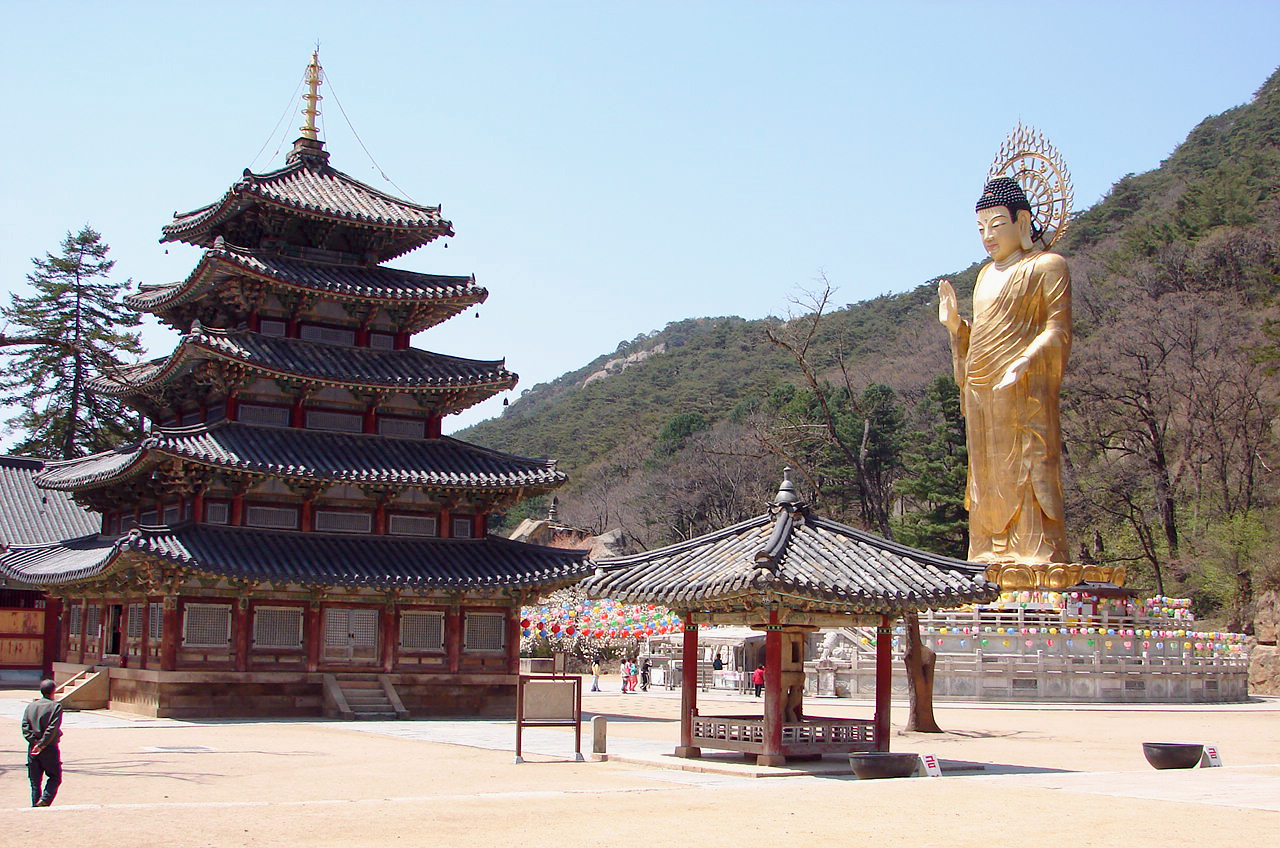
© Steve46814, CC BY-SA 3.0 Resized from original. (This derivative is under the same CC BY-SA license.)