World Heritage Identification Number: 1477
World Heritage since: 2015
Category: Cultural Heritage
WHE Type: Historic Cities & Urban Areas
Transboundary Heritage: No
Endangered Heritage: No
Country: 🇰🇷 Republic of Korea
Continent: Asia
UNESCO World Region: Asia and the Pacific
Map
Exploring the Baekje Historic Areas: A Journey Through Ancient Korea
The Baekje Historic Areas, located in the mountainous mid-western region of South Korea, offer a unique glimpse into the rich history and culture of one of the three earliest kingdoms on the Korean Peninsula - the Baekje Kingdom (18 BCE to 660 CE). This UNESCO World Heritage Site, inscribed in 2015, encompasses eight significant archaeological sites that serve as testaments to the technological, religious, cultural, and artistic exchanges between ancient East Asian kingdoms during the later period of the Baekje Kingdom.
More to come…UNESCO Description of the World Heritage Site
Located in the mountainous mid-western region of the Republic of Korea, this property comprises eight archaeological sites dating from 475 to 660 CE, including the Gongsanseong fortress and royal tombs at Songsan-ri related to the capital, Ungjin (present day Gongju), the Busosanseong Fortress and Gwanbuk-ri administrative buildings, the Jeongnimsa Temple, the royal tombs in Neungsan-ri and the Naseong city wall related to the capital, Sabi (now Buyeo), the royal palace at Wanggung-ri and the Mireuksa Temple in Iksan related to the secondary Sabi capital. Together, these sites represent the later period of the Baekje Kingdom – one of the three earliest kingdoms on the Korean peninsula (18 BCE to 660 CE) - during which time they were at the crossroads of considerable technological, religious (Buddhist), cultural and artistic exchanges between the ancient East Asian kingdoms in Korea, China and Japan.
UNESCO Justification of the World Heritage Site
Criterion (ii): The archaeological sites and architecture of the Baekje Historic Areas exhibit the interchange between the ancient East Asian kingdoms in Korea, China and Japan in the development of construction techniques and the spread of Buddhism.
Criterion (iii): The setting of the capital cities, Buddhist temples and tombs, architectural features and stone pagodas of the Baekje Historic Areas contribute in forming exceptional testimony to the unique culture, religion and artistry of the kingdom of Baekje.
Encyclopedia Record: Baekje Historic Areas
The Baekje Historic Areas (Korean: 백제역사유적지구) is a UNESCO World Heritage Site that consists of eight monuments in three cities in South Korea: Gongju, Buyeo, and Iksan. They relate to the last period of the Koreanic kingdom Baekje, representing the period from 475 to 660 CE.Additional Site Details
Area: 135.1 hectares
Number of Components: 8
(iii) — Unique or exceptional testimony to a cultural tradition
Coordinates: 36.4619444444 , 127.1272222222
Image
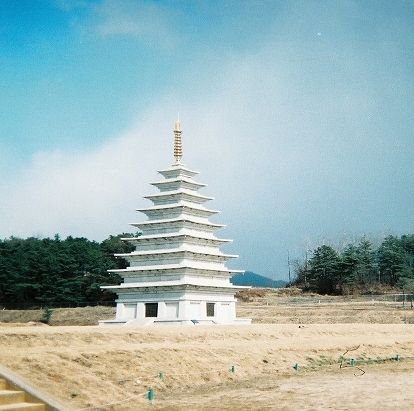
© Unknown, CC BY-SA 3.0 Resized from original. (This derivative is under the same CC BY-SA license.)