World Heritage Identification Number: 1439
World Heritage since: 2014
Category: Cultural Heritage
WHE Type: Buildings & Architectural Ensembles
Transboundary Heritage: No
Endangered Heritage: No
Country: 🇰🇷 Republic of Korea
Continent: Asia
UNESCO World Region: Asia and the Pacific
Map
Namhansanseong: A Fortified City Embodying East Asian Cultural Influences
Namhansanseong, located in Gwangju, Gyeonggi Province, South Korea, stands as a testament to the rich history and architectural prowess of the Joseon dynasty (1392–1910). This historic fortress city, designated as a UNESCO World Heritage Site in 2014, offers a unique blend of Korean, Japanese, and Chinese architectural influences, reflecting its strategic importance during the Joseon era.
More to come…UNESCO Description of the World Heritage Site
Namhansanseong was designed as an emergency capital for the Joseon dynasty (1392–1910), in a mountainous site 25 km south-east of Seoul. Built and defended by Buddhist monk-soldiers, it could accommodate 4,000 people and fulfilled important administrative and military functions. Its earliest remains date from the 7th century, but it was rebuilt several times, notably in the early 17th century in anticipation of an attack from the Sino-Manchu Qing dynasty. The city embodies a synthesis of the defensive military engineering concepts of the period, based on Chinese and Japanese influences, and changes in the art of fortification following the introduction from the West of weapons using gunpowder. A city that has always been inhabited, and which was the provincial capital over a long period, it contains evidence of a variety of military, civil and religious buildings and has become a symbol of Korean sovereignty.
UNESCO Justification of the World Heritage Site
Criterion (ii): The system of fortifications of Namhansanseong embodies a synthesis of the art of defence in the Far East in the early 17th century. It stems from a re-examination of Chinese and Korean standards of urban fortification, and from fears aroused by new firearms from the West. Namhansanseong marks a turning point in mountain fortress design in Korea, and it went on to influence in its turn the construction of citadels in the region.
Criterion (iv): Namhansanseong is an outstanding example of a fortified city. Designed in the 17th century as an emergency capital for the Joseon dynasty, it was built and then defended by Buddhist soldier-monks who respected pre-existing traditions already in place.
Encyclopedia Record: Namhansanseong
Namhansanseong is a historic Korean fortress city in Gwangju, Gyeonggi Province, South Korea. A UNESCO World Heritage Site, the fortress lies atop the mountain Namhansan and stretches 12 km in length. It served as an emergency capital city during the 1392–1910 Joseon period. The design is based on fortress architecture of East Asia, embodying aspects of four historical cultural styles: Joseon of Korea, the Azuchi-Momoyama Period of Japan, and Ming and Qing China.Additional Site Details
Area: 409.06 hectares
Number of Components: 2
(iv) — Outstanding example of a type of building or landscape
Coordinates: 37.4788888889 , 127.1811111111
Image
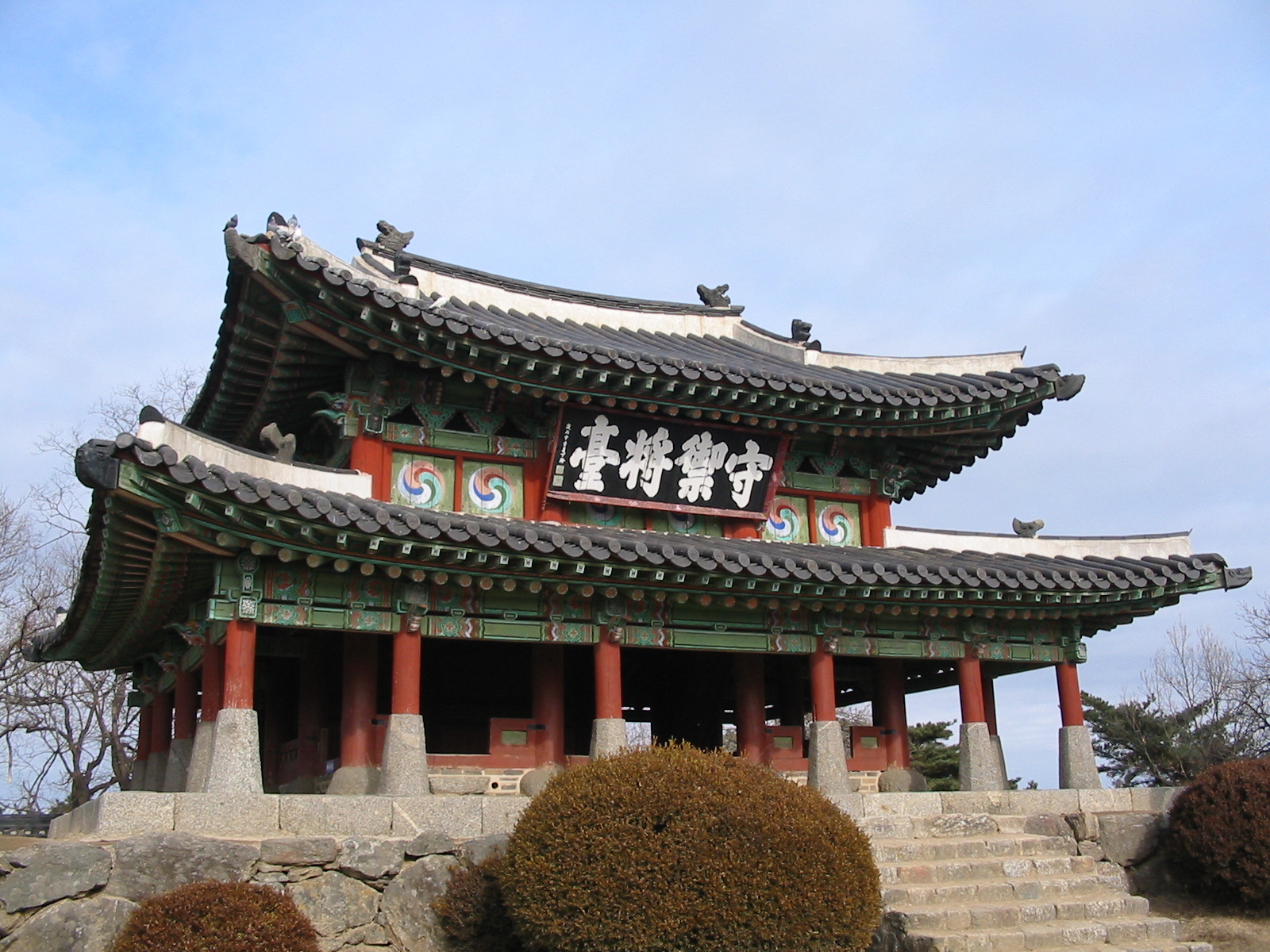
© Khitai (a flickr user), CC BY-SA 2.0 Resized from original. (This derivative is under the same CC BY-SA license.)
World Heritage Research
Discover scientific research and academic studies that deepen our understanding of Namhansanseong from its history and significance to its conservation, management, and contemporary challenges.
-
Analysis of perceptions before and after world heritage listing using text mining techniques : focused on Namhansanseong Fortress
UNESCO World Heritage listing significantly alters public perception and utilization of cultural sites, as demonstrated by Namhansanseong Fortress. Before its 2011 designation as a potential World Heritage Site, the fortress was primarily recognized for its historical value and outdoor activities. Post-listing, perceptions shifted toward global recognition and tourism, with 'Nearby Travel' emerging as the dominant topic during the consolidation phase (2017–2022). Text mining analysis of blog data from 2011 to 2022 revealed that policy influences and heritage-related programs shaped keyword prominence, while visualizing topic changes highlighted the transition in public awareness. This study underscores the need for consistent long-term tourism policies and heritage program development to sustain such positive shifts.
Nam, A.-R., Kim, M.-K., & Kang, Y.-S. (2024). Analysis of perceptions before and after world heritage listing using text mining techniques : focused on Namhansanseong Fortress. Journal of Tourism Studies, 36(1), 63–82. https://doi.org/10.21581/jts.2024.2.36.1.63
View Publication Record | Read Publication -
Management of Namhansanseong in late Joseon
Namhansanseong transitioned from a critical military defense base to a supplementary financial resource during late Joseon. Initially, it served as a strategic fortress after King Injo's resistance against Qing invasions in 1636–1637, with the royal court prioritizing its maintenance, defense systems, and ration storage. However, by the mid-18th century, reduced war probabilities led to its repurposing for national finance, particularly through the management of stored rations from nearby regions like Gwangju. Despite challenges such as poor harvests and corruption, the fortress remained a valuable resource, though its actual capacity was often exaggerated in the 19th century. This study analyzes official records to trace Namhansanseong's evolving role, providing a foundation for future research on its management and historical significance.
Kang, S.-H. (2023). Management of Namhansanseong in late Joseon. Institute for Kyeongki Cultural Studies, 44(1), 207–229. https://doi.org/10.26426/kcs.2023.44.1.207
View Publication Record | Read Publication -
Estimating the preservation value of Namhansanseong Fortress world heritage site using the contingent valuation method
The preservation value of Namhansanseong Fortress is estimated to be approximately 609 billion won annually for the Seoul-Incheon-Gyeonggi region, based on household willingness-to-pay. Using the contingent valuation method (CVM), this study assessed true preservation value by minimizing hypothetical bias through controlled scenarios and real-world conditions. The analysis revealed that heritage value (50.5%) is the most significant factor influencing preservation worth, followed by choice (25.8%) and existence value (23.7%). Key predictors of willingness to contribute to a preservation fund include visit frequency, gender, income exclusion, and strong support for Namhansanseong's conservation. Data was collected from 190 on-site visitors and 70 online respondents with prior experience, excluding 18 non-serious responses.
Shin, Y.-M., & Lee, S.-K. (2018). Estimating the preservation value of Namhansanseong Fortress world heritage site using the contingent valuation method. International Journal of Tourism and Hospitality Research, 32(5), 5–17. https://doi.org/10.21298/ijthr.2018.05.32.5.5
View Publication Record | Read Publication -
Column-leaning Displacement of Korean Traditional Wooden Architecture : 3D Scanning Data of Columns of Sungryeoljeon in Namhansanseong
A study on Sungryeoljeon, a historic structure within Namhansanseongreveals distinct column-leaning patterns in Korean traditional wooden architecture. Using 3D scanning technology, researchers measured the displacement of 12 columns, finding they generally lean southward and rotate clockwise, though at varying rates depending on direction. This method offers precise, periodic data to track structural changes over time, providing insights into the behavior of such heritage structures. The findings underscore the importance of continuous monitoring to understand and preserve architectural characteristics that are already in motion.
Yang, H. W., & An, D. W. (2017). Column-leaning Displacement of Korean Traditional Wooden Architecture : 3D Scanning Data of Columns of Sungryeoljeon in Namhansanseong. Journal of Asian Architecture and Building Engineering, 16(2), 279–286. https://doi.org/10.3130/jaabe.16.279
View Publication Record | Read Publication -
Analysis of Environmentally Responsible Behaviors based on a Typology of Activity Involvement and Place Attachment - Focuses on Visitors to Namhansanseong Provincial Park -
A study analyzing environmentally responsible behaviors among visitors to Namhansanseong Provincial Park reveals that place attachment (PA) significantly influences pro-environmental actions more than activity involvement (AI). Researchers classified hikers into four typologies based on their AI and PA levels: high-involvement/high-attachment, high-involvement/low-attachment, low-involvement/low-attachment, and low-involvement/high-attachment. The findings indicate that hikers with strong attachment to the site exhibit more active environmental behaviors, while those with low involvement and attachment tend to be passive. This suggests that future resource management for tourism and recreation should prioritize enhancing visitors' emotional connection to specific places over merely increasing activity levels.
Kim, H., Song, H., & Kim, Y. (2015). Analysis of Environmentally Responsible Behaviors based on a Typology of Activity Involvement and Place Attachment - Focuses on Visitors to Namhansanseong Provincial Park -. Journal of the Korean Institute of Landscape Architecture, 43(3), 114–124. https://doi.org/10.9715/kila.2015.43.3.114
View Publication Record | Read Publication -
Comparison between Hiker and Non-hiker's Sense of place value at Namhansanseong Provincial Park
Hikers at Namhansanseong Provincial Park place significantly higher value on health, relaxation, and environmental aspects compared to non-hikers. The study, involving 587 respondents, categorized sense of place into three factors: Health Culture, Ecology Environment, and Connectedness. Among hikers, local residents showed stronger appreciation for ecology and connectedness than tourists, while no such differences were observed among non-hikers. Repeat visitors, regardless of hiking status, also exhibited distinct preferences. These findings suggest potential for resident-led management programs focused on natural environments and trails, with a priority on increasing repeat visitor engagement to enhance cultural and traditional value.
Kim, Y.-E., Kim, H., & Paek, N. (2015). Comparison between Hiker and Non-hiker’s Sense of place value at Namhansanseong Provincial Park. Journal of Korean Society of Rural Planning, 21(4), 127–137. https://doi.org/10.7851/ksrp.2015.21.4.127
View Publication Record | Read Publication