World Heritage Identification Number: 738
World Heritage since: 1995
Category: Cultural Heritage
WHE Type: Religious Sites & Sacred Architecture
Transboundary Heritage: No
Endangered Heritage: No
Country: 🇰🇷 Republic of Korea
Continent: Asia
UNESCO World Region: Asia and the Pacific
Map
Jongmyo Shrine: A Testament to Ancestral Veneration and Confucian Tradition
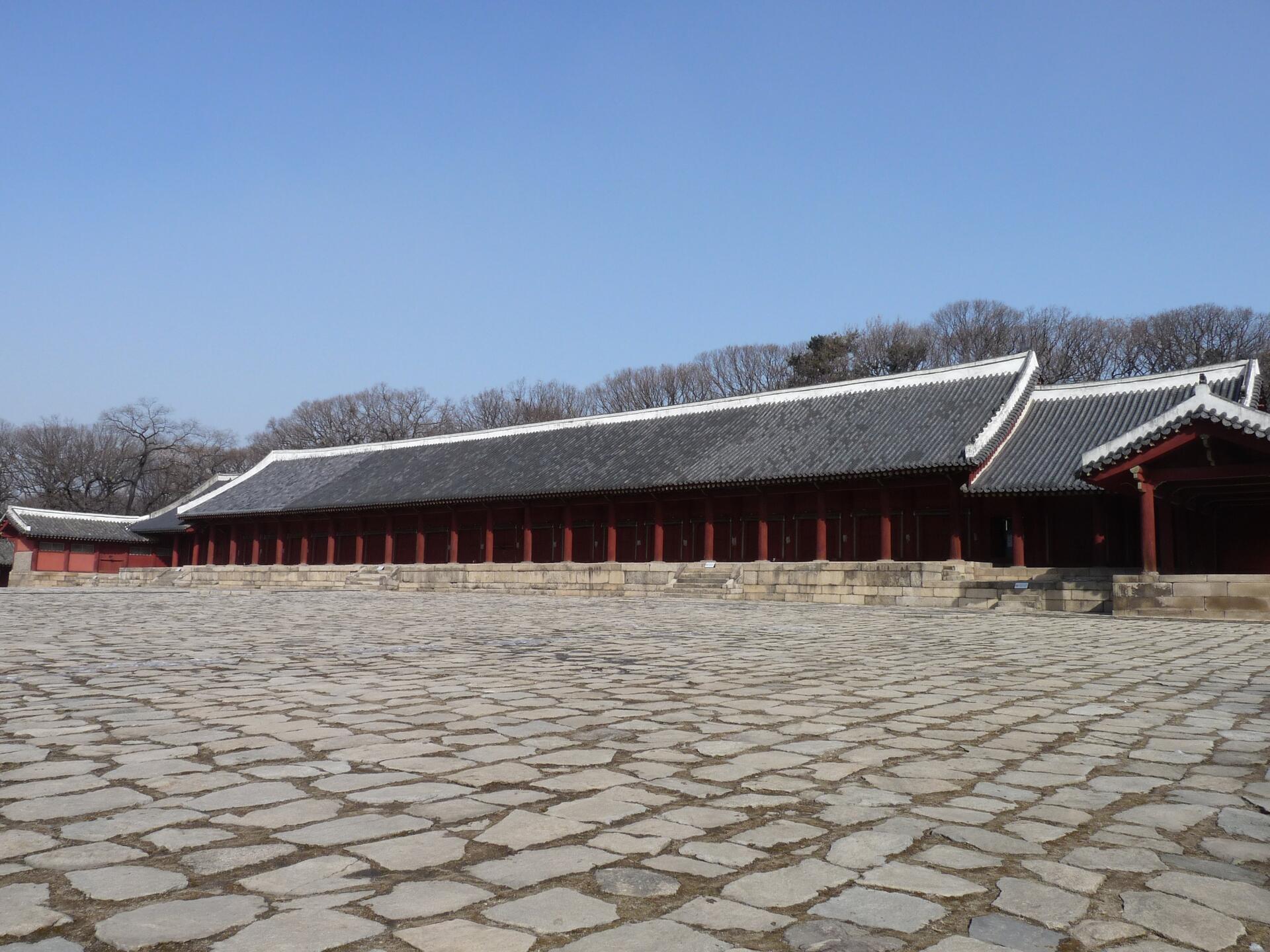
The Jongmyo Shrine, located in the heart of Seoul, South Korea, stands as a testament to the rich cultural heritage and enduring traditions of the Korean people. Inscribed as a UNESCO World Heritage Site in 1995, this ancient Confucian royal shrine offers a unique glimpse into the past, providing insights into the lives of the Joseon dynasty's rulers and their reverence for their ancestors.
More to come…UNESCO Description of the World Heritage Site
Jongmyo is the oldest and most authentic of the Confucian royal shrines to have been preserved. Dedicated to the forefathers of the Joseon dynasty (1392–1910), the shrine has existed in its present form since the 16th century and houses tablets bearing the teachings of members of the former royal family. Ritual ceremonies linking music, song and dance still take place there, perpetuating a tradition that goes back to the 14th century.
UNESCO Justification of the World Heritage Site
Criterion (iv): Jongmyo Shrine is an outstanding example of the Confucian royal ancestral shrine, which has survived relatively intact since the 16th century, the importance of which is enhanced by the persistence there of an important element of the intangible cultural heritage in the form of traditional ritual practices and forms.
Encyclopedia Record: Jongmyo
Jongmyo (Korean: 종묘) is a Confucian royal ancestral shrine in the Jongno District of Seoul, South Korea. It was originally built during the Joseon period (1392–1897) for memorial services for deceased kings and queens. According to UNESCO, the shrine is the oldest royal Confucian shrine preserved and the ritual ceremonies continue a tradition established in the 14th century. Such shrines existed during the Three Kingdoms of Korea period (57–668), but these have not survived. The Jongmyo Shrine was added to the UNESCO World Heritage list in 1995.Additional Site Details
Area: 19.4 hectares
Number of Components: 1
Coordinates: 37.5747222222 , 126.9936111111
World Heritage Research
Discover scientific research and academic studies that deepen our understanding of Jongmyo Shrine from its history and significance to its conservation, management, and contemporary challenges.
-
Six unrecorded macrofungi from the Royal Tombs (Donggureung and Seooreung) of the Joseon Dynasty and Jongmyo Shrine, Korea
A survey of macrofungi at Jongmyo Shrine and two royal tombs (Donggureung and Seooreung) from the Joseon Dynasty uncovered six previously unrecorded species, expanding Korea’s fungal biodiversity inventory. Researchers employed traditional morphological analysis alongside molecular sequencing to identify these fungi, revealing their presence in historically significant but ecologically understudied sites. The findings highlight the role of cultural heritage landscapes as reservoirs for diverse and potentially endemic fungal taxa, emphasizing the need for integrated conservation strategies that balance historical preservation with ecological research.
Cho, H. J., Lee, H., Li, V., Jargalmaa, S., Kim, N. K., & Lim, M.-J. K. and Y. W. (2025). Six unrecorded macrofungi from the Royal Tombs (Donggureung and Seooreung) of the Joseon Dynasty and Jongmyo Shrine, Korea (Version 1766725854855) [Dataset]. Plazi. https://doi.org/10.48580/D4FVW.V4
View Publication Record | Read Publication -
A Study on the Significance and Outcomes of the National Gugak Center’s Overseas Performances of Royal Ancestral Shrine Music -Focusing on Global Expansion and Re-contextualization of Court Sacrificial Ritual Music-
Overseas performances of Jongmyo Jeryeak, led by the National Gugak Center, transcend traditional revival efforts to symbolize diplomacy, cultural exchange, and global solidarity. These performances re-contextualize Joseon dynasty ritual music as a 'living site,' acquiring multifaceted significance—diplomatic gestures, universally appreciated classical music, and prayers for peace. They catalyze cross-cultural knowledge transfer, inspire local artists, and foster Asian cultural heritage pride while preserving individual national legacies. The study reveals that such performances deepen musicians' artistic understanding and responsibility, enhancing the ritual's symbolic and artistic value. By analyzing these performances across diverse regions, the research highlights their role in redefining Jongmyo Jeryeak's global relevance.
Chang, Y. (2026). A Study on the Significance and Outcomes of the National Gugak Center’s Overseas Performances of Royal Ancestral Shrine Music -Focusing on Global Expansion and Re-contextualization of Court Sacrificial Ritual Music-. National Gugak Center, 53, 433–456. https://doi.org/10.29028/jngc.2026.53.433
View Publication Record | Read Publication -
Lighting Devices in the Jongmyo Ancestral Rites: From Offering Candles to Consumables
This study reveals that candles in Jongmyo Shrine's ancestral rites underwent a significant shift from being sacred offerings to becoming consumables, marking a transition in their symbolic and functional roles during the Joseon Dynasty and into the modern era. The research analyzes historical texts and records to trace the evolution of lighting devices, showing how candles were initially categorized based on wax composition and ritual significance, reflecting hierarchical and emotional aspects of the rites. By the late Joseon period, mixed-wax candles were phased out due to smoke and odor issues, replaced by lead-wax candles. Post-liberation, industrial-era lighting like oil lamps and electric bulbs took over, but candles persisted as ritual symbols, bridging tradition and modernity.
Lee, W. (2026). Lighting Devices in the Jongmyo Ancestral Rites: From Offering Candles to Consumables. The Critical Review of Religion and Culture, 49(0), 83–130. https://doi.org/10.36429/crrc.49.3
View Publication Record | Read Publication -
Weathering of Granite-Based Stone Cultural Heritage: A Multianalytical Review of Mineralogical Alteration, Microcracking, and Decay Patterns
Granite, though long considered durable, undergoes universal yet regionally distinctive mineralogical and microstructural alterations that drive its decay in cultural heritage sites. This review reveals coupled processes such as feldspar hydrolysis, biotite oxidation, and iron transformations, which collectively govern macroscopic decay patterns. By integrating multianalytical techniques—ranging from non-destructive to laboratory-based methods—the study provides a mechanistic framework for understanding granite weathering, illustrated through case studies like the 10th-century rock-carved Buddhas of Gyeongju Namsan and Jongmyo Shrine in Seoul. The findings underscore the importance of environmental controls and conservation strategies while identifying key research gaps, including standardization, climate projection, and machine learning applications for heritage science.
Lee, S. (2026). Weathering of Granite-Based Stone Cultural Heritage: A Multianalytical Review of Mineralogical Alteration, Microcracking, and Decay Patterns. Heritage, 9(7), 263. https://doi.org/10.3390/heritage9070263
View Publication Record | Read Publication -
A Reexamination of the Temporal and Spatial Dimensions of Royal Ancestral Shrine Rites (Jongmyo) in Silla
Silla's royal ancestral rites, particularly those conducted at Jongmyo Shrine, were found to differ significantly from Chinese practices, with their scheduling and spatial organization reflecting indigenous Silla traditions. Unlike the Chinese system of four-season sacrifices, Silla's rites incorporated both regular and irregular ancestral sacrifices aligned with seasonal worship and local temporal concepts. The study also revealed distinct ritual functions for the Founder’s Shrine (Sijomyo), the Sacred Palace (Singung), and Jongmyo Shrine, which coexisted within the royal ancestral cult. Notably, the Singung retained its ritual significance even after the full establishment of the Jongmyo system. This reexamination, based on analyses of the Samguk Sagi and related sources, shifts focus from political lineage to the practical operation of these rites, offering new insights into their temporal and spatial dimensions.
Park, C. r. (2026). A Reexamination of the Temporal and Spatial Dimensions of Royal Ancestral Shrine Rites (Jongmyo) in Silla. The Journal of Korean History, 213, 39–76. https://doi.org/10.31791/jkh.2026.06.213.39
View Publication Record | Read Publication -
A Teaching and Learning Method for Jongmyo Jeryeak Focused on the Experience of ‘Akgamu’ - Centered on ‘Yeongsin Huimun’ from Botaepyeong -
A novel teaching and learning method for Jongmyo Jeryeak, a UNESCO-listed Korean ritual music tradition, is proposed to enhance the integration of musical, vocal, and dance elements. This approach centers on the experience of 'Akgamu' (integrated performance) using 'Yeongsin Huimun,' a segment from Botaepyeong, and addresses gaps in current educational curricula by providing structured activities that progress from music (ak), to lyrics (ga), to movement (mu). The method includes newly designed musical scores, visual aids, and a culminating integrated performance, aiming to align with the 2022 revised Korean music education curriculum. This study offers a practical framework for educators to foster deeper engagement with Jongmyo Jeryeak's cultural and artistic dimensions.
Jeong, M.-Y. (2025). A Teaching and Learning Method for Jongmyo Jeryeak Focused on the Experience of ‘Akgamu’ - Centered on ‘Yeongsin Huimun’ from Botaepyeong -. The Journal of Korean Music Education Research, 19(1), 67–119. https://doi.org/10.31177/sskme.2025.19.1.3
View Publication Record | Read Publication -
Jongmyo as urban heterotopia: sacred memory and otherness in hypermodern Seoul
Jongmyo Shrine, a UNESCO World Heritage site and ritual space of the Joseon Dynasty, functions as an 'urban heterotopia'—a counter-space that defies Seoul's hypermodern norms of efficiency and commodification while preserving sacred memory and hierarchy. The study reveals Jongmyo’s unique spatial logic: its secluded, horizontal order contrasts with the city’s verticality and openness, embodying 'observable tradition' while serving as a potential site of political rupture in daily urban life. By applying Foucault’s heterotopia theory and comparing it to Confucian and Shinto traditions, the research highlights Jongmyo’s role in spatializing sacredness, death, and memory, offering insights into how heritage sites navigate modernity.
Youn, H. (2025). Jongmyo as urban heterotopia: sacred memory and otherness in hypermodern Seoul. International Journal of Heritage Studies, 31(11), 1414–1439. https://doi.org/10.1080/13527258.2025.2543745
View Publication Record | Read Publication