World Heritage Identification Number: 1632
World Heritage since: 2021
Category: Cultural Heritage
WHE Type: Archaeological Sites
Transboundary Heritage: No
Endangered Heritage: No
Country: 🇯🇵 Japan
Continent: Asia
UNESCO World Region: Asia and the Pacific
Map
Exploring the Rich History of Jomon Prehistoric Sites in Northern Japan
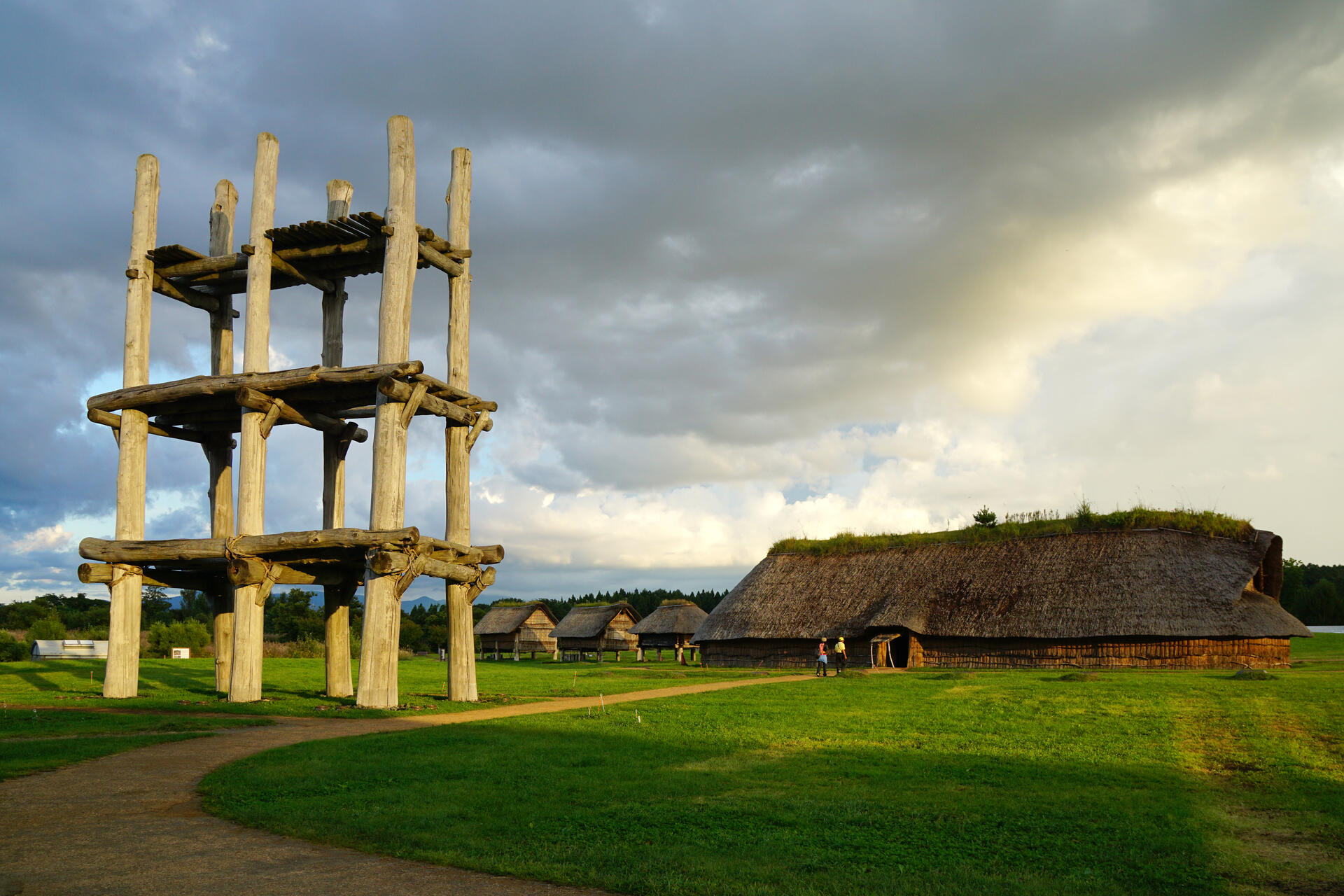
The Jomon Prehistoric Sites in Northern Japan, inscribed as a UNESCO World Heritage Site in 2021, offer a captivating glimpse into the rich cultural history of Japan's pre-agricultural era. This extensive serial site encompasses 17 archaeological locations spread across the southern region of Hokkaido Island and the northern Tohoku region, providing a comprehensive understanding of the Jomon culture that spanned approximately 13,000 years.
More to come…UNESCO Description of the World Heritage Site
The property consists of 17 archaeological sites in the southern part of Hokkaido Island and northern Tohoku in geographical settings ranging from mountains and hills to plains and lowlands, from inland bays to lakes, and rivers. They bear a unique testimony to the development over some 10,000 years of the pre-agricultural yet sedentary Jomon culture and its complex spiritual belief system and rituals. It attests to the emergence, development, maturity and adaptability to environmental changes of a sedentary hunter-fisher-gatherer society which developed from about 13,000 BCE. Expressions of Jomon spirituality were given tangible form in objects such as lacquered pots, clay tablets with the impression of feet, the famous goggle eyed dogu figurines, as well as in ritual places including earthworks and large stone circles reaching diameters of more than 50 metres. The serial property testifies to the rare and very early development of pre-agricultural sedentism from emergence to maturity.
UNESCO Justification of the World Heritage Site
Criterion (iii): The Jomon Prehistoric Sites in Northern Japan bears exceptional testimony to a globally rare prehistoric sedentary hunter-fisher-gatherer society which nurtured a complex spiritual culture, as revealed by archaeological artefacts such as clay tablets with the impression of feet and the famous goggle-eyed dogu figurines, as well as remains including graves, ritual deposits, artificial earthen mounds, and stone circles.
Criterion (v): The Jomon Prehistoric Sites in Northern Japan are an outstanding example of sedentary modes of settlement and land-use from the emergence of sedentism through its subsequent development and ultimate maturity. The Jomon people maintained an enduring hunter-fisher-gatherer way of life by adapting to a changing climate without altering the land significantly, as was the case with agrarian societies. To secure food in a stable manner, diverse locations were selected for settlements, including near rivers where fish swimming upstream could be caught, in tidelands where brackish shellfish could be gathered, and near colonies of nut-bearing trees where nuts and berries could be collected. Skills and tools for obtaining food were developed in accordance with the specific conditions of different locations.
Encyclopedia Record: Jōmon Prehistoric Sites in Northern Japan
Jōmon Prehistoric Sites in Northern Japan (北海道・北東北の縄文遺跡群) is a serial UNESCO World Heritage Site consisting of 17 Jōmon-period archaeological sites in Hokkaidō and northern Tōhoku, Japan. The Jōmon period lasted more than 10,000 years, representing "sedentary pre-agricultural lifeways and a complex spiritual culture of prehistoric people".Additional Site Details
Area: 141.9 hectares
Number of Components: 17
(v) — Outstanding example of traditional human settlement
Coordinates: 41.0655555556 , 140.5522222222
World Heritage Research
Discover scientific research and academic studies that deepen our understanding of Jomon Prehistoric Sites in Northern Japan from its history and significance to its conservation, management, and contemporary challenges.
-
A study on transmission of World Heritage values in Jomon Prehistoric Sites in Northern Japan
A study on the Jomon Prehistoric Sites in Northern Japan reveals that efforts to transmit Outstanding Universal Value (OUV) through exhibitions and hands-on learning are unevenly effective. The research analyzed three transmission approaches—explanatory panels at outdoor interpretation facilities, guidance facilities, and interactive learning—to assess whether they successfully convey the sites' significance. Findings indicate a disparity in how well OUV is transmitted across these methods, suggesting that integrating information from explanatory boards with hands-on experiences could enhance visitor understanding of archaeological remains. This insight is critical for improving heritage site communication strategies.
WAKIZONO, D., & ITO, H. (2022). 世界遺産「北海道・北東北の縄文遺跡群」における遺跡群としての価値伝達手法. Landscape Research Japan Online, 15(0), 21–32. https://doi.org/10.5632/jilaonline.15.21
View Publication Record | Read Publication -
Portable-XRF Analysis of Archaeological Obsidian from Rebun Island, Japan
Archaeological excavations on Rebun Island, Japan, reveal that obsidian—a material not found naturally on the island—was used continuously from the Middle Jomon period (5400–4300 cal. YBP) through to the Okhotsk period (1500–750 YBP). This suggests significant long-distance trade or transportation of raw materials and tools, a pattern consistent with broader prehistoric lithic industries in northeast Asia. To trace the origins of this obsidian, researchers employed portable-XRF analysis on artifacts from three sites: Uedomari 3, Kafukai 1, and Hamanaka 2. The findings promise to illuminate shifts in resource procurement and distribution among hunter-gatherer communities during these periods, offering new insights into the economic and cultural dynamics of prehistoric Northern Japan.
Lynch, S. C. (2013). Portable-XRF Analysis of Archaeological Obsidian from Rebun Island, Japan [University of Alberta Library]. https://doi.org/10.7939/R35D76
View Publication Record | Read Publication