World Heritage Identification Number: 816
World Heritage since: 1997
Category: Cultural Heritage
WHE Type: Buildings & Architectural Ensembles
Transboundary Heritage: No
Endangered Heritage: No
Country: 🇰🇷 Republic of Korea
Continent: Asia
UNESCO World Region: Asia and the Pacific
Map
Exploring the Elegance of Changdeokgung Palace Complex: A Masterpiece of Far Eastern Palace Architecture
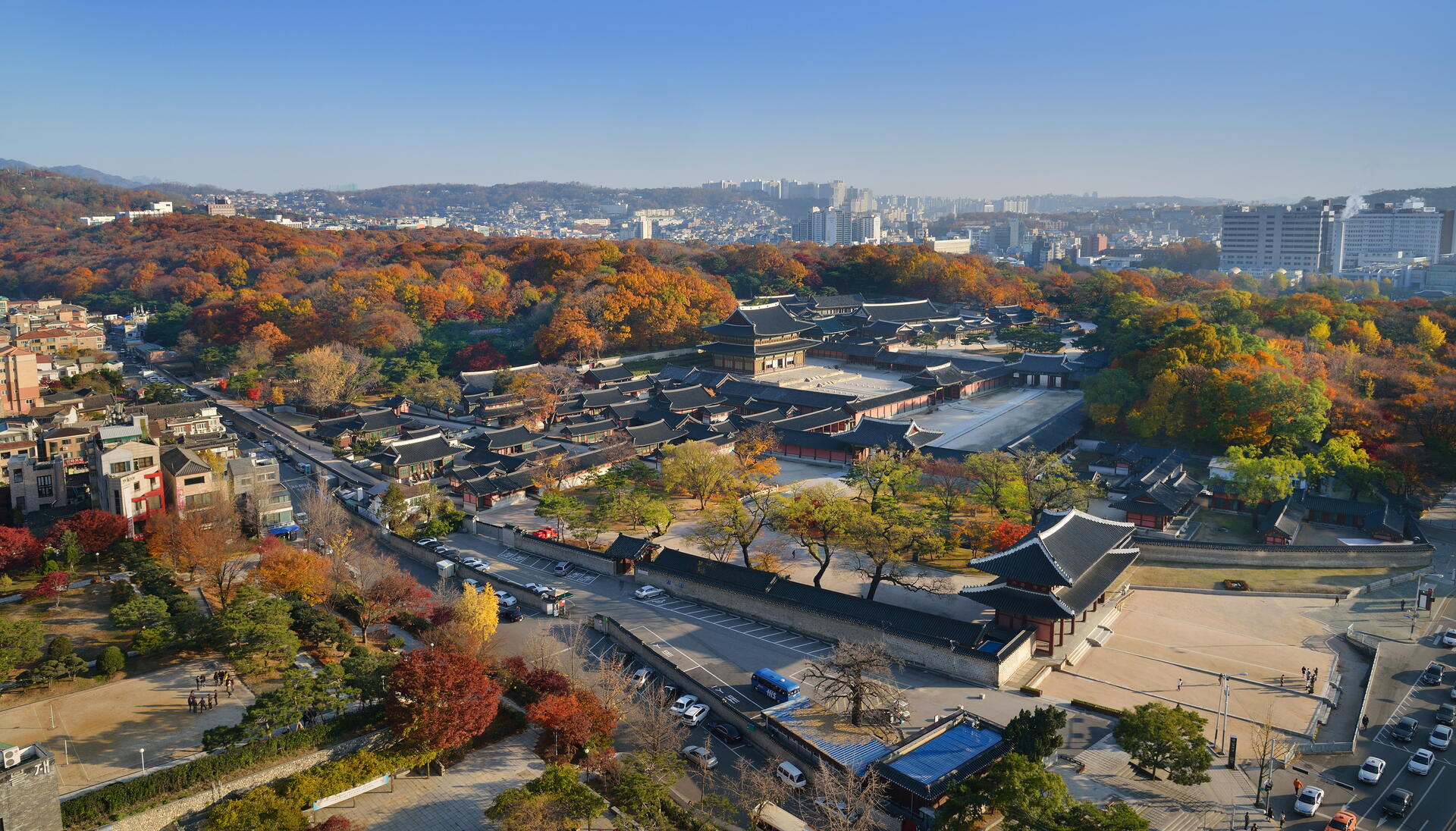
The Changdeokgung Palace Complex, nestled within the heart of Seoul, South Korea, stands as a testament to the rich history and architectural prowess of the Joseon Dynasty (1392-1910). This UNESCO World Heritage Site, officially recognized since 1997, offers visitors a glimpse into the lives of the royal family and their courtiers during this period.
More to come…UNESCO Description of the World Heritage Site
In the early 15th century, the King Taejong ordered the construction of a new palace at an auspicious site. A Bureau of Palace Construction was set up to create the complex, consisting of a number of official and residential buildings set in a garden that was cleverly adapted to the uneven topography of the 58-ha site. The result is an exceptional example of Far Eastern palace architecture and design, blending harmoniously with the surrounding landscape.
UNESCO Justification of the World Heritage Site
Criterion (ii): Changdeokgung had a great influence on the development of Korean architecture, garden design and landscape planning, and related arts for many centuries.
Criterion (iii): Changdeokgung exemplifies the traditional pungsu principles and Confucianism through its architecture and landscape. The site selection and setting of the palace were based upon pungsu principles, whilst the buildings were laid out both functionally and symbolically in accordance to Confucian ideology that together portrays the Joseon Dynasty’s unique outlook on the world.
Criterion (iv): Changdeokgung is an outstanding example of East Asian palace architecture and garden design, exceptional for the way in which the buildings are integrated into and harmonized with the natural setting, adapting to the topography and retaining indigenous tree cover.
Encyclopedia Record: Changdeokgung
Changdeokgung is a former royal palace in Seoul, South Korea. A UNESCO World Heritage Site and a Historic Site of South Korea, it is among the best preserved of all Korean palaces. It and its neighboring palace Changgyeonggung have together been called the "East Palace".Additional Site Details
Area: Not available
Number of Components: 1
(iii) — Unique or exceptional testimony to a cultural tradition
(iv) — Outstanding example of a type of building or landscape
Coordinates: 37.5788888889 , 126.9911111111
World Heritage Research
Discover scientific research and academic studies that deepen our understanding of Changdeokgung Palace Complex from its history and significance to its conservation, management, and contemporary challenges.
-
Exploring the Modern Production Process of Traditional Patterns Based on Digital Design - Focusing on the Patterns of Changdeokgung Nakseonjae -
Digital design technology can standardize and adapt the aesthetic value of traditional cultural heritage, such as the patterns of Changdeokgung Palace Complex's Nakseonjae, to modern lifestyle product specifications without compromising its core identity. This study confirms that a design adaptation process based on morphological analysis allows for flexible expansion into diverse product lines while preserving traditional aesthetics. Additionally, it demonstrates how combining digital precision with traditional craftsmanship in prototype production merges the intangible qualities of digital data with the tangible nature of handcrafted materials. The research contributes to the potential transformation of preservation-focused heritage data into high-value commercial products, supporting the development of a Korean cultural ecosystem with strong identity and economic viability.
Gio, K. S. (2026). Exploring the Modern Production Process of Traditional Patterns Based on Digital Design - Focusing on the Patterns of Changdeokgung Nakseonjae -. Journal of Cultural Product & Design, 84(0), 27–36. https://doi.org/10.18555/kicpd.2026.84.003
View Publication Record | Read Publication -
The Cultural Biography of Wood and Late Joseon Architectural Technology: Focusing on the Changdeokgung Yeonggeon Dogam Uigwe (1834)
A study reveals that the reconstruction of Daejojeon Hall in Changdeokgung Palace (1834) was significantly shaped by the physical constraints of timber, demonstrating how natural materials actively influenced architectural design and state logistics. The research shows that the inability to source ideal timber forced the expansion of a nationwide logistical network, ultimately reducing the hall's scale from 45 to 36 bays. This 'cultural biography' of wood highlights its role as an active agent in reshaping royal space, challenging idealized historical records and emphasizing the interplay between material resistance and architectural innovation.
Oh, Y. (2026). The Cultural Biography of Wood and Late Joseon Architectural Technology: Focusing on the Changdeokgung Yeonggeon Dogam Uigwe (1834). The Korean Journal of History of Science, 48(1), 191–220. https://doi.org/10.36092/kjhs.2026.48.1.191
View Publication Record | Read Publication -
Carbon Storage Assessment of Changdeokgung Palace Forest Based on Biomass Allometric Equations†
Changdeokgung Palace Forest, a UNESCO World Heritage Site and Ecosystem Conservation Area, stores approximately 7,905.26 tons of carbon across its canopy and sub-canopy layers. This finding underscores the significant ecological value of urban palace forests, particularly those dominated by large-diameter and ancient trees like Zelkova serrata (Thunb.) Makino, which contributed the most to carbon storage despite being fewer in number. The study, conducted from 2020 to 2023 across 759 sample plots, used biomass allometric equations to quantify carbon storage in 7,988 trees, providing a baseline for assessing the functional value of historical landscapes. Dominant species varied by terrain, with xeric oaks thriving on ridges and slopes, while Quercus aliena Blume and others prevailed in valley areas. The research highlights the importance of preserving such forests not only for their cultural heritage but also for their critical role in urban carbon sequestration.
Youn-Choul, K., Bong-Ho, H., & Seok-Cheol, P. (2026). Carbon Storage Assessment of Changdeokgung Palace Forest Based on Biomass Allometric Equations†. Journal of the Korean Institute of Landscape Architecture, 54(3), 64–77. https://doi.org/10.9715/kila.2026.54.3.064
View Publication Record | Read Publication -
Reconstructing memory through adaptive heritage: a comparative analysis of Gyeongbokgung and Changdeokgung in UNESCO discourse
A comparative analysis of Gyeongbokgung and Changdeokgung Palaces reveals that Gyeongbokgung, despite its exclusion from UNESCO World Heritage recognition due to reconstruction, embodies adaptive heritage principles by reflecting Korea’s postcolonial transformations and evolving national identity. The study challenges conventional heritage frameworks rooted in the Authorized Heritage Discourse (AHD), emphasizing symbolic reappropriation and historical rupture. Using a case analysis and text mining of over 90,000 news articles, the research highlights Gyeongbokgung’s cultural and interpretive potential as adaptive heritage, advocating for more inclusive and context-sensitive approaches to World Heritage evaluation in East Asia.
Youn, H. C., & Bae, J. (2025). Reconstructing memory through adaptive heritage: a comparative analysis of Gyeongbokgung and Changdeokgung in UNESCO discourse. Journal of Asian Architecture and Building Engineering, 1–13. https://doi.org/10.1080/13467581.2025.2542303
View Publication Record | Read Publication -
Meaning of the Construction of Gyeongbokgung Palace Garden Outside Sinmu-Gate – The Experience of Changdeokgung Palace and Heungseon Daewongun's Architectural Intention –
A new analysis reveals that the garden construction outside Sinmu-Gate at Gyeongbokgung Palace, led by Heungseon Daewongun during its 18th-century reconstruction, was a deliberate architectural and political strategy to re-establish Joseon-era governance structures. The study demonstrates that this design choice, featuring administrative buildings like Yungmunjeong and Yungmujeong, mirrored the spatial organization of early Joseon palaces, reinforcing Confucian political ideals by physically separating civil and military institutions while maintaining symbolic continuity with traditional palace layouts. By integrating past examination sites such as Gyeongmudae into the garden's layout, the reconstruction aimed to revive historical governance models, blending functional utility with ideological symbolism.
Lee, K. M. (2025). Meaning of the Construction of Gyeongbokgung Palace Garden Outside Sinmu-Gate – The Experience of Changdeokgung Palace and Heungseon Daewongun’s Architectural Intention –. The Journal of Seoul Studies, 100, 1–38. https://doi.org/10.17647/jss.2025.08.100.01
View Publication Record | Read Publication -
Newly introduction of indoor passages in Changdeokgung Palace in the early twentieth century: a typological analysis and its architectural implications
A groundbreaking transformation occurred at Changdeokgung Palace between 1907 and 1920, marking the first introduction of fully enclosed indoor passages in traditional Korean palace architecture. This study reveals two distinct passage types—Corridors, which connected separate buildings and were later removed during restorations, and Hallways, which organized interior space within single buildings and became universally standardized post-independence. The findings challenge prior assumptions about colonial imposition, demonstrating instead a complex hybridity where traditional and modern spatial concepts coexisted. By analyzing historical drawings, newspapers, and restoration documents, the research refines architectural typology frameworks and extends postcolonial hybridity theory to palace architecture, offering critical insights for heritage preservation that recognize multiple legitimate historical layers.
Kee, S. (2025). Newly introduction of indoor passages in Changdeokgung Palace in the early twentieth century: a typological analysis and its architectural implications. Journal of Asian Architecture and Building Engineering, 1–32. https://doi.org/10.1080/13467581.2025.2606531
View Publication Record | Read Publication -
Korean-Western Blended Interior Style and Its Meaning in the Korean Royal Palaces During the Japanese Colonial Period - Focused on the Daejojeon and Huijeongdang in Changdeokgung Palace -
During Japan's colonial rule over Korea, the Changdeokgung Palace Complex's Daejojeon and Huijeongdang showcased a unique fusion of Korean and Western interior design elements. This blend, characterized by traditional Korean aesthetics in upper sections and Western influences—particularly French—below, reflected both colonial political pressures and evolving domestic sensibilities toward Western decoration. The study reveals that this eclecticism was not merely a product of modernity but also a response to Japan's own cultural synthesis with the West, offering insights into Korea's interior design industry during this period.
Lee, J.-Y. (2024). Korean-Western Blended Interior Style and Its Meaning in the Korean Royal Palaces During the Japanese Colonial Period - Focused on the Daejojeon and Huijeongdang in Changdeokgung Palace -. Journal of the Korean Institute of Interior Design, 33(6), 31–44. https://doi.org/10.14774/jkiid.2024.33.6.031
View Publication Record | Read Publication