World Heritage Identification Number: 1588
World Heritage since: 2019
Category: Cultural Heritage
WHE Type: Archaeological Sites
Transboundary Heritage: No
Endangered Heritage: No
Country: 🇲🇲 Myanmar
Continent: Asia
UNESCO World Region: Asia and the Pacific
Map
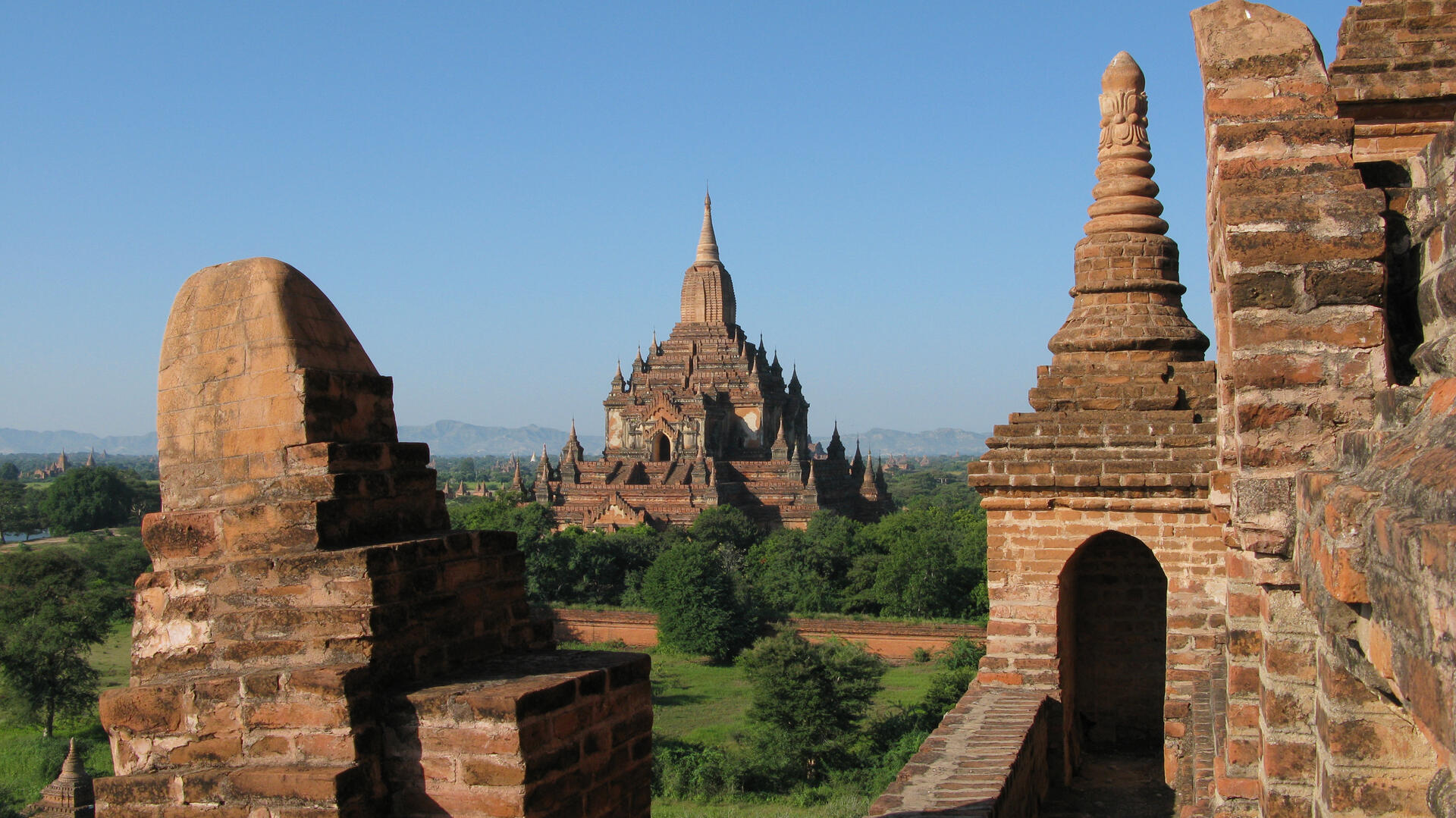
Bagan: A Sacred Landscape of Buddhist Art and Architecture
Bagan, officially known as Arakanese Pagan or Burmese Pagan, is a captivating city located in the Mandalay Region of Myanmar. It serves as a significant historical and cultural landmark, recognized as a UNESCO World Heritage Site since 2019. The designation acknowledges Bagan's unique role as a testament to the peak of the Bagan civilization (11th – 13th centuries CE) and its status as the capital of a regional empire during this period.
More to come…UNESCO Description of the World Heritage Site
Lying on a bend of the Ayeyarwady River in the central plain of Myanmar, Bagan is a sacred landscape, featuring an exceptional range of Buddhist art and architecture. The seven components of the serial property include numerous temples, stupas, monasteries and places of pilgrimage, as well as archaeological remains, frescoes and sculptures. The property bears spectacular testimony to the peak of Bagan civilization (11th -13th centuries CE), when the site was the capital of a regional empire. This ensemble of monumental architecture reflects the strength of religious devotion of an early Buddhist empire.UNESCO Justification of the World Heritage Site
Criterion (iii): Bagan is an exceptional and continuing testimony to the Buddhist cultural tradition of merit making, and to the peak of Bagan civilisation in the 11th-13th centuries when it was the capital of a regional empire.
Criterion (iv): Bagan contains an extraordinary ensemble of Buddhist monumental architecture, reflecting the strength of religious devotion of an early major Buddhist empire. Within the context of the rich expressions and traditions of Buddhist architecture and art found throughout Asia, Bagan is distinctive and outstanding.
Criterion (vi): Bagan is an exceptional example of the living Buddhist beliefs and traditions of merit making, expressed through the remarkable number of surviving stupas, temples and monasteries, supported by continuing religious traditions and activities. While the evidence of practices of merit-making are common in many Buddhist sites and areas, the influences established in the Bagan period, and the scale and diversity of expressions, and continuing traditions make Bagan exceptional.
Encyclopedia Record: Bagan
Bagan is an ancient city and a UNESCO World Heritage Site in the Mandalay Region of Myanmar. From the 9th to 13th centuries, the city was the capital of the Pagan Kingdom, the first kingdom that unified the regions that would later constitute Myanmar. During the kingdom's height between the 11th and 13th centuries, more than 10,000 Buddhist temples, pagodas and monasteries were constructed in the Bagan plains alone, of which the remains of over 2200 temples and pagodas survive.Additional Site Details
Area: 5,005.49 hectares
Number of Components: 7
(iv) — Outstanding example of a type of building or landscape
(vi) — Directly associated with events or living traditions
Coordinates: 21.1488888889 , 94.8844444444
World Heritage Research
Discover scientific research and academic studies that deepen our understanding of Bagan from its history and significance to its conservation, management, and contemporary challenges.
-
Probabilistic seismic hazard analysis for Bagan (Myanmar)
A probabilistic seismic hazard analysis for Bagan, Myanmar, reveals significant underestimation of seismic risk in the region. The study, conducted post-2016 Chauk earthquake, found peak ground acceleration values ranging from 0.25 to 0.36 g for a return period of 2475 years, indicating higher hazard levels than previously estimated. Researchers developed two seismic source models and utilized state-of-the-art ground motion models to assess the seismic vulnerability of 43 temples, incorporating local soil information. The analysis, based on instrumental and historical earthquake records, underscores the need for updated hazard maps and site-specific uniform hazard spectra to mitigate risks to Bagan's historic structures.
Gögen, B., Karimzadeh, S., & Lourenço, P. B. (2024). Probabilistic seismic hazard analysis for Bagan (Myanmar). Acta Geophysica, 72(4), 2193–2221. https://doi.org/10.1007/s11600-023-01263-6
View Publication Record | Read Publication -
Remote sensing-based deformation monitoring of pagodas at the Bagan cultural heritage site, Myanmar
A study employing high-resolution TerraSAR-X imagery identified millimetric-scale deformation hotspots and displacement anomalies in pagodas at the Bagan World Heritage site, linking them to land cover changes and seismic activity. By combining small baseline subset (SBAS) and persistent scatterer synthetic aperture radar interferometry (PSInSAR), researchers achieved precise monitoring across both landscape and monument scales—critical for heritage protection and sustainable development. This non-contact method offers a robust alternative where traditional field-based surveillance is limited, providing valuable insights into the structural stability of this culturally significant site.
Chen, F., Zhou, W., Tang, Y., Li, R., Lin, H., Balz, T., Luo, J., Shi, P., Zhu, M., & Fang, C. (2022). Remote sensing-based deformation monitoring of pagodas at the Bagan cultural heritage site, Myanmar. International Journal of Digital Earth, 15(1), 770–788. https://doi.org/10.1080/17538947.2022.2062466
View Publication Record | Read Publication -
Built Heritage Documentation and Management: An Integrated Conservation Approach in Bagan
A multidisciplinary approach to heritage documentation has proven effective in assessing and managing the conservation of vulnerable UNESCO World Heritage Sites, such as Bagan. The study demonstrates that integrating diverse documentation techniques—including both image-based and non-image-based methods—can provide a robust foundation for monitoring and retrofitting actions, particularly in regions prone to natural disasters like seismic events and flooding. By documenting four temples in Bagan, researchers tested the flexibility of their methodology, evaluating its strengths and limitations across different architectural designs. This work also emphasized capacity-building efforts, training local professionals and archaeologists in advanced digital documentation techniques, thereby enhancing technical knowledge and on-site expertise.
Mezzino, D., Chan, L., Santana Quintero, M., Esponda, M., Lee, S., Min, A., & Pwint, M. (2017). BUILT HERITAGE DOCUMENTATION AND MANAGEMENT: AN INTEGRATED CONSERVATION APPROACH IN BAGAN. ISPRS Annals of the Photogrammetry, Remote Sensing and Spatial Information Sciences, IV-2/W2, 143–150. https://doi.org/10.5194/isprs-annals-iv-2-w2-143-2017
View Publication Record | Read Publication