World Heritage Identification Number: 1091
World Heritage since: 2004
Category: Cultural Heritage
WHE Type: Archaeological Sites
Transboundary Heritage: No
Endangered Heritage: No
Country: 🇰🇵 Democratic People's Republic of Korea
Continent: Asia
UNESCO World Region: Asia and the Pacific
Map
The Complex of Koguryo Tombs: A Unique Testimony to Ancient Korean Culture
The Complex of Koguryo Tombs, inscribed as a UNESCO World Heritage Site in 2004, offers a captivating glimpse into the rich cultural heritage of ancient Korea. Located primarily in the cities of Pyongyang and Nampo, this significant archaeological site is home to approximately 30 individual tombs that date back to the later period of the Koguryo Kingdom (3rd century BC to 7th century AD).
More to come…UNESCO Description of the World Heritage Site
The property includes several group and individual tombs - totalling about 30 individual tombs - from the later period of the Koguryo Kingdom, one of the strongest kingdoms in nowadays northeast China and half of the Korean peninsula between the 3rd century BC to 7th century AD. The tombs, many with beautiful wall paintings, are almost the only remains of this culture. Only about 90 out of more than 10,000 Koguryo tombs discovered in China and Korea so far, have wall paintings. Almost half of these tombs are located on this site and they are thought to have been made for the burial of kings, members of the royal family and the aristocracy. These paintings offer a unique testimony to daily life of this period.
UNESCO Justification of the World Heritage Site
Criterion (i): The wall paintings of the Koguryo tombs are masterpieces of the culture and period of the Koguryo kingdom; the construction of the tombs demonstrates ingenious engineering solutions.
Criterion (ii): The special burial customs of the Koguryo culture had an important influence on other cultures in the region, including Japan.
Criterion (iii): The Koguryo tombs are an exceptional testimony of the Koguryo culture, its burial customs as well as its daily life and beliefs.
Criterion (iv): The Complex of Koguryo Tombs is an important example of burial typology.
Encyclopedia Record: Goguryeo tombs
Goguryeo tombs, officially designated as the Complex of Koguryo Tombs, are tombs in North Korea. In July 2004, they became the first UNESCO World Heritage site in the country. The site consists of 30 individual tombs from the later Goguryeo kingdom, one of Three Kingdoms of Korea, located in the cities of P'yŏngyang and Namp'o. Goguryeo was one of the strongest ancient Korean kingdoms located in the northern and central parts of the Korean Peninsula and the southern and central parts of Manchuria. The kingdom was founded in the present day area of North Korea, and part of Manchuria around 37 BCE, and the capital was transferred to P'yŏngyang in 427 CE.Additional Site Details
Area: 234.73 hectares
Number of Components: 12
(ii) — Significant interchange of human values
(iii) — Unique or exceptional testimony to a cultural tradition
(iv) — Outstanding example of a type of building or landscape
Coordinates: 38.86305556 , 125.415
Image
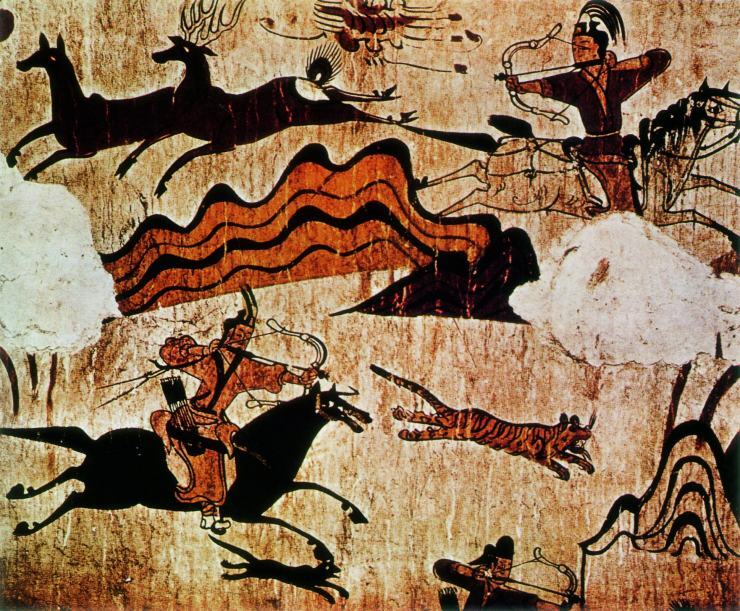
Unknown author, Public domain
World Heritage Research
Discover scientific research and academic studies that deepen our understanding of Complex of Koguryo Tombs from its history and significance to its conservation, management, and contemporary challenges.
-
On the Archaeological Implications of Koguryo Metal Vessels Buried in Silla’s Wooden Chamber Tombs with Stone Mounds
A new study reveals that metal vessels found in Silla’s wooden chamber tombs with stone mounds (jeokseokmokgwak-bun) bear a significant relationship to Koguryo, suggesting these items were not only functional but also held ceremonial significance tied to food offerings. The composition of these vessels mirrors those found in Koguryo’s large stone-mound tombs and aligns with depictions in Koguryo murals, indicating a shift in burial practices that reflects changing political dynamics between Koguryo and Silla. Initially, Koguryo-style metal vessels were prestigious artifacts used in food offering rituals, but their prevalence waned over time as personal utensils shifted to lacquerware, wood, and earthenware. This transformation is linked to the evolving relationship between the two kingdoms and changes in funeral customs during the period.
Kang, H. (2025). On the Archaeological Implications of Koguryo Metal Vessels Buried in Silla’s Wooden Chamber Tombs with Stone Mounds. The Korean Archaeological Society, 136, 645–665. https://doi.org/10.47439/jkras.2025.3.645
View Publication Record | Read Publication -
Contribution to the Understanding of Mural Painting Techniques of Jinpari Tomb No. 4 of the Complex of Koguryo Tombs, World Heritage
A groundbreaking analysis of the mural paintings in Jinpari Tomb No. 4, part of the UNESCO-listed Complex of Koguryo Tombs, has revealed the precise materials and techniques used by ancient Koguryo artisans over 1,500 years ago. Researchers identified malachite as the green pigment through high copper content analysis, distinctive crystal structures, and X-ray diffraction (XRD) patterns, confirming its use in the paintings. The study further uncovered that the ground layer consisted of earthen materials rich in calcium, aluminum, silicon, potassium, magnesium, and iron, while the lime layer contained limestone-derived calcium carbonate. These findings, based on chemical composition and microstructural analysis, provide unprecedented insights into the sophisticated mural painting techniques employed during the Koguryo period.
Lee, H. S., & Han, K. S. (2023). Contribution to the Understanding of Mural Painting Techniques of Jinpari Tomb No. 4 of the Complex of Koguryo Tombs, World Heritage. Crystals, 13(3), 459. https://doi.org/10.3390/cryst13030459
View Publication Record | Read Publication -
An Archaeological Perspective on Ancient East Asian Royal Tombs
Archaeological analysis of East Asian royal tombs reveals that the construction of massive royal tombs, such as those found in Northern Wei (China), Gaya (Korea), and Wa (Japan), was a shared process across different historical contexts, driven by the establishment and growth of royal authority. The study highlights that the Northern Wei dynasty, despite its nomadic origins, began constructing large tombs in the late 5th century, likely as part of sinicization policies and in response to neighboring regimes like Koguryo and the Rouran Khaganate. In Gaya, the decline of state power and changes in royal lines are inferred from the absence of new large tombs after the 4th century, while Daegaya's tombs suggest a social development comparable to Silla and Baekje. In Wa (Japan), the frequent relocation of tomb construction sites indicates dispersed royal authority and instability in hereditary succession. The research combines in-situ investigations with historical analysis to uncover these patterns, providing insights into the political and social dynamics of ancient East Asian societies.
Park, C. (2017). An Archaeological Perspective on Ancient East Asian Royal Tombs. Korean Ancient Historical Society, 98, 95–125. https://doi.org/10.18040/sgs.2017.98.95
View Publication Record | Read Publication