World Heritage Identification Number: 265
World Heritage since: 1983
Category: Cultural Heritage
WHE Type: Buildings & Architectural Ensembles
Transboundary Heritage: No
Endangered Heritage: No
Country: 🇵🇹 Portugal
Continent: Europe
UNESCO World Region: Europe and North America
Map
The Convent of Christ in Tomar: A Symbol of Portugal's Dynamic History
The Convent of Christ in Tomar, officially known as the Convent of the Knights Templar of Tomar (later transferred to the Knights of the Order of Christ), stands as a testament to Portugal's rich history and cultural evolution. Inscribed as a UNESCO World Heritage Site in 1983, this architectural marvel has been a significant part of Portugal's historical landscape for centuries.
More to come…UNESCO Description of the World Heritage Site
Originally designed as a monument symbolizing the Reconquest, the Convent of the Knights Templar of Tomar (transferred in 1344 to the Knights of the Order of Christ) came to symbolize just the opposite during the Manueline period – the opening up of Portugal to other civilizations.
UNESCO Justification of the World Heritage Site
Criterion (i): The primitive church of the Templars, together with its constructions of the Renaissance, forms a masterpiece of human creative genius.
Criterion (vi): The Convent of Christ in Tomar, originally conceived as a symbolic monument of the Reconquest, became, from the Manueline period, an inverse symbol: that of the opening of Portugal to exterior civilizations.
Encyclopedia Record: Convent of Christ (Tomar)
The Convent of Christ of Tomar, also called Convent of Christ or Monastery of Christ, is a former Catholic convent in Tomar, Portugal.Additional Site Details
Area: Not available
Number of Components: 1
(vi) — Directly associated with events or living traditions
Coordinates: 39.60472 , -8.4175
Image
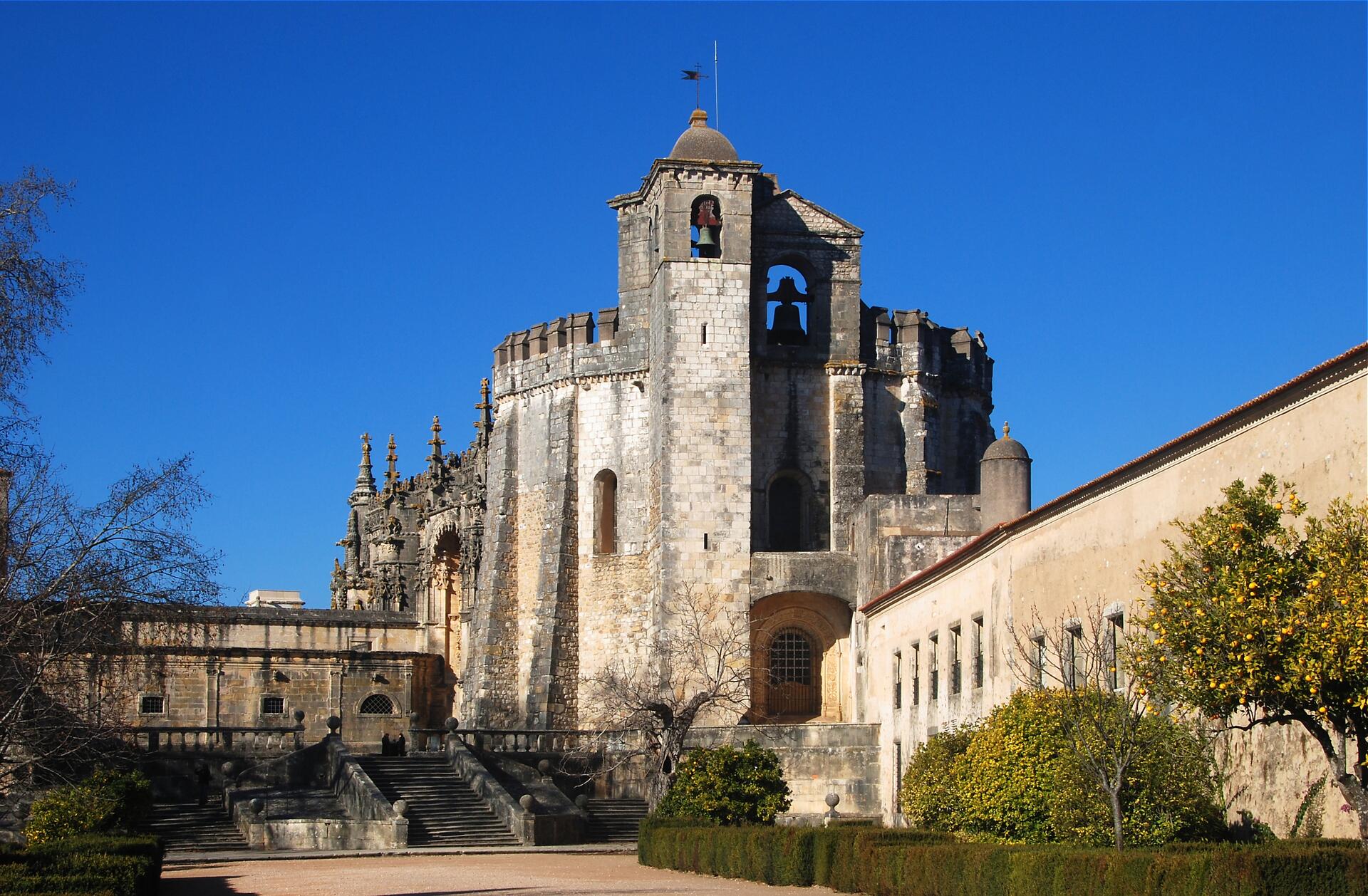
© Alvesgaspar, CC BY-SA 3.0 Resized from original. (This derivative is under the same CC BY-SA license.)
World Heritage Research
Discover scientific research and academic studies that deepen our understanding of Convent of Christ in Tomar from its history and significance to its conservation, management, and contemporary challenges.
-
The extinction inventories of convents in 1834
A comprehensive analysis of the extinction inventories of religious houses in Portugal, particularly focusing on the Santo André de Rendufe monastery and the Convent of Christ in Tomar, reveals critical insights into the processes of archival collection during the ecclesiastical reforms of 1834. These inventories, housed in the Torre do Tombo National Archive, provide a wealth of data that can be leveraged for archival, historical, art historical, economic, and sociological studies. By comparing two Benedictine institutions—one with black monks and the other with friars of the Order of Christ—the study offers hypotheses and conclusions that enhance understanding of how religious houses were extinguished and their archives managed during this period.
Oliveira e Silva, M. J., & Lencart, J. (2024). The extinction inventories of convents in 1834. Boletim Do Arquivo Da Universidade de Coimbra, 37(1), 157–174. https://doi.org/10.14195/2182-7974_37_1_5
View Publication Record | Read Publication -
The degradation of the “Study room” (Convent of Christ, Tomar, Portugal), from a preliminary analysis towards a sustainable maintenance
A sustainable solution for mitigating salt-induced degradation in historic limestone structures has been identified. Researchers analyzed the 'Study Room' columns in the Convent of Christ's Crow’s Cloister, Portugal, focusing on soluble salts causing efflorescence. Through chemical characterization and environmental modeling using ECOS-RUNSALT software, they found that maintaining relative humidity at 65±2% would significantly reduce weathering processes. This approach offers a targeted strategy for preserving cultural heritage sites without altering the existing structure's conditions.
Costa, F. M. d. C., Henriques Rosa, M. A. N., Canetto, M., & Sobral da Fonseca, M. J. (2022). The degradation of the “Study room” (Convent of Christ, Tomar, Portugal), from a preliminary analysis towards a sustainable maintenance. Ge-Conservacion, 21(1), 95–107. https://doi.org/10.37558/gec.v21i1.1052
View Publication Record | Read Publication -
A envolvente do Convento de Cristo em Tomar: Uma leitura sobre o lugar no tempo para uma proposta de regeneração urbana
A comprehensive analysis of the Convent of Christ in Tomar reveals the significant role of its surrounding landscape in shaping its historical identity and architectural character. The study defines a landscape unit by examining the spatial and visual relationships between the monument and its immediate and distant surroundings, tracing transformations from its early occupation to the present day. This approach provides a nuanced understanding of the physical and visual continuities that connect the interiors of the convent with its broader landscape context, offering valuable insights for urban regeneration strategies.
Freitas, A. M. B. (2018). A envolvente do Convento de Cristo em Tomar: Uma leitura sobre o lugar no tempo para uma proposta de regeneração urbana [Universidade do Porto]. https://doi.org/10.34626/2ARN-A550
View Publication Record | Read Publication -
Liturgic emphasis, dramaturgy, identity of power and episcopal jurisdiction (XVIth-XVIIIth centuries)
A rare glimpse into the psychological and physiological responses of a high-ranking church official during a significant liturgical ceremony is provided by this study. Focusing on the unedited solemn ceremony of the imposition of the pallium—a distinctive band symbolizing episcopal power—on Archbishop Augustin of Jesus in 16th-century Portugal, the research reveals the profound impact of such rituals on the protagonist's identity and jurisdiction. The analysis draws from two biographical records and situates the event within the broader context of Portuguese Church hierarchies and political ceremonies during the Habsburg dynasty. By examining the unusual stop at the Convent of Christ in Tomar for this ceremony, the study sheds light on the interplay between liturgical dramaturgy, power dynamics, and episcopal authority.
Nestola, P. (2018). Liturgic emphasis, dramaturgy, identity of power and episcopal jurisdiction (XVIth-XVIIIth centuries). Revista de História Das Ideias, 36, 97–122. https://doi.org/10.14195/2183-1718_36_5
View Publication Record | Read Publication -
The Painted Angels from the central drum of Convent of Christ Rotunda in Tomar - first results of the material and technical comparative study
A comparative analysis of artificial yellow pigments used in the 15th-century paintings of the Convent of Christ's Rotunda in Tomar, Portugal, reveals distinct differences in stoichiometric ratios, melting temperatures, and color hue among lead-tin yellow (type I and II), lead antimonate yellow, and lead-tin-antimony yellow. The study employed micro-Raman spectroscopy alongside X-ray diffraction, scanning electron microscopy with energy dispersive spectroscopy, and differential thermal analysis to characterize these pigments under varying experimental conditions. Findings highlight correlations between chemical composition, melting processes, and the resulting color properties, offering new insights into the material techniques of Renaissance artists.
Gil, M., Pestana, A., Miguel, C., Manhita, A., Dias, L., Cardoso, A., Mirão, J., & Candeias, A. (2015). The Painted Angels from the central drum of Convent of Christ Rotunda in Tomar - first results of the material and technical comparative study. E-Conservation Journal, 4. https://doi.org/10.18236/econs4.201510
View Publication Record | Read Publication -
The Unexecuted Plans for the Eradication of Jewish Heresy in the Hispanic Monarchy and the Example of the Moriscos: The Thwarted Expulsion of the Judeoconversos
A significant political decision to banish approximately 300,000 Moriscos from Spain had profound social implications. During the reign of Philip III, the Portuguese New Christians' petitions were considered, leading to a pivotal Junta in Tomar at the Convent of Christ on May 23, 1629. Over several months, leading authorities of the Portuguese church deliberated and concluded that the expulsion of all 'enteros' or complete New Christians was the most effective means to eradicate Jewish heresy from Portugal. This decision, though uneexecuted, marked a notable shift in policy towards religious uniformity.
Serrano, J. I. P. (2014). The Unexecuted Plans for the Eradication of Jewish Heresy in the Hispanic Monarchy and the Example of the Moriscos: The Thwarted Expulsion of the Judeoconversos. The Expulsion of the Moriscos from Spain, 179–196. https://doi.org/10.1163/9789004279353_009
View Publication Record | Read Publication -
Microbiological diversity in the Unfinished Sacristy building of the Convent of Christ, Tomar, and evaluation of its biocide-based control
A study on the Convent of Christ in Tomar, Portugal, revealed that biocide effectiveness varies significantly depending on the type of microorganism present on limestone walls. Benzalkonium chloride proved more effective against bacterial isolates, while Biotin T showed better performance against fungal isolates. The research characterized microorganisms colonizing the Unfinished Sacristy using classical microbiology techniques and tested three biocides—Biotin T, benzalkonium chloride, and a paint additive—to assess their inhibition effects on microbial growth. This finding highlights the need for tailored biocide-based control strategies to effectively manage microbial colonization in historic structures.
Mateus, D. M. R., Silva, R. B., Costa, F. M. C., & Coroado, J. P. F. (2013). Microbiological diversity in the Unfinished Sacristy building of the Convent of Christ, Tomar, and evaluation of its biocide-based control. Conservar Património, 17, 11–20. https://doi.org/10.14568/cp2012005
View Publication Record | Read Publication -
The case study of the Pátio dos Carrascos at the Convent of Christ. Archaeological record of the recovery project
Archaeological excavations at the Pátio dos Carrascos, part of the UNESCO World Heritage-listed Convent of Christ in Tomar, revealed significant insights into the site's construction and reuse phases. The study, conducted in July 2010 as preliminary work for a restoration project, utilized advanced methodologies including traditional drawings, rectified photography, and point cloud extractions to document all excavation stages with precision. These techniques enabled the post-production of detailed records, capturing the evolution of the site's architecture across multiple phases. The findings contribute valuable data for conservation efforts and computational analysis, enhancing our understanding of this historic monument's architectural history.
Carvalho Dias, Ana; Direção-Geral De Património Cultural, Vieira, Ana; Direção-Geral De Património Cultural, & Canas, José Fernando; Direção-Geral De Património Cultural. (2012). The case study of the Pátio dos Carrascos at the Convent of Christ. Archaeological record of the recovery project. DISEGNARECON; Vol. 5, Numero Speciale (2012), S. Garagnani; 65–72. https://doi.org/10.6092/ISSN.1828-5961/3405
View Publication Record | Read Publication