World Heritage Identification Number: 1387
World Heritage since: 2013
Category: Cultural Heritage
WHE Type: Historic Cities & Urban Areas
Transboundary Heritage: No
Endangered Heritage: No
Country: 🇵🇹 Portugal
Continent: Europe
UNESCO World Region: Europe and North America
Map
The University of Coimbra - A Timeless Testament to Higher Learning and Cultural Tradition
The University of Coimbra, located in the heart of Portugal, stands as a testament to the enduring legacy of higher learning and cultural tradition. Established in 1290, this prestigious institution has weathered the passage of time, evolving into one of the oldest universities in continuous operation worldwide. In 2013, UNESCO recognized the University of Coimbra's architectural, cultural, and historical significance by designating it a World Heritage Site.
More to come…UNESCO Description of the World Heritage Site
Situated on a hill overlooking the city, the University of Coimbra with its colleges grew and evolved over more than seven centuries within the old town. Notable university buildings include the 12th century Cathedral of Santa Cruz and a number of 16th century colleges, the Royal Palace of Alcáçova, which has housed the University since 1537, the Joanine Library with its rich baroque decor, the 18th century Botanical Garden and University Press, as well as the large “University City” created during the 1940s. The University’s edifices became a reference in the development of other institutions of higher education in the Portuguese-speaking world where it also exerted a major influence on learning and literature. Coimbra offers an outstanding example of an integrated university city with a specific urban typology as well as its own ceremonial and cultural traditions that have been kept alive through the ages.
UNESCO Justification of the World Heritage Site
Criterion (ii): The University of Coimbra-Alta and Sofia influences educational institutions of the former Portuguese empire over seven centuries received and disseminated knowledge in the fields of arts, sciences, law, architecture, town planning and landscape design. Coimbra University played a decisive role in the development of institutional and architectural design of universities in the Lusophone world and can be seen as a reference site in this context.
Criterion (iv): The University of Coimbra demonstrates a specific urban typology, which illustrates the far-ranging integration of a city and its university. In Coimbra the city’s architectural and urban language reflects the institutional functions of the university and thereby presents the close interaction between the two elements. This feature has also been reinterpreted in several later universities in the Portuguese world.
Criterion (vi): The University of Coimbra — Alta and Sofia has played a unique role in the formation of academic institutions in the Lusophone world through dissemination of its norms and institutional set-up. It has distinguished itself from early on, as an important centre for the production of literature and thought in Portuguese language and the transmission of a specific academic culture, which was established following the Coimbra model in several Portuguese overseas territories.
Encyclopedia Record: University of Coimbra
The University of Coimbra (UC) is a public research university in Coimbra, Portugal. Officially chartered by King Denis on 1 March 1290, and recognised by Pope Nicholas IV on 9 August 1290, it is the oldest university in Portugal and one of the world's oldest in continuous operations, having begun operations in Lisbon before moving permanently to Coimbra in 1537. It had an influential role in the development of higher education in the Portuguese-speaking countries, and in their history. Due to its historic influence, architecture, unique culture and traditions, it was declared in 2013 a World Heritage Site by UNESCO.Additional Site Details
Area: 36.2 hectares
Number of Components: 2
(iv) — Outstanding example of a type of building or landscape
(vi) — Directly associated with events or living traditions
Coordinates: 40.2078111111 , -8.425775
Image
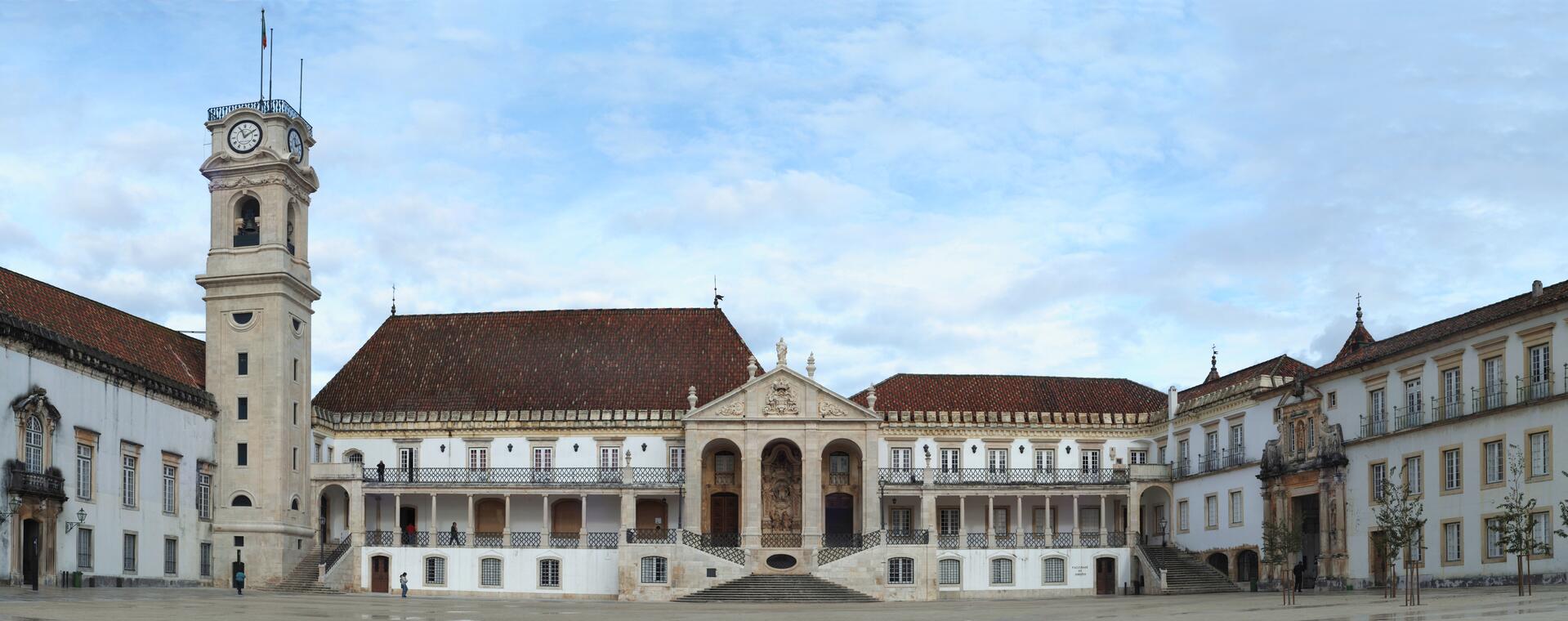
© Alvesgaspar, CC BY-SA 3.0 Resized from original. (This derivative is under the same CC BY-SA license.)
World Heritage Research
Discover scientific research and academic studies that deepen our understanding of University of Coimbra – Alta and Sofia from its history and significance to its conservation, management, and contemporary challenges.
-
Tourism management of World Heritage Sites. Perspectives on 10 years of integration of the University of Coimbra, Alta and Sofia in the UNESCO list
A decade after the University of Coimbra – Alta and Sofia was inscribed on the UNESCO World Heritage List, research identifies four critical challenges shaping its tourism management: strategic positioning across sectors, urban competitiveness enhancement, stimulation of local industry and entrepreneurship, and leveraging the UNESCO designation for international recognition. The study employs a Delphi technique within the quadruple helix model, engaging 23 stakeholders from public authorities, academia, private sector, and civil society over three rounds to assess impacts and strategies for adaptation, innovation, and entrepreneurship. Findings underscore the need for cohesive strategies to align with evolving visitor expectations while capitalizing on global heritage status. This approach offers a novel framework for managing tourism at World Heritage Sites, though its single-site focus limits broader applicability.
Santos, N., Oliveira Moreira, C., Cardoso Ferreira, C., & Silveira, L. (2025). Tourism management of World Heritage Sites. Perspectives on 10 years of integration of the University of Coimbra, Alta and Sofia in the UNESCO list. Cadernos de Geografia, 52, 197–214. https://doi.org/10.14195/0871-1623_52_10
View Publication Record | Read Publication -
The limestone of Ançã Formation: a heritage stone from Portugal
Ançã limestone, a middle Jurassic formation from Portugal's Lusitanian Basin, stands out as a heritage stone with significant historical and architectural importance. This study identifies it as a strong candidate for 'Global Heritage Stone' designation due to its extensive use since the 14th century in notable structures like Coimbra University's UNESCO-listed buildings, including the Royal Palace of Alcáçova and the Joanine Library. The formation, characterized by its low porosity and high strength, is exploited from three quarry zones near Cantanhede, contributing approximately 8000 m³ annually to civil construction. The research highlights the need for protection and sustainable use of this stone, emphasizing its role in regional economic growth and cultural heritage preservation. Supported by Portuguese funding, the study underscores the importance of collaboration between urban planners and policymakers to ensure the continued viability of traditional quarry extraction areas.
Freire-Lista, D. M., Catarino, L., Figueiredo, F., & Henriques, M. H. (2023). The limestone of Ançã Formation: a heritage stone from Portugal. https://doi.org/10.5194/egusphere-egu23-3284
View Publication Record | Read Publication -
Bacterial and Archaeal Structural Diversity in Several Biodeterioration Patterns on the Limestone Walls of the Old Cathedral of Coimbra
A study of the Old Cathedral of Coimbra reveals that bacterial and archaeal communities contributing to biodeterioration are highly diverse and adaptable to harsh conditions. While these microbes form complex biofilms, their distribution is more strongly influenced by abiotic factors such as water availability and salinity rather than specific deterioration patterns. The research used Next-Generation Sequencing (NGS) to analyze samples from deteriorated limestone walls in three chapels, identifying dominant phylogenetic groups but finding no clear link between microbial communities and distinct biodeterioration types. These findings suggest that microbial populations interact dynamically with algal and fungal species, offering critical insights for the preservation of historic stone monuments.
Coelho, C., Mesquita, N., Costa, I., Soares, F., Trovão, J., Freitas, H., Portugal, A., & Tiago, I. (2021). Bacterial and Archaeal Structural Diversity in Several Biodeterioration Patterns on the Limestone Walls of the Old Cathedral of Coimbra. Microorganisms, 9(4), 709. https://doi.org/10.3390/microorganisms9040709
View Publication Record | Read Publication -
The Role of Tourism Education in Overtourism and Destination Management
A proposed walking route for young visitors in Coimbra, Portugal, demonstrates how cultural tourism can mitigate overtourism by engaging families and fostering local development through non-formal educational programs. The study suggests that well-designed heritage interpretation products for youth can raise awareness of cultural conservation while diversifying tourist experiences. Researchers analyzed socio-economic, cultural, and attitudinal impacts of UNESCO World Heritage Site (WHS) designation on Coimbra’s Alta and Sofia districts, combining literature reviews with surveys to inform the route’s design. Findings highlight the potential for destination managers to enhance competitiveness by integrating informal educational activities that satisfy young and family tourists while strengthening local value creation.
Carreira, V., Azeredo, J., González-Rodríguez, M. R., & Díaz-Fernández, M. C. (2021). The Role of Tourism Education in Overtourism and Destination Management. Overtourism as Destination Risk, 35–48. https://doi.org/10.1108/978-1-83909-706-520211003
View Publication Record | Read Publication -
Beyond Sight and Sound: Fado of Coimbra, Intangible Heritage with Touristic Value
Fado of Coimbra, recognized as an intangible cultural heritage with significant touristic value, contributes to the distinction of the University of Coimbra – Alta and Sofia. This study reveals that Fado's aesthetic expression, rooted in lyricism and musicality, is deeply intertwined with the city's cultural legacy and holds substantial economic potential in global tourism markets. The research employs bibliographical, documental analysis, and direct observation to trace the genre's origins, unique characteristics, and its complex relationship with Lisbon Fado, while also examining its social history and evolution. The findings underscore Fado's role as a living tradition that enriches Coimbra's heritage and its broader cultural significance.
Costa, J., Nossa, P. N.,. (2017). Beyond Sight and Sound: Fado of Coimbra, Intangible Heritage with Touristic Value. Revista Rosa Dos Ventos - Turismo E Hospitalidade, 9(4), 557–568. https://doi.org/10.18226/21789061.v9i4p557
View Publication Record | Read Publication