World Heritage Identification Number: 1046
World Heritage since: 2001
Category: Cultural Heritage
WHE Type: Agriculture Landscapes, Parks & Gardens
Transboundary Heritage: No
Endangered Heritage: No
Country: 🇵🇹 Portugal
Continent: Europe
UNESCO World Region: Europe and North America
Map
The Alto Douro Wine Region: A Terroir of Timeless Tradition and Quality
The Alto Douro Wine Region, situated in the northernmost part of Portugal, is a testament to the enduring legacy of viticulture and winemaking that spans over two millennia. Inscribed as a UNESCO World Heritage Site in 2001, this cultural landscape showcases the harmonious blend of human ingenuity, natural beauty, and the rich history of port wine production.
More to come…UNESCO Description of the World Heritage Site
Wine has been produced by traditional landholders in the Alto Douro region for some 2,000 years. Since the 18th century, its main product, port wine, has been world famous for its quality. This long tradition of viticulture has produced a cultural landscape of outstanding beauty that reflects its technological, social and economic evolution.
UNESCO Justification of the World Heritage Site
Criterion (iii): The Alto Douro Region has been producing wine for nearly two thousand years and its landscape has been moulded by human activities.
Criterion (iv): The components of the Alto Douro landscape are representative of the full range of activities associated with winemaking – terraces, quintas (wine-producing farm complexes), villages, chapels, and roads.
Criterion (v): The cultural landscape of the Alto Douro is an outstanding example of a traditional European wine-producing region, reflecting the evolution of this human activity over time. Since the 18th century, its main product, Port wine, has been world famous for its quality. This long tradition of viticulture has produced a cultural landscape of outstanding beauty that reflects its technological, social and economic evolution.
Encyclopedia Record: Douro DOC
Douro is a Portuguese wine region centered on the Douro River in the Trás-os-Montes e Alto Douro region. It is sometimes referred to as the Alto Douro, as it is located some distance upstream from Porto, sheltered by mountain ranges from coastal influence. The region has Portugal's highest wine classification as a Denominação de Origem Controlada (DOC) and is registered as a Protected Designation of Origin under EU and UK law, and as a Geographical Indication in several other countries through bilateral agreements. While the region is best known for Port wine production, the Douro produces just as much table wine as it does fortified wine. The non-fortified wines are typically referred to as "Douro wines".Additional Site Details
Area: 24,600 hectares
Number of Components: 1
(iv) — Outstanding example of a type of building or landscape
(v) — Outstanding example of traditional human settlement
Coordinates: 41.10166667 , -7.798888889
Image
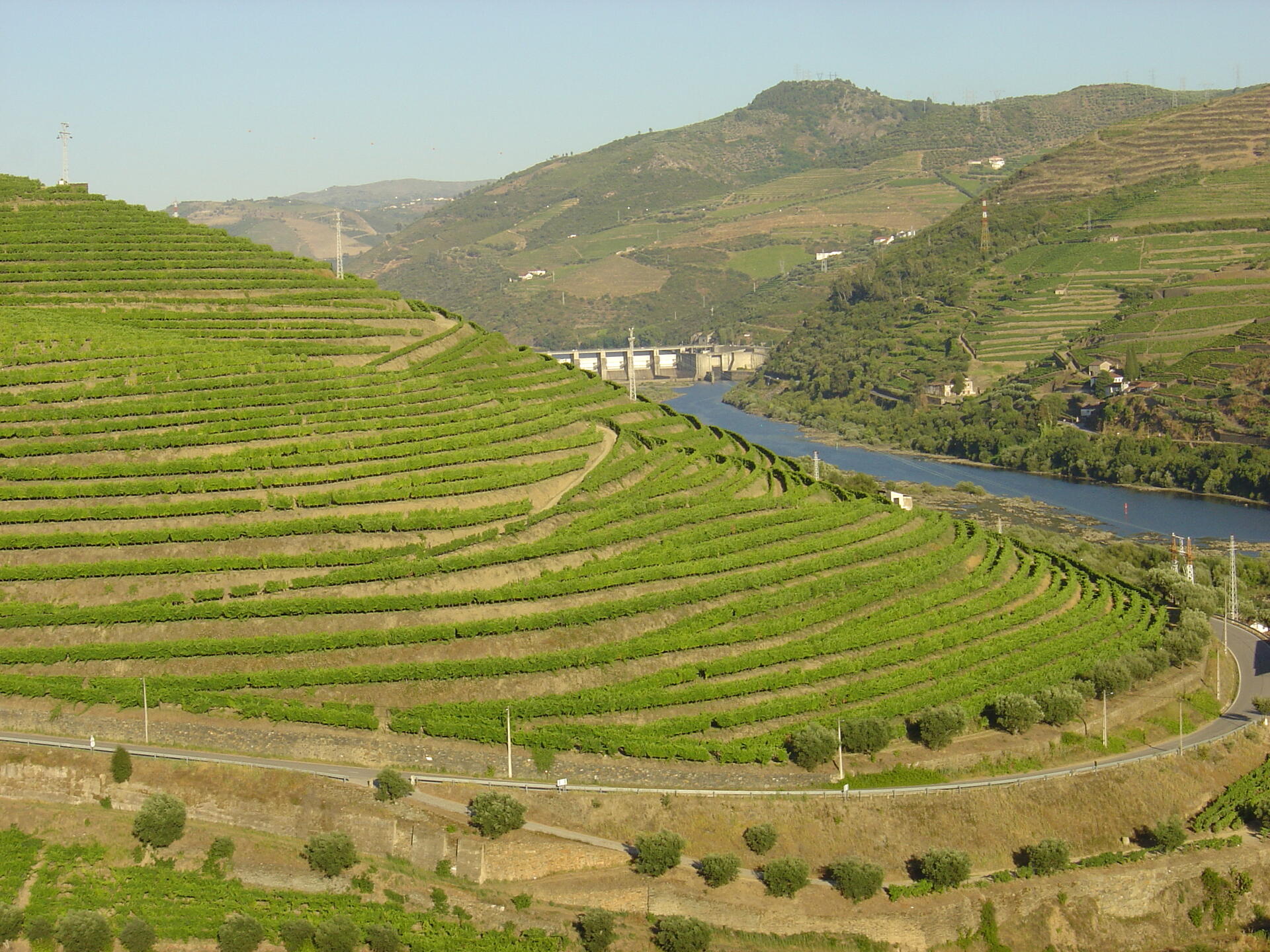
© Husond, CC BY-SA 3.0 Resized from original. (This derivative is under the same CC BY-SA license.)
World Heritage Research
Discover scientific research and academic studies that deepen our understanding of Alto Douro Wine Region from its history and significance to its conservation, management, and contemporary challenges.
-
How can landscape visual assessment inform landscape planning and management? – Alto Douro Wine region case study, Portugal
Landscape visual quality (LVQ) assessment is a powerful tool for monitoring and guiding landscape planning, particularly in UNESCO-recognized cultural landscapes like the Alto Douro Wine Region (ADWR). Research demonstrates that monitored areas within ADWR exhibit higher LVQ scores, characterized by imageability, color diversity, and land-use mosaics, while unmonitored regions with significant land-use changes show decreased visual quality. The study highlights that expansion of agricultural fields at the expense of traditional terraced vineyards and olive grove hedges negatively impacts aesthetic value. These findings underscore the importance of prioritizing conservation efforts for such features to maintain landscape integrity. The LVQ protocol, which evaluates physical, aesthetic, and psychophysical attributes, proves effective in identifying priority measures and tracking landscape evolution over time.
Medeiros, A., Fernandes, C., Gonçalves, J. F., Farinha-Marques, P., & Martinho Da Silva, I. (2024). How can landscape visual assessment inform landscape planning and management? – Alto Douro Wine region case study, Portugal. Applied Geography, 164, 103203. https://doi.org/10.1016/j.apgeog.2024.103203
View Publication Record | Read Publication -
Water Heritage in the Rural Hinterland Landscapes of the UNESCO Alto Douro Wine Region, Portugal: A Digital Humanities Approach
A digital reconstruction of the water heritage landscape in the UNESCO Alto Douro Wine Region reveals how augmented reality can enhance archaeological interpretation by visualizing historical transformations. Using IT, Digital Humanities tools, and historical cartographic data, researchers mapped anthropic elements related to water and natural features along the Corgo River, providing a realistic view of this cultural and natural landscape's evolution over time.
Vidal Gonçalves, G., Borges Pereira, D., Gómez-Ullate, M., & da Silva Mano, A. (2023). Water Heritage in the Rural Hinterland Landscapes of the UNESCO Alto Douro Wine Region, Portugal: A Digital Humanities Approach. Heritage, 6(4), 3706–3721. https://doi.org/10.3390/heritage6040196
View Publication Record | Read Publication -
(Un)changing Landscape. Architecture and landscape in the Alto Douro Wine Region: memory for the future
The cultural landscape of the Alto Douro Wine Region faces significant challenges in balancing tradition and modernity. Research indicates that the mythification of rural life and nostalgic vernacular architecture creates tensions in heritage preservation. The study explores how the development of a 'heritage-landscape' concept can contribute to contemporary wine architecture between 2001 and 2011, enhancing tourist activities and territorial valorization. This approach highlights the potential for sustainable development through architectural innovation while preserving cultural identity.
Duarte, J. (2022). (Un)changing Landscape. Architecture and landscape in the Alto Douro Wine Region: memory for the future. Revista PH, 78. https://doi.org/10.33349/2022.105.4881
View Publication Record | Read Publication -
The Alto Douro Wine Region: potentialities for the development of environmental education projects
A study highlights the potential of the Alto Douro Wine Region (ADWR) to foster environmental education and sustainable development through interdisciplinary school projects. The research, currently in its initial phase, aims to leverage the region's unique mesological and climatic conditions to promote awareness about heritage preservation among younger generations. Divided into three stages, the study employs a project-based methodology across 18 schools within the ADWR, focusing on developing new skills, scientific literacy, and a culture of environmental education. This approach seeks to contribute to broader goals of sustainable development and community engagement.
Montenegro, P., & Correia, G. P. (2018). The Alto Douro Wine Region: potentialities for the development of environmental education projects. Aula, Museos Y Colecciones de Ciencias Naturales, 5, 17–22. https://doi.org/10.29077/aula/5/02_moontenegro_wines
View Publication Record | Read Publication -
Visitor segments for the Alto Douro Wine Region cultural heritage site
A study of the UNESCO World Heritage site Alto Douro Wine Region identified three distinct visitor segments: same-day visitors, cultural visitors, and individual mass visitors. These groups were characterized by their socioeconomic traits, cultural consumption experiences, and travel behavior. The research employed univariate and multivariate statistical analyses, including Categorical Principal Component Analysis and Cluster Analysis, to segment the data collected from site visitors. This segmentation provides valuable insights for heritage management, helping to optimize provision, attract new visitors, and encourage repeat visits.
Rebelo, J., Lourenço Gomes, L., & Ribeiro, C. (2018). Visitor segments for the Alto Douro Wine Region cultural heritage site. Cultural Heritage, 167–182. https://doi.org/10.4324/9781315107264-13
View Publication Record | Read Publication -
Earth-based construction material field tests characterization in the Alto Douro Wine Region
Field tests for characterizing earth-based materials in tabique buildings, a traditional construction method in the Alto Douro Wine Regionreveal critical insights into their physical and chemical properties. This study marks the first systematic evaluation of such materials in situ, providing a foundation for assessing material suitability for conservation, rehabilitation, or new constructions. The research proposes a series of field tests to guide future normative documents, offering architects and engineers actionable knowledge to preserve this vernacular heritage. By addressing the lack of scientific studies on tabique technology, this work bridges gaps in traditional building practices while ensuring sustainable preservation efforts.
Cardoso, R., Pinto, J., Paiva, A., & Lanzinha, J. C. (2017). Earth-based construction material field tests characterization in the Alto Douro Wine Region. Open Engineering, 7(1), 435–443. https://doi.org/10.1515/eng-2017-0048
View Publication Record | Read Publication -
Building Heritage In The Alto Douro Wine Region, Portugal – Tabique Wall Nails Characterization
A first-of-its-kind characterization of tabique wall nails in the Alto Douro Wine Region reveals significant dimensional variability, with iron as the predominant material. The study highlights that existing nails should be replaced during conservation efforts due to their deteriorating condition, and provides guidelines for rehabilitation and rust prevention. This research addresses critical gaps in knowledge about vernacular construction techniques, offering actionable insights for preserving this UNESCO World Heritage Site's building heritage.
CARDOSO, R., PINTO, J., & LANZINHA, J. C. (2016). Building Heritage In The Alto Douro Wine Region , Portugal – Tabique Wall Nails Characterization. Architecture, Civil Engineering, Environment, 9(1), 59–70. https://doi.org/10.21307/acee-2016-007
View Publication Record | Read Publication -
Wine and cultural heritage. The experience of the Alto Douro Wine Region
A study on the Alto Douro Wine Region reveals that visitors prioritize the preservation of vineyards supported by schist walls and the region's characteristic landscape mosaic. Using a mixed logit model, researchers found that wealthier, employed, better-educated individuals with deeper knowledge of the site's culture are more willing to engage in heritage conservation. The research highlights structural changes in the region's economy, driven by wine production and tourism, which threaten traditional cultural landscapes. This analysis underscores the need for public attention and preservation efforts to maintain the region's unique identity.
Lourenço-Gomes, L., Pinto, L. M. C., & Rebelo, J. (2015). Wine and cultural heritage. The experience of the Alto Douro Wine Region. Wine Economics and Policy, 4(2), 78–87. https://doi.org/10.1016/j.wep.2015.09.001
View Publication Record | Read Publication -
Economic Valuation of Cultural Heritage: Application to a museum located in the Alto Douro Wine Region World Heritage Site
A museum's cultural value within the UNESCO World Heritage Site of Alto Douro Wine Region is positively influenced by visitors' educational level and gender, while negatively affected by travel costs. This insight emerged from applying the travel cost method—a non-market valuation technique—to analyze demand for the Museum of Lamego. Researchers used a Poisson model to quantify these relationships, revealing that higher education and female visitors are more likely to engage with cultural heritage, whereas travel expenses deter participation. The study underscores the importance of indirect economic valuation methods in assessing intangible assets like museums, which lack market transactions but drive territorial development through spillover effects.
Fonseca, S., & Rebelo, J. (2010). Economic Valuation of Cultural Heritage: Application to a museum located in the Alto Douro Wine Region World Heritage Site. PASOS Revista de Turismo Y Patrimonio Cultural, 8(2), 339–350. https://doi.org/10.25145/j.pasos.2010.08.024
View Publication Record | Read Publication