Historic Centre of Oporto, Luiz I Bridge and Monastery of Serra do Pilar


World Heritage Identification Number: 755

World Heritage since: 1996

Category: Cultural Heritage

WHE Type: Historic Cities & Urban Areas

Transboundary Heritage: No

Endangered Heritage: No

Country: 🇵🇹 Portugal

Continent: Europe

UNESCO World Region: Europe and North America

Map

The Historic Centre of Oporto, Luís I Bridge, and Monastery of Serra do Pilar: A Cultural and Architectural Gem

The Historic Centre of Oporto, Luís I Bridge, and Monastery of Serra do Pilar form a captivating ensemble that showcases the rich cultural heritage and architectural diversity of Portugal. This triad was collectively designated as a UNESCO World Heritage Site in 1996, acknowledging their historical significance and aesthetic value.

More to come…

UNESCO Description of the World Heritage Site

The city of Oporto, built along the hillsides overlooking the mouth of the Douro river, is an outstanding urban landscape with a 2,000-year history. Its continuous growth, linked to the sea (the Romans gave it the name Portus, or port), can be seen in the many and varied monuments, from the cathedral with its Romanesque choir, to the neoclassical Stock Exchange and the typically Portuguese Manueline-style Church of Santa Clara.

UNESCO Justification of the World Heritage Site

Criterion (iv): The Historic Centre of Oporto, Luiz I Bridge and Monastery of Serra do Pilar with its urban fabric and its many historic buildings bears remarkable testimony to the development over the past thousand years of a European city that looks outward to the sea for its cultural and commercial links.

Encyclopedia Record: Porto

Porto, also known in English as Oporto, is the second largest city in Portugal, after Lisbon. It is the capital of the Porto District and one of the Iberian Peninsula's major urban areas. Porto city proper, which is the entire municipality of Porto, is small compared to its metropolitan area, with an estimated population of 252,687 people in a municipal area of 41.42 km2 (16 sq mi). As of 2025, Porto's urban area has around 1.4 million people in an area of 2,395 km2 (925 sq mi), making it the second-largest urban area in Portugal. while the Porto metro area has more than 1.8 million people. It is recognized as a global city with a Gamma + rating from the Globalization and World Cities Research Network.

Read more on Wikipedia

Additional Site Details

Area: Not available

Number of Components: 1

UNESCO Criteria: (iv) — Outstanding example of a type of building or landscape

Coordinates: 41.14166667 , -8.616666667

Image
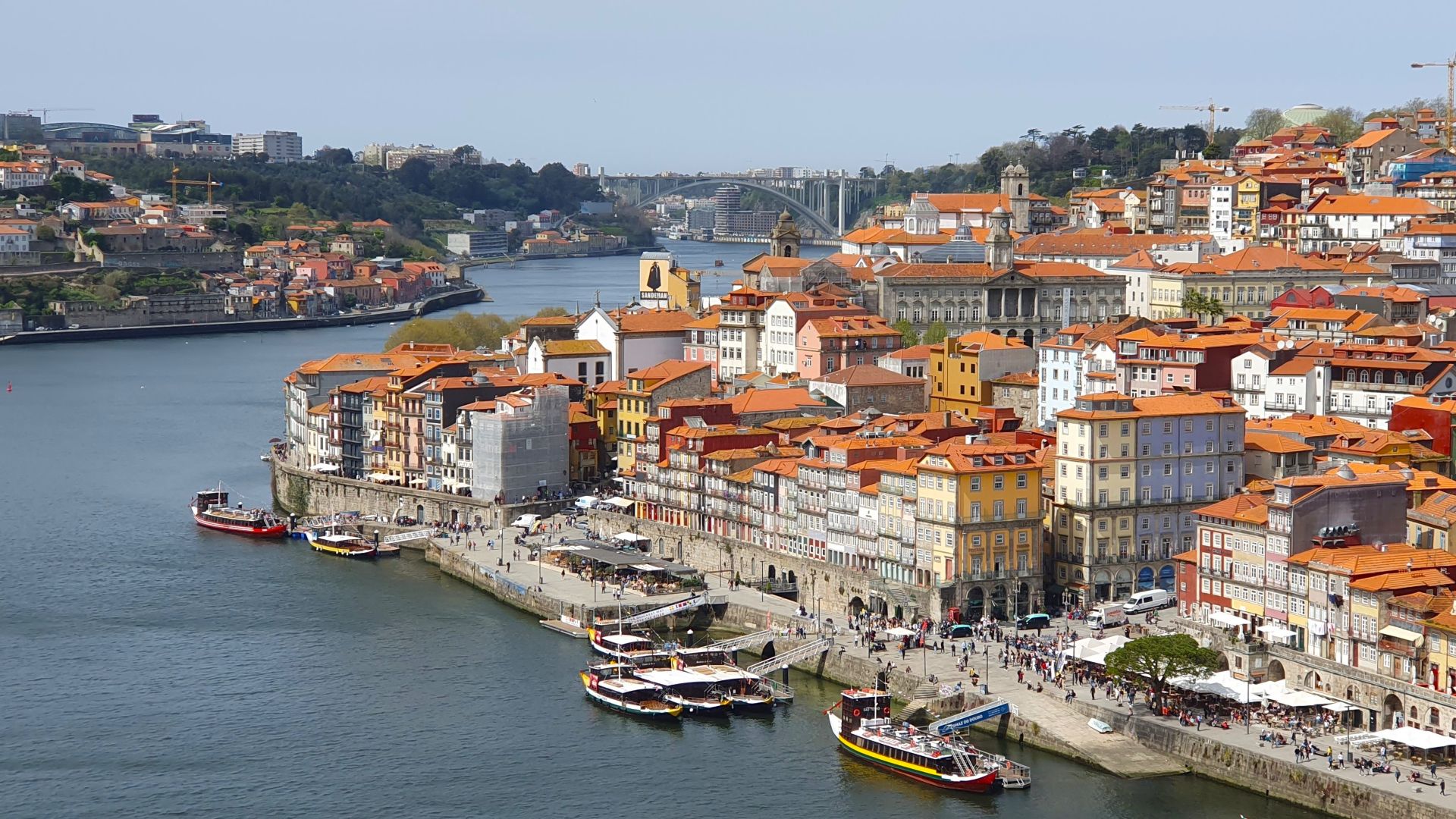
Image of Historic Centre of Oporto, Luiz I Bridge and Monastery of Serra do Pilar

© TWE. Used with permission.

About World Heritage Explorer

World Heritage Explorer is an independent educational project designed to uncover and share the richness of our world’s cultural and natural heritage. Dive into detailed site profiles, immersive imagery, interactive maps, and tools that help you explore UNESCO World Heritage Sites across the globe. Drawing extensively on open data sources, the project delivers authoritative, well-structured information for learners, educators, travelers, and younger explorers alike.

Learn more about the project

Nearby World Heritage Sites

Historic Centre of Guimarães and Couros Zone
43 km — Portugal
Sanctuary of Bom Jesus do Monte in Braga
50 km — Portugal
Alto Douro Wine Region
69 km — Portugal
University of Coimbra – Alta and Sofia
105 km — Portugal
Monastery of Batalha
166 km — Portugal
Flag of Portugal

Portugal and the World Heritage Convention

State Party since: September 30, 1980

Status: Ratification

Mandates to the World Heritage Committee: 1999-2005, 2013-2017

Total of Mandate Years: 10

Total of Mandates: 2

WHC Electoral Group: I (Western Europe/North America)

Learn more about Portugal

Weather at the World Heritage Site

World Heritage Insights

Monasteries and Abbeys on the World Heritage List: Sacred Landscapes of Monastic and Spiritual Life

From vast cave universities and cliffside hermitages to monumental abbeys and temple cities, monastic heritage on the UNESCO World Heritage List reflects one of the most persistent ways in which human societies have organized spiritual life, learning, and landscape transformation. These sites are not only architectural achievements but also long-lived institutional systems—sometimes still active, sometimes archaeological—where religious practice shaped settlement patterns, artistic production, and political authority.

Last updated: May 31, 2026

Portions of the page Historic Centre of Oporto, Luiz I Bridge and Monastery of Serra do Pilar are based on data from UNESCO — World Heritage List Dataset and on text from the Wikipedia article Porto, licensed under CC BY-SA 4.0. Changes made. Additional original content by World Heritage Explorer (WHE), licensed under CC BY-SA 4.0. WHE is not affiliated with UNESCO or the World Heritage Committee. Legal Notice. Privacy Policy.

Open Data for an Open World