World Heritage Identification Number: 616
World Heritage since: 1992
Category: Cultural Heritage
WHE Type: Historic Cities & Urban Areas
Transboundary Heritage: No
Endangered Heritage: No
Country: 🇨🇿 Czechia
Continent: Europe
UNESCO World Region: Europe and North America
Map
The Historic Centre of Prague: A Medieval Marvel in the Heart of Europe
The Historic Centre of Prague, inscribed as a UNESCO World Heritage Site in 1992, stands as a testament to the grandeur and cultural significance that has defined this city since the Middle Ages. Situated on the banks of the Vltava River, Prague serves as the capital and largest city of the Czech Republic, with a population of around 1.3 million within its urban limits and approximately 2.3 million in its metropolitan area.
Prague’s development is deeply rooted in the history of the Kingdom of Bohemia and later its prominence within the Holy Roman Empire. The city experienced its greatest flourishing in the 14th century under Emperor Charles IV, when it became one of the leading political and cultural centres of Europe. This long historical evolution is still visible today in its urban fabric, where different architectural periods coexist rather than replace one another.
The historic centre encompasses three main districts: the Old Town (Staré Město), the Lesser Town (Malá Strana), and the New Town (Nové Město). Each district showcases a unique blend of architectural styles, ranging from Gothic to Renaissance and Baroque, and offers a vivid glimpse into the city’s layered history.
The Old Town, established in the 12th century, is characterized by its cobblestone streets, colorful buildings, and vibrant Old Town Square. One of its most notable landmarks is the Old Town Hall, featuring the Astronomical Clock (Orloj), one of the oldest of its kind still in operation. Another significant structure is the Church of Our Lady before Týn, a striking example of Gothic architecture with twin spires that dominate the skyline.
The Lesser Town, nestled beneath Prague Castle, is known for its winding streets and elegant Baroque character. Among its many landmarks is the Church of St. Nicholas, one of the finest examples of Baroque architecture in Central Europe, with its monumental dome and richly decorated interior. The district is also home to the Wallenstein Palace, an early Baroque complex surrounded by formal gardens that reflect the grandeur of the period.
The New Town, founded in the late 14th century by King Charles IV, represents a more planned expansion of medieval Prague. Its broader streets and open squares contrast with the older districts, while its architecture reflects later Renaissance and Baroque influences. Key attractions nearby include the historic Estates Theatre in the Old Town, where Mozart’s Don Giovanni premiered, and the New Town's grand National Museum, which dominates Wenceslas Square and preserves the cultural memory of the Czech lands.
Perhaps the most iconic symbol of Prague is the Charles Bridge, which connects the Old Town and the Lesser Town across the Vltava River. Built in the 14th century in Gothic style, it is lined with 30 statues, mostly added during the Baroque period, creating a striking dialogue between different artistic eras.
Above the city rises Prague Castle, one of the largest ancient castle complexes in the world. Dating back to the 9th century, it forms a vast architectural ensemble of palaces, courtyards, and churches, including the magnificent St. Vitus Cathedral, a Gothic masterpiece that took nearly six centuries to complete.
An essential part of the old city centre is also the Jewish Quarter (Josefov), one of the most significant preserved Jewish districts in Europe. Its synagogues, historic cemetery, and tightly woven streets reflect centuries of continuous Jewish life and its deep cultural presence within Prague’s history.
Prague’s historic core is remarkable not only for its monuments, but also for the way it has preserved its historical layers. Unlike many European cities, it was not significantly damaged during the Second World War, allowing medieval, Renaissance, Baroque, and modern elements to survive side by side in a remarkably intact urban landscape.
Altogether, the Historic Centre of Prague offers visitors a captivating journey through time, where political history, architectural brilliance, and cultural memory intertwine. From the bustling market squares of the Old Town and the grand avenues of the New Town to the tranquil streets of the Lesser Town and the majesty of Prague Castle, it remains one of Europe’s most complete and visually striking historic cities.
UNESCO Description of the World Heritage Site
Built between the 11th and 18th centuries, the Old Town, the Lesser Town and the New Town speak of the great architectural and cultural influence enjoyed by this city since the Middle Ages. The many magnificent monuments, such as Hradcany Castle, St Vitus Cathedral, Charles Bridge and numerous churches and palaces, built mostly in the 14th century under the Holy Roman Emperor, Charles IV.
UNESCO Justification of the World Heritage Site
Criterion (ii): The Historic Centre of Prague admirably illustrates the process of continuous urban growth from the Middle Ages to the present day. Its important role in the political, economic, social, and cultural evolution of Central Europe from the 14th century onwards and the richness of its architectural and artistic traditions meant that it served as a major model for urban development of much of Central and Eastern Europe.
Criterion (iv): Prague is an urban architectural ensemble of outstanding quality, in terms of both its individual monuments and its townscape, and one that is deservedly world-famous.
Criterion (vi): The role of Prague in the medieval development of Christianity in Central Europe was an outstanding one, as was its formative influence in the evolution of towns. By virtue of its political significance in the later Middle Ages and later, it attracted architects and artists from all over Europe, who contributed to its wealth of architectural and artistic treasures. The 14th century founding of the Charles University made it a renowned seat of learning, a reputation that it has preserved up to the present day. Since the reign of Charles IV, Prague has been intellectual and cultural centre of its region, and is indelibly associated with such world-famous names as Wolfgang Amadeus Mozart and Franz Kafka.
Encyclopedia Record: Prague
Prague is the capital and largest city of the Czech Republic and the historical capital of Bohemia. Located on the Vltava River, the city has a population of about 1.4 million, making it the twelfth-largest city in the European Union. Its metropolitan area is home to approximately 2.3 million people.Additional Site Details
Area: 1,106.36 hectares
Number of Components: 2
(iv) — Outstanding example of a type of building or landscape
(vi) — Directly associated with events or living traditions
Coordinates: 50.08972 , 14.41944
Image
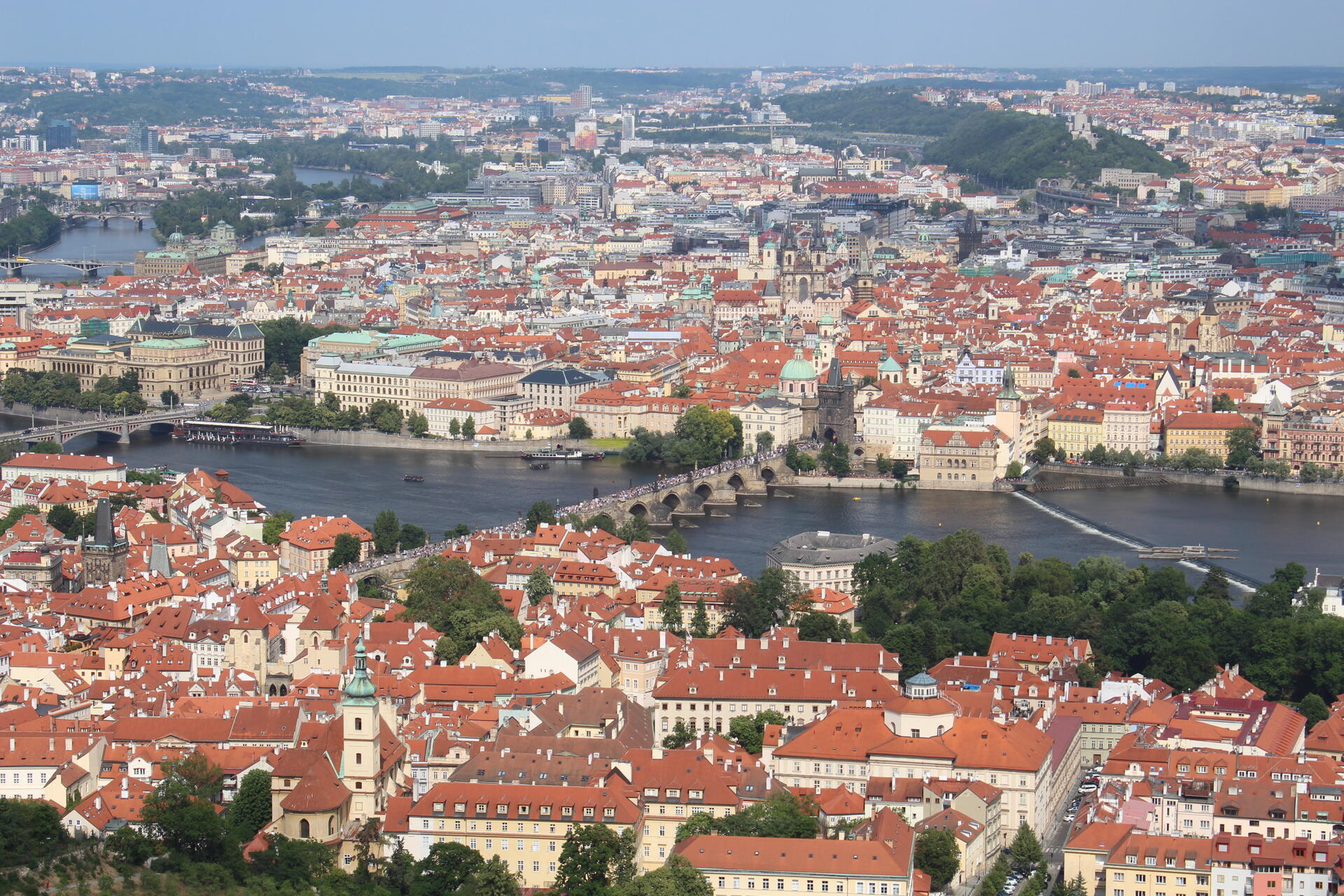
© Deror_avi, CC BY-SA 4.0 Resized from original. (This derivative is under the same CC BY-SA license.)
World Heritage Research
Discover scientific research and academic studies that deepen our understanding of Historic Centre of Prague from its history and significance to its conservation, management, and contemporary challenges.
-
Spatial Planning Systems in Historical Capital Cities in Europe
Contemporary spatial planning systems in historic European capital cities, including Prague, Edinburgh, and Vienna—all UNESCO World Heritage Sites—serve as models for sustainable urban development. This study highlights how these cities leverage heritage status, urban typology, and citizen participation to create holistic, future-oriented planning frameworks. By employing the 'arena' metaphor, it argues that their approaches can guide other cities in balancing preservation with progress. The research compares spatial planning instruments across the three capitals, offering insights into effective governance for historic urban centers.
Bianco, L. (2026). Spatial Planning Systems in Historical Capital Cities in Europe. Historia Urbana, 33, 43–75. https://doi.org/10.59277/hu.33.03
View Publication Record | Read Publication -
Let’s Inject Some Randomness into the City: Reflecting on Eliza Soroga’s Site-Specific Performances in London and Prague
Site-specific performances can redefine public spaces by introducing unpredictability and spontaneity, fostering authentic encounters with passers-by. This study examines three such performances—Breakfast on London Bridge (2014), Women in Agony (2015), and IN QR WE TRUST (2023)—to explore how randomness challenges routine urban experiences and creates a new public sphere. The research questions whether site-sensitive approaches can reveal the poetics of places while incorporating lived experiences, ultimately offering a model for reinventing public spaces through artistic intervention. The findings suggest that injecting randomness into performance art disrupts urban alienation and consumerism, revealing spontaneous reactions that enrich collective experience.
Soroga, E. (2026). Let’s Inject Some Randomness into the City: Reflecting on Eliza Soroga’s Site-Specific Performances in London and Prague. Proceedings of the Performing Space 2023 Conference. https://doi.org/10.12681/ps2023.9961
View Publication Record | Read Publication -
New Buildings in the Historic Centre of Prague 1990-2020
Between 1990 and 2020, the Historic Centre of Prague underwent significant transformation post-communist regime change, marked by new buildings that filled long-standing gaps, creating a distinct architectural layer. While some developments, like the Four Seasons or Quadrio, sparked controversy due to their size and commercial nature, others, such as the Langhans House or Hotel Metropol, were celebrated for their sensitive integration with historic surroundings. The study analyzes these projects in context, revealing a shift from pluralistic approaches in the 1990s—characterized by public debates and architectural diversity—to a later period dominated by administrative and commercial interests, exacerbated by weakened heritage institutions and relaxed urban regulations. This analysis highlights the dual impact of new constructions on Prague's architecture: both as potential enrichment and as threats to its historic integrity.
Biegel, R. (2025). New Buildings in the Historic Centre of Prague 1990-2020. Staletá Praha, 41(1), 2–69. https://doi.org/10.56112/sp.2025.1.01
View Publication Record | Read Publication -
The role of shading on biometeorological conditions in the historic centre of Prague, Czech Republic.
Researchers found that the historic centre of Prague, particularly the Náplavka area along the Vltava river, experiences significant heat stress during summer due to a lack of greenery and shading. While morning conditions were comfortable, afternoon thermal comfort indices such as Physiologically Equivalent Temperature (PET) and Universal Thermal Climate Index (UTCI) showed high heat stress levels, exacerbated by limited shade. The study used meteorological measurements from eight sites between Charles Square and Náplavka, collected over 14 days in 2019 and 2022, alongside fisheye photographs to quantify shading effects. Findings suggest relocating day-long events to shaded areas like Charles Square or providing adequate sun protection could mitigate heat stress in this UNESCO World Heritage Site.
Chlapcová, L., Urban, A., & Kyselý, J. (2025). The role of shading on biometeorological conditions in the historic centre of Prague, Czech Republic. https://doi.org/10.5194/egusphere-egu24-6696
View Publication Record | Read Publication -
„Zlata Praha”? Praskie „city” przebudowane w XIX i XX wieku
Prague's historic center, as seen today, is largely a product of extensive urban reconstruction during the Belle Époque (late 19th century), interwar period, and post-World War II era. A comprehensive study by Richard Biegel, an art historian from Charles University, reveals that this transformation involved massive demolition, straightening of streets, creation of new traffic routes, and construction of large buildings and department stores—mirroring similar urban changes in Vienna and Paris. The study, 'Město v bourů: Urbanismus a architektura historického centra Prahy 1830–1970,' meticulously documents the disappearance of Prague's earlier picturesque architecture, offering a detailed exploration that advances comparative research on Central European urban development.
Zabłocka-Kos, A. (2024). „Zlata Praha”? Praskie „city” przebudowane w XIX i XX wieku. Quart, (2(72)), 98–107. https://doi.org/10.19195/2449-9285.72.8
View Publication Record | Read Publication -
Geotourism Aspects of Building Stone Use (Romanesque Style and the Onset of Gothic) in UNESCO Heritage Sites of the Historic Centre of Prague for Construction and Architectural Purposes
Prague's Historic Centre stands out for its architectural evolution reflecting Romanesque and Gothic styles. A key insight from this study is the significant role of building stones in shaping the city's iconic landmarks, such as St. Vitus Cathedral and Charles Bridge, which are major tourist attractions. Despite their importance, the sources and types of these stones remain largely overlooked in tourism narratives. This research bridges that gap by linking architectural development with detailed descriptions of the stones used during the Romanesque and Gothic periods, including their source areas. By doing so, it not only advances architectural research but also proposes new forms of geotourism that integrate geological and historical perspectives, enriching visitor experiences.
Duraj, M., Marschalko, M., Kubáč, J., Niemiec, D., Pohanka, R., Sombathy, E., Vlček, J., & Sysala, D. (2024). Geotourism Aspects of Building Stone Use (Romanesque Style and the Onset of Gothic) in UNESCO Heritage Sites of the Historic Centre of Prague for Construction and Architectural Purposes. Inżynieria Mineralna, 1(2). https://doi.org/10.29227/im-2024-02-72
View Publication Record | Read Publication -
What do we visually focus on in a World Heritage Site? A case study in the Historic Centre of Prague
Newly constructed high-rise buildings with large heights and strong contrasting colors pose significant visual threats to the integrity of UNESCO World Heritage Sites, such as the Historic Centre of Prague. This study used eye-tracking technology to generate visual heatmaps, revealing that people's attention is primarily drawn to complex artistic elements like facades, domes, mural paintings, and sculptures, while greenery, roofs, and floors attract minimal focus. The research also identified that buffer zones around main attractions help maintain unobstructed views, but pedestrian flow and transportation planning can introduce visual concerns. These findings provide actionable insights for the design, conservation, and management of World Heritage Sites to prevent artificial constructions from endangering their Outstanding Universal Values.
Liu, F., Kang, J., Wu, Y., Yang, D., & Meng, Q. (2022). What do we visually focus on in a World Heritage Site? A case study in the Historic Centre of Prague. Humanities and Social Sciences Communications, 9(1). https://doi.org/10.1057/s41599-022-01411-1
View Publication Record | Read Publication